
Gold demand shifts as central banks buy 59 tonnes
Goldman Sachs reports central banks bought 59 tonnes of gold in April, with China alone accounting for 24 tonnes.
Call it what it is: a regime change. We are now in a period of permanent strategic imperative. Goldman Sachs labels this behavior "structural rather than cyclical," a distinction that matters because it separates sticky institutional holdings from the noise of speculative trading. Their proprietary nowcast model confirms that while the buying pace has settled near 50 tonnes on a moving average basis, the motive has shifted. Sovereign balance sheets are aggressively de-risking away from dollar-denominated assets.
This isn't about yield chasing. It's about survival in a fragmenting monetary system.
You need to understand how structural gold demand rewrites modern portfolio theory. Traditional cyclical models are broken; they cannot capture a baseline where official sector intent overrides price signals. We will dissect Goldman's "conviction buyers" methodology, which isolates long-term official accumulation. Then we will contrast institutional price targets for 2026 and 2027. The math is simple: a projected monthly intake of 40 to 50 tonnes creates a hard floor for valuations that short-term macroeconomic noise cannot breach.
Even as monthly volumes fluctuate, the trajectory toward diversified reserves is locked in. Goldman projects sustained purchases of 50 tonnes monthly through 2026. The market must adjust to a reality where central banks act as the primary, unyielding bid side.
Defining Structural Gold Demand in Modern Reserve Portfolios
Structural vs Cyclical Gold Demand via Nowcast Models
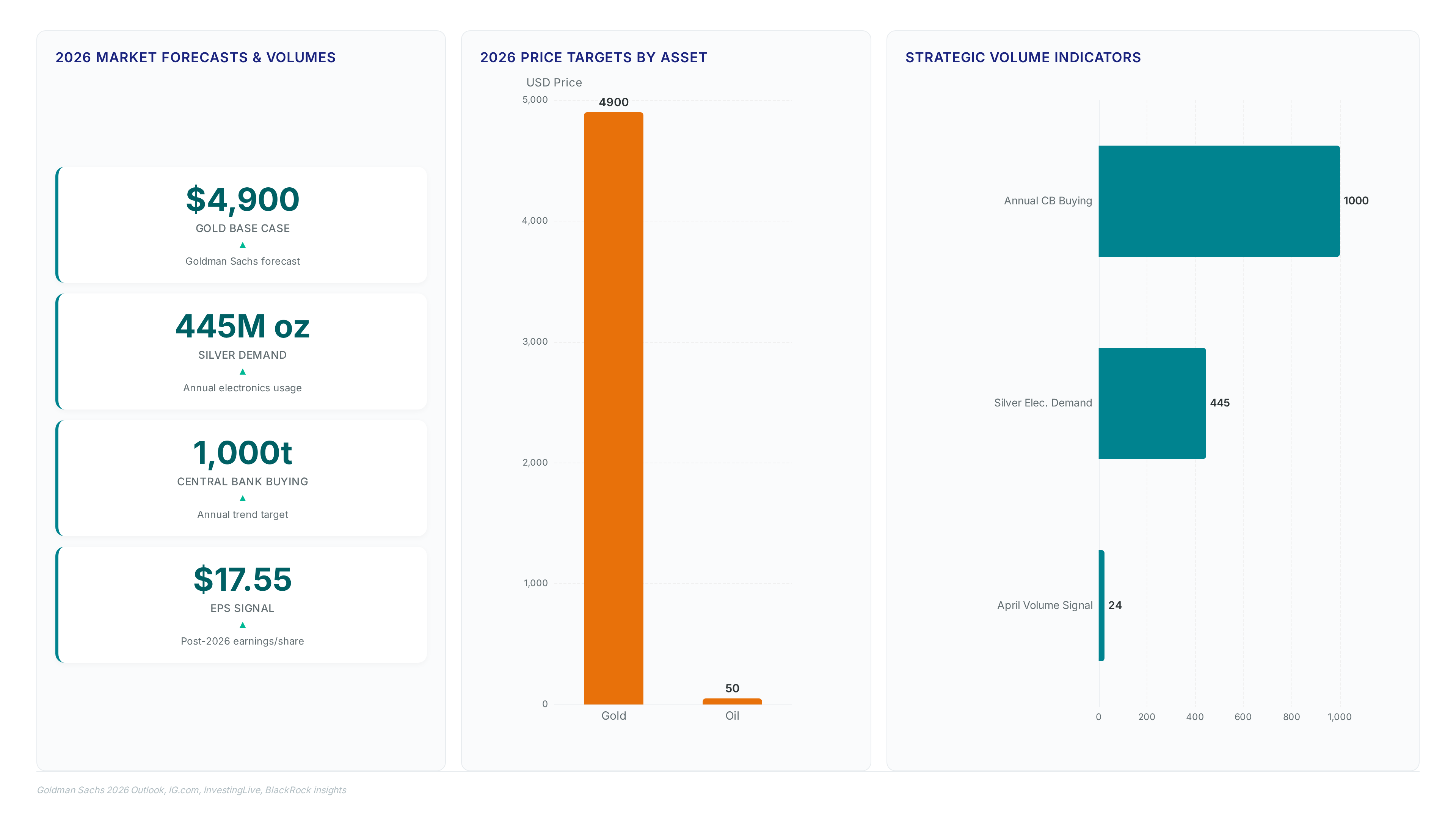
Geopolitical fragmentation, not temporary price arbitrage, drives the permanent reallocation of reserve assets. Goldman Sachs separates these sticky holdings from volatile speculative flows using a proprietary nowcast model built on a conviction buyers framework. This method isolates official sector accumulation that continues regardless of short-term yield fluctuations. The data validates the approach: central banks extended purchasing for 15 straight months through January 2026, pushing prices above $4,000/oz.
When structural and cyclical drivers diverge, standard portfolio modeling breaks. Traditional mean-reversion strategies fail when central bank buying absorbs supply independently of price signals. Forecasts now anticipate monthly acquisitions reaching 60 to 70 tonnes in 2026 due to de-dollarization pressures. The catch? Data latency. Official reporting often lags real-time market moves by months, creating blind spots for traders relying on public filings.
Stop prioritizing technical indicators over geopolitical reality. The market now prices in a durable floor where official buying prevents deep corrections. Ignoring this shift exposes portfolios to asymmetrical risk during liquidity crunches.
Measuring Reserve Intent with the World Gold Council Survey
A record 45% of respondents plan to increase holdings over the next 12 months, according to the World Gold Council survey.
This metric isolates strategic allocation shifts distinct from tactical trading. Not a single participant projected a decline in global official stocks. However, interpreting this data requires cross-referencing sentiment against realized flows, such as the 15 straight months of buying. The survey's qualitative nature limits its utility; it signals direction but lacks the granularity to predict monthly volume volatility. Consequently, portfolio models must weight this sentiment indicator alongside quantitative nowcasts that track actual tonnage. Reliance on historical averages fails when structural forces dominate.
Operationalizing these findings demands a dual-track analysis framework:
- Track the percentage of banks intending to buy versus those maintaining stable levels.
- Monitor the divergence between survey intent and reported monthly accumulation data.
- Adjust duration risk in fixed-income portfolios as de-dollarization pressures persist.
- Validate price forecasts against the $4,800 consensus for late 2026.
- Observe the gap between the 59 tonnes purchased in April and the projected 70-tonne monthly ceiling.
Tracking error for traditional models becomes measurable when intent diverges from executed volume. April's 59 tonnes of purchases trail the projected 70-tonne monthly ceiling for 2026. This gap quantifies the acceleration inherent in structural gold demand. Unlike cyclical trading, this conviction buyers approach reflects a permanent reserve reallocation driven by geopolitical fragmentation rather than price arbitrage. Goldman Sachs explicitly models this shift, expecting volumes to reach the upper bound of 70 tonnes monthly within the next year. Current moderated flows support a price floor, yet the market must price in a near-doubling of monthly intake that has not yet materialized in aggregate data.
Operators relying on historical averages miss the inflection point where de-dollarization forces accelerate. Current nowcast models depend on opaque reporting, which is a constraint; a sudden disclosure from substantial holders could trigger a sharp repricing event before the 2026 target is reached. Portfolio strategies must therefore weight forward-looking geopolitical signals heavier than trailing volume data to capture the full upside potential of this structural shift.
Mechanics of Global Gold Accumulation and Forecasting Models
Smoothing Volatility with Three-Month and 12-Month Moving Averages
Applying three-month seasonally adjusted and 12-month moving average bases filters noise to reveal a steady 50-tonne buying pace. These statistical filters suppress outlier months where speculative flows distort the underlying structural demand signal from official sectors. Without this smoothing, short-term volatility obscures the consistent accumulation pattern required for accurate forecasting.
Raw monthly data exhibits significant variance, with trading ranges expanding to a markedly wider level in early 2026 compared to a more moderate level in late 2025. The moving average mechanism weights recent observations to dampen these spikes while preserving the trend direction.
| Metric | Function | Limitation |
|---|---|---|
| 3-Month SA | Removes seasonal bias | Lags sudden regime shifts |
| 12-Month MA | Eliminates annual cycles | Slow to reflect acceleration |
Relying solely on historical averages fails to capture the projected acceleration to 60, 70 tonnes monthly by 2027. This lag creates a blind spot where realized volumes trail forward estimates during rapid market transitions. The cost of this latency is missed entry points before prices adjust to the new structural reality.
Operators must therefore cross-reference smoothed data with conviction buyers. Every 50 basis points of Federal Reserve easing adds approximately a modest amount per ounce of support, further complicating the volume-price relationship. The implication for portfolio construction is clear: moving averages confirm the baseline, but nowcast models identify the inflection points where strategic allocation must precede broad market validation.
Interpreting China's 24-Tonne Contribution Amid Data Lags
China's estimated 24-tonne contribution in April demonstrates how analysts bridge opacity using economic nowcasting to infer strategic shifts before official releases. Mechanisms rely on Mixed-Data Sampling regressions that ingest high-frequency trade data to estimate flows where Beijing reporting lags. This technical approach isolates structural demand signals from noisy speculative volume, yet the method carries inherent model risk if trade classifications shift. A single unreported acceleration could trigger outsized price volatility that aggregate monthly figures fail to predict immediately.
| Data Source | Latency | Reliability |
|---|---|---|
| Official PBOC Reports | High (Months) | Absolute |
| Nowcast Estimates | Low (Days) | Probabilistic |
Treat these inferred volumes as leading indicators rather than confirmed facts. The limitation remains that every 50 basis points of Fed easing adds roughly $120/oz support, complicating the isolation of pure reserve diversification effects (source). Consequently, markets often overreact to estimated Chinese buying intensity due to the lack of verifiable real-time data.
Strategic interpretation requires distinguishing between temporary tactical pauses and genuine structural deceleration in Asian accumulation. Any deviation from the expected trajectory moves prices more sharply than Western ETF flows because the perceived duration of the buying program changes instantly. Investors applying these models must weight the probability of data revisions heavily in their risk frameworks. The conviction buyers framework suggests that even with lagged confirmation, the directional bias remains upward. Ignoring the data gap invites significant basis risk in portfolio hedging strategies.
Forecasting Risks When Ignoring Structural Demand Shifts
Standard cyclical models fail by underestimating the projected acceleration to 60 to 70 tonnes. Treating this volume as temporary creates immediate valuation gaps because forecasts miss the permanent reserve reallocation driven by geopolitical fragmentation.
- Cyclical algorithms assume mean reversion, mispricing the durable floor.
- Static assumptions ignore the compounding effect of sustained conviction buyers.
- Price targets based on historical averages underestimate upside risk to $4,900.
The primary failure mode stems from relying on lagging official reports rather than real-time nowcast models. While traditional metrics wait for quarterly releases, structural shifts occur monthly, rendering backward-looking data obsolete for price discovery. This latency allows market disconnects to widen before correction.
| Model Type | Demand Assumption | Forecast Error Source |
|---|---|---|
| Cyclical | Temporary spike | Misses permanent baseline shift |
| Structural | Persistent accumulation | Overestimates short-term volatility |
Replace linear regressions with conviction-based frameworks that distinguish sticky official holdings from speculative flows. Ignoring this distinction leads to under-hedging against currency debasement risks. The cost of maintaining outdated assumptions is measurable in missed appreciation as central banks continue purchasing regardless of spot price fluctuations. This figure represents a conservative floor compared to the $5,400 upside scenario, which aligns with the solitary target issued by UBS for the same period. J. P. Morgan projects an intermediate valuation of $5,055 by the final quarter, creating a tight consensus range among substantial banks. Portfolios hedged only to the median forecast remain exposed to rapid repricing if geopolitical fragmentation forces official sectors to front-load accumulation. The price target range therefore functions less as a prediction and more as a volatility boundary for stress-testing reserve adequacy.
Applying Central Bank Demand Projections to Price Models
Integrating the projected acceleration to 60, 70 tonnes monthly demand into valuation frameworks directly shifts the 2026 baseline above historical averages. Standard cyclical algorithms fail because they treat this volume as temporary, creating immediate valuation gaps that miss the permanent reserve reallocation driven by geopolitical fragmentation. Models ignoring the shift from tactical to structural buying underestimate the durability of the price floor. A single unreported acceleration in this jurisdiction moves prices more sharply than diversified buying patterns imply. The sustained nature of this demand validates the use of nowcast models over lagging indicators. Traders must also monitor 15-month purchasing streaks to confirm the structural thesis remains intact against potential policy pivots.
Operators using Coverage Pillars should prioritize models that isolate conviction buyers from speculative noise. The cost of relying on historical correlation matrices is a systematic underestimation of upside risk during periods of coordinated official sector accumulation.
Contrasting Goldman Sachs' Structural Thesis with Conservative Peers
Divergence in 2026 price targets stems from conflicting views on whether central bank accumulation is a temporary hedge or permanent reserve reallocation. The timing of the peak also varies materially across institutions. HSBC anticipates an earlier breach of psychological barriers, forecasting gold could hit $5,000 in the first half of 2026 before momentum potentially fades. J. P. Morgan's view sits between the extremes. If central banks maintain current paces, conservative models underprice the asset by ignoring the reduction in available float. However, if geopolitical tensions ease, the structural premium embedded in the Goldman Sachs forecast evaporates quicker than cyclical models predict. Investors relying on historical averages face immediate valuation gaps when conviction buyers alter the fundamental supply curve. The cost of misidentifying this shift is measurable in missed upside or premature hedging against a non-existent correction.
Strategic Portfolio Adjustments Based on Reserve Diversification Trends
Defining the Debasement Trade and Dollar Risk Reassessment
The debasement trade has evolved from a tactical hedge into a structural portfolio requirement. This shift reclassifies precious metals as a permanent counterbalance to expanding government debt levels rather than a transient safe haven. The mechanism driving this change is a fundamental reassessment of dollar-denominated asset risk fueled by geopolitical fragmentation. Research identifies a move toward structural hedges against currency debasement, distinguishing current reserve management from previous cyclical patterns. Evidence points to expanding conviction among reserve managers that gold's role in official portfolios is expanding permanently.
However, the opacity of Beijing's reporting creates a measurable blind spot for real-time risk modeling. Any acceleration or deceleration in Chinese purchasing could move prices more sharply than aggregate figures imply, creating volatility that standard models miss. The cost of ignoring this structural floor is the potential mispricing of long-term valuation gaps. Operators must adjust frameworks to account for sticky official demand that does not revert to historical means. Failure to integrate this structural reality leaves portfolios exposed.
Applying China's 24-Tonne Signal to Portfolio Entry Points
Investors must time allocations using the estimated 24 tonnes from April. This specific volume signal matters because accelerated Chinese purchasing moves prices more sharply than aggregate figures imply. The structural nature of this demand creates a valuation gap that cyclical models fail to capture. Portfolio managers should treat the debasement trade as a permanent constraint on dollar-denominated assets instead of a temporary hedge. However, relying solely on monthly totals ignores the volatility risk inherent in this transition. Such swings punish passive entry strategies that do not account for reserve reallocation speed. A tactical approach involves scaling positions when market noise obscures the underlying structural buying pressure.
About
Sofia Mendes, Broker Reviews & Trading Education Editor at ForexCFD. Top, brings a unique, risk-focused perspective to the analysis of surging central bank gold holdings. While her daily work primarily involves rigorous due diligence on regulated brokers and crafting trading education materials, this expertise is vital when interpreting macro shifts like the 59-tonne purchase reported by Goldman Sachs. As central banks increasingly treat gold as a structural reserve asset, retail traders must understand how these moves impact XAUUSD volatility and liquidity. Mendes connects these high-level institutional flows to practical trading realities, ensuring her audience grasps the implications for use and capital preservation. Her role at ForexCFD. Top, an independent publication dedicated to vendor-neutral market news, allows her to contextualize how official sector demand influences the very platforms and spreads traders encounter. By bridging the gap between central bank policy and retail execution, she provides the factual clarity needed to navigate a market driven by sovereign conviction rather than short-term speculation.
Conclusion
Liquidity thins, and the disconnect between real-time purchasing signals and lagging official data creates dangerous execution gaps. Passive accumulation strategies fail here because volatility ranges expanding toward significant levels will trigger stop-losses before the next leg up materializes. Treat this as a liquidity mismatch that demands active management, not a simple hedge. The window to exploit the opacity in Chinese reserve reporting closes once the channels catch up, likely by mid-2026.
Commit to a staggered entry protocol immediately. Allocate capital tranches only when three-month seasonally adjusted momentum diverges from the twelve-month moving average. Do not wait for headline confirmation; the cost of delayed deployment outweighs the risk of early positioning in this specific regime. Begin this week by auditing your current gold exposure against your cash runway to ensure you have dry powder reserved specifically for volatility spikes exceeding significant daily moves. This mechanical discipline prevents emotional decision-making when price action disconnects from narrative consensus. Success depends on executing these buys during periods of market confusion rather than clarity.
Frequently Asked Questions
A record 45% of surveyed central banks plan to increase holdings. This high intent level signals strong structural demand rather than temporary trading activity among global official institutions today.
Around 90% of respondents expect global central bank gold holdings to rise. This overwhelming majority confirms that reserve managers view gold accumulation as a critical strategic priority for the future.
Continuous purchasing extended through January 2026, pushing prices above $4,000. This momentum validates the structural demand thesis as official sectors aggressively de-risk sovereign balance sheets away from dollar assets.
Analysts validate price forecasts against the $4,800 consensus for late 2026. This benchmark helps investors gauge potential upside as central banks continue their documented strategy of permanent reserve reallocation.
Traditional models fail because central bank buying now absorbs supply independently of price signals. Structural drivers like geopolitical fragmentation create a durable floor that ignores short-term yield fluctuations completely.