
Gold data gaps: Verify US-Iran shipping flows
Gold jumped 3% to $4,337 after the US-Iran MOU, only to hit a wall. This isn't a simple knee-jerk reaction. It's a clash between geopolitical de-escalation and the hard reality of AI infrastructure demand. While hopes of reopening the Strait of Hormuz push oil down, the technical structure of XAU/USD tells a different story: buyers cannot breathe until they clear the 200-day moving average. That barrier has held a bearish bias in place since Kevin Warsh's January appointment.
The real story lies in the data gaps. Geopolitical catalysts often rely on verified shipping numbers that may not match the hype coming out of Tehran. If the traffic data is inflated, the perceived stability of the supply chain evaporates. Meanwhile, tech giants locking in metal supplies for data centers are building a structural floor under valuations, reinforcing the debasement trade narrative pushed by JPMorgan.
The market's next move hinges on a simple question: do the actual traffic flows match the optimistic spin from Washington and Tehran? If the numbers are fluffed, the disconnect between supply chain data and price action will spark another volatility spike. Navigating this gold valuation environment requires ignoring the noise. Today, SpaceX's performance and central bank rhetoric weigh just as heavily on price as traditional inflation metrics.
Geopolitical Catalysts and Macroeconomic Drivers of Gold Valuation
US-Iran MOU Impact on Gold Risk Premiums
The US-Iran memorandum of understanding cuts gold risk premiums by signaling a potential reopening of the Strait of Hormuz shipping lane. Precious metals started the week higher on this diplomatic news, but the market reaction shows a strange decoupling. Oil prices are dropping on hopes of normalized supply, yet gold is climbing on the resulting inflation outlook, not fear. This divergence proves that monetary policy sensitivity now drives valuation models more than traditional geopolitical panic.
The immediate catalyst is the 10-year U. S. Treasury yield, which fell to 4.59% in May 2026. That drop directly lowers the opportunity cost for holding non-yielding bullion.
| Factor | Market Reaction | Driver |
|---|---|---|
| Oil Prices | Declining | Strait reopening hopes |
| Gold Spot | Rising | Inflation outlook shift |
| Yields | Falling | Fed stance adjustment |
Traders need to separate verified shipping data from speculative noise. Here is the hard limit: if actual traffic flow doesn't match the diplomatic narrative, volatility will spike. The double bottom pattern near $4,337 offers technical support, but a sustained recovery demands breaking the 200-day moving average. Unlike previous cycles, the use of products like GOLD-PERP futures amplifies these moves, forcing quicker liquidations during false breakouts. Watch yield curves, not headlines. Market narratives collapse when tested against verified data. A less hawkish stance helps, but traders often conflate geopolitical noise with actual data. Distinguishing the two requires tracking specific yield curves rather than reading the news.
| Signal Type | Data Source | Impact |
|---|---|---|
| Leadership Rhetoric | Fed Chair Selection | High Volatility |
| Shipping Flows | Strait of Hormuz Status | Inflation Outlook |
| Yield Curves | 10-Year Treasury | Opportunity Cost |
Traditional models relying heavily on yields need re-evaluation as monetary policy sensitivity shifts toward geopolitical fragmentation. Speculative narratives regarding Kevin Warsh triggered the initial sell-off, but sustained recovery depends on verified shipping data. Silver prices rising past $80 per ounce earlier demonstrated this fragility before the crash. Prioritize actual traffic flow reports over diplomatic memorandums.
For network engineers monitoring financial data feeds, latency sensitivity during announcement windows is critical. A 30% single-day drop creates massive order book imbalances that testing environments rarely simulate. Real-world deployments must handle asymmetric load spikes when central bank figures speak. Ignoring the divergence between oil supply hopes and metal demand leads to flawed risk models. Traders watching the 10-year U. S. Treasury yield find a more reliable signal than political speculation.
Gold Price Support Levels Below 200-Day Moving Average
Gold remains technically fragile below the $4,450 threshold until price action sustains a break above this critical resistance.
The 200-day moving average acts as a flexible ceiling that has capped bullish momentum since October 2023. A breach below this level previously signaled deep corrective phases, whereas current support holds firmly near the key bottom. This specific price floor represents the last line of defense before a deeper structural re-evaluation occurs.
Traders often misinterpret falling oil prices as purely bearish for gold, ignoring the inflationary hedge flexibility. As energy costs drop due to Strait of Hormuz optimism, the resulting disinflationary pressure supports higher real yields, which traditionally pressures non-yielding assets.
However, relying on this single metric ignores the rising infrastructure cost environment that fundamentally alters the supply-side floor for precious metals. Miners face declining ore grades and energy inflation, creating a cost basis that supports prices even when technicals appear weak. The moving average cannot capture these fundamental production constraints. Operators must weigh the technical ceiling against the tangible economic reality of extraction expenses.
Interpreting the Double Bottom Rebound Following the March Low Break
The daily chart confirms a solid rebound after last week's brief break below the March low, forming a double bottom pattern. Spot prices previously surged past $4,500, establishing 50 new all-time highs within the 2025 calendar year alone.
Traders analyze this recovery by observing how price action respects the lower boundary of the pattern while testing resistance. The validity of this setup relies on distinguishing between speculative narratives and verified shipping data affecting inflation expectations. Market sensitivity to real rates has diminished relative to geopolitical fragmentation, requiring analysts to re-evaluate traditional modeling approaches for monetary directive sensitivity.
| Pattern Phase | Price Action | Trader Signal |
|---|---|---|
| Initial Low | Break below support | False breakdown |
| Recovery | Rally toward mean | Buyer entry |
| Retest | Hold above low | Confirmation |
Retail participants now access used positions through instruments like Coinbase's GOLD-PERP. The limitation remains the 200-day moving average ceiling; failure to clear this level keeps the broader trend bearish. A sustained break above resistance validates the pattern, whereas rejection implies continued consolidation within the established range.
The 200-day moving average acts as a flexible ceiling where selling pressure has historically intensified. A sustained breach below this mean suggests the recent rebound lacks structural conviction. If price action cannot reclaim the midpoint, the market risks retesting these lows as speculative capital exits.
Mining economics provide a secondary constraint on downside volatility through rising production expenses. Declining ore grades and escalating energy costs create persistent inflationary pressure on extraction margins, effectively propping up the price floor for precious metals through 2026 and beyond. This fundamental support contrasts sharply with technical resistance, creating a tight trading range. Structural demand drivers remain potent even during corrective phases, yet technical posture dictates immediate risk management. Ignoring the moving average threshold exposes capital to prolonged drawdowns despite favorable macro fundamentals. The cost of premature entry before confirmation is measurable loss of opportunity capital.
Verifying Supply Chain Data and Strait of Hormuz Traffic Flows
Defining Managed Reopening and Data Fluffing Risks
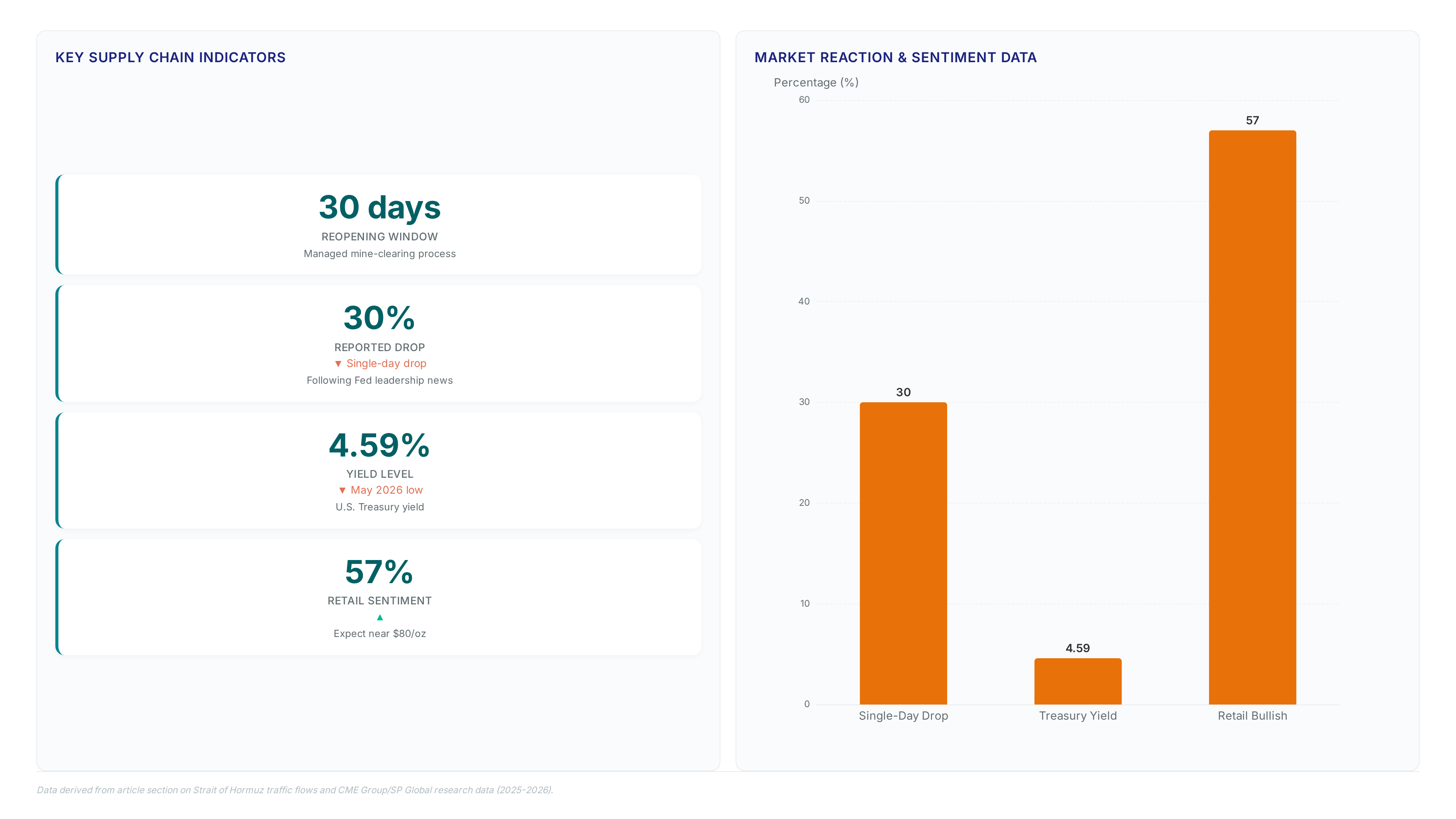
A managed reopening over 30 days describes the gradual mine-clearing process Iran initiates to restore Strait of Hormuz traffic. This phased approach contrasts sharply with immediate normalization, creating a window where reported volume increases may not reflect true capacity. Skepticism is warranted: if Iran reports the numbers, data may be fluffed with actual shipping figures to construct a misleading recovery narrative. Verifying these flows requires cross-referencing official claims against independent satellite telemetry rather than accepting aggregate tonnage at face value.
The risk extends beyond oil. Industrial metal markets react to perceived supply chain stability, yet AI infrastructure demand drives a separate, structural bid that geopolitical noise often obscures. Rising infrastructure costs mean traders must distinguish between the Stage 3 diplomatic signaling and physical cargo movements. A failure to separate verified logistics from political posturing invites capital misallocation during this fragile 30-day window. The market penalizes reliance on unverified state media reports when actual price pressure diverges from the promoted storyline.
Applying Narrative vs Reality Checks to Gold Prices
Stage 3 of the geopolitical play-by-play demands traders cross-reference official US and Iran narratives against verified shipping flows rather than headline sentiment. Market participants must distinguish between a managed reopening and genuine capacity restoration, as data reported by Iran may be fluffed to mask lingering bottlenecks in the Strait of Hormuz. If actual price pressure diverges from these curated metrics, the technical setup near current levels becomes unstable. Industrial demand dynamics for palladium often diverge from pure investment flows seen in precious metals, creating cross-asset noise that obscures the true supply signal.
The upcoming expiration of Jerome Powell's term in May 2026 adds another layer of uncertainty. Operators relying solely on diplomatic MOUs risk holding positions through a false breakout if traffic volumes do not match the optimistic narrative. The cost of ignoring this divergence is a potential retest of lower support zones once the initial euphoria fades. Reality checks require validating tonnage data against independent telemetry before assuming the bearish bias has broken.
Risk of Traffic failing to meet US Demand Levels
Shipping volumes may stagnate below pre-war benchmarks despite diplomatic claims, invalidating bullish commodity forecasts. The managed reopening relies on gradual mine clearance, yet verified telemetry often contradicts official tonnage reports from Iran. Traders monitoring Strait of Hormuz flows must distinguish between staged increases and genuine capacity restoration. If Stage 3 narratives outpace physical throughput, the resulting supply deficit pressures industrial users reliant on stable energy inputs. This divergence directly impacts markets tied to AI infrastructure demand, where power constraints limit data center expansion.
Applying Silver Futures Volume Surges to Precious Metals Allocation
Silver futures trading volume surged significantly year-to-date in Q1 2026, signaling a divergence from gold's purely speculative drivers. This industrial demand spike validates broader portfolio exposure beyond the yellow metal's geopolitical hedging role. Retail sentiment aligns with this shift, as 57% of investors project prices exceeding $100/oz later in the year. The market now offers varied access points, including Coinbase futures. Reliance on high-use instruments introduces liquidation risks absent in physical holdings. A sharp correction could trigger cascading sell-offs, particularly if the AI infrastructure boom cooling reduces industrial silver consumption unexpectedly.
Traders answering "should I buy gold on rebound" queries should note that silver's volatility often leads the sector, offering higher beta exposure. Industrial cycles can decouple from monetary premiums, creating a false correlation during manufacturing slowdowns. Validating this move requires monitoring physical delivery notices alongside paper markets. Without concurrent inventory draws, the volume spike may represent purely financial engineering. The introduction of Coinbase futures increases access but also risk when sentiment diverges from technical reality. A mere small adverse price move triggers total capital loss for maximum-use positions, regardless of long-term thesis validity.
The divergence between retail expectation and institutional caution creates a fragile liquidity environment. Large banks remain hesitant near current price levels, whereas retail traders aggressively price in future gains. This mismatch often results in violent mean reversion events that flush out over-used accounts before any fundamental trend resumes. Operators relying on skewed sentiment data face heightened probability of stop-hunting during low-volume windows. The cost of maintaining such high-use exposure during 24/7 markets frequently exceeds the potential alpha from correct directional calls.
Sustaining positions through geopolitical noise requires strict adherence to risk parameters rather than crowd-sourced price targets.
About
Aisha Rahman serves as the Gold & Commodities Analyst at ForexCFD. Top, where she leads the publication's flagship XAUUSD coverage. Her deep expertise in safe-haven flows and commodity-currency correlations makes her uniquely qualified to dissect the current market reaction to US-Iran geopolitical developments. Based in the Gulf, Aisha analyzes daily how regional tensions, such as potential disruptions in the Strait of Hormuz, directly impact oil prices and subsequently drive gold's inflation hedging appeal. Her work connects these macro drivers with technical analysis, providing retail traders with clear insights on how central bank policies and risk sentiment shape precious metal trajectories. At ForexCFD. Top, an independent resource for forex and CFD news, Aisha ensures that complex market movements are explained through a factual, vendor-neutral lens. This approach helps global traders navigate volatility without hype, grounding speculative news in rigorous fundamental and technical analysis.
Conclusion
Sustaining momentum above the modest floor demands more than passive holding; it requires active management of the widening gap between 24/7 crypto-native futures and traditional settlement windows. When liquidity thins during weekends, use becomes a liability rather than an accelerator, as minor fluctuations trigger liquidations before institutional desks reopen to stabilize prices. The real break point occurs not at technical resistance, but when funding rates on perpetual swaps decouple from physical delivery costs, signaling that paper speculation has outpaced metal availability.
Allocators must shift from binary "buy" or "sell" mandates to a conditional framework by Q3 2026. Only increase exposure if the 10-year yield stabilizes below a moderate threshold while open interest contracts; otherwise, treat any rally as a hedging opportunity rather than an entry signal. Do not confuse volatility with liquidity, especially when retail sentiment diverges sharply from bank positioning. The market will punish those who assume continuous trading equates to continuous stability.
Start this week by auditing your current use ratios against a hypothetical modest overnight drawdown, ensuring your portfolio survives a weekend gap without margin calls. Adjust position sizes immediately if your current setup cannot withstand a temporary disconnection between paper prices and physical settlement realities.
Frequently Asked Questions
Buyers must push prices above the $4,450 threshold to confirm a trend reversal. This specific resistance level represents the 200-day moving average that currently caps further upside momentum for the metal.
Silver prices crashed by 31.4% following the controversial Fed Chair announcement. This massive single-day drop highlights the extreme volatility precious metals face during major central bank leadership transitions and policy shifts.
Support is forming near the $4,337 level, creating a potential double bottom pattern. This price action suggests buyers are stepping in after the metal recently dipped below its previous March low point.
The 10-year U.S. Treasury yield fell to 4.59%, directly reducing the opportunity cost for investors holding non-yielding bullion assets in their portfolios during this specific market cycle.
The US-Iran memorandum of understanding is lowering risk premiums by signaling potential Strait of Hormuz reopening. This diplomatic progress helps stabilize oil prices and improves the general inflation outlook for global markets.