
Gold prices drop: Why rate fears beat safe-haven demand
Gold prices slid to $4,015 on June 29, 2026, as inflation fears cemented a hawkish Fed outlook. The market currently treats the precious metal as a liability rather than a shield because rising rates destroy its appeal compared to yield-bearing assets. You will learn how interest rate expectations override safe-haven demand, why US Dollar strength correlates with these declines, and what upcoming employment data signals for your portfolio.
The dual nature of gold fails when central banks prioritize fighting inflation over growth. FXStreet reports that traders are bracing for policy tightening after the Federal Reserve held rates steady in June but signaled future hikes. This higher-for-longer stance increases the opportunity cost of holding non-yielding assets, pushing values down despite ongoing geopolitical friction in the Middle East.
Investors must now parse ADP employment figures and Nonfarm Payrolls to gauge the Fed's next move. Peter Grant from Zaner Metals notes that markets remain sensitive to both regional headlines and monetary policy shifts. If labor data remains reliable, the US Dollar will likely strengthen, further pressuring gold prices below key psychological thresholds.
The Dual Nature of Gold as an Inflation Hedge and Safe-Haven Asset
Defining Gold as a Non-Issuer Store of Value
Gold functions as a non-issuer store of value because the metal carries no counterparty liability or government mandate. Unlike fiat currencies, its worth does not depend on a central authority's solvency or specific monetary policy decisions. This structural independence allows investors to treat the asset as a safe-haven asset during periods of geopolitical instability or currency debasement. Capital frequently rotates into physical holdings to preserve purchasing power when trust in specific issuers erodes.
Official sector purchases reached 1,136 tonnes in 2022, representing the highest annual volume since records began. Central banks recognize this unique attribute and actively accumulate reserves to diversify away from single-currency exposure. Emerging economies including China, India, and Turkey have led this accumulation to strengthen their balance sheets against external shocks. These nations prioritize holding physical assets that cannot be printed or sanctioned by foreign powers.
The definition of an inflation hedge becomes complex when rising prices trigger aggressive interest rate responses. Recent market behavior shows that inflationary consequences from geopolitical conflict can initially suppress gold prices if traders anticipate higher real yields. A liquidity squeeze often forces investors to sell liquid gold holdings to cover margins in crashing equity portfolios. This flexible creates a temporary divergence where bad news drives prices down rather than up. Understanding this mechanism clarifies why gold price action sometimes contradicts its traditional role during acute stress events. Markets react to immediate cash flow needs before assessing long-term value preservation.
Central Bank Strategies for Reserve Diversification
Emerging economy central banks actively deploy gold purchases to dilute single-currency exposure and reinforce domestic currency strength. Institutions in China, India, and Turkey prioritize this accumulation to insulate national balance sheets from external fiat volatility. This strategy uses the metal's status as a non-issuer asset to stabilize reserves when geopolitical instability threatens traditional holding values. Aggressive monetary tightening cycles create immediate headwinds for this.
Oil price shocks trigger inflation fears that cause markets to price in higher interest rates. Such moves increase the opportunity cost of holding yield-less assets. The constraint is structural; long-term accumulation supports solvency perceptions, yet short-term price action remains tethered to real rate dynamics. A stronger US dollar frequently overrides safe-haven flows, forcing reserve managers to absorb mark-to-market losses during accumulation phases. Diversification benefits accrue over multi-year horizons rather than daily trading sessions. Physical gold lacks the yield generation of sovereign bonds, making it a defensive instrument. This approach ensures systemic durability but requires patience during periods where nominal rates exceed inflation expectations.
When Inflation Fears Trigger Gold Sell-Offs
Rising oil prices triggered a gold decline below $4,000 as markets priced aggressive Federal Reserve rate hikes. This flexible illustrates how inflation fears can paradoxically suppress the very asset traditionally viewed as an inflation hedge. Traders anticipate that central banks will raise interest rates to curb resulting price growth when crude costs surge due to geopolitical tension. Since gold yields no interest, higher rates increase the opportunity cost of holding the metal compared to yield-bearing bonds.
Consequently, the negative correlation between oil and gold intensified, with energy-driven inflation expectations overriding safe-haven demand. The mechanism relies on the real interest rate outlook rather than nominal price levels alone. As inflationary pressure mounts, the expectation of tighter monetary policy strengthens the US Dollar, further pressuring dollar-denominated commodities. Peter Grant noted that markets remain focused on a hawkish Fed tilt despite ongoing geopolitical instability. This creates a scenario where the cure for inflation (higher rates) hurts gold more than the disease (inflation) helps it.
The limitation of this hedge becomes apparent when monetary tightening cycles accelerate. Investors prioritizing real yields will liquidate non-yielding assets regardless of geopolitical risk premiums. ForexCFD.top analysts observe that this specific tension forces a choice between protecting purchasing power and preserving capital efficiency. In a high-rate environment, the opportunity cost of holding gold often outweighs its insurance value against currency debasement.
Macroeconomic Drivers Including Interest Rates and US Dollar Correlation
Real Interest Rates as the Primary Driver of Gold Valuation
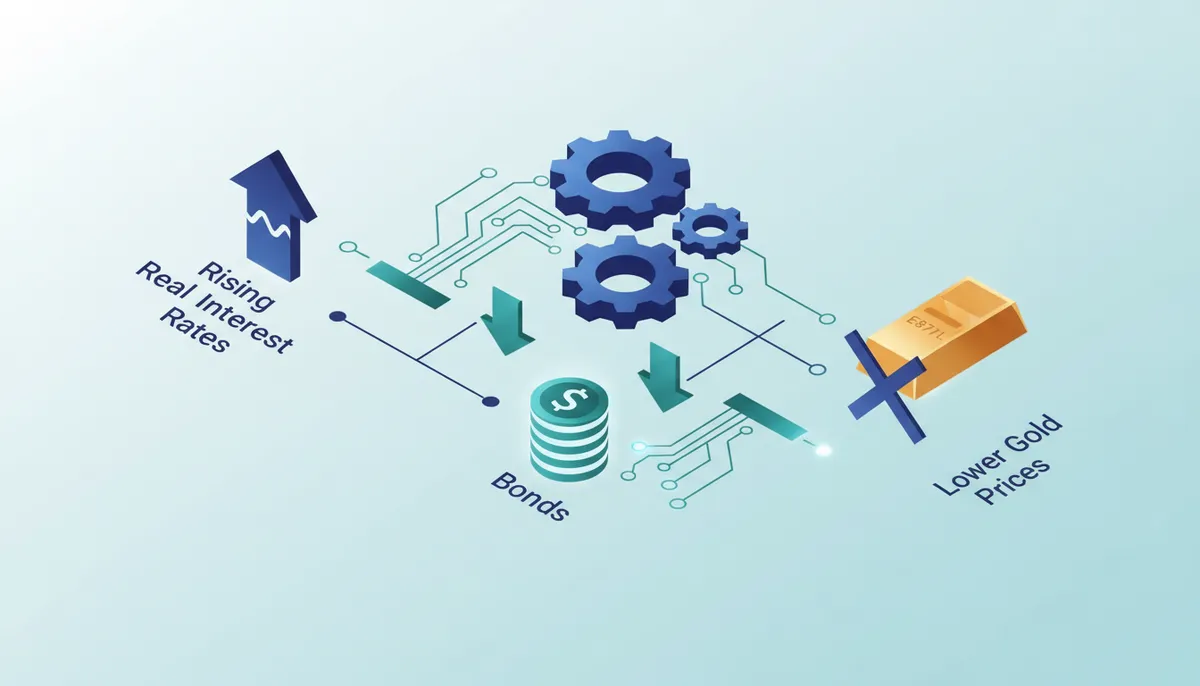
Gold prices face immediate pressure when real interest rates rise, as the metal offers no yield to compete with bonds. While investors often view the asset as an inflation hedge, it does not generate cash flow, rendering it less attractive when interest rates are high. Consequently, hawkish signals from the US Federal Reserve directly increase the opportunity cost of holding non-yielding positions.
| Factor | Impact on Gold | Mechanism |
|---|---|---|
| Rising Real Rates | Negative | Increases opportunity cost of zero-yield assets |
| Strong US Dollar | Negative | Makes dollar-priced metal expensive for foreigners |
| High Inflation | Mixed | Spurs hedging but invites rate hikes that hurt price |
Market participants now prioritize employment data releases over geopolitical tension when assessing valuation trajectories. A stronger-than-expected labor report could cement a "higher-for-longer" stance, further weighing on the yellow metal. Conversely, any signs of weakening in the US labor market might drag down the US Dollar and underpin the commodity price in the near term. The critical limitation for bulls is that inflation fears currently trigger rate hike bets rather than safe-haven buying. This flexible forces a divergence where rising oil prices and conflict initially spark demand but ultimately drive prices lower due to resulting inflation concerns. Traders must monitor the US Nonfarm Payrolls report on Thursday for confirmation of this trend.
Labor Market Data Triggers for Federal Reserve Rate Decisions
Employment figures serve as the primary mechanical trigger for Federal Reserve rate adjustments, directly dictating capital flows into non-yielding assets. When US ADP data or US Nonfarm Payrolls reports exceed consensus estimates, the market prices in a 'higher-for-longer' stance that suppresses Gold prices. This reaction occurs because strong labor metrics suggest persistent inflation, forcing the central bank to maintain restrictive policy above its 2% target. Conversely, weak hiring signals can drag down the US Dollar and support commodity valuations in the near term.
| Data Outcome | Fed Expectation | Gold Reaction |
|---|---|---|
| Stronger-than-expected | Rate hikes likely | Decline |
| Weaker-than-expected | Cuts or holds | Rally |
Traders await the Wednesday release of employment data before the Thursday report for further clues on monetary direction. A strong labor market reinforces the view that interest rates will remain elevated, increasing the opportunity cost of holding metal that generates no cash flow. The limitation of this framework is that geopolitical shocks can temporarily decouple labor data from price action, though inflation fears usually restore the correlation. Investors must prioritize real rate dynamics over traditional safe-haven narratives during these windows. Strong payrolls effectively lock in a bearish outlook by validating the need for tight policy. ForexCFD.top analysts note that liquidity often evaporates ahead of these releases, amplifying volatility beyond fundamental justification. Execution strategies must account for this noise rather than reacting to initial spikes.
Why Geopolitical Instability Can Depress Gold via Oil-Price Inflation
Escalating Middle East hostilities triggered an immediate negative correlation between crude oil spikes and bullion valuations. When conflict drives energy costs higher, markets pivot from safe-haven buying to pricing in sustained inflation. This flexible forces traders to anticipate aggressive monetary tightening that suppresses non-yielding assets. The mechanism operates through real interest rates, where rising bond yields increase the opportunity cost of holding metal. Unlike standard crisis protocols where capital flees to safety, the inflationary consequence of war overrides the initial appeal. Investors face a structural trade-off: physical protection against chaos versus financial protection against rate hikes.
| Trigger | Market Reaction | Dominant Force |
|---|---|---|
| Geopolitical Shock | Initial Safe-Haven Bid | Fear |
| Oil Price Surge | Inflation Expectations Rise | Cost Push |
| Rate Hike Bets | Gold Price Decline | Opportunity Cost |
The limitation of this environment is that traditional hedging strategies fail when the cure for inflation becomes more painful than the disease of instability. While the US Federal Reserve targets price stability, the market reaction often front-runs policy shifts before data confirms them. Operators must recognize that war-driven supply shocks create a scenario where the US Dollar strengthens alongside commodities, crushing gold prices despite global uncertainty. This counter-intuitive move highlights that inflation fears currently outweigh geopolitical risk premiums in valuation models.
Strategic Investment Decisions Based on Employment Data and Fed Signals.
How Nonfarm Payrolls and ADP Data Signal Fed Rate Hikes
Traders await the US ADP employment data on Wednesday and the US Nonfarm Payrolls (NFP) report on Thursday for clues on the Federal Reserve's stance. Strong labor numbers often reinforce a hawkish tilt, pushing real yields higher and diminishing gold's appeal as a non-yielding asset. This flexible raises the opportunity cost of holding bullion, driving prices down toward $4,015 as seen during recent Asian sessions. The Federal Reserve (Fed) policy stance on interest rates directly influences gold's attractiveness.
A stronger-than-expected outcome supports a higher-for-longer narrative, whereas signs of weakening could drag the US Dollar and underpin the commodity. The critical tension lies in gold's dual nature; geopolitical instability typically boosts safe-haven demand, yet the resulting oil-driven inflation fears can trigger rate hike bets that crush prices. Investors prioritizing real interest rate dynamics must watch these releases closely, as hawkish signals currently override traditional hedging benefits. Market participants monitor these specific data points to gauge the timing of potential policy shifts. During the European session on June 24, 2026, gold hit an intraday low of $4,050 before settling near $4,077.77, reflecting clear short-term bearish sentiment. This price action demonstrates that real interest rate dynamics currently override traditional safe-haven demand during periods of monetary tightening.
| Signal Type | Market Reaction | Market Context |
|---|---|---|
| Hawkish Fed Commentary | USD strength, Gold decline | Prices adjusted to a more hawkish Fed tilt |
| Strong Employment Data | Higher yield expectations | Could support higher-for-longer Fed stance |
| Escalating Geopolitics | Temporary spike | Market remains attuned to Middle East headlines |
Investors asking should I buy gold during high inflation must recognize that persistent price pressures often force central banks to maintain restrictive policies, rendering non-yielding assets less attractive. The limitation here is timing; the market is still adjusting to a hawkish Fed tilt which exposes capital to further downside as expectations for a rate hike later in the year grow. Consequently, market focus remains on whether upcoming employment data, such as the US Nonfarm Payrolls (NFP) report, will confirm a shift in the labor market trajectory or reinforce the current stance. Until then, the correlation between a strengthening dollar and falling bullion prices remains the dominant trade structure. Retail traders should monitor these macro signals closely via the educational resources provided by ForexCFD.top. *Risk Warning: CFDs are complex instruments and come with a high risk of losing money rapidly due to use. 74-a majority of retail investor accounts lose money when trading CFDs with this provider.*
*Disclosure: ForexCFD.top may receive compensation from partners listed on this page. This compensation may impact how and where products appear.*
The Opportunity Cost Risk of Holding Gold When Rates Rise
Gold yields no interest, creating a tangible liability when bond returns rise alongside Federal Reserve tightening cycles. The relative cost of holding the metal effectively increases as investors sacrifice guaranteed income from fixed-income alternatives. Even persistent inflation fails to support prices if the central bank maintains a hawkish stance to combat it. Geopolitical escalations, such as recent US-Iran Conflict impacts, initially spark safe-haven buying before oil-driven rate fears trigger sharp reversals. This flexible forces traders answering "should I buy gold during high inflation" to prioritize real yield trajectories over nominal price stability.
Monitor the US ADP employment report on Wednesday to gauge initial labor market strength before the main event. Stronger-than-expected data often reinforces a hawkish Federal Reserve stance, pressuring non-yielding assets like gold. Conversely, signs of weakening could drag down the US Dollar and support the commodity price in the near term.
- Assess preliminary labor signals from mid-week releases for early positioning clues.
- Await the Nonfarm Payrolls report on Thursday to confirm the employment trajectory.
- Consider entries if price action aligns with the revised rate hike expectations.
This "push-and-pull" flexible indicates that pricing remains highly sensitive to macroeconomic data releases rather than physical constraints, keeping the market volatile and range-bound volatile. Capital flows rapidly toward bonds when futures price in rate hikes, reversing interest from zero-yield instruments. The cost of this strategy is measured in slippage; transaction costs or spreads may widen as investors offload gold to cover losses in crashing asset classes. Traders must recognize that geopolitical headlines from the Middle East may temporarily override labor data, creating false breakouts. Gold spot prices fell 0.6% to an unspecified amount an ounce on June 18, 2026, after a temporary ceasefire deal erased safe-haven premiums instantly. Investors asking how to invest in gold must recognize that Middle East tension alone does not sustain rallies without active escalation. The mechanism is binary: news of de-escalation triggers immediate liquidation as traders pivot from fear to yield-seeking behavior.
- Monitor real-time headlines for any mention of talks in Doha or Qatar. 2.
The limitation is that rising oil prices from conflict can paradoxically hurt gold by sparking inflation fears that demand higher interest rates. This negative correlation means geopolitical instability sometimes drives the metal lower rather than higher. Traders must prioritize real rate dynamics over headline risk when central banks remain hawkish.
| Scenario | Gold Reaction | Driver |
|---|---|---|
| Escalation | Rally | Safe-haven flow |
| Ceasefire Talk | Drop | Premium evaporation |
| Oil Spike | Drop | Rate hike fear |
ForexCFD.top advises that geopolitical de-escalation acts as a hard reset on pricing models.
About
Sofia Mendes serves as the Broker Reviews & Trading Education Editor at ForexCFD.top, where she oversees the platform's core educational resources and rigorous broker evaluation standards. Her expertise in macroeconomic drivers and risk management makes her uniquely qualified to analyze gold's reaction to shifting inflation data and central bank policies. While her daily work focuses on vetting regulated brokers and crafting beginner-friendly guides, these fundamentals are critical when interpreting how higher interest rates impact XAU/USD valuations for retail traders. At ForexCFD.top, an independent publication dedicated to transparent market analysis, Sofia ensures that complex topics like the interplay between geopolitical tensions and precious metal pricing are explained with clarity and factual precision. Her structured approach helps traders in emerging markets understand not just price action, but the underlying economic forces, reinforcing the publication's commitment to education-first content over speculative hype.
Conclusion
Gold's recent drop below key levels reveals a critical fragility: the market now prioritizes Federal Reserve policy signals over traditional safe-haven impulses. When central banks maintain restrictive stances to combat inflation, the opportunity cost of holding non-yielding assets becomes prohibitive, triggering rapid liquidation even during geopolitical tension. This flexible creates a dangerous trap where positive news regarding Middle East de-escalation instantly evaporates price premiums, forcing traders to choose between fear-based rallies and yield-seeking reality.
Investors must stop treating every headline as a buy signal and instead align positions with real-rate expectations. If the Federal Reserve signals it will keep policy tight above its 2% target, gold will struggle to sustain momentum regardless of external conflicts. The strategic pivot requires waiting for confirmed shifts in labor data or explicit dovish turns before committing capital to long positions.
Start this week by reviewing your exposure to gold futures against the latest gold pricing data, specifically looking for divergence between spot prices and bond yield movements. Only when rate hike fears subside should you consider rebuilding positions, ensuring your portfolio reflects monetary reality rather than transient geopolitical noise.
Frequently Asked Questions
Prices falling below $4,000 indicate aggressive rate hike expectations. This drop to $4,015 shows investors favor yield-bearing assets over non-yielding metal during inflation fights.
Strong jobs reports support a higher-for-longer Fed stance, pressuring prices. Weak labor data could drag the US Dollar down and underpin the commodity price in the near term.
They diversify reserves to improve perceived currency strength during turbulence. In 2022, they added 1,136 tonnes worth around $70 billion to build trust in their national solvency.
The US Dollar and US Treasuries usually move opposite to gold. A strong dollar keeps prices controlled, while dollar weakness typically pushes the metal value up significantly.
It fails when inflation fears trigger aggressive interest rate responses. Rising rates increase opportunity costs, making the yield-less asset less attractive than bonds offering real returns.
References