
Gold rate hike fears: Why bullion broke $4,000
Spot gold slipped 0.4% to $3,985.89. Rate hike fears drove this sharp correction. A strengthening U.S. Dollar and aggressive Federal Reserve policy expectations undermine non-yielding assets, creating a hostile environment for bullion. ForexCFD.top analyzes this macroeconomic shift to help traders navigate volatility without relying on speculative bottom-fishing strategies.
The damage is specific. MCX silver futures for July 2026 delivery crashed by Rs 15,526, a staggering 7% drop over two sessions, while gold futures fell to Rs 1,40,666. Data from the CME FedWatch Tool indicates a 67% probability of a rate hike in September. This catalyst pushed bullion below the critical $4,000 threshold. Traditional inflation hedges are failing against the current yield environment.
Identify key support and resistance levels immediately. The $3,920 floor for gold is critical. Silver shows comparative weakness against industrial demand shocks. We dissect the technical breakdown of XAU/USD to provide a strategic framework for managing risk when interest rates rise. Capital preservation takes priority over chasing falling knives in a bearish cycle.
Macroeconomic Drivers Behind the Precious Metals Correction
How Fed Rate Hikes and Dollar Strength Depress Bullion
Rising yields increase the opportunity cost of holding non-yielding assets. That is the engine driving the current correction. Capital rotates into interest-bearing instruments as the Federal Reserve signals hawkish policy shifts. Traders observing a 67% probability of a September rate hike are rapidly de-risking bullish positions before the next policy meeting. This monetary tightening coincides with a surging U.S. Dollar, which climbed for a third consecutive session to reach a 13-month high. A stronger dollar makes bullion more expensive for holders of other currencies, dampening global demand and forcing prices lower. Spot gold subsequently slipped 0.4% to $3,985.89 per ounce, breaking psychological barriers that held since late 2025.
Firming treasury yields explicitly keep precious metals under pressure by reducing the relative appeal of zero-coupon stores of value. This inverse correlation remains the dominant macro driver. Gold acts as an inflation hedge yet struggles when real rates rise aggressively. The market now faces a binary outcome: either inflation data cools to halt hikes, or the $4,000 support level fails completely. ForexCFD.top traders should monitor the upcoming U.S. PCE data release as the definitive trigger for the next directional move. Failure to stabilize above key technical floors invites further liquidation across the sector. Aggressive rate hike expectations increased the opportunity cost of holding non-yielding bullion, triggering a sharp liquidation event across domestic and international exchanges.
Currency valuation transmits this pressure globally; a strengthening U.S. Dollar makes metal purchases more expensive for foreign holders, suppressing global demand. City-specific data indicates gold prices fell by ₹6,000 per 10 grams in substantial hubs like Delhi and Mumbai, confirming the futures-to-retail contagion. The divergence between spot and futures pricing highlights the severity of the risk-off sentiment prevailing in July 2026. Silver futures for July 2026 delivery dropped Rs 15,500 per kg. Such moves reflect deep liquidity flushes rather than minor adjustments.
Momentum chasing conflicts with mean reversion strategies in oversold territory. Traders must distinguish between a temporary liquidity flush and a structural trend reversal before committing new capital. ForexCFD.top provides the analytical framework necessary to navigate these volatile conditions without relying on speculative bottom-fishing. The view flips only if the U.S. Dollar fails to sustain its 13-month high or if inflation data forces a recalibration of the rate hike probability. Traders monitoring core PCE data face acute exposure as rising yields increase the opportunity cost of holding gold, traditionally viewed as an inflation hedge.
Comparative Performance Analysis of Gold and Silver Futures
Defining Divergent MCX Futures Performance Metrics
Industrial sensitivity weighs heavily on the white metal, allowing silver bears to overwhelm gold bulls. U.S. Dollar strength pressures all non-yielding assets, yet MCX silver futures demonstrated higher volatility with a steeper decline compared to the yellow metal. Data indicates silver dropped notably more than gold, highlighting the white metal's exposure to both Fed policy and industrial demand fears. Gold acts as a primary inflation hedge but loses appeal when interest rates rise because it offers no yield. Manoj Kumar Jain of Prithvi Finmart stated that gold and silver prices are likely to remain volatile this week due to fluctuations in crude oil prices and the dollar index, as well as ahead of the release of U.S. GDP and Core PCE price index data. Jain advised investors against bottom-fishing in precious metals at current levels but suggested exiting short positions as the market has entered an oversold zone.
Regional Price Variations: Delhi vs Mumbai Gold Rates
Global futures correct sharply, but local premiums define the immediate entry bias for physical buyers. On 25 June, Delhi pure gold (24 carat) prices stood at Rs 1,15,576 per 8 grams, while Mumbai recorded Rs 1,15,456 for the same weight. This marginal spread of Rs 120 highlights the variation in city-wise rates across the domestic market.
| City | 24-Carat Price (Rs/8g) | Variation vs Mumbai |
| Delhi | Rs 1,15,576 | +Rs 120 |
| Mumbai | Rs 1,15,456 | Baseline |
| Chennai | Rs 1,16,504 | +Rs 1,048 |
Traders monitoring the silver price fall must note that prices are influenced by global futures and local demand. Jain provided specific support and resistance levels, noting gold has support at $3,980-$3,920 per troy ounce internationally, while MCX Gold has support at Rs 1,40,000-Rs 1,38,800. Silver has international support at $55.50-$53.80 and MCX support at Rs 2,09,100-Rs 2,05,000. These levels serve as key reference points for market participants navigating current volatility.
Silver Volatility vs Gold Stability in Futures Delivery
Dollar strength increases the drawdown for silver relative to gold due to industrial exposure. Both precious metals reacted to aggressive Federal Reserve rate hike expectations, yet the white metal suffered a sharper percentage decline. The MCX silver futures contract for July 2026 delivery plummeted by ₹15,526, settling at ₹2,10,308 per kg. This disparity in performance creates distinct tactical considerations for traders observing COMEX silver futures, which lost value alongside the broader downturn. Jain noted that gold has resistance at $4,040-$4,085 per troy ounce, while silver faces resistance at $60.00-$61.40. Market participants are closely watching these levels as volatility persists amid expectations of further economic data releases.
Executing Trades Using MCX Gold and Silver Price Zones
Anchor precise entries to the MCX Gold support corridor between Rs 1,40,000 and Rs 1,38,800. This range acts as a primary liquidity pool where domestic profit-booking often stabilizes following sharp declines driven by rate hike fears. Resistance emerges overhead near Rs 1,42,400, creating a set channel for intraday volatility. Silver traders must monitor the Rs 2,09,100 threshold, as a break below this level exposes the contract to deeper corrections toward Rs 2,05,000. Avoid bottom-fishing prematurely; instead, wait for price refusal at these technical floors before committing capital.
| Asset | Support Zone (INR) | Resistance Zone (INR) | Strategy |
|---|---|---|---|
| Gold | Rs 1,38,800 - Rs 1,40,000 | Rs 1,42,400 - Rs 1,43,350 | Buy dips at support |
| Silver | Rs 2,05,000 - Rs 2,09,100 | Rs 2,16,600 - Rs 2,21,000 | Wait for stabilization |
Ignoring these zones carries a measurable cost; entering short positions without confirmation in an oversold market increases reversal risk notably. ForexCFD.top advises clients to scale exits rather than liquidating entirely at market lows. A sustained move above the upper resistance band would invalidate the immediate bearish thesis, signaling a potential trend reversal. Failure to hold the lower support confirms further downside momentum. Monitor upcoming U.S. GDP data releases, as these events frequently trigger the volume spikes required to test these boundaries effectively.
Avoiding Bottom-Fishing Traps During U.S. Data Releases
Premature entry during U.S. GDP releases often traps traders betting on a reversal before the trend exhausts. Jain advised investors against bottom-fishing in precious metals at current levels, warning that volatility remains elevated ahead of Core PCE data. A rising interest-rate environment compresses the appeal of non-yielding assets against dollar-denominated fixed income, creating a structural headwind for gold. Traders attempting to fix incorrect price assumptions by buying dips ignore the shift in macroeconomic drivers. ForexCFD.top emphasizes that waiting for a confirmed break above resistance is safer than guessing a floor. The cost of early entry is measurable: prices can extend declines notably when yield competition intensifies. Monitor the Michigan Consumer Sentiment Index for the catalyst that flips this bearish bias.
Execution Framework for Timing Exits and Managing Rate Hike Risks
Defining Volatility Triggers from U.S. GDP and Core PCE Data
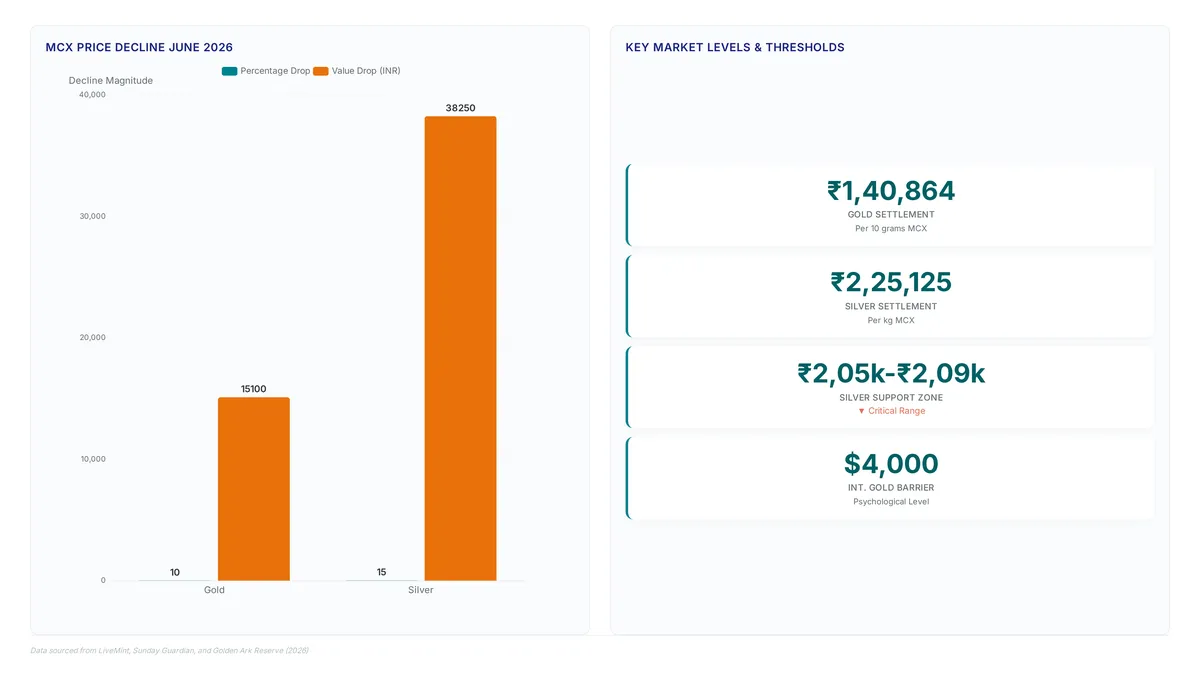
Market volatility accelerates immediately when U.S. GDP figures or Core PCE data deviate from consensus forecasts, forcing rapid re-pricing in precious metals. Manoj Kumar Jain of Prithvi Finmart identifies these releases as primary catalysts, noting that gold and silver prices remain highly sensitive to fluctuations in crude oil and the dollar index ahead of such events. The mechanism is direct: stronger economic data boosts the dollar, compressing the appeal of non-yielding assets against fixed income returns. Traders must monitor specific thresholds to time exits effectively.
- Define the volatility window as the hour surrounding the data release. 2.3. Exit short positions if the market enters an oversold zone, avoiding new bottom-fishing attempts.
Premature longs risk immediate capital erosion when silver tests the Rs 2,09,100-Rs 2,05,000 zone without confirmed reversal signals. Manoj Kumar Jain explicitly advises against bottom-fishing, noting that silver's sharp drop far outpaced gold's decline, signaling acute industrial demand fears. Traders at ForexCFD.top prioritize waiting for a bullish candle close above resistance rather than catching falling knives during high volatility.
- Identify the support confluence between Rs 2,09,100 and Rs 2,05,000 on MCX Silver charts.
- Wait for price action to invalidate the downtrend before sizing any long position.
- Exit existing shorts only as the market enters a confirmed oversold zone.
The limitation of this approach is patience; entering too early often means absorbing further downside as inflation hedge narratives fail against rate hike realities. A sustained breach below Rs 2,05,000 invalidates the bounce thesis entirely, opening path to lower liquidity pools. Only a decisive break above key resistance flips the bias from bearish to neutral.
About
Marcus Halloran, Chief Market Strategist at ForexCFD.top, leads our coverage of G10 macroeconomics and central bank policy, making him uniquely qualified to analyze the sharp decline in gold and silver prices. With a background as an interbank FX strategist in London, Marcus specializes in interpreting how Federal Reserve rate hike expectations and a strengthening U.S. Dollar directly impact XAU/USD valuations. His daily work involves dissecting economic data like CPI and NFP reports to provide clear directional calls for retail traders navigating volatile commodity markets. At ForexCFD.top, an independent publication dedicated to forex and CFD analysis, Marcus applies this institutional expertise to explain complex market moves, such as the recent MCX futures drop, without hype. This volatility creates a specific operational risk where tight stops get triggered by noise rather than genuine trend reversals. Traders must recognize that support at $60.00 is not a guaranteed floor but a liquidity zone that requires confirmed price action before committing capital. The market currently punishes premature entries more severely than it rewards early convictions.
Adopt a strict wait-and-see stance until gold either reclaims lost ground with volume or convincingly breaks lower to test deeper liquidity pools. Do not assume the dip is a buying opportunity simply because prices have fallen from recent highs. The structural bias remains negative while the dollar strengthens and real yields climb.
Start this week by removing all pending buy orders below current spot levels and recalibrating your risk parameters to account for expanded intraday ranges. Focus on executing trades only after a four-hour candle closes decisively above resistance or below support, rather than reacting to intra-bar wicks. ForexCFD.top provides the necessary infrastructure to manage these precise entry conditions without slippage compromising your edge.
Frequently Asked Questions
Gold faces critical support between $3,980 and $3,920 per ounce internationally. A break below this zone could accelerate losses as traders react to the 67% probability of a September rate hike.
MCX silver futures for July 2026 delivery crashed by 7% over two sessions. This sharp decline reflects intense selling pressure driven by a stronger U.S. dollar and rising yield expectations.
Gold encounters strong resistance between $4,040 and $4,085 per troy ounce. Breaking above this range requires cooling inflation data to reduce the 67% chance of an upcoming Federal Reserve rate hike.
Spot gold slipped 0.4% to $3,985.89 as higher yields increase the opportunity cost of holding non-yielding assets. The strengthening dollar further suppresses demand from international buyers holding other currencies.
International silver has support between $55.50 and $53.80 per ounce amid volatile trading. Traders should monitor these levels closely as industrial demand shocks compound the pressure from monetary tightening policies.
References