
Gold drops as Fed rate bets hit 63%
Gold faces a 3.4% weekly loss as hawkish Fed bets drive the dollar higher while inflation breaks 4.0%.
Monetary tightening crushes non-yielding assets when real rates climb. The Federal Reserve maintains the target range for the federal funds rate at 3.50% to 3.75% as of the June 17, 2026 meeting. The window for easy money has closed. Spot gold slipped 0.1% to $4,022.95 per ounce by 0046 GMT, reflecting investor flight to the safety of the U.S. Dollar index. A tentative S.-Iran deal cannot outweigh the gravitational pull of sustained interest rate hikes.
The CME FedWatch Tool signals a 63% chance of a September rate increase, a scenario that further strengthens the greenback. Meanwhile, China's net gold imports via Hong Kong fell about 38% month-on-month in May, signaling a critical shift in global demand dynamics.
The interplay between currency strength and gold valuation has never been more volatile. As U.S. Inflation increased further in May, breaking above 4.0% for the first time in three years, the path for precious metals remains obstructed by policy. Navigating this environment requires understanding Federal Reserve maneuvers, where even a tentative peace agreement fails to spark a rally.
The Mechanics of Hawkish Fed Policy on Gold Valuation
Defining Hawkish Fed Stance via IORB and Rate Hikes
A hawkish Fed stance maintains restrictive policy via the Interest on Reserve Balances (IORB) to suppress inflation above the 2% target. The interest rate paid on reserve balances was unanimously voted to be maintained at 3.65%, effective June 18, 2026. This creates a floor for short-term rates that directly increases the opportunity cost of holding non-yielding bullion. When central banks hold this rate steady while inflation pressures remain elevated, they signal a commitment to tightening liquidity rather than providing relief. Federal Reserve Bank of New York President John Williams noted that while inflation may moderate, current levels remain excessive relative to goals.
Active rate hikes differ from the maintenance of high reserve yields, yet both constrain capital. Market participants now price a 63% probability of a September increase, reflecting the severity of the monetary policy shift. High rates reduce market liquidity and increase borrowing expenses across the economy. This strategy relies on rate persistence to anchor expectations rather than shrinking the balance sheet through quantitative tightening. Gold's decline below $4,000 coincides with these elevated yield expectations, occurring even as investors assess fragile geopolitical agreements. Policy rates dictate asset allocation flows notably alongside risk events for network operators and traders alike. Monitoring these yield differentials remains necessary as markets digest headline news. The opportunity cost mechanism functions because the Federal Reserve maintained the target range for the federal funds rate at 3.50% to 3.75%.
Market Volatility from Divergent FOMC Projections
Divergent FOMC projections create pricing instability when committee members signal conflicting terminal rate paths. A widening divergence in Federal Open Market Committee projections fuels market volatility, introducing significant uncertainty into asset valuation models. Internal disagreement forces traders to constantly reprice risk as new data arrives. The market attempts to gauge which faction of the committee will dominate future policy decisions, driving this turbulence. Conflicting signals complicate the formation of a clear consensus trajectory for interest rates, leading to heightened sensitivity in precious metals markets.
Gold investors face a volatile environment where sudden shifts in sentiment override fundamental supply and demand dynamics. Widened bid-ask spreads and erratic price swings during trading sessions measure the cost of this ambiguity. Such conflicting signals fuel market volatility as participants struggle to gauge the true direction of monetary policy. Traditional hedging strategies may face challenges when the central bank itself appears divided, posing practical implications for network operators managing liquidity. Investors often look to the dot plot for clearer signals before establishing long-term positions, as further divergence could trigger sharper corrections in precious metals prices.
*Disclaimer: This content is for educational purposes only and does not constitute financial advice. Trading involves significant risk.*
Currency Strength and Geopolitical Drivers in Commodities Markets
Dollar Index Mechanics Driving Gold's Weekly Losses
Spot gold slipped 0.1% to $4,022.95 per ounce by 0046 GMT as the strengthening U.S. Dollar index raised conversion costs for international buyers. Currency appreciation forces holders of other funds to pay more, suppressing global demand and driving spot prices down to clear markets. The greenback heading for a second straight weekly gain demonstrates this inverse relationship clearly. This dynamic creates tension where geopolitical risks in the Strait of Hormuz fail to sustain price floors against monetary tightening. Dollar dominance often nullifies traditional safe-haven flows during rate hike cycles.
| Factor | Impact on Gold | Mechanism |
|---|---|---|
| Dollar Strength | Negative | Increases cost for non-dollar holders |
| Fed Rate Bets | Negative | Boosts dollar yield appeal |
| Geopolitics | Neutralized | Overshadowed by monetary policy |
The primary limitation for bullish strategies remains the opportunity cost of holding non-yielding assets while real rates rise. Investors relying solely on conflict premiums ignore how a stronger denominator reduces commodity valuations. ForexCFD.top analysts note that until the dollar index reverses its weekly gain streak, price recovery remains structurally constrained.
Strait of Hormuz Tensions Versus Rate Hike Expectations
Gold prices declined despite fresh escalations in US-Iran tensions because Federal Reserve rate hike bets currently outweigh geopolitical risk premiums in pricing models. The U.N. International Maritime Organization paused its operation to escort ships through the Strait of Hormuz on Thursday after a vessel reported an attack, yet this supply threat failed to sustain a rally. Data shows U.S. This flexible illustrates a scenario where the "Fed rate-hike bet" narrative suppresses the traditional geopolitical risk premium usually associated with gold. Central bank signals now overpower regional conflict, causing gold to fail reacting positively to escalations when overshadowed by dominant Federal Reserve policy signals. Traders must prioritize Fed rate hike bets over physical supply disruptions during such cycles. The constraint of relying on conflict alone is clear: without accommodative monetary policy, the opportunity cost of holding non-yielding assets remains prohibitive. ForexCFD.top analysts note that until inflation data moderates, the signal will likely continue to override safe-haven flows.
Gold Versus Silver Performance Amid Import Drops
China's net gold imports via Hong Kong fell about 38% month-on-month in May, a sharp contraction that suppresses physical demand while paper markets remain volatile. This import drop signals weakening industrial and retail appetite in the world's largest consumer, removing a key floor for prices. Platinum held steady at $1,600.95, while palladium managed a slight gain of 0.4% at $1,188.97, showing marginal durability against the broad sell-off. The divergence suggests that while gold suffers from opportunity costs, industrial metals face distinct supply chain variables.
Reduced Chinese buying directly pressures global spot rates through the mechanical link between import volumes and price discovery. Unlike geopolitical shocks that might spike oil, this demand withdrawal creates a persistent drag on valuation. Investors must recognize that without physical support from Asia, rate hike expectations will continue to drive precious metals lower regardless of regional tensions.
Using the CME FedWatch Tool for Rate Probability Analysis
CME FedWatch Tool Probability Mechanics
The CME FedWatch Tool calculates rate hike probabilities by analyzing pricing in federal funds futures contracts. This mechanism translates market positioning into a percentage likelihood of specific basis point moves at upcoming Federal Open Market Committee meetings.
- Identify the federal funds futures contract for the target meeting date.
- Observe the implied rate derived from the contract's settlement price.
3.4. Calculate the probability distribution across possible rate outcomes based on pricing discrepancies.
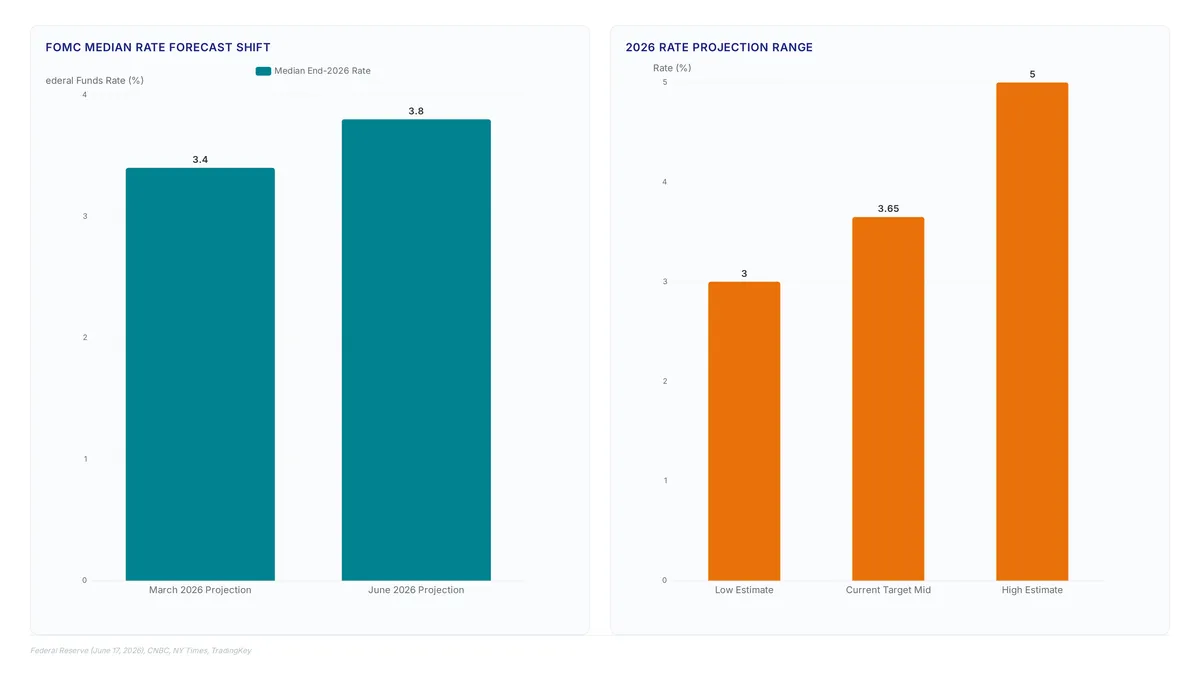
Market participants monitor these probabilities alongside economic data, as sudden shifts in volume can reflect changing sentiment regarding the terminal rate. The divergence in FOMC projections, with individual estimates for the end-of-2026 federal funds rate ranging from 3.4% to 4.4% around a 3.8% median in the June 2026 Summary of Economic Projections, introduces volatility into these probability readings. Traders must distinguish between structural positioning driven by the "dot plot" and transient market noise when relying on these figures for capital allocation. Monitoring probability percentages alongside fundamental drivers helps validate signal integrity before executing trades.
Trading Fed Rate Hike Probabilities with FedWatch
Traders time entries by monitoring how inflation commentary shifts probability curves on the CME FedWatch Tool. Chicago Federal Reserve President Austan Goolsbee noted a "glimmer of hope" in services data, yet underlying pressures remain elevated, sustaining bearish sentiment for non-yielding assets like gold which recently touched $4,050 near two-week low.
- Observe the implied rate movement immediately following FOMC member speeches.
- Cross-reference sudden probability spikes with scheduled releases like the US U Mich Sentiment survey.
- Monitor price action as dollar strength intensifies ahead of core PCE data.
The cost of this strategy is potential false signals during low-liquidity windows where algorithmic trading exaggerates rate hike fears.
Validating Inflation Data Against Rate Expectations
Align scheduled releases with probability shifts to confirm trade timing before execution. This checklist cross-references specific inflation metrics against CME FedWatch Tool fluctuations to validate hypotheses.
- Monitor the 1400 GMT U.S. Michigan Sentiment print for immediate deviations from consensus expectations.
- Observe if the implied probability of a September rate adjustment expands beyond current baselines.
3.4.
| Data Event | Time (GMT) | Market Context |
|---|---|---|
| France Unemp Class-A | 1000 | Scheduled Economic Release |
| U.S. Mich Sentiment | 1400 | Scheduled Economic Release |
The opportunity cost for holding non-yielding assets rises sharply when rate expectations shift. Even if geopolitical tensions persist, a confirmed hawkish pivot overrides safe-haven demand. Investors must prioritize monetary policy signals over transient news cycles to avoid capital erosion. This specific rate acts as a risk-free floor for short-term returns, forcing institutional investors to weigh the potential upside of gold against a guaranteed yield available through reserve balances. The Fed confirmed an ample reserves operational framework, indicating no immediate plans to reduce its $6.7 trillion balance sheet.
Consequently, gold enters the new week near a record high per ounce, suppressed by the allure of fixed income alternatives. The limitation of this flexible is that geopolitical premiums, such as tensions affecting the Strait of Hormuz, fail to trigger safe-haven rallies when real rates remain positive. Traders must recognize that hawkish Fed policy effectively neutralizes traditional inflation hedges until the rate trajectory shifts. This environment requires a strategic reassessment of portfolio weighting, prioritizing liquidity and yield over speculative preservation. Interest rate hikes. However, the limitation is timing; holding non-yielding assets exposes capital to opportunity costs as the Federal Reserve maintains restrictive policy.
About
Sofia Mendes serves as the Broker Reviews & Trading Education Editor at ForexCFD.top, where she oversees the platform's rigorous analysis of market conditions and regulated trading environments. Her expertise in broker due diligence and risk management makes her uniquely qualified to interpret gold's recent volatility driven by hawkish Federal Reserve signals. While her daily work often focuses on evaluating execution quality and spreads for XAUUSD, understanding the macroeconomic forces impacting price action is necessary for educating traders on capital preservation. At ForexCFD.top, an independent publication dedicated to vendor-neutral market news, Sofia connects complex currency dynamics to practical trading strategies. Her analysis helps retail investors navigate periods where a strengthening dollar pressures precious metals, ensuring they approach gold trading with a clear understanding of regulatory risks and fundamental drivers rather than speculation.
Conclusion
The current market structure reveals that geopolitical friction alone cannot sustain gold prices when the Federal Reserve actively pursues a hawkish trajectory. With the median projection for the federal funds rate climbing to a multi-year high by year-end 2026, the metal faces a structural headwind that overrides traditional safe-haven demand. Investors must recognize that holding non-yielding assets becomes increasingly punitive as real rates stabilize above inflation targets. This flexible forces a shift from speculative accumulation to strategic patience, specifically waiting for the central bank to signal an end to its tightening cycle beforeallocating significant capital.
Market participants should immediately adjust their exposure models to account for this prolonged period of yield competition rather than anticipating a quick rebound. The optimal approach involves deferring substantial long-position entries until the probability of further rate hikes diminishes materially or until inflation data forces a policy pivot. Start by reviewing your current commodity allocation this week to ensure it does not exceed risk tolerance limits given the heightened volatility from conflicting FOMC signals. Prioritize liquidity and fixed-income yields while the terminal rate remains uncertain, treating any price stability as a consolidation phase rather than a confirmed bottom.
Frequently Asked Questions
China's net gold imports dropped significantly by 38% month-on-month during May. This sharp decline signals a critical shift in global demand dynamics that could further suppress prices despite ongoing geopolitical tensions in the region.
Market participants currently price a 63% probability of a rate increase occurring this September. This high likelihood strengthens the U.S. dollar and increases the opportunity cost for investors holding non-yielding bullion assets today.
Gold fell below $4,000 as hawkish Fed bets drove the dollar higher against major currencies. Elevated yield expectations create a hard floor for short-term rates that directly competes with precious metals for capital allocation.
Inflation breaking above 4.0% forces the Federal Reserve to maintain restrictive policies to suppress prices. This stance keeps the federal funds rate target range between 3.50% and 3.75% to anchor long-term market expectations effectively.
The metal is on track for a weekly loss of 3.4% even with ongoing geopolitical friction. Risk-free alternatives provided by central bank policy currently override speculative buying driven by external conflict or supply chain disruptions.
References