
Gold price crash: Why $4,219 is just the start
Gold prices collapsed to $4,219 as the Federal Reserve signaled tighter policy under new Chair Kevin Warsh.
Accommodative monetary policy is dead. This reality forces a brutal repricing of non-yielding assets like Gold (XAU/USD). With the Federal Reserve removing forward guidance and emphasizing that inflation remains well above the 2% target, investors face a hostile environment for precious metals. The US Dollar Index surged to three-month highs, compounding the pressure on bullion as the central bank prioritizes price stability over growth concerns.
We are witnessing a reinterpretation of the dual mandate to justify aggressive rate hikes despite labor market steadiness. Kevin Warsh's debut press conference offered no specific economic projections; instead, he established task forces to reassess data quality and the balance sheet. Technical breakdowns below critical support levels now drive price action, fueled by Core PCE forecasts sticking near 3.3% and swaps pricing in 30 basis points of tightening by year-end.
Can the FOMC curb inflation without triggering a recession? Warsh claims this is not a "cruel choice." Data from Capital Edge confirms the market is bracing for volatility as the median forecast for the Fed Funds Rate climbs to 3.8%. This shift marks a definitive end to liquidity-driven rallies.
The Dual Mandate Framework Driving Current Fed Decisions
Defining the Fed Dual Mandate: Price Stability and Full Employment
Statutory law binds the Federal Reserve to a dual mandate demanding price stability alongside maximum employment. Monetary policy in the US flows directly from this Federal Reserve obligation to achieve price stability while supporting full employment. Adjusting interest rates serves as the primary tool for execution. Inflation rising above the Fed's 2% target triggers rate hikes that strengthen the US Dollar. This specific mechanism recently drove gold prices to collapse below $4,000 as markets priced in tighter policy Federal Reserve (Fed). Prioritizing price stability often requires suppressing employment growth temporarily.
Hawkish Fed Tilt Overriding Geopolitical Safe Havens
Mechanically raising borrowing cools inflation, whereas lowering rates stimulates employment. This policy divergence directly dictates asset valuation, as seen when gold plummeted to $4,219 following hawkish signals, illustrating how rate expectations override technical support levels gold. The FOMC executes these shifts through a twelve-member voting body comprising seven Board governors, the New York Fed president, and four rotating regional presidents. Committees may cut rates to encourage borrowing when inflation falls below target or unemployment spikes. A constraint exists in the rotating voting structure; regional presidents serving one-year terms can introduce transient volatility to the committee's long-term consensus, potentially creating mixed signals for market participants.
Rising real yields driven by the hawkish Fed tilt currently suppress gold demand despite active conflict zones. Signaling higher interest rates to combat inflation sharply increases the opportunity cost of holding non-yielding assets like gold for institutional investors. Market analysis confirms that monetary policy expectations now outweigh traditional safe-haven drivers during this cycle. Prices continued falling even with an uptick in Middle East tensions over the weekend prior to June 29, 2026, as traders prioritized the interest rate outlook. Liquidity conditions dictated by central bank projections override fear-based buying in the current regime. Bullish traders face a limitation: geopolitical premiums evaporate quickly when the Fed Funds Rate projection rises toward 3.8%. Consequently, gold trading near $4,015 demonstrates that monetary tightening remains the primary price discovery mechanism regardless of external shocks. Safe-haven status fails when the cost of capital rises aggressively across the yield curve. Higher projected rates strengthen the dollar, making dollar-denominated gold more expensive for foreign buyers while reducing its appeal as a zero-yield store of value.
Defining Bearish Momentum via RSI and Support Breaches
Gold repeatedly fails to sustain prices above the 100-period Simple Moving Average, creating a mechanical ceiling that forces sellers back into the market. Technical evaluations identify this indicator as a primary resistance level where momentum consistently reverses southward after minor rallies. Rising rate expectations increase the opportunity cost of holding non-yielding assets, driving this flexible. Algorithmic trading systems recognize the moving average as an invalidation point for bullish positions. A break above $4,300 is required to negate this bearish structure, yet the hawkish tilt prevents such momentum. Monetary tightening directly suppresses precious metal valuations by strengthening the dollar.
Risks of DXY Strength and Fed Hawkishness on Gold
The US Dollar Index (DXY) trades near three-month highs of 100.57, up by 1.55%, establishing a formidable headwind that forced prices lower. This correlation intensifies as traders price in 30 basis points of additional tightening by year-end, raising the opportunity cost of holding gold. Breakdown below key technical floors confirms that dollar strength is the dominant variable. Further DXY appreciation could invalidate near-term support zones regardless of global instability. An accelerating feedback loop where strong employment data fuels more rate hike bets poses the primary risk.
Strategic Positioning Amidst Geopolitical Tempering and Policy Tightening
US-Iran MOU Terms and the 60-Day Truce Mechanism
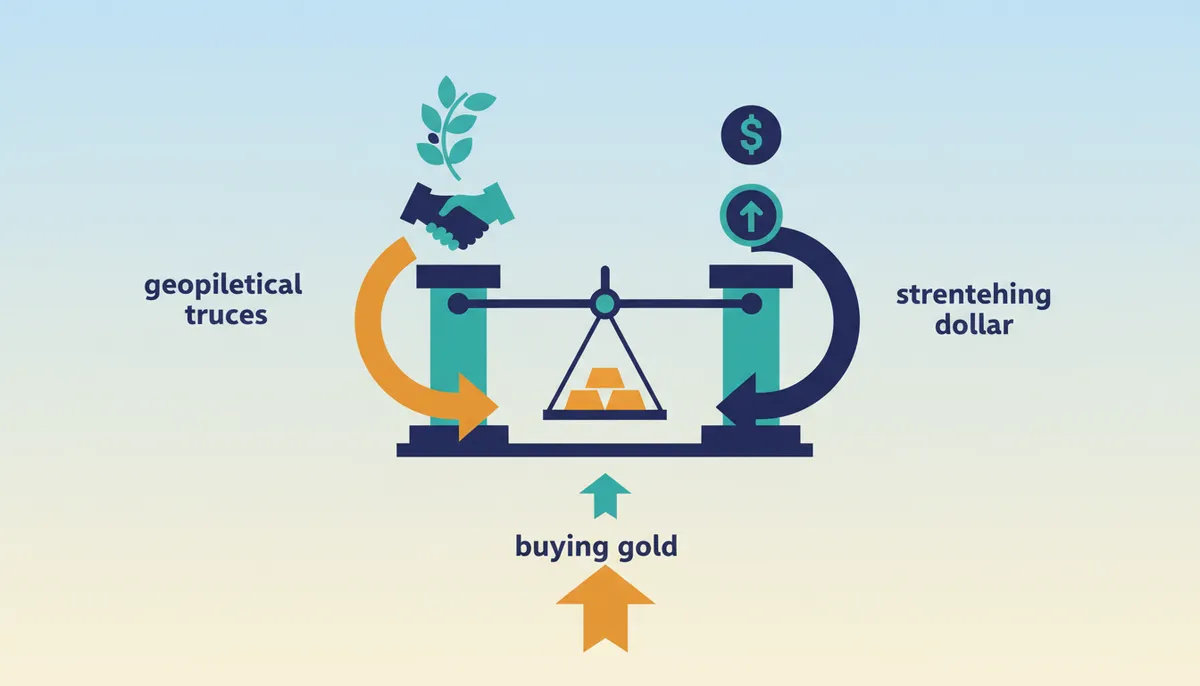
Traders asking should i buy gold after fed announcement must first weigh the fragility of the current Middle East tensions against a temporary diplomatic pause. The US and Iran agreed on a Memorandum of Understanding establishing a 60-day truce to discuss Tehran's nuclear program. This accord explicitly prohibits the acquisition of nuclear weapons, yet US President Donald Trump warned the deal remains non-final and threatened to resume bombing if Iranian behavior falters. Such conditional diplomacy often fails to sustain safe-haven premiums when monetary policy tightens.
| Factor | Geopolitical Impact | Market Reaction |
|---|---|---|
| MOU Status | Temporary 60-day pause | Reduced immediate fear premium |
| US Stance | Conditional threat of force | Volatility remains elevated |
| Fed Policy | Hawkish inflation fight | Dominates gold price action |
The hawkish Fed tilt frequently overrides geopolitical risk, causing gold to decline even as regional dangers persist. Investors often mistake a diplomatic truce for a resolution, ignoring that the Federal Reserve prioritizes domestic price stability over foreign conflicts. The market clearly discounts short-term diplomatic wins when real yields rise. Allocation strategies now require distinguishing between structural support levels and fleeting geopolitical noise. While the 60-day truce offers temporary stability, it lacks the permanence to counteract tight monetary conditions. The market currently prices in higher borrowing costs, making cash a superior holding until inflation data cools significantly. ForexCFD.top advises maintaining reduced exposure until the 100-period Simple Moving Average flattens. The tension between seeking safety and chasing yield dictates that gold remains a tactical hedge rather than a core holding during this tightening cycle. Only a decisive break of technical resistance validates a shift to accumulation.
Geopolitical Risk Premiums Versus Hawkish Fed Tilt Impact
Traders asking should i buy gold after fed announcement must recognize that monetary tightening currently overrides regional conflict. Despite a weekend uptick in Middle East tensions, the metal declined because markets prioritized the hawkish Fed tilt over safe-haven demand. The recent 60-day truce between the US and Iran further dampened geopolitical fear, even as Donald Trump warned the agreement remains fragile. This flexible reveals a structural shift where inflation fears suppress traditional flight-to-safety flows during diplomatic standoffs. Investors should note that safe-haven buying rarely materializes when real yields rise sharply, regardless of regional instability. The implication is clear: allocation strategies must weight central bank signals heavier than headline news cycles until inflation data cools. ForexCFD.top advises monitoring Core PCE releases closely, as these data points dictate the next substantial directional move more effectively than geopolitical headlines.
About
Sofia Mendes, Broker Reviews & Trading Education Editor at ForexCFD.top, brings a disciplined, risk-aware perspective to the recent volatility in Gold (XAU/USD). While her daily work focuses on vetting regulated brokers and crafting trading education materials, this rigorous approach to due diligence is necessary when analyzing market reactions to Federal Reserve policy shifts. As Kevin Warsh makes his debut amidst a hawkish tilt, retail traders face heightened execution risks and spread volatility. Mendes connects these macro events to practical trading realities, emphasizing how central bank decisions directly impact the safety and reliability of CFD platforms. Her analysis bridges the gap between high-level monetary policy and the specific needs of global retail traders in emerging markets. By applying her structured methodology for evaluating broker transparency and risk management, she ensures readers understand not just the price action, but the critical importance of trading with compliant providers during periods of significant market stress.
Conclusion
Gold's current vulnerability stems from a structural disconnect where rising real yields neutralize traditional safe-haven demand, forcing a recalibration of risk models that previously prioritized geopolitical instability. The persistent gap between Core PCE forecasts and the central bank's target creates an environment where cash equivalents outperform physical assets, imposing an ongoing operational cost on portfolios that maintain heavy exposure without technical confirmation. Investors must recognize that diplomatic truces offer only transient relief against the gravitational pull of monetary tightening, meaning any rally lacking fundamental inflation cooling is likely a liquidity trap rather than a trend reversal.
Traders should strictly limit new long positions until price action sustains above the $4,300 resistance level, as breaking this barrier is the sole validator for a bullish shift in this high-rate regime. Until inflation data cools sufficiently to alter the Fed's trajectory, gold remains a tactical hedge rather than a core wealth store. The immediate priority is to audit current exposure levels against the 100-period Simple Moving Average this week. Reducing use now prevents forced liquidation if the metal tests lower support zones near $4,015. Discipline in waiting for confirmed technical breaks outweighs the temptation to front-run potential geopolitical escalations that the market has already discounted.
Frequently Asked Questions
Buyers must push prices above $4,300 to negate the current bearish structure. Failure to clear this hurdle keeps sellers in control as momentum remains sour.
Core PCE forecasts sit at 3.3%, which is 1.3% above the central bank goal. This gap reinforces the higher-rate outlook driving the recent gold collapse.
A drop below $4,200 opens the door to test the June 11 swing low of an undisclosed amount This move would bring prices dangerously close to the psychological $4,000 mark.
The median forecast for the Fed Funds Rate has climbed to 3.8% by period end. This projection drives tighter policy expectations that hurt non-yielding assets like gold.
Retail sales rose 0.9% month-over-month, beating the 0.5% forecast and showing consumer resilience. This strength supports the case for continued policy tightening by the Fed.
References