
Inflation core rises to 2.6% despite oil relief
Eurostat reports May 2026 inflation rising to 3.2%. The anticipated drop to 3.0% is far from guaranteed, even with falling oil costs. Commerzbank analysts argue energy relief should drive headline inflation down, but persistent core inflation pressures suggest the European Central Bank will maintain its hawkish stance. HICP metrics distort the true picture of price stability when core inflation climbs to 2.6% even as headline figures fluctuate. Commerzbank data shows oil price dynamics near pre-war levels reduce tail risks but fail to curb building price pressure in the services sector. ECB official Isabel Schnabel warns that energy price shocks can still feed broader inflationary dynamics, undermining hopes for a rapid return to the target.
A disconnect exists between AI-driven productivity gains, which the European Central Bank estimates could boost output by over 4%, and the immediate reality of sticky consumer prices. Firm-level studies suggest AI adoption increases employee productivity by three percentage points, yet these structural benefits remain too distant to influence current rate decision drivers. Energy accounts for only 11% of the index, while food, alcohol, and tobacco represent 21%. Headline inflation includes all components, making it volatile due to energy swings. Core inflation excludes energy and food to reveal underlying pressure trends. Recent data illustrates this divergence clearly. Conversely, core inflation increased from a modest rate to 2.6% in the same period.
Relying on headline improvements risks premature policy easing. The European Central Bank (ECB) prioritizes the stability of the larger services basket over short-term energy-driven headline drops. Monetary tightening remains the default stance until core metrics decisively break downward. Misinterpreting a headline dip as a core victory invites a renewed inflationary spiral. Treat national early warns as volatile noise rather than definitive trend reversals. Only sustained core deceleration validates a hawkish pivot.
Mechanics: Volatility Risks from Temporary Oil Price Relief
Declining energy costs mask persistent price pressure because Services constitute nearly half of household spending. Headline figures often drop sharply when oil prices normalize, creating a false impression of resolved inflation. This temporary relief obscures the reality that core metrics remain elevated due to structural rigidity in the services sector. Relying on volatile energy components to judge monetary policy success ignores the dominant weight of non-energy sectors.
The composition of the consumption basket dictates that service sector inertia drives long-term outcomes more than transient fuel costs. This gradual trajectory confirms that temporary energy dips do not equate to sustained price stability.
Real GDP growth forecasts of just 1.0% illustrate the stagflationary tension where sluggish output coexists with stubborn price rises. This slow growth environment limits the central bank's ability to wait out inflation without causing deeper economic contraction. The Euro area faces a dilemma where suppressing service-sector inflation demands tighter policy than weak growth can sustain.
Falling energy costs do not equate to resolved inflationary pressure. Monitor service-sector wage data rather than headline energy swings for accurate trajectory assessment. The sheer size of the services basket ensures that even modest price increases there negate larger percentage drops in energy. Until service price momentum breaks, disinflation remains incomplete despite favorable commodity markets.
Oil price upticks at the week's start could overcast national consumer price reports with false disinflation signals. Temporary drops in energy costs create a deceptive headline inflation reading that masks persistent upstream pressure. Services constitute the largest share of household final monetary consumption expenditure, meaning their sticky pricing power dominates the long-term trajectory. A sudden reversal in oil markets would immediately expose this fragility, causing volatility that temporary relief cannot buffer.
The risk lies in the divergence between volatile energy inputs and rigid service costs. Policymakers monitoring the Vanguard European Macro Model understand that supply shocks feed through to growth and prices with varying lags. If oil prices rebound, the brief window of perceived stability vanishes, forcing a recalculation of rate expectations.
| Component | Price Behavior | Inflation Impact |
|---|---|---|
| Energy | Highly Volatile | Temporary headline suppression |
| Services | Structurally Rigid | Persistent core elevation |
| Food | Weather Dependent | Unpredictable upside spikes |
Guntermann notes that although oil prices near pre-war levels reduce tail risks, inflation is likely not coming down quickly enough to dispel ECB hawkishness. The European Central Bank (ECB) remains sensitive to second-round effects where temporary energy dips fail to anchor long-term expectations. Reliance on transient oil performance introduces a specific tail risk for growth forecasts. Real GDP growth projections remain constrained because uncertainty prevents capital deployment. The Conference Board forecasts indicate that elevated uncertainty continues to dampen economic expansion despite energy price normalization.
ECB Monetary Policy Stance and Rate Decision Drivers
Defining ECB Hawkishness Amid Sticky Services Inflation
Falling energy costs fail to offset persistent price pressures in services inflation, a flexible that currently defines ECB hawkishness. Schnabel warns that an energy price shock can feed into broader inflationary dynamics, complicating the path to stability. This divergence exists because Services constitute the bulk of the basket. Even if headline figures drop, the dominant weight of this sector keeps aggregate metrics elevated. Guntermann observes that inflation is not falling fast enough to dispel this cautious approach despite lower oil prices. Relying on energy relief ignores the structural rigidity of non-energy components. Core inflation remains sticky as food, goods, and service inflation face upside risks. A potential 50 basis points cumulative increase in rate expectations reflects this reality rather than temporary headline fluctuations. Policy tightness persists until the bulk of the consumption basket stabilizes. Ignoring the stability-oriented monetary policy strategy historical context leads to mispricing of rate duration risks. Operators must anticipate continued volatility as the ECB prioritizes broad disinflation over temporary energy-driven dips.
National statistical agencies release lower June headline readings in Spain and Belgium days before the aggregate report, allowing traders to position ahead of the official European Central Bank data drop. These figures act as the primary leading indicator for broader Euro area HICP trends. This timing gap creates a predictable window where early national prints drive immediate market repricing of rate expectations. Market pricing assumptions noted a cumulative increase of 50 basis points over 2026 relative to pre-war levels in the baseline scenario for inflation. Operators weigh this aggressive curve against the reality that energy-driven headline drops often mask sticky upstream pressures. The Eurosystem staff macroeconomic projections foresee annual average real GDP growth of just 0.8% in 2026, highlighting the stagflationary tension that complicates policy normalization.
The dominance of non-energy components means a transient oil dip cannot single-handedly secure a dovish pivot. Guntermann observes that while oil prices near pre-war levels reduce tail risks, inflation is not falling fast enough to dispel ECB hawkishness. Reliance on early national data without adjusting for services inertia leads to premature long-duration positioning that volatility quickly erodes.
Application: Oil Price Volatility Risks Overshadowing Disinflation Progress
Weekly oil price upticks could overcast the message from national consumer price reports, a fact traders questioning if they should expect ECB rate cuts must recognize. Guntermann compares the current situation to unstable weather, noting that while the hottest spell is likely over, trends remain volatile before stabilizing at comfortable levels. This instability creates a specific risk where temporary energy spikes obscure underlying disinflationary progress in the broader economy. The Harmonised Index of Consumer Prices relies on weighted aggregates, yet market focus often fixates narrowly on the Energy component rather than the dominant services sector. A sudden reversal in crude valuations would immediately expose this fragility, causing volatility that temporary relief cannot buffer. The Services sector constitutes the largest share of household final monetary consumption expenditure, meaning its sticky pricing power dominates the long-term trajectory. Consequently, even if headline figures drop due to cheaper fuel, the dominant weight of this sector keeps aggregate metrics elevated.
Upside Risks to Disinflation Trends from Geopolitical Instability
Defining Upside Risks to Disinflation from Geopolitical Shocks
This mechanism exploits the heavy weighting of Services within household consumption, where sticky pricing power dominates long-term trajectories despite volatile energy inputs. The specific risk involves a geopolitical escalation in the Middle East causing oil upticks that overcast national consumer price reports.
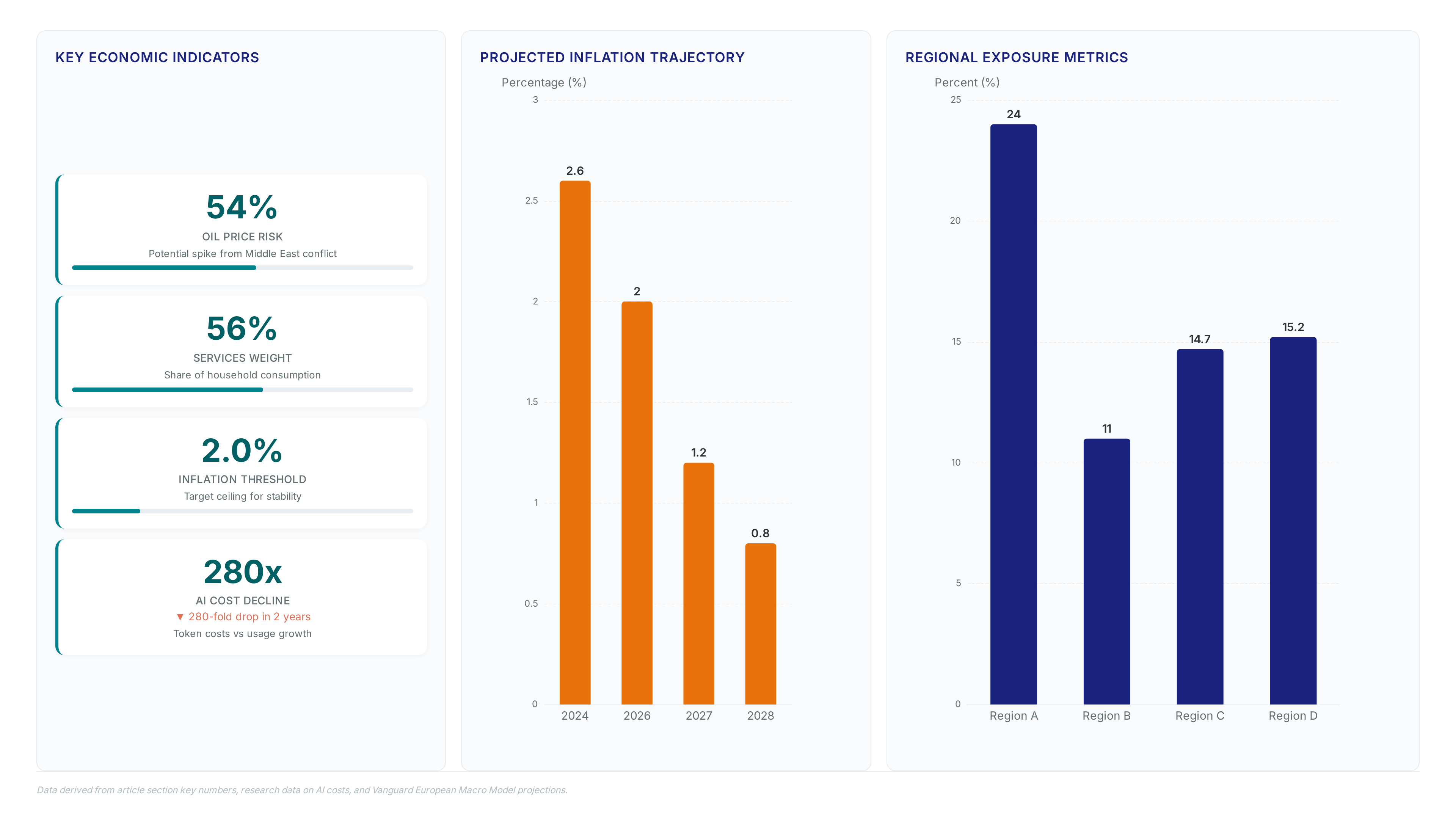
Such a shift would validate hawkish stances by demonstrating how transient energy drops fail to anchor expectations.
- Persistent Core Pressure: Food, goods, and service inflation face distinct upside risks independent of crude valuations.
- Expectation Anchoring: A sudden spike disrupts the fragile confidence required for wage moderation in the services sector.
- Policy Lag: The European Central Bank cannot easily distinguish transient noise from structural shifts without prolonged data stability.
- Transmission Delays: Falling oil costs often fail to transmit quickly enough to the broader economy, leaving aggregate metrics elevated.
Relying on headline relief masks the underlying fragility of the disinflation process. Lower crude prices might drive the aggregate rate down, yet this metric ignores the structural weight of non-energy components. The Harmonised Index composition ensures that services constitute the largest share of expenditure, meaning their sticky pricing power dominates the trajectory. Monitor national prints for early signs of this reversal rather than trusting aggregate calm. Structural rigidity means falling oil costs fail to transmit quickly enough to the broader economy, leaving aggregate metrics elevated despite headline improvements. The Vanguard European Macro Model uses Bernanke-Blanchard equations to demonstrate how labor market slack directly links wage demands to persistent price pressures. The limitation lies in the composition of household spending, where Services dominate over volatile energy components. Even with stable crude prices, the sheer weight of this sector prevents rapid disinflation. Guntermann notes that trends remain unstable, implying that temporary relief does not equate to structural resolution.
Hidden costs of this feedback loop include:
- Delayed monetary easing cycles despite headline drops.
- Increased borrowing costs for capital-intensive industries.
- Reduced consumer purchasing power in non-energy sectors.
- Elevated long-term yield curves reflecting sustained uncertainty.
- Compressed profit margins for retailers unable to pass on full costs.
Operators modeling rate paths must recognize that HICP aggregates mask underlying service-sector heat. Stress-test portfolios against scenarios where core inflation remains stubborn despite energy price collapses. The risk is not a spike, but a plateau that keeps real rates restrictive longer than markets price. Analysts use this regional divergence to distinguish between temporary energy dips and structural price stickiness within the services sector.
- Rising food costs threaten to negate headline relief from falling oil prices.
- Geopolitical breaches in the Middle East introduce sudden upside volatility to transport fuels.
- Wage negotiations in labor-intensive industries sustain pressure on final consumer costs.
- Supply chain bottlenecks for non-energy industrial goods delay pass-through effects.
- Housing component adjustments lag notably behind other CPI categories.
Guntermann notes that while tail risks recede, the disinflation path remains unstable due to these entrenched dynamics. The limitation of relying on early national data is its inability to capture broad-based second-round effects from food, goods and service inflation facing upside risks. Market participants pricing in aggressive easing ignore the reality that core pressures require more than favorable energy markets to resolve. Monitor the divergence between national CPI prints and aggregate Eurostat releases to forecast genuine trend reversals accurately.
About
Vikram Nair, Emerging Markets & Asia FX Writer at ForexCFD. Top, brings a distinct global perspective to the analysis of Euro area HICP dynamics. While his daily work focuses on emerging-market currencies and central bank policies in Asia and Africa, this broad macroeconomic coverage requires rigorous tracking of substantial developed market drivers like the European Central Bank (ECB). Understanding how oil-driven inflation relief impacts the Euro area is critical, as ECB hawkishness directly influences global capital flows and currency volatility affecting his core beat. At ForexCFD. Top, an independent publication dedicated to factual market news, Nair applies his expertise in cross-border monetary policy to dissect how Eurostat data and falling energy prices reshape the trading environment. His analysis connects complex inflation outlooks to actionable insights for retail traders, ensuring that even region-specific European data is contextualized within the broader, interconnected framework of global FX majors and commodity markets.
Conclusion
Falling energy costs will not drive broad disinflation when core pressures stem from domestic wage dynamics and service sector rigidity. The widening gap between headline relief and sticky core inflation signals that monetary policy will remain restrictive far longer than current yield curves suggest, specifically because labor-intensive industries cannot absorb rising input costs without passing them to consumers. Do not bet on a V-shaped recovery in purchasing power; instead, assume a prolonged plateau where borrowing costs erode use-dependent strategies. The market's expectation of aggressive rate cuts ignores the reality that food and service inflation create a self-sustaining cycle that energy volatility alone cannot break.
Start this week by auditing your fixed-income exposure to peripheral Eurozone debt, specifically stress-testing portfolios against a scenario where core inflation holds above 2.5% through Q4 2026.
Frequently Asked Questions
Core inflation reveals persistent pressure better than volatile headline data. Services constitute 42% of the basket, driving core inflation to 2.6% while headline rose to 3.2%, signaling the ECB will likely maintain restrictive rates longer.
Energy accounts for only 11% of the index, limiting its total impact. Although energy drops help, services represent 42% of the basket, meaning sticky service prices keep overall inflation elevated despite temporary relief in fuel costs.
The European Central Bank aims to return inflation to its 2% target eventually. However, with core inflation rising to 2.6% and services driving price pressure, policymakers warn that reaching this goal requires sustained effort beyond temporary energy price declines.
Rising service costs offset falling energy prices because services drive household spending. While headline inflation hit 3.2%, core inflation increased to 2.6%, demonstrating that the larger services component dominates the long-term inflationary trajectory for the euro area.
Analysts expect headline inflation to drop to 3.0% if national trends continue. Additionally, core inflation might slip to 2.5%, though the outlook remains unclear due to building price pressures within the critical services sector across the region.