
Inflation mandate locks Fed out: 14 of 19 see zero cuts
With 14 of 19 FOMC participants projecting zero or one rate cut, the Federal Reserve has officially abandoned immediate relief. The era of accommodative monetary policy is dead. A rigid commitment to the 2% inflation target now prioritizes price stability over market comfort. Warsh's dismissal of any goal revision until inflation is "delivered" signals a sharp departure from his nomination narrative, effectively ending hopes for rapid easing. Markets priced in a modest share of cuts by year-end, contradicting earlier expectations for aggressive moves. The transmission was violent: the S&P 500 dropped 1.4% and US 2-year yields surged 17 basis points immediately following the announcement.
This shift reflects a broader macroeconomic trend where substantial central banks maintain rates well above pre-COVID norms to combat persistent price pressures. The narrow confirmation margin and the unanimous vote to hold the interest rate on reserve balances at 3.65 percent illustrate the political and economic fortitude required to sustain this restrictive stance. This is not a temporary pause but a deliberate recalibration of modern monetary orthodoxy.
The Primacy of the 2% Inflation Mandate in Modern Monetary Policy
Defining the Fed's 2% Inflation Mandate Under Warsh
Fed Chair Warsh prioritizes the 2% inflation mandate as a statutory price stability definition, placing it above employment metrics following his swearing-in on May 22, 2026. He stated explicitly that inflation runs "well ahead" of the target, refusing to revisit the goal until delivery occurs. This rigid stance clashes with market pricing for rate cuts, creating immediate volatility in bond yields. The technical framework relies on the Summary of Economic Projections, which tracks real GDP growth and unemployment ranges quarterly. Current projections indicate a median federal funds rate of 3.4% by year-end 2026, reflecting a single 25-basis-point reduction rather than the multiple cuts previously anticipated. Infrastructure cost inflation complicates this path, with producer prices for steel and aluminum surging over 20% year-over-year according to industry analysis. The FOMC June 2026 dot plot confirms this hawkish shift, showing 14 of 19 participants expecting zero or one cut. Price stability now supersedes growth accommodation, altering liquidity conditions for all asset classes. The cost of this singular focus is measurable in reduced forward guidance flexibility for the central bank.
Applying Price Stability: Warsh's Shift From Campaign Rhetoric
The FOMC June 2026 dot plot confirms a hawkish pivot where price stability overrides employment mandates. This stance manifests in the Summary of Economic Projections, where 14 out of 19 participants projected zero or one rate cut. Such tight consensus forces bond markets to price higher-for-longer yields immediately. Operators must note that 3.65% interest on reserve balances now anchors short-term funding costs firmly. Unlike previous cycles, the central bank accepts equity volatility to crush inflation persistence. Warsh's refusal to compromise signals that future dot plot updates will likely maintain this restrictive bias. Consequently, liquidity planning must account for sustained high borrowing costs rather than imminent relief.
March vs June 2026 Dot Plot: Quantifying the Hawkish Pivot
The June 2026 projection reveals a stark compression in rate cut expectations compared to earlier forecasts. In March 2026, only seven members anticipated one or two cuts, whereas the June update shows 14 members projecting zero or one cut. This numerical shift quantifies Fed Chair Warsh's prioritization of the inflation mandate over growth concerns.
| Period | Members Expecting ≤1 Cut | Policy Implication |
| March 2026 | 7 | Moderate easing bias |
| June 2026 | 14 | Aggressive hold stance |
The Summary of Economic Projections drives this pivot by forcing individual accountability for inflation forecasts. Data indicates US GDP growth is projected at a modest rate while inflation remains elevated at 3.6%. However, this hawkish clustering reduces flexibility if labor markets deteriorate rapidly. Unlike previous cycles, the central bank accepts higher unemployment risk to anchor price stability. Network operators must note that bond yield volatility, seen in the 17 basis point rise in 2-year yields, directly increases capital costs for infrastructure debt. The dot plot now serves as a rigid constraint rather than a flexible guide. Market participants misinterpreting this strategic shift face immediate repricing risks in fixed-income portfolios. The divergence between employment mandates and price stability goals creates a fragile equilibrium for Q4 2026 planning.
Decoding the FOMC Dot Plot and Forward Guidance Mechanisms
How the June 2026 Dot Plot Signals Rate Paths
The June 2026 dot plot aggregates individual FOMC participant submissions into a median path showing 3.8% as the year-end target. This visualization relies on the Summary of Economic Projections framework, which compiles ranges for real GDP and unemployment alongside inflation estimates. Operators interpret this data by identifying the central tendency rather than the mean, as outliers skew average expectations significantly.
- Participants submit anonymous projections for the federal funds rate.
- The FOMC June 2026 meeting consolidates these dots into a public chart.
- Market algorithms parse the median to price bond yields instantly.
| Variable | Projection Type | Data Source |
|---|---|---|
| Federal Funds Rate | Median Dot | FOMC Participants |
| Real GDP Growth | Range Center | SEP Framework |
| Unemployment Rate | Central Tendency | Quarterly Update |
Governor Stephen Miran voted against the consensus, preferring a quarter-point cut while the majority held firm. This dissent highlights a policy tension where internal disagreement exists despite the outwardly unified median signal. The cost of misreading this median projection is immediate portfolio repricing, as seen when US 2-year yields jumped to 4.21%. Unlike origin-only validation in routing protocols, the dot plot validates the entire committee stance, creating a single point of failure if the median shifts abruptly. Network liquidity providers must treat the SEP framework updates as critical configuration changes rather than advisory notes. Ignoring the specific distribution of dots behind the median leaves firms exposed to volatility spikes when new data arrives.
Overreliance on the median dot projection obscures the fragility introduced by Governor Stephen Miran, the sole dissenter voting for a rate cut during the FOMC June 2026 meeting. Warsh confirmed his chairmanship by the narrowest margin in history, creating a precarious policy foundation where a single vacancy could flip the median outcome. The mechanism here involves the Summary of Economic Projections, which aggregates individual member inputs into a public signal that markets treat as binding guidance.
| Risk Factor | Operational Consequence |
|---|---|
| Single Dissenter | Signals internal division on inflation vs. growth priorities. |
| Narrow Confirmation | Creates vulnerability to membership changes. |
| Median Reliance | Masks underlying distribution risks. |
Traders parsing Fed statements often miss that the unanimity of the majority is an illusion maintained only by the current committee composition.
Market Transmission Channels from Hawkish Fed Rhetoric to Asset Prices
Defining the Transmission Channel from Hawkish Rhetoric to Yields

Market pricing shifted instantly to 40 bps of hikes, rising from 21 bps before the meeting. This repricing forces the 2-year yield to lead volatility, jumping 17 bps while the 10-year lagged with a smaller rise. Such front-loading occurs because operators now anticipate a "simultaneous hold" among substantial central banks rather than the global easing seen recently. The shift reflects a transition where Fed policy diverges from peers, moving away from the environment where most institutions were cutting rates. However, this aggressive stance creates a tension with global liquidity, as other regions like Europe faced different pressures requiring distinct insurance rate hikes.
Amazon shares fell 3.5% as traders priced a simultaneous hold across substantial central banks. Target dropped 4.3% when the press conference confirmed price stability remains the sole priority over growth support. Consumer discretionary equities react violently to hawkish rhetoric because high rates compress future earnings valuations more than industrial sectors. The mechanism involves immediate duration compression where algorithms sell long-duration cash flows first. Data shows selling accelerated only after the Chair's verbal confirmation, distinguishing this from typical statement-driven volatility. However, the equity decline ignores that 1.4% S&P losses may already reflect the new terminal rate reality. Ignoring the shift from global easing to a simultaneous hold risks underestimating the duration of elevated borrowing costs. Operators must recognize that rate shock transmission now bypasses traditional lag indicators due to algorithmic sensitivity to Fed language. The implication is clear: portfolios heavy in consumer discretionary names require immediate duration hedging rather than waiting for quarterly earnings revisions. Adjusting asset allocation post-meeting demands analyzing the dot plot shifts rather than headline inflation numbers alone.
Comparing USD Strength Against GBP and JPY Volatility
Currency volatility diverged sharply as the pound dropped to 1.3280 from 1.3400 while the yen limited losses. This disparity highlights how regional policy stances dictate market reaction magnitude rather than broad dollar strength alone. Traders struggled with prediction accuracy because the Federal Reserve favored delayed normalization, contrasting with expectations for other central banks to implement insurance hikes.
| Currency | Move Type | Magnitude |
|---|---|---|
| GBP | Drop | 120 pips |
| JPY | Drop | 20 pips |
| EUR | Drop | >100 pips |
The Bank of England approach differs significantly from the Fed, creating asymmetric pressure on sterling versus yen. While the Fed uses the dot plot to signal individual policymaker views, the European Central Bank faces distinct inflation pressures requiring quicker action. This policy gap explains why the yen showed relative stability despite broad USD buying. Operators must note that yield curve shifts often precede these currency moves, yet the timing remains inconsistent across pairs. Relying solely on headline inflation data ignores the detailed transmission channels where liquidity facilities impact specific regions differently. The divergent paths suggest that future volatility will cluster around policy announcement windows rather than macro data releases. Prediction models failing to account for these structural differences will continue to underestimate cross-asset correlation breakdowns during hawkish surprises.
Strategic Implications of a Pro-Stability Fed Chair for Investors
Defining the 2010 Hawkish Warsh Persona Versus Campaign Rhetoric
The curt statement finishing on price stability confirms the arrival of the 2010 hawkish version of Warsh. This demeanor contradicts the candidate who campaigned sounding like Stephen Miran, a dovish figure now isolated as the sole dissenter for cuts. The shift eliminates ambiguity regarding the Fed Chair priority, moving decisively away from growth support.
| Aspect | Campaign Persona | Governing Reality |
|---|---|---|
| Primary Goal | Rate Reduction | Price Stability |
| Tone | Accommodative | Curt and Direct |
| Alignment | Stephen Miran | 2010 Hawkish Wing |
Investors adjusting portfolios must recognize that the narrowest margin in history confirming Warsh creates a fragile consensus vulnerable to single vacancies. The mechanism driving this volatility is the abrupt closure of the easing narrative, forcing immediate duration compression across equity valuations. However, relying on historical dot plot transparency assumes consistent member attendance, a risk given the precarious confirmation vote count. The implication for operators is clear: strategies betting on rate cuts face structural headwinds until inflation data aligns with the 2.0% target. The market now prices stability over liquidity, demanding a recalibration of risk models that previously assumed dovish intervention.
Applying AI Efficiency Metrics to Counteract Rising Fed Service Costs
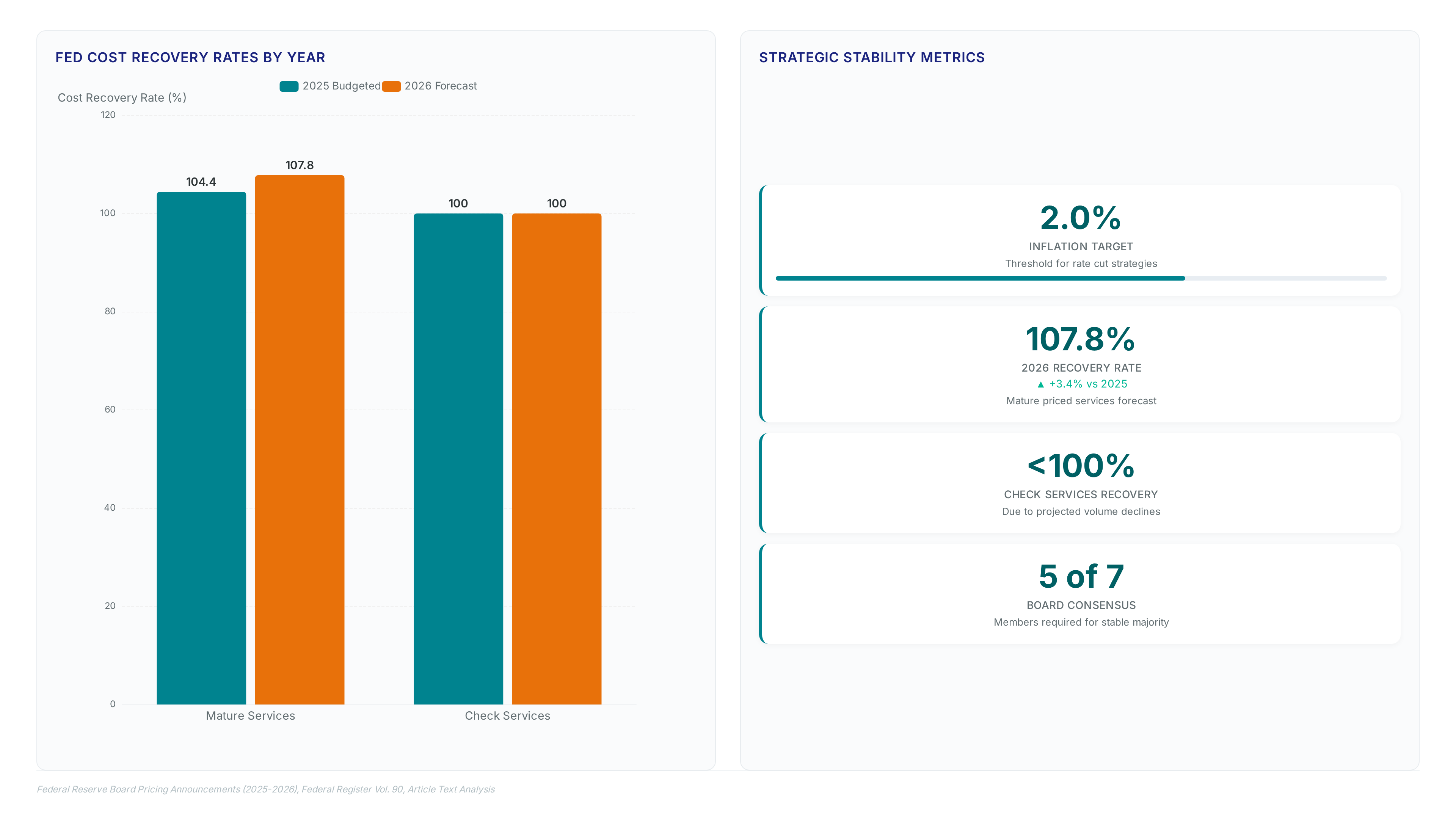
Operational deficits emerge immediately as the Federal Reserve targets a cost recovery rate of 107.8 percent for mature priced services in 2026. Financial institutions counter these rising infrastructure fees by deploying artificial intelligence to compress labor hours into milliseconds. Research indicates that 50% of financial service enterprises have actively integrated such automation tools. JPMorgan Chase demonstrated this efficiency by analyzing 12,000 commercial credit agreements in seconds, a task previously requiring 360,000 hours of manual review. This operational use offsets the tangible impact of the central bank's price stability mandate on service costs. However, the capital expenditure required for AI deployment creates a barrier for smaller regional banks lacking scale. The limitation is clear: only large institutions can afford the upfront technology spend needed to neutralize regulatory fee hikes. Investors must therefore distinguish between banks with existing automation maturity and those facing margin compression from both rate hikes and increased service fees. When to expect rate hikes matters less than whether a bank can automate its way out of the resulting cost pressure. The divergence in profitability trajectories will depend entirely on this technological offset capability.
Risk of Overlooking Cross-Shipped Volume Fee Increases in April 2026
Institutional liquidity faces immediate erosion from the April 1, 2026 fee increase on bundles of cross-shipped volume exceeding the de minimis threshold. This infrastructure cost hike operates independently of the federal funds rate, creating a hidden drag on high-frequency arbitrage strategies that rely on thin margins. The Federal Reserve implemented these pricing changes to recover indirect costs, distinguishing this move from standard monetary policy adjustments.
| Cost Factor | Impact Scope | Operator Response |
|---|---|---|
| Cross-shipped volume fees | High-frequency traders | Reduce settlement frequency |
| Direct cost recovery | All payment users | Upgrade routing logic |
| De minimis threshold | Large institutions | Consolidate transaction batches |
Portfolios requiring rebalancing after the Fed meeting must account for this non-interest expense, which compresses net yields on cash equivalents. The limitation is that smaller regional banks lack the technological scale to optimize around these payment services charges as effectively as global counterparts. Ignoring this operational friction leads to inaccurate yield projections for the remainder of 2026.
About
Vikram Nair, Emerging Markets & Asia FX Writer at ForexCFD. Top, brings critical perspective to the Federal Reserve's inflation mandate through his specialized lens on global monetary interconnectivity. While his daily work focuses on RBI policy and emerging market pairs like USD/INR and USD/NGN, these assets are disproportionately sensitive to Fed Chair Warsh's hawkish pivot. Nair's expertise lies in tracing how strict price stability goals in Washington trigger capital flows that destabilize Tier-2 and Tier-3 currencies. At ForexCFD. His background in analyzing regional funding rails and local broker landscapes ensures this coverage connects high-level FOMC projections directly to tangible trading realities in Asia and Africa, avoiding hype while clarifying complex macroeconomic shifts.
Conclusion
The structural break occurs when operational friction from rising infrastructure fees outpaces the yield benefits of a 3.4% terminal rate environment. While markets fixate on headline inflation metrics, the real erosion of capital happens through these obscure, non-interest expense lines that disproportionately penalize institutions lacking automated routing logic. The divergence in profitability will not stem from interest rate sensitivity alone, but from an institution's ability to technically bypass the de minimis thresholds now embedded in the payment system. Operators must recognize that holding excess liquidity without optimizing settlement frequency creates a silent drag that compound interest cannot overcome.
Adopt a strict protocol by Q4 2027 to audit all cross-shipped volume exposures against the new 2026 fee schedules. Any entity moving significant daily settlement volume must implement batch consolidation algorithms immediately to avoid margin compression that exceeds 15 basis points annually. Do not wait for the April implementation date to adjust your treasury workflows. Start by mapping your current transaction granularity against the specific de minimis thresholds this week to identify immediate leakage points before the regulatory window closes.
Frequently Asked Questions
Warsh prioritized price stability over employment, shocking markets. The S&P 500 dropped 1.4% immediately after his hawkish comments confirmed no immediate rate relief.
The median federal funds rate is projected at 3.4% by year-end. This reflects a single cut, contradicting earlier hopes for multiple reductions in the current cycle.
Producer prices for steel and aluminum surged over 20% year-over-year. These rising input costs make the Fed's rigid 2% inflation target significantly harder to achieve quickly.
Operators must note that 3.65% interest on reserve balances now anchors short-term funding. This unanimous vote confirms the Fed's commitment to a restrictive monetary policy stance.
US 2-year yields jumped to 4.21% following the announcement. This sharp rise directly increases capital costs, signaling that higher-for-longer rates are the new baseline.