
EUR/USD pair faces Middle East tension risks
The EUR/USD pair holds steady near 1.1385 as traders weigh a hawkish Federal Reserve debut against Middle East tensions. HICP inflation data dictates ECB strategy, while Kevin Warsh's policy shift supports the US Dollar. Measuring trading ROI now requires watching oil prices as closely as central bank calendars.
Market stability remains fragile following reports that the US and Iran will stand down after exchanging fire near the Strait of Hormuz. While CNN notes planned talks in Doha, Iran's Foreign Minister Abbas Araghchi warns that bypassing Tehran's preferred route invites escalation. These geopolitical flashpoints stoke inflation pressures, yet currency markets currently fixate on monetary policy rather than conflict.
A surprisingly hawkish debut by new Fed chair Kevin Warsh has reversed expectations for US rate cuts, providing near-term support for the US Dollar. Conversely, all eyes turn to Christine Lagarde as she opens the ECB annual forum. Her speech must address the balance between lower oil prices and stock market volatility without committing to premature tightening. Understanding these monetary policy nuances is necessary for navigating an environment where traditional safe-haven flows compete with yield differentials.
The Role of the Euro and HICP in Modern Forex Markets
Euro Definition and ECB Price Stability Mandate
Legal tender for 20 European Union members comprising the Eurozone, the Euro is a heavyweight. In 2022, it accounted for 31% of all foreign exchange transactions, with an average daily turnover of over $2.2 trillion a day. The EUR/USD pair alone constitutes a significant portion of global volume, dwarfing secondary crosses like EUR/JPY.
The European Central Bank (ECB) operates under a strict mandate to maintain price stability. Policymakers define this objective as controlling inflation primarily through interest rate adjustments. Unlike dual-mandate central banks, the ECB focuses singularly on purchasing power preservation rather than employment targets.
ECB rate decisions occur eight times yearly via the Governing Council. Policymakers vote based on HICP readings relative to the 2% target. This framework creates a volatile environment for Euro denominated assets during oil price spikes.
HICP Inflation Data Driving EUR/USD Forex Volatility
The Harmonized Index of Consumer Prices serves as the primary inflation gauge triggering ECB rate adjustments. When this metric exceeds the central bank's target, policymakers face immediate pressure to tighten monetary conditions, directly influencing the EUR/USD exchange rate. Markets react swiftly to these releases because higher interest rates attract foreign capital seeking yield. Traders monitoring geopolitical developments note that tensions have continued to stoke inflation pressures, creating volatility linked to energy costs.
Headline inflation driven by energy costs often clashes with core price stability. The ECB must distinguish between transient supply shocks and persistent inflationary trends before altering policy. Misreading a temporary spike as structural leads to premature rate hikes that stifle growth unnecessarily. Conversely, ignoring sustained pressure erodes purchasing power and currency value.
Recent market behavior illustrates this sensitivity. The pair has shown rapid recalibration of rate expectations in response to data. Analysts project exchange rate movements if divergence persists. Operators should weigh HICP figures against broader economic indicators like GDP and employment data. A complete view prevents overreaction to noisy prints.
EUR/USD vs EUR/JPY Transaction Volume Share
EUR/USD liquidity concentration creates a structural disparity where order flow exceeds secondary crosses by an order of magnitude. While the Euro represents a significant portion of global turnover, the EUR/JPY pair captures a mere fraction of that volume, resulting in wider spreads during volatility.
| Pair | Transaction Share | Liquidity Profile |
|---|---|---|
| EUR/USD | 30% | Deep, tight spreads |
| EUR/JPY | 4% | Moderate, gap risk |
| EUR/GBP | 3% | Regional, event-driven |
The EUR/USD pair is the most heavily traded currency pair in the world, accounting for an estimated 30% of all transactions, while EUR/JPY accounts for approximately 4%. The Eurozone economy relies heavily on exports from Germany and France, yet the trading infrastructure favors the dollar pairing overwhelmingly.
Execution certainty defines the limitation here; EUR/USD accounts for the vast majority of foreign exchange transactions compared to other Euro pairs. Liquidity is not uniform, and assuming equal market depth across all Euro pairs is a costly error.
Inside EUR/USD Price Drivers and Central Bank Divergence
Defining ECB vs Fed Policy Divergence Mechanics
Policy splits arise when the Federal Reserve shields growth from geopolitical friction while the European Central Bank tightens to crush inflation. American officials prioritize capital flow stability during bilateral crises. European leaders sacrifice expansion to anchor price expectations. This mechanical divergence creates a trading environment where European inflation fears supersede the growth protection guiding American decisions. Stagflation triggered by energy shocks haunts the euro area, whereas the Fed navigates a conventional constraint between output and prices.
| Feature | Federal Reserve (Fed) | European Central Bank (ECB) |
|---|---|---|
| Primary Reaction | Accommodative stance | Contractionary approach |
| Trigger Event | Bilateral risk shocks | Heightened inflation concerns |
| Underlying Driver | Capital flow protection | Price stability mandate |
| Growth Impact | Supports consumption | Risks persistent negative effect |
Reduced private investment in the euro area quantifies the cost of this split. Supply-driven oil price increases transmit directly to consumer bills, forcing the ECB to reject the growth-supportive stance favored by the Fed. Operators tracking EUR/USD must recognize that these oil spikes erode private consumption and investment persistently. Market participants price a hawkish Fed relative to the ECB as long as the interest rate differential holds. Supply-driven oil price increases specifically degrade the purchasing power base the ECB guards. Traders watch for signs that energy costs continue to drain household budgets across the continent.
Applying Warsh and Lagarde Signals to EUR/USD Trades
Mapping verbal cues from Kevin Warsh and Christine Lagarde to entry points defines the strategy. A surprisingly hawkish debut from Warsh as Federal Reserve chair reversed expectations for rate cuts, pushing the US Dollar higher immediately. This shift contradicts earlier accommodative rhetoric seen during bilateral geopolitical risk shocks. Lagarde opens the ECB annual forum on Monday while markets scan for deviations from the bank's contractionary stance on price stability. Her tone dictates whether the shared currency finds support or faces further selling pressure.
| Signal Source | Expected Tone | Currency Impact |
|---|---|---|
| Kevin Warsh | Hawkish / Restrictive | Strengthens USD |
| Christine Lagarde | Data-Dependent | Supports EUR if firm |
Operationalizing these signals demands close attention to the June employment data release alongside central bank commentary. Strong economic figures may encourage the ECB to raise interest rates, directly strengthening the Euro, whereas weak data could trigger a decline. Persistent inflation drivers linked to global supply chains complicate this correlation because energy geopolitics force the ECB to maintain tight policy despite growth risks. Research indicates that supply-driven oil price increases negatively affect euro area growth by reducing private consumption. To address elevated uncertainty, the ECB has expanded its analytical toolkit to simulate alternative scenarios and quantify transmission channels.
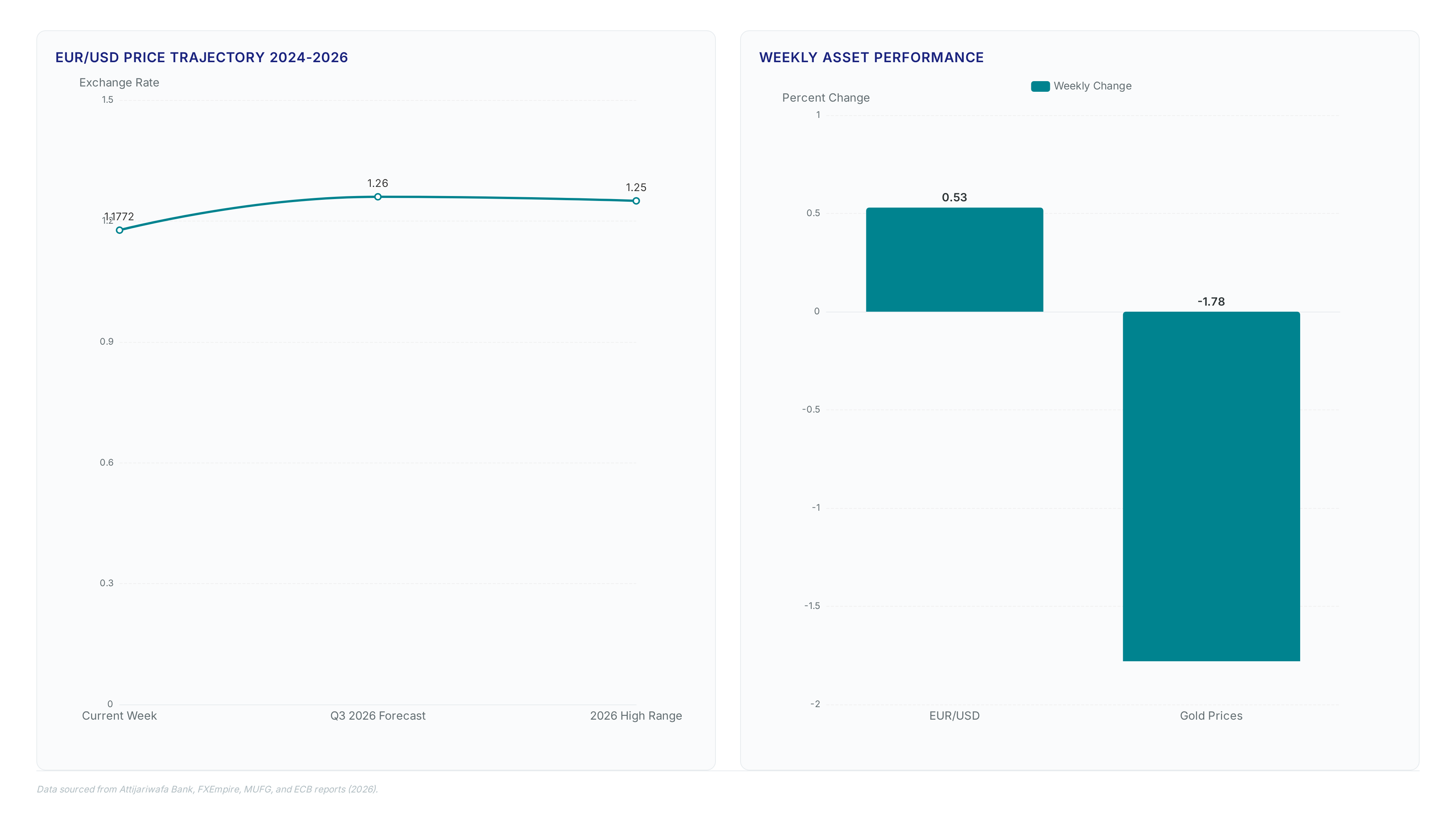
MUFG forecasts the EUR/USD pair will strengthen to 1.26 by the third quarter of 2026, citing weaker US fundamentals. This projection assumes current hawkish Fed rhetoric proves temporary as lower yields eventually dominate market sentiment. Geopolitical tensions involving Iran have stoked inflation pressures, altering the inflation calculus for both central banks. The interplay between Warsh's anti-inflation credibility and Lagarde's mandate creates volatility where standard correlation models fail. Success depends on distinguishing transient geopolitical noise from structural shifts in monetary policy transmission. Traders must separate short-term spikes from lasting regime changes.
Risks of Stagflation and Energy Shocks on ECB Strategy
Energy shocks from the Iran war force the European Central Bank (ECB) to confront stagflation, a paralyzing mix of stalled growth and rising prices that complicates monetary transmission. Unlike the Federal Reserve, which eases policy to cushion trade disruptions, the ECB faces contractionary pressure due to heavy reliance on imported fuel sources. This structural vulnerability means supply-driven oil price increases persistently reduce private consumption and investment across the euro area. The region lacks the energy independence to simply wait out the volatility.
Christine Lagarde addressed these specific supply shocks during her keynote on navigating energy shocks, emphasizing the difficulty of balancing competing mandates. A positive trade balance typically strengthens a currency by attracting foreign capital, yet the economic cost of the war in the Middle East acts as an acute blow to the global economy. This asymmetric shock disrupts standard pricing models for energy and trade. The divergence creates a scenario where the outlook for euro area financial stability is shaped by geoeconomic stress and energy supply disruptions. Standard inflation hedges may fail when the central bank cannot stimulate growth without exacerbating price rises. The operational reality is a narrowed policy window where the ECB struggles with stagflation caused by energy shocks.
Measurable ROI from Trading EUR/USD Amid Geopolitical Volatility
Defining Geopolitical Risk Premium in EUR/USD Pricing
Threats near the Strait of Hormuz force an immediate risk premium into EUR/USD pricing as supply chain fears mount. Market participants separate temporary spikes from structural shifts by watching whether inflation pressures persist after headlines fade. When the US and Iran stand down temporarily, traders reassess premium durability rather than assuming resolution. This flexibility creates a measurable divergence where credit spreads lag behind actual geopolitical uncertainty, suggesting potential mispricing in current rates.
Operators face a hard constraint: inflation pressures driven by Middle East tensions do not vanish just because firing stops. The market must price the probability of future escalation, keeping the premium elevated even during calm periods. Unlike temporary liquidity gaps, this structural component alters the baseline valuation of the Euro against the Dollar consistently.
Diplomatic meetings rarely erase the cumulative effect of sustained tension in a single session. Ignoring this distinction exposes portfolios to abrupt repricing if negotiations fail. The geopolitical risk component remains a vital input for valuation models long after the initial news cycle ends.
Applying MUFG's 1.26 Target to Current EUR/USD Positions
Calculating exposure against the MUFG forecast of 1.26 requires recognizing that current prices near 1.1385 reflect temporary de-escalation near the Strait of Hormuz. Reports indicate US and Iranian forces will stand down for now, yet the structural divergence between Fed hawkishness and ECB stability mandates remains the primary driver for long-term positioning. Long positions here bet that lower US yields will eventually overwhelm short-term dollar strength caused by geopolitical risk premiums.
Reaching the Q3 2026 target involves navigating significant volatility as markets reprice adverse scenarios that credit spreads currently ignore. Retail accounts face a specific constraint where use restrictions often prevent holding sufficient notional value to make the pip distance between 1.14 and 1.26 meaningful without excessive risk. The risk premium embedded in oil prices may persist longer than equities suggest, capping Euro gains until inflation data confirms a peak.
Investors asking should I buy EUR USD must weigh attractive upside potential against the reality that US Iran tensions forex headlines can trigger sharp, liquidity-draining reversals. The trade relies entirely on the Federal Reserve pivoting to easing while the ECB maintains its contractionary stance, a sequence that is probable but not guaranteed within the forecast window.
Risk of Escalation if Tehran Bypasses Preferred Hormuz Routes
Immediate EUR/USD volatility spikes when diplomatic channels fracture over Strait of Hormuz access rights. Iran's Foreign Minister Abbas Araghchi asserted that responsibility for the waterway lies solely with Tehran, warning that bypassing preferred routes triggers "tension and escalation." Markets reacted to this specific threat profile on Monday, holding the pair near 1.1385 while awaiting Tuesday talks in Doha. The mechanism targets the logistical chokepoint rather than crude output volumes alone. Gold prices subsequently fell roughly 1.78% to settle near $4,016 as ceasefire hopes temporarily capped the risk premium. Calm remains fragile; any failure to secure route access guarantees a renewed inflation surge that forces the ECB into deeper contractionary policy. Operators monitoring geopolitical risks must recognize that Iranian threats to bypass protocols create asymmetric downside for the Euro, given the region's energy dependency. Liquidity providers will widen spreads preemptively before official announcements, punishing late entries during these narrow negotiation windows.
Executing a Data-Driven Forex Trading Strategy in Five Steps
Defining Hawkish Debut Signals from Fed Chair Warsh
A surprisingly hawkish debut from Kevin Warsh as the new Federal Reserve chair earlier in the month has reversed market expectations for US rate cuts this year. This shift could underpin the US Dollar against the Euro in the near term, as market participants price in a more hawkish Fed relative to the ECB while the interest rate differential persists. Verbal guidance from the central bank influences capital flows, though this perception remains sensitive to US growth data relative to eurozone fundamentals.
Research indicates the Fed has historically adopted an accommodative stance in response to bilateral geopolitical risk shocks driven by disruptions in capital flows and trade activities.
Applying Lagarde's ECB Forum Speech to Trade Entries
ECB President Christine Lagarde will open the forum on Monday, providing immediate entry signals for traders monitoring the event. Her keynote addresses policy evolution amid lower oil prices and stock market volatility, offering a window into the central bank's reaction function. Any hawkish remarks from policymakers could provide support to the shared currency.
- Isolate sentences referencing the ECB's primary mandate of price stability in the transcript.
- Compare these remarks against current market pricing for rate decisions.
This specific tension means Lagarde's hints may signal caution rather than aggressive tightening, capping the upside potential for the currency even if the tone appears firm.
Checklist for Validating EUR/USD Trades Against June Employment Data
The EUR/USD pair appreciated by +0.53% in a single week to settle at 1.1772, driven by expectations of Federal Reserve monetary easing.
- Monitor Christine Lagarde for syntax shifts regarding price stability during her Monday keynote address.
| Data Point | Bullish EUR Signal | Bearish EUR Signal |
|---|---|---|
| US Employment | Significant miss | Strong beat |
| ECB Tone | Inflation concern | Growth focus |
| Geopolitics | De-escalation | Escalation |
The cost of ignoring this divergence is premature position sizing during liquidity gaps.
About
Vikram Nair, Emerging Markets & Asia FX Writer at ForexCFD.top, brings a distinct macroeconomic perspective to the analysis of the EUR/USD pair. While his daily coverage primarily focuses on emerging-market currencies and central bank policies in Asia and Africa, this broader global view is necessary for understanding how geopolitical shocks, such as tensions in the Strait of Hormuz, ripple through substantial pairs like EUR/USD. His expertise in translating complex macro-to-FX dynamics allows him to contextualize how oil price volatility and US-Iran relations impact the US dollar's strength against the euro. At ForexCFD.top, an independent publication dedicated to regulation-aware market news, Vikram applies his rigorous analytical framework to ensure retail traders in Tier-2 and Tier-3 markets receive clear, factual insights. By connecting global geopolitical events to currency movements, he helps traders navigate the risk environment surrounding key levels like 1.1400 without hype or speculation.
Conclusion
When liquidity concentrates so heavily in a single instrument, the primary risk shifts from execution slippage to correlated narrative failure. A unified signal error across this volume does not merely create a bad trade; it triggers a systemic repricing that standard stop-losses cannot contain during gap events. Traders often mistake deep liquidity for infinite safety, yet the 30% market share of this pair means that when sentiment inverts, the exit door narrows instantly regardless of spread tightness. The operational cost here is the false confidence that allows positions to drift into unmanaged exposure during scheduled verbosity from central bankers.
Treat upcoming policy speeches as binary event risks rather than continuous trend contributors. If the ECB focuses on growth while the Fed maintains a hawkish posture, the resulting differential will force a rapid unwind of long positions. Do not wait for the actual rate decision to adjust your thesis; the market prices the trajectory shown in the syntax of these addresses.
Execute a liquidity stress test on your current open positions this week by simulating a 100-pip adverse move triggered by a single dovish phrase from Christine Lagarde. If your account equity cannot withstand that specific shock without violating your risk parameters, reduce your size immediately before the Monday keynote.
Frequently Asked Questions
EUR/USD offers deep liquidity with 30% of transactions, ensuring tight spreads for traders. In contrast, EUR/JPY holds only 4% share, creating moderate gap risk during sudden price moves.
The ECB mandates price stability by targeting a 2% inflation rate using HICP data. Breaching this level obliges policymakers to raise rates, directly impacting Euro attractiveness for global investors seeking yield.
Weakness in these nations often triggers Euro declines, while strength encourages ECB rate hikes to strengthen the currency further.
This massive volume ensures the EUR/USD pair remains the primary vehicle for executing large institutional orders efficiently.
This move highlights how quickly monetary policy shifts can override geopolitical tensions to drive short-term currency valuation changes.
References