
Inflation Pressures: Why RBA Holds Rates at 4.35%
Headline inflation cooled to 4.0% in May, yet the Reserve Bank of Australia maintains a tightening bias. Core pressures persist. Underlying inflation remains far too high, forcing policymakers to prioritize price stability over immediate growth despite mixed economic signals.
The trimmed mean accelerated to 3.6%, driving RBA caution and contradicting the relief seen in headline figures. Hauser argues that early action minimizes labour market damage, a stance justifying the three consecutive rate hikes preceding the current pause. Global oil prices and geopolitical uncertainty in the Middle East continue to threaten the path back to the 2, 3% target.
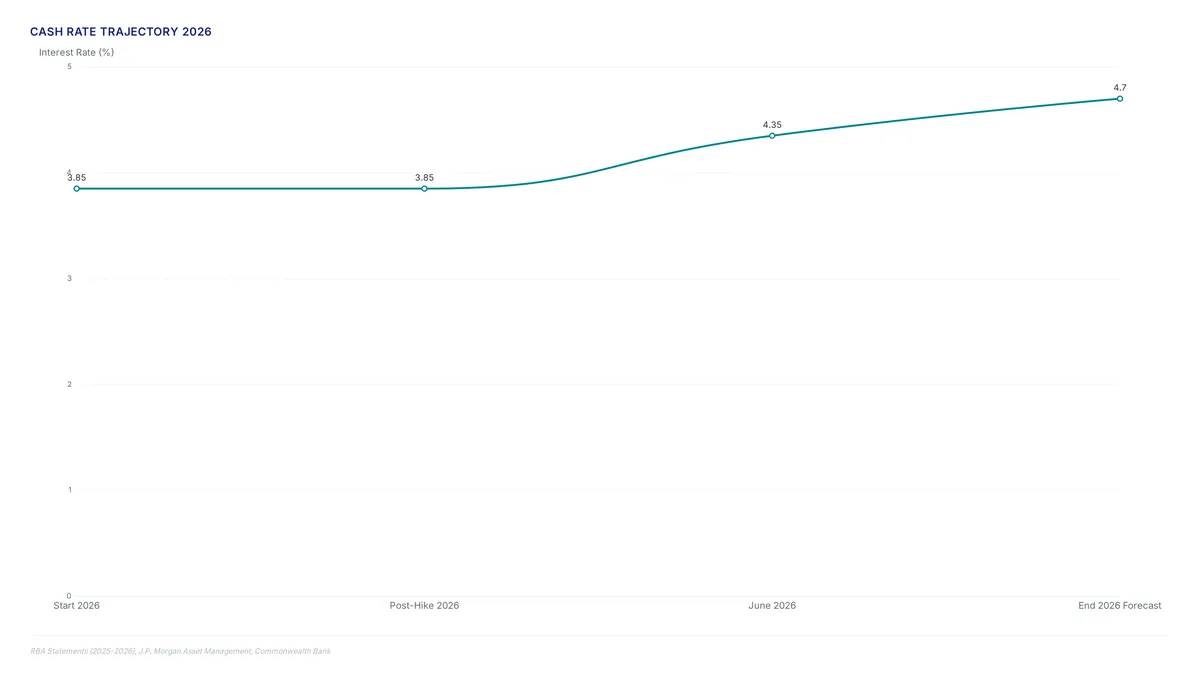
Unemployment has risen to 4.5%, yet wage pressures remain resilient enough to sustain demand-side risks. The Board left the cash rate at 4.35% in June while keeping options open for further restriction. Understanding these policy signals is critical. The central bank refuses to declare victory prematurely.
The Role of Trimmed Mean Inflation in RBA Policy Framework
Defining Trimmed Mean Inflation as RBA's Primary Metric
Strip away volatile extremes, and persistent price pressure stands clear. This makes trimmed mean inflation the Reserve Bank of Australia's preferred gauge for underlying momentum. Headline figures capture immediate shocks from energy or food. This underlying metric removes items at the distribution's edges to reveal the true trajectory of domestic prices. Recent data indicates that while headline rates fluctuate, the trimmed mean inflation reading in the December quarter confirms that core pressures remain stubbornly elevated above the target band. Monetary policy targets sustainable employment and stable prices over the medium term. It demands a clear view of capacity pressures rather than temporary noise.
Applying Trimmed Mean Data to RBA Rate Decisions
Sticky underlying prices validate a restrictive stance. The Reserve Bank of Australia maintains the cash rate at 4.35% because of this reality. Policymakers prioritize trimmed mean readings over headline volatility to gauge whether capacity pressures have truly abated. Headline figures cooled to 4.0% recently. Yet, the acceleration of core metrics to higher levels signals that domestic demand remains excessive. This divergence forces the Monetary Policy Board to hold rates steady rather than pivot prematurely. Governor Hauser stated that Australia still faces a significant inflation challenge despite some improvement in recent data. The mechanism relies on suppressing household discretionary spending to lower excess demand without causing a sharp rise in unemployment.
How Global Oil Prices and Labour Market Strength Drive Inflation Risks
Transmission Mechanisms of Global Oil Shocks to Headline Inflation
Geopolitical instability contributes to volatility in energy costs, directly altering headline inflation metrics before impacting broader price levels. When crude prices fluctuate due to Middle East tensions, the effect transmits through fuel pumps. Headline figures vary independently of domestic demand. This temporary relief often masks the persistence of underlying inflation, which the RBA tracks via trimmed mean measures to gauge genuine economic heat.
The mechanism operates through direct cost-push channels where higher transport and production expenses feed into consumer prices. However, the central bank remains wary that renewed energy shocks could reverse recent gains, embedding temporary spikes into long-term expectations. The critical distinction for traders is that geopolitical risks can invalidate a cooling headline print if core pressures re-accelerate. Analysts monitor these divergences to identify where market pricing fails to account for sticky energy pass-through.
Evaluating Labour Market Strength as a Buffer Against Policy Tightening
Australia's unemployment rate rose to around 4.5%, signaling some easing in labour-market tightness. Employment and wage pressures remain resilient enough to sustain demand-side inflation risks. This labour market durability allows the Reserve Bank to maintain restrictive settings without triggering an immediate spike in joblessness. When capacity pressures persist despite higher borrowing costs, underlying inflation remains anchored above target, forcing policymakers to keep the cash rate elevated.
The mechanism relies on the belief that timely action reduces long-term damage. Hauser expressed confidence that unemployment costs from tighter policy may remain limited, reflecting the view that the labour market has enough strength to absorb shocks. This trajectory aligns with global peers, yet the domestic labour torque remains the primary variable.
Traders monitor employment data releases for early signs of deterioration that would flip the RBA's bias. Conditions have softened but not cracked. The labour market has enough strength to absorb restrictive policy without a sharp deterioration. Until then, the tightening bias stands as the default posture for the Australian dollar.
Geopolitical Uncertainty and the Persistence of Sticky Underlying Inflation
Geopolitical friction sustains sticky underlying inflation even as headline metrics cool from temporary energy relief. Headline figures recently improved. Trimmed mean inflation accelerated to 3.6% from 3.4%, signaling that domestic price pressures remain entrenched despite global oil volatility. This divergence occurs because core measures exclude volatile items, revealing a persistence that headline data obscures.
Hauser noted there have been necessary economic developments since May, not least the prospect of the US-Iran deal, but cautioned that full conflict resolution is not assured. This uncertainty forces analysts to evaluate risk through the lens of capacity constraints rather than transient fuel spikes.
| Risk Factor | Impact on Core Metrics | Policy Implication |
|---|---|---|
| Unresolved Conflict | Sustains high transport costs | Delays rate cuts |
| Wage Durability | Anchors services inflation | Maintains tightening bias |
| Oil Volatility | Distorts headline prints | Increases data dependence |
While a resolution to Middle East tensions would be welcome, the RBA remains cautious given that full conflict resolution is not yet assured. The Board opted to pause after three consecutive rate hikes to assess the lagged effects of earlier tightening, yet the language remains hawkish. This divergence between the current hold and future hike expectations defines the bias. ForexCFD.top traders must distinguish this from a neutral stance where the next move is equally likely up or down. Here, the skew is clearly upward. The risk is that markets misprice this nuance, assuming the pause equals peak rates. However, the RBA has signaled that acting early reduces long-term labor market damage.
Delayed tightening risks embedding inflation, ultimately inflicting deeper unemployment costs than preemptive action. Andrew Hauser warns that waiting to protect current job numbers may force a more severe correction later if price growth hardens. The logic rests on the premise that timely policy steps could lower the ultimate toll on employment compared with a scenario where the central bank falls behind the curve.
Current data shows the jobless rate near 4.4%, suggesting a tight market that might absorb higher rates without immediate collapse. However, this durability creates a dangerous illusion of stability. If policymakers misread this strength and delay necessary hikes, they allow inflation expectations to anchor above the target band.
This gap signals that monetary policy remains restrictive, requiring individuals to stress-test variable debt against potential rate increases.
- Calculate your personal inflation gap by subtracting the target midpoint from current underlying readings. 2.
The cost of compliance is viewed as necessary to prevent inflation from becoming embedded, particularly given the impulse from higher oil prices. This flexible creates a tangible tension for homeowners: maintaining liquidity for emergencies versus accelerating principal repayments to reduce duration risk.
While lower international oil prices would be a welcome development, full conflict settlement is not yet assured, suggesting that energy-driven price pressures may persist.
Risks of Geopolitical Energy Shocks to Headline Inflation
Unresolved conflict in the Middle East creates a volatile ceiling for fuel costs that can instantly reverse disinflationary progress. Hauser noted that while lower worldwide oil prices would be welcome, full resolution remains uncertain, leaving markets exposed to sudden supply disruptions. This fragility means headline figures can spike independently of domestic demand conditions, complicating the RBA's assessment of underlying pressure.
1.2.
The cost of compliance with the inflation target is viewed as necessary to prevent price growth from becoming embedded, particularly given the impulse from higher oil prices. However, the limitation here is temporal; policy acts with a lag, meaning rate decisions made today cannot offset an oil shock occurring tomorrow. This mismatch forces borrowers to self-insure against volatility that central banks cannot immediately neutralize. Given that the RBA remains wary of renewed energy shocks feeding back into headline inflation, traders must treat headline inflation as a conditional variable rather than a fixed trajectory while geopolitical risk premiums remain elevated. The next scheduled Monetary Policy Board meeting is set for August 10, 11, 2026, where further data on inflation and employment will be assessed.
About
Marcus Halloran, Chief Market Strategist at ForexCFD.top, brings over a decade of interbank FX experience to the analysis of rising inflation and central bank responses. Having formerly served as an FX strategist on a London dealing desk, Marcus specializes in decoding monetary policy shifts and their immediate impact on G10 currency pairs. His daily work involves interpreting complex economic data, such as CPI releases and central bank statements like RBA Governor Hauser's recent warnings, to provide clear directional calls for retail traders. At ForexCFD.top, an independent publication dedicated to forex and CFD market news, Marcus uses this background to translate high-level macroeconomic themes into actionable trading insights. His expertise ensures that discussions on inflationary pressures are grounded in rigorous fundamental analysis rather than speculation, helping traders navigate volatile markets driven by interest rate differentials and policy tightening cycles globally.
Conclusion
Scale breaks when borrowers treat temporary headline dips as permanent relief while inflation fundamentals remain entrenched by energy volatility. The operational cost of this complacency is severe duration risk, leaving households exposed if geopolitical shocks reverse recent cooling trends. You must assume that domestic price pressures will persist above comfort levels well into 2026, rendering static budgeting models obsolete. The path forward requires shifting from reactive repayment strategies to proactive liquidity buffering specifically designed for rate uncertainty.
Traders should immediately stress-test their variable debt portfolios against a scenario where the cash rate climbs toward a multi-year high before year-end. Do not wait for the August board meeting to adjust your use; the lag in policy transmission means today's decisions must account for tomorrow's shocks. Start by calculating your break-even point if energy costs spike again next quarter, then lock in any available fixed-rate portions of your debt before market pricing fully adjusts. This defensive posture protects your capital when external forces drive prices beyond central bank control. Focus your strategy on surviving the gap between current data and the next inevitable policy shift rather than hoping for a rapid return to low rates.
Frequently Asked Questions
The central bank ignores temporary drops because core pressure remains sticky at 3.6%. This persistence forces policymakers to maintain restrictive settings until underlying metrics align with the official target band.
The Reserve Bank holds the official cash rate target at 4.35% to combat persistent price growth. This pause allows assessment of previous hikes while keeping options open for further restriction if needed.
This projection reflects ongoing concerns that inflationary pressures will remain difficult to fully contain.
Rising joblessness to 4.5% shows some easing but wages remain resilient enough to sustain demand. Consequently, the labour market has not cracked sufficiently to prompt an immediate shift to easing.
Acceleration in the trimmed mean to 3.6% confirms that domestic price pressures are intensifying rather than fading. This metric drives the tightening bias despite cooler headline figures driven by energy costs.
References