
Trimmed Mean Data Shows Sticky Price Pressures
Australia's annual CPI dropped to 4.0% in May 2026, yet underlying price pressures remain stubbornly high. While headline figures suggest cooling, trimmed mean inflation reveals a more persistent reality that demands immediate attention from policymakers. This divergence signals that transient factors are masking deeper, structural cost increases within the Australian economy.
Underlying inflation pressures are actually accelerating despite the headline miss, driven by broadening second-round effects from the Middle East conflict. The six-month annualised pace lifted to 3.5% according to Westpac Banking Corporation data, even as volatile categories like recreation dragged the main index down. Housing costs tell the real story: new dwelling prices surged 0.9% month-on-month, marking the strongest rise since December 2022.
When services inflation proves stickier than goods prices, Reserve Bank decisions face a difficult pivot. Firms are passing on higher input costs for energy and freight, creating a feedback loop that simple headline misses fail to capture. Understanding this dynamic is critical for forecasting future rate moves in an environment where cost pass-through appears increasingly entrenched.
The Role of Trimmed Mean Inflation in Revealing Underlying Price Pressures
Defining Trimmed Mean Inflation vs Volatile Headline CPI
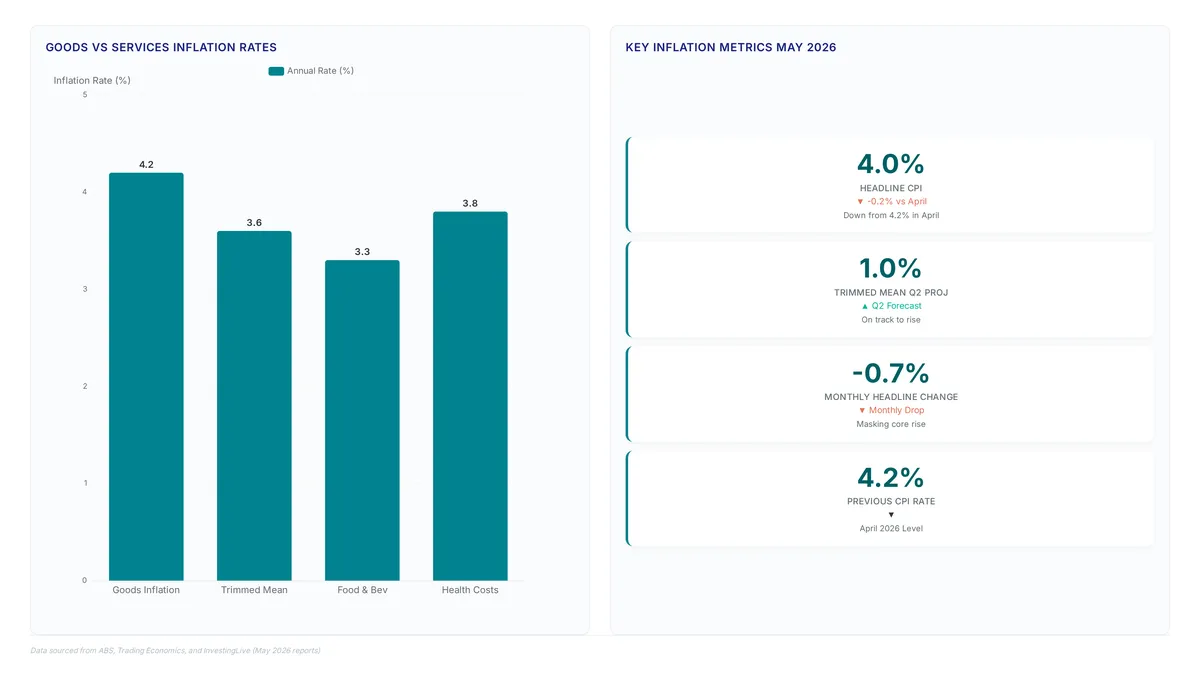
Trimmed mean inflation strips out extreme price swings to isolate persistent trends, standing in stark contrast to headline CPI which captures all raw movements including seasonal noise. Statistical agencies handle outliers mechanically. The Australian Bureau of Statistics removes the most volatile price changes from both ends of the distribution to calculate the underlying inflation rate. This methodology filters out temporary shocks that distort the broader economic picture. May 2026 headline figures dropped 0.7%mth in original terms, creating a deceptive impression of cooling prices driven by transient factors.
The core metric tells a different story, rising to 3.6%yr to reveal that fundamental price pressures actually accelerated.
Analysts interpret CPI data by isolating volatile seasonal noise from persistent underlying inflation trends. The May 2026 divergence highlights a critical tension where headline figures mask rising core pressures. Temporary fuel price drops suppress the aggregate view while domestic cost structures firm up. Housing costs alone surged 0.5% monthly, with new dwelling costs jumping 0.9% as the strongest increase since late 2022. If housing inflation, which comprises roughly 20% of the basket, continues its current trajectory, the Reserve Bank faces a narrowed path to stability. A reversal in fuel surcharges or a slowdown in rental growth would be required to validate a dovish pivot. Until then, the bias remains hawkish despite the headline cooling. Traders should monitor upcoming wage data for confirmation of this passthrough mechanism.
Seasonally Adjusted CPI Miss vs Trimmed Mean Expectations
A , 0.1%mth seasonal dip against a +0.2%mth forecast created the catalyst for confusion, establishing a bias where headline noise masks firming core pressures. Headline figures often mislead during volatile months by capturing temporary price swings rather than persistent trends. While the aggregate index softened due to seasonal factors, the trimmed mean metric printed at 0.4%mth, signaling that underlying momentum remains upward. This divergence forces policymakers to look past the superficial cooling suggested by the headline miss.
The six-month annualised pace lifting from 3.2% to 3.5% confirms that second-round effects are broadening across the basket. Relying solely on seasonally adjusted data risks underestimating the stickiness of services inflation. Traders at ForexCFD.top prioritize these core metrics over volatile headline prints when positioning for Reserve Bank of Australia decisions. The data sets the bias; the chart sets the entry. A reversal in housing cost momentum or a sharp decline in global energy prices would be required to invalidate this hawkish core narrative.
Divergent Drivers Behind May's Headline Miss and Core Inflation Rise
Recreation and Travel Volatility Driving CPI Miss
Seasonal turbulence within the recreation & culture basket propelled the headline miss against market consensus. Domestic travel prices collapsed by, 12.1%mth, far exceeding the forecasted, 5.5%mth decline. International airfares also weakened, falling, 0.8%mth versus an anticipated 3.8%mth rise. Clothing & footwear contributed to the downside surprise with a, 2.9%mth drop compared to the expected, 1.8%mth decrease. These transient falls masked the persistent rise in underlying pressures. Fuel and travel dips temporarily suppress the aggregate index yet fail to reflect broadening second-round effects visible in core metrics.
Service sector reports require close monitoring for confirmation of broadening price pressures. Surging construction pricing directly offsets seasonal weakness in travel and recreation, creating a deceptive calm in the headline inflation rate. Elevated input costs for materials and labor feed into final dwelling prices through this divergence mechanism. Structural cost increases embed themselves into the long-term inflation trajectory unlike transient fuel excise impacts. Traders at ForexCFD monitor these divergences closely because misreading the persistence of housing costs against temporary fuel drops leads to significant positioning errors in AUD pairs. Upside risks remain front of mind given evidence from price notifications data.
Second-Round Inflation Effects from Global Supply Shocks
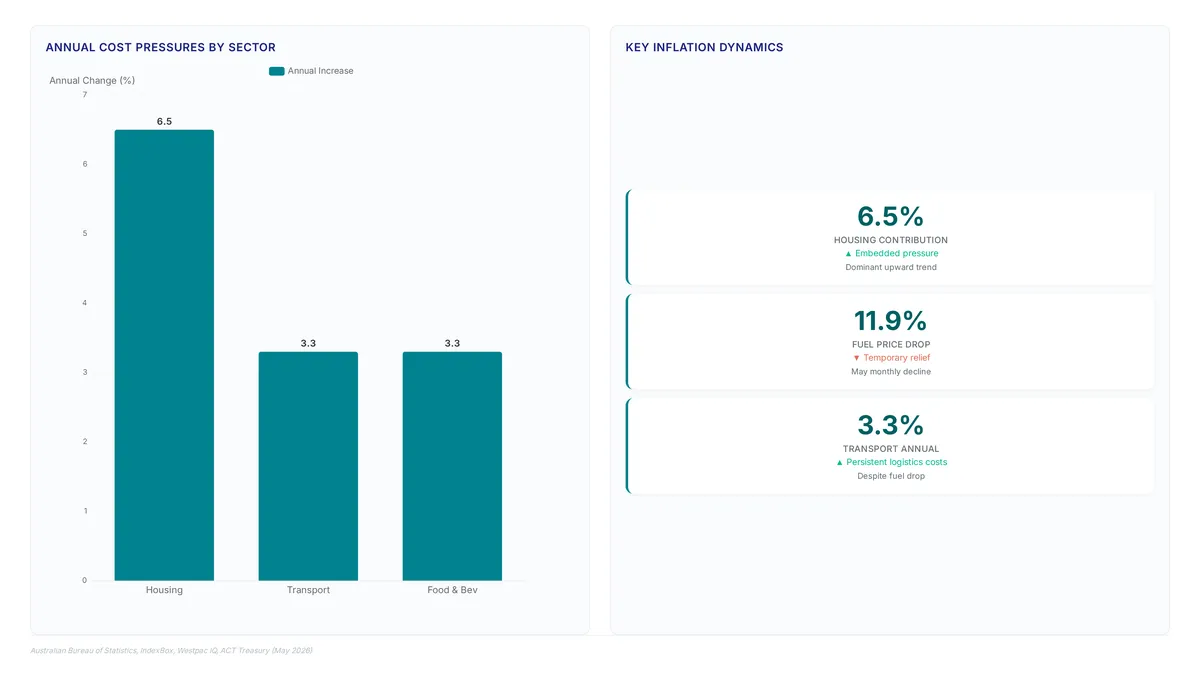
Pass-through from the Middle East conflict is broadening beyond energy into sticky service sectors. Automotive fuel fell, 11.9%mth, yet this decline was shallower than the, 14.5%mth forecast, signaling that initial cost shocks are embedding deeply. Input costs drive the mechanism; firms facing higher freight and plastic prices adjust final offers to preserve margins. A secondary inflation wave emerges where temporary supply shocks become permanent price levels.
Increases may persist even as oil prices moderate. Service pricing reflects longer-term expectations of operating expenses unlike volatile travel costs. Businesses anticipating sustained high costs lock in higher wages and output prices. Monetary policy cannot fix supply chains but must crush demand to stop the spiral, complicating the RBA's task. ForexCFD.top strategists monitor this divergence closely; headline relief may mask the firming underlying pressures that drive rate decisions. A reversal in global oil prices alone will not suffice if the pass-through to services has already occurred. Continued strength in non-volatile categories serves as the true test of inflation control for the market. Further pass-through from still elevated fuel and commodity costs is expected over coming months.
Strategic Implications of Sticky Services Inflation for RBA Rate Decisions
Sticky Services Inflation and RBA Rate Decision Mechanics
Wage costs and operating expenses lock in higher prices, creating a divergence where goods inflation moderates while core measures maintain upward momentum. Firms pass elevated input costs into final service prices, reflecting broader expectations of expensive operations rather than immediate commodity spikes. Ignoring this persistence carries a measurable cost: wage costs could add further pressure in the second half, especially across market services. Housing supply constraints prevent quick normalization, a limitation that keeps upside risks front of mind for policymakers. Further tightening remains on the table to counteract these structural drags. Data reinforces the RBA's concern that inflation remains too high, demanding a period of slower growth to return to target. This view depends entirely on whether pass-through in services proves sticky as policy supports unwind.
Forecasting the August RBA Rate Hike Probability
Market pricing assigns a specific probability to an August rate hike, biasing positioning toward caution despite rising core pressures. Financial institutions maintain that further cash rate increases are necessary, with the next hike likely at the August meeting. This divergence between market pricing and bank forecasts stems from deceptive cooling in headline figures, which masks the persistent rise in underlying costs. The fundamental thesis relies on the trajectory of the trimmed mean, which is on track to rise 1.0% in the second quarter. Headline volatility offers temporary relief, yet structural drivers including unwinding policy supports suggest the Reserve Bank of Australia faces limited room to pause. Investors weigh seasonal noise against the signal of rising core inflation. The path is not linear. If wage costs fail to accelerate in market services or if housing inflation moderates unexpectedly, the case for immediate tightening weakens.
Risk of Persistent Pass-Through in Market Services
Second-order effects from global supply shocks embed into services, creating a deceptive lag in the return to target bands. Higher input costs continue feeding through to broader categories even as headline volatility subsides, making inflation stickier than anticipated.
| Component | Flexible | Implication |
|---|---|---|
| Goods | Moderating prices | Masks core pressure |
| Services | Sticky pass-through | Delays target return |
| Housing | Persistent rise | Anchors Trimmed Mean |
Pass-through in various service areas reflects a structural reset in operating cost expectations rather than transient fuel surcharges. Postal costs fell as fuel surcharges were reduced, demonstrating that some pass-through can unwind. Other services areas may prove stickier. Stability requires more than volatile commodity corrections; it demands a cooling in domestic demand that has yet to materialize. Service sector price notifications remaining elevated despite falling global energy prices shifts the focus to how broad and persistent these price increases become. Housing inflation accounts for around 20% of the CPI basket and serves as a source of persistence in trimmed mean inflation. This reality keeps upside risks front of mind for the RBA and leaves further tightening firmly on the table.
Policy Limitations and Structural Risks in Addressing Persistent Cost Pressures
Risks: Defining Second-Round Inflation from Supply Shocks
Danger originates in the breadth of subsequent adjustments rather than the initial price jump. Hairdressing costs signal entrenched expectations for higher operating expenses, standing in sharp contrast to volatile fuel prices. Broadening price rises risk triggering wage demands that further cement inflation within the economy. Critics point to falling transport costs as evidence the broader index will deflate, citing recent monthly declines. Divergence between falling headline figures and rising underlying metrics suggests the shock is mutating rather than dissipating. Market positioning depends on distinguishing these phases accurately. Scope for policy relief narrows if housing inflation remains elevated near current highs. Traders must watch for broadening pass-through in market services as the definitive signal that temporary shocks have become permanent structural burdens. Continued firmness in service price momentum would reinforce this persistent inflation thesis.
Housing and Services as Persistent Inflation Drivers
Rising trimmed mean figures confirm that shelter costs are embedding inflation despite headline volatility. Service sector data reveals the specific mechanism of entrenchment. Firms adjust hairdressing prices not merely for current fuel spikes but for anticipated long-term operating cost increases. This behavior transforms transient energy shocks into permanent price level shifts. The risk is that second-round effects broaden beyond logistics into core services.
- Wage costs could add further pressure in the second half, especially across market services.
- Elevated freight and chemicals costs continue flowing to consumers.
- Businesses price for persistence rather than temporary disruption.
- Physical supply shortages limit the effectiveness of demand destruction.
Relying solely on rate hikes ignores the supply-side nature of dwelling shortages. This mismatch means inflation remains sticky even as activity slows. Traders monitor these divergences to position for prolonged rate stability or further hikes. The next CPI release will determine if these pressures have peaked.
Limitations of Rate Hikes Against Sticky Pass-Through
Monetary tightening faces steep challenges when input costs embed across service margins. The divergence between falling headline figures and rising trimmed mean inflation highlights this structural rigidity. Firms continue passing through cumulative expenses for freight, plastics, and chemicals while volatile components cool. Unnecessary economic contraction occurs while core inflation remains elevated.
- Categories like hairdressing reflect broadened cost expectations rather than temporary shocks.
- Shelter costs maintain upward pressure due to physical supply shortages.
- Labor markets may tighten further as workers seek compensation for living costs.
- Goods inflation moderation fails to transmit rapidly to domestic services.
The trade-off becomes increasingly severe if goods inflation moderation does not quicker transmit to domestic services. Data confirms that second-round effects are broadening, making the path to stability steeper than headline metrics suggest. Investors should watch for wage data that confirms whether these pass-through effects are becoming permanent features of the economy. Policy tools struggle against supply constraints.
About
Marcus Halloran, Chief Market Strategist at ForexCFD.top, uses his background as a former interbank FX strategist to dissect complex inflation metrics like trimmed mean CPI. His daily work involves translating raw central bank data and economic calendar events into actionable insights for retail traders, making him uniquely qualified to analyze Australia's recent CPI miss. At ForexCFD.top, an independent publication dedicated to forex and CFD market news, Marcus applies his expertise in monetary policy to explain how underlying inflation trends impact G10 currency pairs. His analysis connects the dots between seasonal CPI fluctuations and broader macro positioning, helping traders navigate volatility in majors and commodities. By focusing on factual, regulation-aware content, Marcus ensures that ForexCFD.top's global audience receives clear, professional guidance on how inflation data drives market movements without relying on third-party product recommendations.
Conclusion
Cooling headline numbers mask rising underlying momentum, signaling that monetary policy alone cannot resolve supply-driven price persistence. When trimmed mean CPI YoY accelerates while broader metrics fall, it confirms that input costs for freight, chemicals, and shelter are embedding into service margins rather than dissipating. This structural rigidity means rate hikes risk inducing unnecessary contraction without effectively clearing the bottleneck in physical supply chains or housing stock. Wage pressures will likely intensify as workers demand compensation for these entrenched living costs, creating a feedback loop that central banks struggle to break.
Traders must shift modeling assumptions to favor prolonged rate stability over rapid cuts, as the data suggests inflation will remain sticky well into the next cycle. Stress-test current portfolios against a scenario where service sector pricing power remains intact despite slowing goods inflation. Focus specifically on sectors with high exposure to domestic labor and rent costs, as these will drive the next phase of economic volatility. Ignoring the trimmed mean CPI YoY signal in favor of headline relief exposes positions to significant repricing risk when future reports confirm the durability of these core pressures.
Frequently Asked Questions
Headline figures fell 0.7% due to seasonal noise, masking rising core pressures. Underlying momentum actually accelerated to 3.6%, signaling that firms are passing on higher input costs despite the deceptive aggregate cooling.
New dwelling costs surged 0.9%, marking the strongest monthly increase since late 2022. This sharp rise drives the broader housing component, which comprises 20% of the basket, creating significant upside risks for future rate decisions.
The seasonal CPI dipped 0.1% against a forecasted rise, creating a false sense of cooling. In contrast, the trimmed mean printed at 0.4%, confirming that second-round effects from supply shocks are broadening across the economy.
Services inflation proves stickier as firms adjust prices for higher operating costs beyond just fuel. This persistence keeps the six-month annualised pace elevated at 3.5%, suggesting the central bank faces a narrowed path to stability.
Traders must ignore the 0.7% headline drop and focus on the 3.6% underlying rate. Relying on volatile headline data leads to flawed strategies, whereas core metrics reveal the true trajectory of purchasing power erosion.
References