
PBOC reference rate: Why 6.8045 sets the tone
The PBOC pins the USD/CNY reference rate at 6.8045. This number is not an accident; it is a policy lever. By anchoring the yuan within a strict 2% trading band, Beijing walks a tightrope between export competitiveness and financial stability. Unlike the chaotic drift of a pure float, China's system injects deliberate discretion into every morning's print. The People's Bank of China uses this midpoint determination to signal tolerance for depreciation or a commitment to support, effectively bypassing the noise of the volatile US dollar.
Market participants dissect the PBOC fixing for deviations that reveal hidden handiwork. These aren't just mechanical calculations; they incorporate capital flows and growth momentum into the official rate. While Gartner predicts that AI agent-intermediated transactions will soon dominate B2B buying, the current FX procurement landscape remains tethered to interpreting these manual central bank signals (Gartner's strategic predictions for 2026). The difference between a stronger-than-expected CNY midpoint and a passive drift dictates financial market confidence amidst shifting US rate expectations. For anyone navigating Asia's foreign exchange markets, this reference rate is the only metric that matters.
The Role of the PBOC Fixing in China's Managed Floating Exchange Rate System
PBOC Fixing Mechanics and the 0115 GMT Reference Rate
Every trading day begins at 0115 GMT. That is when the People's Bank of China, an institution founded on December 1, 1948, publishes the daily USD/CNY reference rate. This midpoint sets the center of gravity for the onshore yuan. While market forces provide the baseline within this managed floating architecture, the central bank retains the authority to smooth volatility. Policymakers guide expectations through this initial price setting, rejecting a pure float in favor of controlled movement.
Global FX trading volume hit USD 9.6 trillion per day in April 2025. Against that backdrop, the 0115 GMT print carries outsized weight. The regime itself was formalized in 1994, integrating official and swap rates into a single system. But do not mistake the system for a spreadsheet. The calculation includes the previous close and substantial currency moves, yet domestic stability objectives often override pure math. This discretion creates a gap between transparency and policy flexibility. Market participants parse deviations from expected levels as explicit guidance on capital controls or liquidity support. A stronger-than-expected fix signals resistance to depreciation. A weaker one suggests tolerance for downward pressure. The 2% trading band limits intraday volatility, but the reference rate remains the primary tool for expectation management. Operators must distinguish between algorithmic components and the discretionary policy overlay embedded in the number. Failure to decode this signal risks misalignment with broader monetary objectives.
Managed Float vs Pure Float: Balancing Export Competitiveness
China's managed float permits market-determined baselines while reserving the right to curb extreme volatility. This stands in sharp contrast to pure floats like the US dollar, where no intervention targets specific levels, or fixed pegs like the Hong Kong dollar, which strictly anchor value. Here, market forces determine the baseline, but the central bank intervenes against disorderly moves. The regime type dictates that the onshore yuan trades within strict bounds whereas offshore rates fluctuate freely.
This duality creates a structural conflict: maintaining export competitiveness requires a weaker currency, yet financial stability demands confidence in the peg. Excessive reliance on the fixing mechanism can distort price signals in the interbank market. The cost of this stability is reduced monetary autonomy during global shock events. Market participants must monitor the spread between onshore and offshore rates as a primary indicator of policy stress. When the spread widens, the market is questioning the peg.
Mechanics of Midpoint Determination and the Two Percent Trading Band
PBOC Midpoint Inputs: Closing Price and Basket Adjustments
Governor Pan Gongsheng calculates the daily midpoint using the prior close, US dollar movements, and domestic capital flow data. This inputs-driven approach allows the central bank to intervene against short-term fluctuations rather than adhering to a rigid mechanical formula. The process explicitly weighs international FX conditions alongside internal stability goals, creating a hybrid signal for market participants.
- Previous day's closing price acts as the baseline anchor.
- Major currency basket fluctuations, led by the US dollar, provide external pressure context.
- Domestic economic considerations, including growth momentum, dictate policy discretion.
The People's Bank of China retains significant latitude to adjust the fixing away from pure market pricing to guide investor expectations. Such discretion exists because the regime prioritizes financial stability over transparent price discovery. This opacity distinguishes the system from peers; the US Treasury notes China's relative lack of transparency compared to the Federal Reserve or ECB. Consequently, forecasting the USD/CNY rate requires modeling policy intent alongside raw economic data.
| Previous Close | Baseline anchor | High mechanical weight |
| Dollar Index | External pressure gauge | Variable adjustment |
| Capital Flows | Stability indicator | Discretionary override |
Operators must recognize that the midpoint serves as a strategic signal rather than a simple clearing price. A stronger-than-expected fixing often signals a desire to curb depreciation fears, while a weaker print may tolerate softness to aid growth. This dual mandate forces traders to decode subtle shifts in the daily reference rate.
Intervention Tools: Reverse Repos and State Bank Guidance
When market forces threaten the trading band, direct liquidity injections serve as the primary mechanism for smoothing USD/CNY volatility. Operational deployment follows a distinct hierarchy. Outright reverse repo operations, introduced in October 2024, allow the central bank to inject massive short-term capital, evidenced by a recent 1.1-trillion-yuan announcement designed to maintain system stability. Smaller, targeted adjustments occur frequently, such as the 13.5 billion yuan 7-day operation conducted on January 5, 2026.
State-owned institutions execute the second layer of defense through algorithmic trading. The Bank of China uses deep learning models to forecast trade signals, effectively narrowing the window for speculative attacks before the central bank must intervene directly.
| Reverse Repos | System Liquidity | Injects short-term yuan cash |
| State Bank Guidance | Market Sentiment | Algorithmic order flow coordination |
| Reserve Sales | Exchange Rate | Direct FX spot market intervention |
Transparency remains a strategic friction point; the US Treasury notes China's opaque reporting compared to the Federal Reserve. This lack of clarity forces traders to infer policy intent from transaction volume rather than explicit forward guidance. The critical limitation is that heavy reliance on state banks creates a disconnect between onshore liquidity and offshore pricing. When domestic banks tighten conditions artificially, the cost of hedging rises sharply for importers, distorting real economy trade flows even if the spot rate remains stable. Without intervention, speculation could exhaust reserves, yet the managed floating architecture mandates smoothing rather than rigid defense. The PBOC deploys state-owned banks to execute direct buying or selling, often using deep learning models to time entries against algorithmic traders. This approach contrasts with pure floats where price discovery occurs without official interference.
| Stronger CNY Fixing | Resistance to appreciation | Sell yuan, buy dollars |
| Weaker CNY Fixing | Tolerance for depreciation | Buy yuan, sell dollars |
The cost of this stability is moral hazard; traders increasingly front-run known defense levels, assuming the central bank will absorb losses to maintain the trading band. A stronger fixing signals policy tightening to curb capital outflow, whereas a weaker fixing accommodates export needs despite inflation risks. Operators must monitor liquidity injections closely, as sudden reversals in state bank flow often precede official statement updates. The tension remains between maintaining export competitiveness and preventing disorderly capital flight.
Interpreting Central Bank Signals Through Daily Fixing Deviations
Decoding Stronger vs Weaker CNY Midpoint Policy Signals
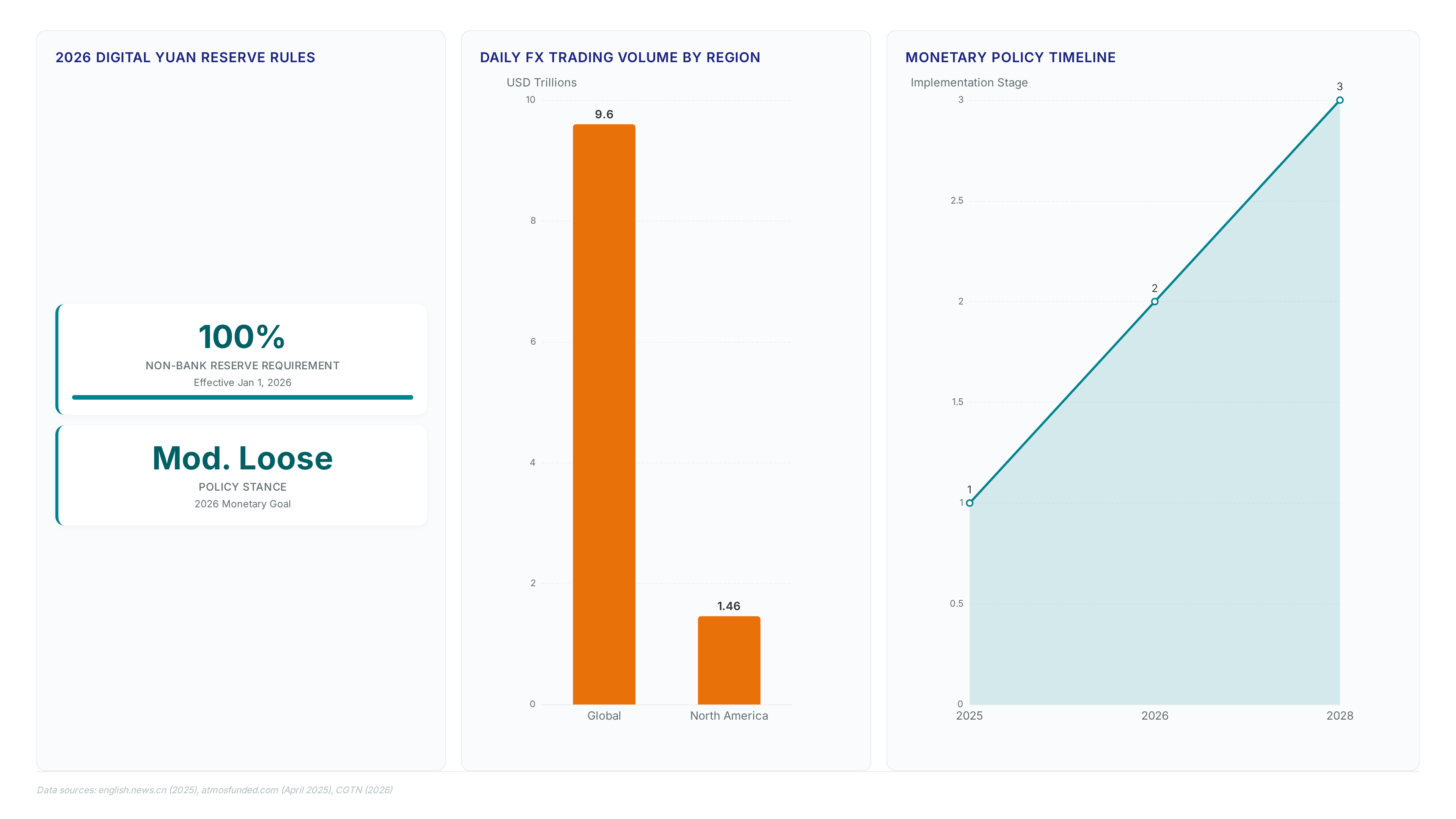
A stronger-than-expected CNY midpoint signals the PBOC is actively leaning against depreciation pressure. This specific configuration of the reference rate acts as a declarative policy statement rather than a passive market reflection. Conversely, a weaker fixing indicates tolerance for currency softness, often aligning with the moderately loose monetary stance adopted for 2026 to support recovery.
The operational reality involves balancing these signals against substantial external volumes. Global FX trading reaches $9.6 trillion daily, creating immense pressure on the managed floating architecture. When the reference rate deviates from algorithmic forecasts, it corrects market pricing without requiring direct capital deployment. State-owned banks apply deep learning.
| Fixing Type | Policy Implication | Market Trigger |
|---|---|---|
| Stronger Midpoint | Resistance to depreciation | Capital outflow risk |
| Weaker Midpoint | Tolerance for softness | Dollar strength |
Operators misinterpreting a weak fix as negligence rather than strategic accommodation often face unnecessary hedging costs. Reliance on discrete daily signals creates a latency gap where intraday volatility can spike before the next fixing resets expectations. Traders must distinguish between mechanical adjustments to the basket and genuine shifts in Beijing's tolerance for exchange rate movement. Confusing these two drivers leads to position errors.
Applying Fixing Analysis During Global Volatility and Rate Shifts
Shifts in US rate expectations under potential Federal Reserve Chair Kevin Warsh change the daily fixing into a primary volatility filter. Investors scrutinize the midpoint deviation to discern Beijing's immediate priority between export competitiveness and capital stability. A stronger-than-expected fix signals active resistance to depreciation, countering external pressure from dollar strength. A weaker midpoint implies tolerance for currency softening to cushion domestic headwinds.
The operational environment relies on a managed floating regime where market forces set the baseline within strict boundaries. This hybrid architecture allows the central bank to intervene via liquidity adjustments or direct trading when volatility spikes. Unlike pure floats, this system embeds policy intent directly into the price discovery mechanism. Price action reflects administrative will as much as supply and demand.
| Fixing Deviation | Policy Signal | Operational Implication |
|---|---|---|
| Stronger than spot | Lean against depreciation | Capital outflow control prioritized |
| Weaker than spot | Tolerance for softness | Export support or growth focus |
Institutional actors now deploy deep learning algorithms to parse these signals against high-frequency noise. These models analyze price progressions to generate trade triggers before manual reaction times allow. The tension lies in distinguishing genuine policy shifts from algorithmic overreactions to minor fixing variations. Excessive reliance on the fixing as a signal risks creating one-way bets that exhaust liquidity buffers. Operators must weigh the signaling value against the finite capacity for sustained intervention during prolonged global stress events. Liquidity constraints ultimately bound the duration of any defense.
Moderately Loose 2026 Policy Versus Digital Yuan Integration
The moderately loose monetary stance for 2026 creates immediate tension with the new reserve requirements for digital deposits. Policy signals now compete between liquidity injection and the structural rigidity introduced by treating e-CNY as reserve money. This framework shift, proven January 1, 2026, mandates that non-bank payment institutions hold 100% reserves against managed digital yuan balances.
| Feature | Moderately Loose Policy | Digital Deposit Framework |
|---|---|---|
| Primary Goal | Stimulate growth via liquidity | Stabilize shadow banking risks |
| Liquidity Impact | Increases available capital | Locks capital in reserve accounts |
| Signal Type | Cyclical support | Structural tightening |
| Operator Risk | Currency depreciation pressure | Compliance capital costs |
Misinterpretation occurs when traders read a weak fixing solely as depreciation tolerance, ignoring the liquidity drain from the upgraded digital yuan framework. The cost of this regulatory upgrade is measurable capital immobilization for payment processors, contrasting sharply with the central bank's broader injection efforts. A stronger midpoint might falsely suggest tight policy when it actually reflects the mechanical demand for reserves in the new system. Market pricing often lags these structural changes.
Operational strategy requires separating cyclical fixing deviations from structural balance sheet changes. The PBOC faces a distinct limitation: aggressive liquidity provision to support recovery could undermine confidence if the market perceives the digital reserve lock-up as insufficient to prevent instability. Investors must weigh the 16.7 trillion yuan transaction volume processed prior to the change against current reserve constraints. The signaling value of the daily fix diminishes if the market fails to account for the reduced velocity of money caused by the new reserve rules.
Strategic Adjustments for Forex Positions Amidst Yuan Volatility
Defining PBOC Intervention Firepower and Liquidity Tools
Direct forex reserves usage targets exchange rates, whereas reverse repos manage domestic banking liquidity. Market models struggle to quantify the exact threshold where policymakers deploy capital, creating a fundamental problem with forex volatility prediction. Liquidity adjustments operate differently by altering the cost of yuan funding rather than selling dollars. Outright reverse repo operations, introduced in October 2024, provide a mechanism to inject massive short-term cash, such as the 1.1-trillion-yuan injection noted in recent months. Draining liquidity to support the currency can spike local borrowing costs and potentially choke the real economy. Operators must distinguish between a liquidity squeeze and a true reserve defense to avoid misreading policy intent. Coverage Pillars advises monitoring interbank rates alongside fixing deviations to detect these shifts early.
Adjusting Forex Positions Using e-CNY Transaction Data
Traders adjust forex positions by analyzing the 3.48 billion cumulative transactions recorded as of November 2025 to gauge true market depth. The mechanism relies on correlating sudden spikes in digital yuan velocity with impending PBOC interventions. Relying solely on volume introduces latency risks because the upgraded framework treating e-CNY as digital deposit money only became Proven January 1, 2026. Historical correlations between payment flows and currency moves may not yet reflect the new reserve requirement calculations due to this recent shift. A false positive on depreciation pressure could lock capital in losing shorts before Beijing acts, making the cost of misinterpreting these signals measurable.
Differentiation between organic trade flows and state-directed smoothing operations is necessary for success. Volume data confirms the *timing* of a fix but not the *direction*. A stronger-than-expected midpoint combined with low e-CNY throughput suggests limited follow-through, whereas high throughput validates the signal. Traders should wait for volume confirmation before sizing entries against the USD/CNY reference rate.
Risks of Misreading State Bank Guidance and Deep Learning Signals
Immediate liquidation risk faces traders when algorithmic signals conflict with opaque state-bank directives. The Bank of China uses deep learning applications to forecast trade flows, yet these proprietary models often prioritize policy stability over market-clearing mechanics. A model might signal a short position based on technical divergence, unaware that state guidance mandates support for the midpoint. This creates a false sense of predictive accuracy where the algorithmic forecast fails to price in non-market intervention thresholds. Integration of the digital yuan further complicates volatility prediction by altering reserve calculations unseen in traditional pairs. Unlike standard fiat systems, this unique feature embeds policy directly into the settlement layer, masking true liquidity conditions from external observers. Operators relying solely on historical price action miss these structural shifts until the trading band is breached. Strategies depending on pure technical analysis incur higher drawdowns during policy pivots. The cost of misinterpretation is not merely missed profit but forced exit at unfavorable rates. Market participants must weight state signaling higher than quantitative outputs during periods of suspected intervention.
About
Marcus Halloran, Chief Market Strategist at ForexCFD. Top, brings deep interbank expertise to the analysis of the USD/CNY reference rate. Having previously served as an FX strategist in London, Halloran specializes in decoding central bank maneuvers and G10 macro flows, making him uniquely qualified to interpret the People's Bank of China's daily fixing. His daily work involves translating complex monetary policy decisions into actionable insights for retail traders, directly connecting his background to the nuances of China's managed float system. At ForexCFD. Top, an independent publication dedicated to vendor-neutral market news, Halloran uses his experience with interest-rate differentials and USD positioning to contextualize how the 6.8045 estimate impacts broader foreign exchange markets. This specific focus ensures that readers receive factual, professional analysis on how PBOC signals influence global liquidity and trading strategies without hype or sales bias.
Conclusion
Scaling these strategies reveals a critical fracture: algorithmic models fail when policy stability overrides market-clearing mechanics, creating hidden liquidity traps that technical divergence cannot predict. As AI agents begin intermediating B2B spend, the disconnect between proprietary forecasting and state-directed smoothing will widen, forcing a fundamental reevaluation of how execution risk is priced. Traders can no longer rely on historical price action alone, as the integration of digital settlement layers masks true reserve conditions until a breach occurs.
Adopt a hybrid validation framework by Q3 2026 that weighs state signaling significantly higher than quantitative outputs during periods of suspected intervention. Do not deploy capital against the reference rate without corroborating e-CNY throughput data, as volume confirms the *direction* of support where price action lies. This shift is necessary for surviving the transition toward agent-intermediated commerce, where speed amplifies errors in interpreting opaque directives.
Start by auditing your current entry logic this week to ensure it requires volume confirmation before sizing positions against the midpoint. Reject any signal lacking this specific liquidity validation, regardless of technical appeal, to prevent forced exits at unfavorable rates when policy pivots occur.
Frequently Asked Questions
The onshore yuan trades within a strict 2% band around the PBOC reference rate. This cap restricts intraday volatility while global FX trading reaches 9.6 trillion daily, creating immense external pressure on China's managed floating exchange rate system boundaries.
A stronger-than-expected midpoint signals resistance to depreciation, while a weaker one suggests tolerance. Traders watch these deviations closely because global FX volume hit 9.6 trillion per day, making the reference rate a critical signal amidst massive liquidity.
The bank intervenes to smooth volatility when prices approach the 2% trading band limits. Such action is necessary because global FX trading reaches 9.6 trillion daily, creating immense pressure that could otherwise destabilize the managed floating regime quickly.
North American volumes reaching 1.46 trillion daily increase pressure on these fixed boundaries. This massive liquidity flow tests the 2% trading band limits, forcing regulators to constantly weigh intervention costs against the benefits of maintaining exchange rate stability.
Global FX trading reaches 9.6 trillion daily, creating immense pressure on the system. Despite this scale, the 2% trading band limits intraday volatility, allowing the central bank to maintain control over the reference rate through discretionary policy tools.