
Rate signals: Decoding Beijing's 2% trading band
The PBOC sets the USD/CNY reference rate at 6.7659, a precise figure anchoring China's $3.342 trillion in foreign reserves. This daily fixing is not a passive market observation but a calculated policy instrument within Beijing's managed floating exchange rate system. While algorithmic trading now dominates liquidity, the counter-cyclical factor remains the decisive variable that human policymakers use to neutralize pro-cyclical market sentiment.
You will learn how the People's Bank of China uses the China Foreign Exchange Trade System to enforce a rigid 2% trading band around the official midpoint. This is not a pure float; it is a engineered equilibrium where Governor Pan Gongsheng's team balances domestic growth against external capital flow pressures. We will analyze how traders decode these morning announcements as explicit signals of Beijing's tolerance for currency depreciation or appreciation. As Gartner predicts that 90% of B2B buying will soon be AI-intermediated, understanding the non-mechanical discretion embedded in the reference rate becomes critical for navigating a environment where human policy overrides automated pricing models. (Gartner's strategic predictions for 2026) The daily fixing remains the ultimate lever for financial stability in an era of aggressive algorithmic speculation.
The Role of the USD/CNY Midpoint in China's Managed Exchange Rate System
PBOC Daily Midpoint and the 2% CFETS Trading Band
Beijing does not leave its currency to chance. The USD/CNY midpoint acts as a daily reference rate set by the PBOC via the China Foreign Exchange Trade System to anchor onshore liquidity. This mechanism queries market makers against a basket of 24 currencies before the session opens, establishing a fixed pivot for the day. Such constraints prevent runaway volatility while allowing limited price discovery within the set range. Unlike the pure float of the US Dollar or the rigid peg of the Hong Kong Dollar, this structure relies on a managed float model formalized on January 1, 1994 A critical operational constraint emerges here: the midpoint calculation incorporates discretionary inputs beyond simple market averages, enabling the central bank to signal policy shifts without explicit verbal guidance. This dual nature means the reference rate functions as both a technical price floor and a political instrument. Market participants must decode the fix to gauge whether Beijing prioritizes export competitiveness or capital stability at any the moment. The result is a system where the rate often diverges from pure supply-demand equilibrium to meet broader macroeconomic objectives.
Counter-Cyclical Factor Impact on Onshore Yuan Volatility
Emotional trading drives volatility, and the counter-cyclical factor exists to kill it. This proprietary variable is inserted into the quotation model to neutralize pro-cyclical market sentiment. This technical adjustment offsets volatilities driven by emotional trading, a specific tool not employed by the Federal Reserve which relies more on interest rate differentials. The mechanism allows the central bank to stabilize the yuan without abandoning the market-based reference rate entirely. Pure floats lack this specific damping coefficient, leaving exchange rates fully exposed to momentum shocks. The limitation is that discretionary calibration introduces opacity for foreign portfolio managers. Market participants cannot algorithmically predict the exact magnitude of the intervention factor before the daily fixing.
China employs a managed floating exchange rate distinct from the pure float of the US Dollar or the fixed peg of the Hong Kong Dollar. This regime allows the PBOC to intervene directly, smoothing volatility that purely market-driven systems cannot absorb.
| Feature | China Managed Float | US Dollar Pure Float | Hong Kong Dollar Peg |
|---|---|---|---|
| Valuation | Policy-guided midpoint | Market supply/demand | Fixed to USD |
| Volatility Control | Active intervention | None | Reserve backing |
| Origin Date | January 1, 1994 | March 1973 | 1983 |
The onshore yuan operates under strict administrative constraints, whereas offshore markets react instantly to global liquidity shifts. Historical data indicates that managed floats now exhibit greater durability against capital flow shocks than intermediate regimes. The trade-off is reduced price transparency for domestic participants compared to the US Dollar. Operators must distinguish between policy-driven midpoints and genuine market clearance levels. Failure to separate these signals leads to mispriced hedging strategies during liquidity crunches.
Mechanics of PBOC Currency Fixing and Daily Market Intervention
Algorithmic Inputs for PBOC Midpoint Calculation
Forget the idea of a purely mechanical formula. The midpoint calculation relies on discretionary inputs rather than a purely mechanical formula, granting policymakers latitude to guide market expectations. This non-mechanical nature allows the PBOC to weigh the previous day's closing price against broader international conditions, such as global volumes reaching $9.6 trillion per day. Domestic stability goals frequently override strict market signals when capital flows threaten financial equilibrium. Operators face a transparency deficit when modeling these algorithmic weightings compared to Western peers. The US Treasury highlights China's relative lack of transparency regarding exchange rate policies, contrasting sharply with the Federal Reserve's public data releases.
In practice, the limitation of this approach is the finite nature of reserves relative to daily global FX volumes. Persistent defense of a specific level drains capital and may delay necessary economic adjustments. Operators must weigh the immediate stability gain against the long-term distortion of price signals. A weaker fixing often signals tolerance for depreciation to aid exporters, whereas a strong fix indicates a priority on capital retention. This dual mandate creates a tension where intervention smooths noise but obscures the true equilibrium price.
Risks of Misinterpreting Discretionary Fixing Signals
Traders assuming the daily midpoint is purely algorithmic face immediate losses because the Bank of China uses deep learning applications to forecast forex trade signals that override standard technical models. This computational asymmetry allows state actors to anticipate market moves before they materialize in the order book. The PBOC embedding proprietary AI into its quotation model means historical price action often fails to predict the next fixing. Standard econometric models frequently miss these non-linear policy adjustments. Unlike the transparent mechanics of Western central banks, the Chinese system integrates opaque neural networks that process vast datasets beyond public view. Institutions like ING have deployed autonomous AI trading algorithms to compete, yet human analysts relying on linear regressions remain vulnerable to sudden discretionary shifts. The cost of this misinterpretation is measurable; while average direct fees for CFDs sit near a modest amount, the total transaction cost for futures across a full trade lifecycle reaches $6.47 due to volatility spikes triggered by unexpected fixes.
| Risk Factor | Traditional Model Assumption | Actual Market Condition |
|---|---|---|
| Signal Source | Mechanical formula | AI-enhanced discretion |
| Volatility Driver | Market sentiment | Policy guidance |
| Prediction Horizon | Historical data | Real-time state objectives |
The critical limitation for external operators is the inability to distinguish between a market-driven move and a engineered signal. Reliance on technical indicators alone invites exploitation by algorithms trained on non-public policy variables.
Interpreting Policy Signals Through Daily Fixing Analysis
Decoding Stronger-Than-Expected CNY Midpoint Signals
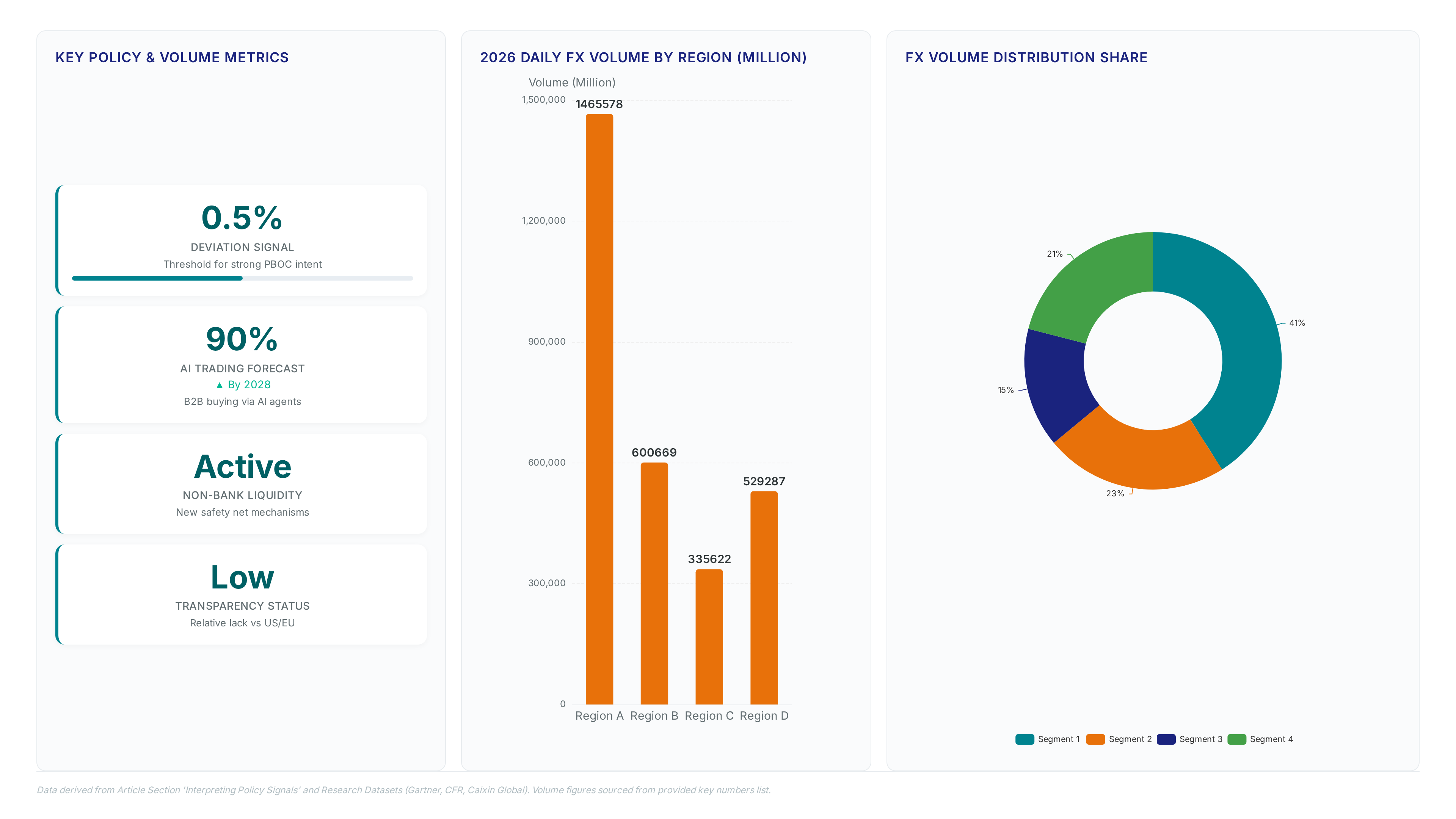
A stronger-than-expected midpoint is a warning shot. When the midpoint arrives stronger than traders anticipate, the PBOC leans against depreciation pressure with visible intent. This policy signal overrides mechanical market inputs to stabilize sentiment during periods of sharp volatility. Unlike a purely algorithmic adjustment, the fixing incorporates a counter-cyclical factor to offset pro-cyclical volatilities driven by speculative flows. Market participants interpreting this move must recognize the central bank's willingness to sacrifice short-term export competitiveness for capital stability. The daily fixing thus serves as a forward guide rather than a lagging indicator of economic fundamentals. Historical price action often fails when Beijing prioritizes non-transparent stability goals over technical patterns. Institutions using transaction cost analysis tools can improved benchmark execution quality against these discretionary shifts. Only state actors possess full visibility into the weighting of domestic growth targets versus exchange rate levels. Consequently, a strong fix often precedes tighter liquidity conditions for non-bank institutions facing new stability mandates. Latency advantages matter less than understanding the policy intent behind the number for network engineers monitoring financial data feeds.
Assessing Beijing's Priorities During Global Volatility
Global volatility forces Beijing's hand. Measuring the daily midpoint deviation against US rate shifts allows investors to gauge currency policy direction during heightened global volatility A stronger-than-expected fixing signals a priority on capital stability, whereas a weaker print tolerates depreciation to support exports. This discretionary signal carries added weight following the Monetary Stance announcement at the January 5, 6, 2026 work conference, which emphasized moderately loose policy. Operators must now weigh this easing bias against the risk of capital flight. Defending the currency conflicts with stimulating growth within this narrow corridor. Analyzing these signals requires more than spot price observation as institutions increasingly deploy Transaction Cost Analysis The PBOC is evaluating liquidity mechanisms for non-bank entities, expanding the central bank's ability to stabilize markets without direct FX intervention. Future volatility management may rely less on reserve deployment and more on domestic funding channels. External competitiveness and internal financial confidence create the ultimate constraint. Misreading the policy signal during these volatile windows exposes portfolios to abrupt liquidity adjustments.
Validating Tolerance for Softer Currency via Fixing Deviations
Do not mistake noise for policy. Confirming genuine tolerance for a softer currency requires measuring the fixing deviation against domestic headwinds rather than transient dollar strength. A "weaker fixing for the CNY" suggests policy accommodation, yet operators must distinguish this from mechanical adjustments driven by the basket of 24 currencies. Analysts should verify if the counter-cyclical factor is actively offsetting pro-cyclical volatilities or allowing them to pass through. Standard econometric approaches will fail to predict the USD/CNY midpoint accurately if the Bank of China deploys deep learning models to forecast these signals. Discretionary overrides render historical price action unreliable during Monetary Stance shifts. Operators must cross-reference the 0115 GMT release with liquidity conditions to validate the signal. A weaker print accompanied by tight liquidity indicates a controlled test of market sentiment rather than an abandonment of stability goals. This nuance separates genuine policy easing from temporary volatility management.
Strategic Steps for Hedging CNY Exposure and Analyzing Intervention
Defining PBOC Intervention Mechanics and Liquidity Tools
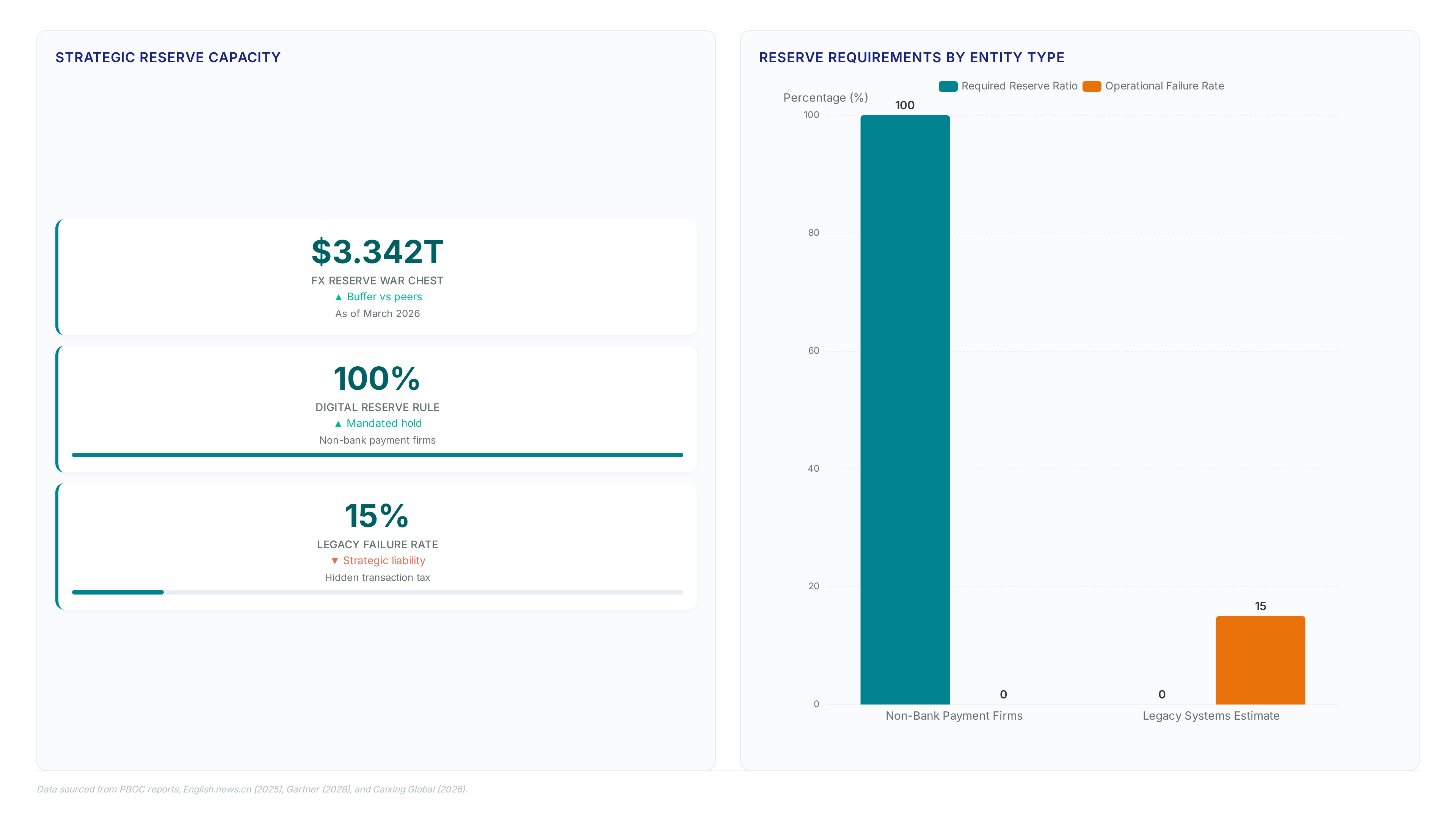
Direct intervention relies on the $3.342 trillion reserve war chest to execute large-scale USD/CNY swaps that pin the spot rate within the mandated band.
- Execute direct currency swaps using sovereign reserves to alter the supply-demand balance in the onshore market. 2.3. Expand liquidity windows to non-bank financial institutions to prevent fire sales of bonds during stress events.
- Adjust the counter-cyclical factor within the fixing model to mechanically offset pro-cyclical speculative flows. However, the shift toward digital deposit money requires non-bank payment firms to hold 100% reserves reducing the velocity of private capital available for speculative attacks. Coverage Pillars recommends modeling these liquidity shocks explicitly rather than assuming continuous market depth. The primary limitation remains the opacity of the counter-cyclical factor, which prevents precise calculation of the true equilibrium rate. Operators must treat every fixing deviation as a binary policy signal rather than a linear market input.
Executing Hedging Strategies Based on Fixing Signals
Traders initiate forward cover immediately when the USD/CNY midpoint prints stronger than market consensus, signaling active defense against depreciation. This specific reaction requires distinguishing between mechanical basket adjustments and the deliberate application of the counter-cyclical factor to offset pro-cyclical volatilities. A stronger fixing implies Beijing prioritizes capital stability over export competitiveness, necessitating a shift from passive monitoring to active position squaring.
- Compare the published fixing against the prior close to quantify the policy deviation magnitude.
- Execute USD/CNY buy stops above the spot rate if the signal indicates leaning against depreciation pressure. 3.
About
Sofia Mendes, Broker Reviews & Trading Education Editor at ForexCFD. Top, brings a unique, risk-focused perspective to the analysis of the USD/CNY reference rate. While her daily work primarily involves rigorous broker due diligence and developing trading education materials, this background is critical when interpreting central bank signals like the PBOC fixing. Her expertise in evaluating execution quality and spread volatility allows her to explain how deviations in the 6.7659 estimate could impact retail traders holding emerging market positions. At ForexCFD. Top, an independent publication dedicated to vendor-neutral market news, Sofia connects complex macroeconomic events to practical risk management strategies. By using her deep understanding of regulated broker frameworks, she clarifies how China's managed floating exchange rate system influences liquidity and pricing for global CFD traders, ensuring the audience grasps both the mechanical and strategic implications of today's FX market movements.
Conclusion
Scaling currency exposure in this environment breaks when hidden infrastructure latency compounds with policy-driven volatility spikes. The operational cost of maintaining legacy payment systems now exceeds the theoretical savings of passive hedging, creating a drag that erodes margins quicker than spot rate movements alone. As the central bank expands its liquidity safety net to include non-bank entities, the market will see compressed tail-risk premiums, fundamentally altering the risk-reward profile for speculative positions. Traders relying on historical volatility clusters will find their models failing as state backstops dampen the very spikes they seek to arbitrage.
Firms must transition from reactive monitoring to active infrastructure auditing by Q2 2026. Do not wait for a liquidity crisis to reveal your system's breaking point; the window to upgrade before regulatory mandates tighten is closing. Specifically, prioritize replacing legacy settlement rails that contribute to the observed 15% transaction failure rate, as this technical debt acts as a silent multiplier of execution risk during fixing events.
Start this week by mapping your current FX execution path against the CFETS Price Enquiry System data to identify any mechanical lag between your internal pricing and the official midpoint. This single audit will reveal whether your current setup can distinguish between a structural policy shift and transient noise, enabling you to adjust algorithmic parameters before the next liquidity injection cycle begins.
Frequently Asked Questions
The PBOC enforces a rigid 2% trading band around the official midpoint to prevent runaway volatility. This constraint allows limited price discovery while ensuring the central bank retains final authority over the currency's trajectory.
Policymakers insert a counter-cyclical factor into the quotation model to offset volatilities driven by emotional trading. This specific tool stabilizes the yuan without abandoning the market-based reference rate entirely during stress.
Direct intervention relies on the $3.342 trillion reserve war chest to execute large-scale buying or selling. This massive buffer allows the central bank to smooth volatility when onshore prices threaten to breach prescribed limits.
Gartner predicts that 90% of B2B buying will soon be AI-intermediated, making human policy discretion critical. Understanding non-mechanical factors in the reference rate helps navigate landscapes where policy overrides automated pricing models.
A stronger-than-expected midpoint signals the PBOC is leaning against depreciation pressure to support the currency. Conversely, a weaker fixing indicates tolerance for depreciation to aid exporters amidst capital outflows.