
Rupee Gains: Why 94.71 Matters Now
The Indian rupee surged 40 paise to close at 94.71 as West Asia tensions eased. Geopolitical calm dictates valuation here, but RBI intervention remains the primary engine driving forward market dynamics, while oil price declines offer the only genuine relief to external balances.
This rally to a five-week high of 94.45 tracks directly with falling global oil prices following reports of a potential peace agreement. Brent crude prices declined nearly 5% to around $82.9 a barrel, providing temporary relief to India's inflation outlook. Despite this gain, the currency remains 5.6% down for the year. Gains driven by external news cycles lack the durability of fundamental economic shifts.
Sustained support depends heavily on dollar inflows into the debt market, fueled by recent Reserve Bank of India measures. While experts like Anindya Banerjee from Kotak Securities project further gains to the 93/93.50 range by September, such forecasts assume a continuous absence of conflict.
The Role of Geopolitical Stability in Rupee Valuation
Defining Rupee-Dollar Dynamics Amid West Asia Conflict
News that the West Asia conflict might end triggered a broad-based rally, sending the Indian rupee up 40 paise on Monday to close at 94.71 against the dollar. This marked its sharpest single-day gain in recent months as the currency moved from an open of 94.68 to an intra-day high of 94.45. Emerging market currencies tied to energy imports react sharply to shifts in global risk appetite. Last month, the local unit saw its record low of 96.96, driven by elevated energy prices. Traders now anticipate lumpy dollar inflows through foreign currency non-resident bank accounts. The local unit remains down this year despite the rebound. Investors must distinguish between temporary sentiment shifts and durable balance-of-payment improvements as the market assesses the sustainability of these gains.
How Brent Crude Drops to $82.9 Drive Rupee Recovery
Brent crude dropped to around $82.9 a barrel, its lowest level since March, providing immediate relief to India's inflation outlook and external balances. When energy costs fall nearly 5%, the macroeconomic pressure on the rupee eases as lower oil prices reduce the national import bill. This mechanism explains why the currency found rapid support during the recent geopolitical thaw after previously hitting record lows amid elevated energy prices. Falling crude prices have directly reduced the import bill for India, effectively lowering the cost of energy imports which is a primary driver of dollar demand. Analysts forecast that this slide in crude prices could improve India's macroeconomic outlook and support domestic markets by easing concerns around inflation and external balances.
RBI Record Short Forward Positions and Intervention Risks
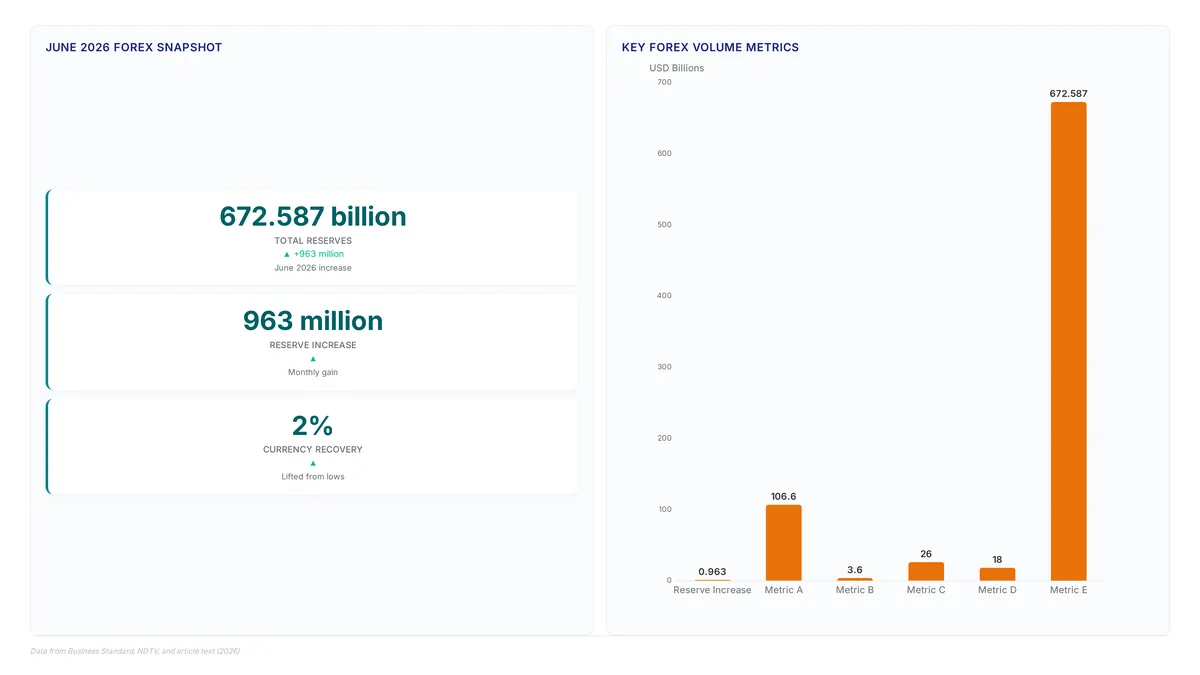
The Reserve Bank of India's derivative book signals the sheer scale of intervention used to manage currency volatility. In May 2026, the RBI's net short forward position surged to a historic $106.6 billion, revealing the massive scale of off-balance sheet interventions employed to shield the rupee. This derivatives burden indicates that recent market stability relies heavily on active central bank management, including pre-market dollar sales via state-run banks and regulatory curbs such as banning rupee non-deliverable forwards (NDFs) for residents. ForexCFD.top provides the analytical tools necessary to monitor these central bank footprints in real-time. Current market calm should not be mistaken for fundamental strength while derivative exposures remain at record extremes. The RBI continues to apply aggressive strategies to alter speculative positioning and manage price discovery.
RBI Intervention Mechanisms and Forward Market Dynamics
Off-Balance Sheet Intervention via Net Short Forwards
Selling dollars in the forward market lets the Reserve Bank of India influence rates without instantly draining spot reserves. This off-balance sheet tactic absorbs liquidity and signals resolve while keeping visible foreign exchange holdings intact. Direct spot sales cut reserve assets immediately, yet this method employs non-deliverable forwards to manufacture synthetic dollar supply. Market players selling dollars forward lock in future exchange rates, which dampens today's speculative pressure on the spot rate. The mechanism follows a specific sequence:
- The central bank enters swap contracts or sells forward dollars to authorized dealers.
- Domestic rupee liquidity tightens as banks hedge their positions against the central bank.
- Speculative capital faces higher hedging costs, discouraging aggressive shorting of the local currency.
Maturity risk defines the limitation of this tool. Spot interventions provide immediate price support, whereas forward contracts generate a future liability settled or rolled over at prevailing market rates. A significant rupee strengthening by the settlement date yields a profit for the central bank on the difference; sustained weakness raises the fiscal cost of the intervention upon maturity. Tension exists between suppressing immediate volatility and exposing the future balance sheet. Traders watching these dynamics track the divergence between spot and forward premiums to gauge policy intensity. Participants navigating such complex macro environments with transparent use and risk controls find regulated access to currency derivatives at ForexCFD.top.
Pre-Market Dollar Sales and NDF Bans in Practice
State-run banks execute heavy dollar sales before the market opens to anchor the rupee's opening price discovery mechanism, according to reports from state-run banks. This tactical move disrupts early morning volatility costs without rapidly depleting physical spot reserves. Regulators simultaneously enforce strict caps on bank forex positions to limit speculative use. The strategy technically restricts market participants from building short positions against the domestic currency. Banning rupee non-deliverable forwards for residents severs the offshore feedback loop that often accelerates depreciation. Standard spot interventions react to established trends, yet this dual approach targets the price discovery phase itself. Reduced market liquidity during the initial trading hour represents the operational cost, creating an artificial calm that may delay genuine price realization.
| Mechanism | Target | Operational Effect |
|---|---|---|
| Pre-Market Sales | Opening Rate | Stabilizes gap-ups |
| NDF Bans | Speculative Flow | Blocks offshore shorts |
| Position Caps | Bank Use | Limits systemic risk |
Traders at ForexCFD.top monitor these regulatory shifts to identify valid entry points amidst controlled volatility. Reliance on continuous regulatory enforcement forms the constraint of this method; any signal of laxity invites immediate speculative pressure. Investors must distinguish between fundamental strength and administratively suppressed volatility when sizing used positions.
2026 Derivative Strategy vs 2013 FCNR Deposit Window
Regulatory friction drives current RBI influence rather than the subsidized deposit mobilization seen in 2013. Authorities opened a special window that attracted $26 billion in foreign currency nonresident accounts using hedging subsidies during the Taper Tantrum. That approach directly expanded the liability side of the balance sheet to arrest capital flight.
| Feature | 2013 FCNR Window | 2026 Derivative Strategy |
|---|---|---|
| Primary Tool | Subsidized Deposit Rates | Pre-market Forward Sales |
| Balance Sheet | On-balance (Liability Increase) | Off-balance (Derivative Exposure) |
| Target | Long-term Inflow Mobilization | Speculative Position Disruption |
| Cost Mechanism | Explicit Hedging Subsidy | Implicit Forward Points |
Preserving visible reserve levels while managing volatility prioritizes off-balance sheet maneuvers in the modern framework. Regulators now enforce strict caps on bank positions and ban resident participation in rupee non-deliverable forwards to sever offshore feedback loops. This tactical shift avoids the explicit fiscal cost of past hedging subsidies while disrupting speculative opening price discovery. Forward markets create a massive future delivery obligation that requires careful rollover management. The 2013 model secured fresh liquidity, yet the current method essentially delays settlement pressure. Traders must monitor how long these synthetic dollar supplies can be sustained without triggering a spot market squeeze upon maturity. Participants seeking to navigate these complex currency dynamics with precision find the necessary analytical tools and used access at ForexCFD.top. Lowering the primary driver of dollar outflows provides immediate relief to India's external balances through a reduced import bill.
A structural limitation faces this theoretical relief: India lacks the deep strategic petroleum reserves of Japan or South Korea to buffer against future volatility without heavy central bank intervention. Peers with fiscal space subsidize domestic fuel directly, unlike New Delhi, which relies on RBI foreign exchange maneuvers to stabilize the rupee during such transitions. Lower oil costs improve the macroeconomic outlook, yet the currency remains vulnerable to sudden geopolitical reversals that could spike costs before strategic reserves are replenished. Falling crude oil prices have directly reduced the import bill for India, effectively lowering the "cost" of energy imports which is a primary driver of dollar demand and rupee depreciation pressure. Investors seeking to capitalize on these forex volatility patterns should note that the RBI's intervention strategy involves deploying heavy dollar sales via state-run banks before market open, a tactic that influences the opening price discovery mechanism and limits early morning volatility costs. Used trading on commodities involves significant risk of loss and may not be suitable for all investors.
Rupee Performance Before and After June 19 Peace Talks
Market volatility contracted sharply as the rupee appreciated 20 paise to trade at 94.25 against the US dollar in early trade on June 29, 2026. This pivot follows the de-escalation of geopolitical tensions, specifically the scheduled peace agreement between the US and Iran on June 19. Severe pressure faced the currency prior to this diplomatic advance, hitting a record low of 96.96 amid soaring energy costs. The subsequent calming of market sentiment has altered the technical environment, allowing domestic units to recover ground lost during the conflict peak. Expert analysis suggests this appreciation is not merely a temporary spike but a structural shift driven by policy. Veteran foreign currency consultant KN Dey projects the local unit will trade within a range of 92.
Validating Forex Buffer Strength Against Import Shocks
Verifying that foreign exchange reserves can absorb import shocks without triggering excessive volatility is necessary for investors. This liquidity allows the central bank to manage dollar demand effectively when oil prices fluctuate.
| Metric | Pre-Conflict Status | Post-Easing Trend |
|---|---|---|
| Reserve Buffer | Under Pressure | Expanding |
| Dollar Inflows | Constrained | Improving |
| Import Costs | Elevated | Declining |
Sustained dollar inflows remain the critical variable for maintaining this stability beyond temporary geopolitical relief. Nandish Shah, deputy vice president with HDFC Securities, noted that sustained dollar inflows and improving global risk appetite supported the currency. Reliance on regulatory curbs rather than deep strategic fuel reserves creates a structural vulnerability compared to peers like Japan. The RBI offered domestic banks a highly subsidized hedging rate during the 2013 crisis to mobilize foreign currency, a pricing strategy that altered the cost of dollar liquidity for banks, contrasting with current reliance on pre-market interventions. Traders should monitor whether inflow sustainability matches the pace of reserve accumulation. Used trading involves significant risk; capital is at risk.
Practical Frameworks for Tracking Forex Movements and Trends
Defining the Intra-Day Range and Gap Mechanics
The currency opened the day at 94.68 a dollar, reflecting a gap of 43 paise from Friday's close of 95.11. The session established clear boundaries as market participants assessed overnight sentiment shifts and domestic liquidity conditions.
- Identify the Gap: Calculate the difference between the previous close and the current open to measure immediate sentiment shifts.
- Map the Range: Mark the intra-day low and high points to define the active trading corridor for the session.
- Validate Breakouts: Technical analysis suggests monitoring key resistance levels that could open the way towards higher ranges, while lower zones act as potential support.
Monitor the Brent crude price decline as a primary leading indicator for rupee strength. This specific drop in energy costs directly reduces India's import bill, lowering the structural demand for dollars that typically drives depreciation. Investors can track this correlation by observing how falling oil prices immediately ease pressure on the external balance, creating a favorable environment for the local currency to appreciate against the greenback.
- Correlate Oil Drops: Falling crude oil prices have directly reduced the import bill for India, effectively lowering the "cost" of energy imports which is a primary driver of dollar demand.
- Assess Import Impact: Recognize that lower energy costs reduce the dollar outflow required for imports, supporting currency appreciation.
Anchor any September target near 93.50, consistent with expectations for the local unit to gain ground by September. This outlook coincides with the record net short forward position held by the central bank. This massive derivatives book creates a structural ceiling that pure technical analysis often misses during bullish sentiment shifts.
- Compare Forecasts: Contrast analyst projections for lower levels with the sheer scale of outstanding official hedges.
- Assess Intervention Risk: Recognize that technical regulatory measures, including the ban on rupee non-deliverable forwards (NDFs) for residents, actively restrict speculative positioning.
- Validate Flow: Ensure dollar inflows exceed the threshold required to offset these locked synthetic shorts, noting that foreign currency non-resident bank accounts are expected to see lumpy inflows.
| Metric | Bullish Signal | Intervention Risk |
|---|---|---|
| Forward Book | Declining size | Record high levels |
| Price Target | Breaks key resistance | Stalled at support |
| Policy Mode | Passive monitoring | Active derivative caps |
The hidden tension lies in the fact that while falling oil prices support appreciation, the cost of hedging remains artificially suppressed by policy bans on residents. Consequently, expert targets assuming free-market mechanics may fail if the regulator decides to defend the substantial book rather than allow rapid parity adjustments. Traders must prioritize this regulatory overhang over simple momentum charts when sizing used positions.
About
Aisha Rahman, Gold & Commodities Analyst at ForexCFD.top, brings specialized expertise in the complex links between energy markets and emerging-market currencies. Although her primary focus remains on gold and oil, her deep analysis of geopolitical risk and crude oil dynamics is directly the to the Indian rupee's recent surge. As detailed in our coverage, the rupee's five-week high against the USD was driven by easing Middle East tensions and falling energy prices, factors Aisha monitors daily. Her work at ForexCFD.top involves dissecting how commodity fluctuations impact USD/INR and other emerging-market pairs for retail traders. By connecting global oil trends to currency volatility, she provides the factual, macro-driven context necessary for understanding such sharp market moves. This analytical approach ensures our global audience receives clear, regulation-aware insights without reliance on third-party narratives, aligning with our commitment to independent, educational financial journalism.
Conclusion
Falling energy costs clash with the Reserve Bank's record forward book, creating a unique friction point for the rupee. Cheaper crude eases import burdens, but the sheer volume of outstanding hedges acts as a hidden liability that prevents linear appreciation. Traders assuming a free-market rally risk mispricing the probability of continued intervention, as the central bank has a vested interest in managing the unwind of its massive derivatives position rather than allowing sharp parity adjustments. This flexible suggests that bullish targets near 93.50 will face repeated testing until the official hedge book shrinks materially.
Market participants must prioritize regulatory constraints over momentum indicators when sizing positions. A passive reliance on oil-price correlation is insufficient when policy bans on resident hedging distort the true cost of protection. The optimal approach involves treating any rapid strength as a potential liquidity event-driven by official flows rather than a fundamental trend shift.
Start by mapping the size of the central bank's forward exposures against current inflow thresholds to identify where intervention pressure will likely intensify. This analysis grounds your risk management in the actual mechanics of the rupee exchange rate rather than speculative forecasts.
Frequently Asked Questions
This capital allows the regulator to manage volatility without exhausting its primary liquidity sources during market stress.
The net short forward position hit a record $106.6 billion in May 2026. This massive off-balance sheet exposure reveals the extreme measures required to shield the currency from excessive volatility.
Crude falling nearly 5% to $82.9 reduces the national import bill significantly. Lower energy costs ease macroeconomic pressure on the currency by decreasing the overall demand for dollars in the market.
The currency is still 5.6% down for the year despite recent rallies. This highlights that gains driven by temporary news cycles often fail to offset deeper fundamental economic weaknesses immediately.
The unit touched a record low of 96.96 last month due to high energy costs. Such extreme lows often trigger defensive positioning until external balances improve through sustained dollar inflows.
References