
Rupee Strength: Energy Costs Drop to Pre-War Lows
The rupee is set to open in the 94.25-94.30 range as oil drops below pre-war levels, defying regional trends. This divergence proves that energy costs and central bank signals now outweigh broad Asian currency weakness in determining Indian market direction.
Brent crude falling to $72.28, a level not seen since before the February 28 conflict, directly alters valuation math. We examine RBI intervention mechanics, specifically how Governor Sanjay Malhotra utilized forward premium adjustments to stabilize the currency while the dollar index hovered near 101.50. The contract is down over 21% for the month despite wider market volatility.
While ING notes that traders price in a swift normalization of shipping traffic, the local reaction remains distinct from peers. This article dissects the specific interplay between these falling energy prices and monetary policy tools. We focus on the tangible impact of these variables rather than speculative forecasts about future rate hikes or geopolitical accords.
The Role of Oil Prices and Geopolitics in Rupee Valuation
Brent Crude as the Primary Driver of India's Import Bill
India's current account dynamics hang on a single mechanical anchor: Brent crude. As a net importer sourcing nearly the vast majority of its oil externally, the domestic currency reacts hypersensitively to this one benchmark. When prices drop, the import bill contracts, reducing the volume of rupees sold to acquire dollars for settlement. Recent market action illustrates this clearly. Brent crude fell more than 4% on Wednesday and dropped a further 2% in Asian trading to reach $72.28. This level sits below the threshold seen before the US-Iran conflict began on February 28. Such a decline eases pressure on the trade deficit, permitting the rupee to firm even as regional peers weaken against a strong dollar.
Cheaper oil does not guarantee automatic currency appreciation if capital outflows accelerate simultaneously. Foreign portfolio investors can withdraw liquidity quicker than the trade balance improves, nullifying the benefit of lower energy costs. Traders must determine whether savings from reduced energy imports outweigh the drag of broader dollar strength. A sudden escalation in geopolitical tensions disrupting Strait of Hormuz traffic remains the primary risk. Brent crude prices previously topped a significant threshold per barrel at the peak of the crisis in July 2026, highlighting the volatility inherent in the region.
Rupee Rally to 96.24 Driven by Falling Oil and Forex Inflows
The Indian rupee strengthened by 21 paise to close at 96.24 against the US dollar on a single Tuesday session. This price action demonstrates how geopolitical de-escalation directly alters currency valuation mechanics when energy costs collapse. Local forex inflows provided the necessary liquidity buffer while Asian peers faltered under dollar strength. These funds offset the mechanical pressure from import bills, allowing the currency to decouple from regional weakness.
Distinctions between transient oil spikes and structural capital shifts matter for position sizing. The current rally relies on sustained low energy prices rather than temporary portfolio rebalancing. A failure to maintain these inflow levels would expose the underlying fragility of the exchange rate despite favorable crude metrics. Navigating such volatile currency pairs requires attention to the specific liquidity conditions of emerging markets. The cost of hedging interest obligations on foreign currency deposits has become a constraining factor for the rupee's rally, as the RBI manages a sizable FX forward book. Unlike periods of calm, the current environment demands precise execution to manage slippage during rapid geopolitical shifts. A reversal in the Strait of Hormuz security situation or a sudden halt in foreign investment programs would challenge the current market positioning.
Geopolitical Normalization Risks in the Strait of Hormuz
Market pricing currently assumes a swift normalization of traffic through the Strait of Hormuz, creating a fragile bias for risk assets. This consensus rests entirely on the durability of the recent accord to end the conflict, leaving valuations exposed to sudden reversal if hostilities resume. The catalyst for this steep discount was the memorandum of understanding signed on June 18, 2026, which initiated an immediate drop in oil prices. The contract is down more than 10% for the week and over 21% for the month as traders bet on uninterrupted flow. Such rapid compression in the risk premium leaves little buffer for fresh geopolitical shocks.
The cost of this complacency is measurable should the geopolitical environment deteriorate. Current positioning relies on diplomatic continuity rather than physical inventory buffers, creating a distinct limitation. Market analysts monitor real-time shipping data and crude volatility to identify when this normalization trade becomes overcrowded. The data sets the bias; the chart sets the entry. A verified escalation in regional tension or a failure to reopen the waterway would immediately flip the view from long-risk to defensive preservation.
RBI Intervention Mechanics and Forward Premium Signals
RBI Intervention Mechanics and Forward Premium Signals
State-run banks execute dollar sales on behalf of the Reserve Bank of India to arrest depreciation pressure, a protocol relying heavily on the forward book. The central bank's net short position recently surged to a record $106.6 billion in May. Such derivative accumulation signals an aggressive defense of future currency value rather than immediate spot market correction. Comments from RBI leadership pulled forward premium levels lower during recent sessions, directly altering the cost of hedging for market participants. Balance sheet expansion remains the necessary cost to maintain this stability, as foreign exchange reserves stood at hundreds of billions of dollars as of April 3, 2026. The forward premium acts as the primary pricing mechanism for these risks; when the Governor signals intent, the premium compresses, reducing the carry cost for importers. Sustained intervention drains liquidity from the domestic banking system, creating tension between exchange rate stability and local money market rates. Market participants monitor these forward signals to time entry points, recognizing that the central bank's capacity to absorb volatility is vast but not infinite. The current outlook depends heavily on oil prices remaining below pre-conflict levels. A sustained rise above the per barrel forecast by some analysts for the three-month horizon would increase pressure on the import bill and challenge the RBI's defensive posture.
Interpreting Dollar Index Levels Near 101.50 for Rupee Liquidity
Market bets that elevated inflation will force Federal Reserve rate hikes keep the dollar index holding near 101.50, creating a divergent path for Asian currencies. This level sits close to its highest in more than a year and dictates immediate hedging thresholds for rupee pairs. Regional peers weaken under this pressure while the rupee's stability relies on interpreting central bank signals through forward premium adjustments rather than spot rates alone. Operators must monitor how the forward book constrains spot rallies even when oil prices fall. The short-dollar forward book represents a massive derivative position requiring complex unwinding, often capping gains despite favorable crude dynamics. Compressed forward premiums measure the cost of maintaining this defense, directly impacting hedging costs for importers. This approach signals a preference for stabilizing future value over immediate exchange rate fixation. The rupee appears resilient yet underlying liquidity remains artificially constrained by these hedges. A decisive break higher in the dollar index suggests the Federal Reserve narrative is overwhelming local support mechanisms.
Regional Currency Weakness Risks Amid US Rate Hike Expectations
Federal Reserve hike bets driving the dollar index near 101.50 stem the broader Asian weakness. External pressure creates a divergence where regional peers falter while the rupee holds ground through targeted intervention. Operators must distinguish between general regional softness and specific local support mechanisms.
A sudden reversal poses the primary risk if oil stabilizes above a critical threshold, removing the terms-of-trade advantage. Indian banks offer up to a competitive rate on FCNR deposits to attract hard currency flows, unlike neighbors relying solely on rate hikes. This dual approach of fiscal exemption and direct market operations isolates the rupee from immediate contagion. Sustained dollar strength near the 101.50 threshold maintains pressure on the cost of hedging for importers, potentially eroding the currency's relative outperformance over time. Traders should monitor the forward premium for signs of stress as liquidity tightens. A breakdown in the correlation between falling crude and rupee stability would signal that intervention capacity is reaching its limit. Analytical frameworks help navigate these divergent central bank paths without exposure to unverified third-party signals.
Rupee Performance Relative to Broader Asian Currency Weakness
Defining Rupee Divergence Amid Asian Currency Weakness
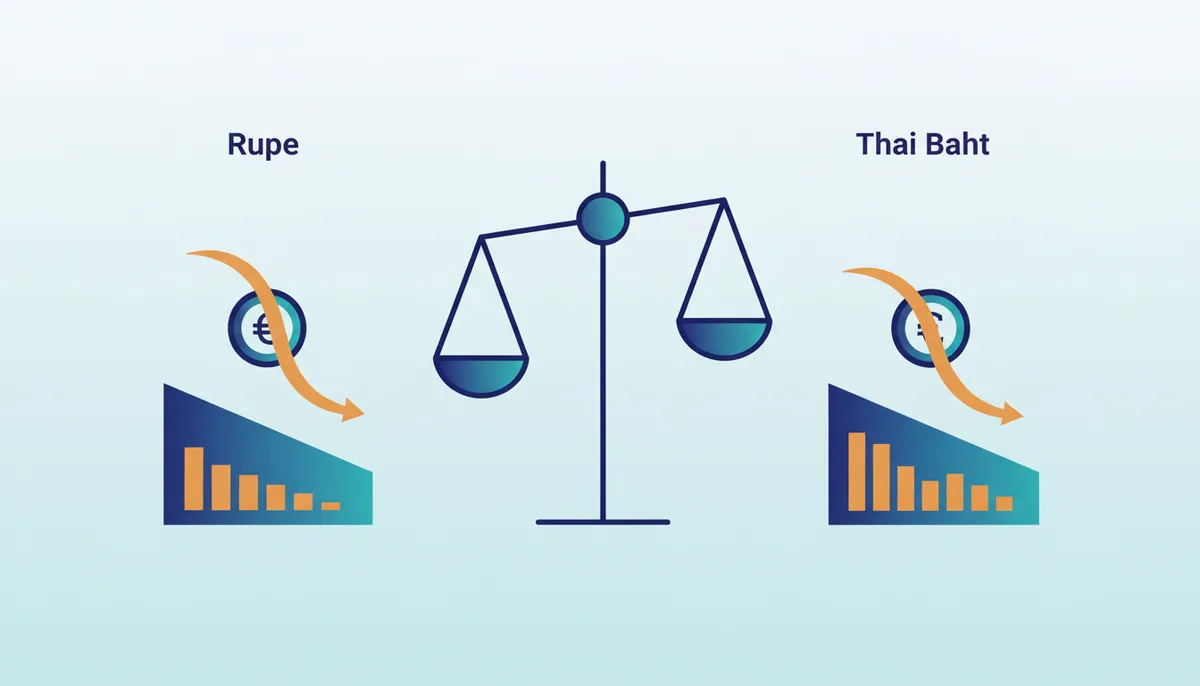
Traders anticipate the local unit opening firmer within the 94.25-94.30 band, a sharp contrast to regional counterparts crumbling under dollar strength. This divergence stems from a dual engine: collapsing energy costs and a static tax regime designed to attract foreign capital. While neighbors bleed reserves fighting pure FX outflows, the Indian market absorbs shock through falling oil bills and aggressive central bank defense.
| Dimension | Regional Peers | Indian Rupee |
|---|---|---|
| Primary Driver | US Rate Hike Fears | Oil Price Collapse |
| Central Bank Action | Rate Adjustments Only | Direct Forex Selling |
| Forward Book | Standard Hedging | Elevated at billions |
| Fiscal Context | Static Tax Regimes | Capital Gains Exemptions |
The mechanism depends on the Reserve Bank of India deploying a massive short-dollar forward book to anchor future expectations, a tool less available to counterparts like the Bank of Thailand. Oil relief offers fundamental cover, yet forward premium signals confirm that liquidity stays tightly managed rather than floating freely. Participants at ForexCFD.top observe that this setup creates a fragile equilibrium where any stabilization in crude prices removes the implicit subsidy, exposing the currency to the same gravitational pull dragging down the broader Asian basket. The specific price level, now sitting below pre-conflict baselines, acts as a leading indicator for appreciation distinct from peers constrained by US rate expectations. Analysts at ForexCFD.top isolate this gap by monitoring the distance between oil-driven inflows and general market risk-off sentiment. Geopolitical reignition poses a hard constraint; renewed tension in the Strait of Hormuz would instantly invalidate the low-oil thesis.
Market focus remains fixed on the stability of the 94.25-94.30 support zone as the primary entry trigger. A break below this range signals that oil dynamics no longer dominate the narrative, shifting attention back to external dollar pressure. Conversely, any escalation disrupting supply chains flips the bias, rendering oil-price-based long positions untenable regardless of technical support. While Asian peers falter under DXY pressure near 101.50, the Indian rupee decouples due to this unique energy import advantage. This combination of falling oil bills and aggressive central bank defense isolates the currency from broader market risk-off sentiment. The cost of maintaining such divergence is measurable; RBC Capital Markets strategist Abbas Keshvani warned that reserve depletion could limit future aggressive intervention capacity. Unlike peers relying solely on rate hikes, the RBI combined direct forex selling with fiscal policy changes, specifically exempting foreign investors from capital gains tax on bond interest. This structural difference allows the rupee to absorb shocks that cripple neighbors. Traders at ForexCFD.top monitor the spread between Brent futures and local forward premiums to time entries. A reversal in oil prices above pre-conflict levels or a sudden halt in these specific forex inflows would invalidate the bullish thesis immediately.
Strategic Steps for Hedging Currency Exposure and Investment Timing
Defining Strategic Hedging Triggers Using Oil and RBI Signals
Hedging triggers fire when Brent crude holds beneath pre-conflict baselines while the forward premium tightens on central bank signaling. This split emerges because the Reserve Bank of India manages a sizable FX forward book to smooth volatility rather than chase absolute strength. Interest obligations on foreign currency deposits create a tangible cost that limits how far the rupee can rise.
Market participants must separate fundamental relief from cheaper energy against the technical ceiling created by unwinding forward book maturities. A specific limitation exists: if oil prices stabilize while the central bank keeps absorbing dollars to build reserves, the expected currency rally may stall despite favorable trade dynamics. Analysis suggests watching the interplay between these variables closely, as standard correlation models often break during such dual-signal periods. Proprietary trading solutions navigate these specific liquidity constraints effectively. The view flips if crude prices rebound sharply or if RBI Governor Sanjay Malhotra signals a shift away from current absorption policies.
Executing Rupee Entry Points During 94.25-94.30 Firmer Openings
Operational discipline dictates entering short-hedge positions only when the market tests the 94.25-94.30 liquidity zone, a range notably firmer than the prior 94.6650 settlement. This specific window emerges as Brent crude volatility creates temporary mispricing against the broader Asian weakness driven by a dollar index hovering near 101.50.
Mistaking central bank smoothing for a trend reversal poses the primary risk. Falling energy costs reduce the import bill, yet the Reserve Bank of India actively manages the forward premium to prevent excessive appreciation that could hurt export competitiveness. Comments from RBI Governor Sanjay Malhotra have previously signaled discomfort with rapid premium compression, effectively capping upside momentum despite favorable oil fundamentals. Investors relying on institutional-grade execution tools should note that hedging costs can expand rapidly if the market prices in a swift normalization of Strait of Hormuz traffic.
A contrarian view suggests that if the 94.25 support fails to hold during the Thursday open, the subsequent break could trigger accelerated flows toward the psychological 95 level. Real-time volatility monitors help distinguish between genuine breakdown and liquidity hunts. The view flips only if Brent crude sustains levels above pre-conflict baselines while the dollar index breaches its yearly highs, invalidating the current divergence thesis. Market participants should avoid over-using use ahead of US interest rate decisions, as geopolitical headlines can reverse price action instantly.
Application: Mitigating Dollar Index Volatility Risks Near 101.50 Levels
Dollar index persistence near 101.50 defines the immediate resistance ceiling where resilient US data could abruptly reverse rupee gains. Investors must hedge currency exposure when Federal Reserve rate hike expectations tighten liquidity, specifically monitoring how a strong dollar offsets oil-driven relief. While falling Brent crude supports the local currrency, the Dollar Index holding near 13-month highs introduces a counter-vailing force that demands tactical protection.
Protection costs rise if the forward book requires complex unwinding, a constraint noted when technical sizes approach massive scales requiring complex unwinding procedures. Clients should separate the fundamental thesis of low oil from the technical trigger of a dollar breakout. A decisive move above the 101.50 level invalidates the bullish rupee narrative, necessitating an immediate review of open positions. Traders should await confirmation of US inflation data before committing capital to long-rupee strategies. The view flips only if oil prices reclaim pre-conflict highs or if the Federal Reserve signals a pause in tightening cycles.
About
Marcus Halloran serves as Chief Market Strategist at ForexCFD.top, where he specializes in translating complex macroeconomic shifts into actionable insights for retail traders. His extensive background as a former interbank FX strategist in London provides the precise expertise required to analyze the Indian rupee's divergence from regional peers. Halloran's daily work involves dissecting central bank policies and commodity correlations, directly connecting the recent slide in oil prices to USD/INR movements. At ForexCFD.top, an independent publication dedicated to forex and CFD market analysis, he leads coverage on how energy dynamics and Federal Reserve decisions impact emerging market currencies. This specific article reflects his core competency in mapping intermarket relationships, ensuring traders understand the fundamental drivers behind the rupee's durability. By using his experience with G10 macro and interest rate differentials, Halloran delivers the data-led context necessary for navigating volatile currency pairs without relying on third-party recommendations.
Conclusion
Falling oil prices offer temporary relief, but they mask a critical structural vulnerability: the sheer scale of unhedged exposure when the Dollar Index challenges the 101.50 resistance. While Brent crude averaging a moderate level in the fourth quarter offers fundamental support, relying solely on energy deflation ignores the liquidity trap created by the Reserve Bank's massive forward book. If US inflation data forces a repricing of rate expectations, the resulting dollar strength will overwhelm oil-driven gains instantly. The window for passive hedging closes the moment geopolitical headlines shift, turning a technical breakdown into a cascading loss of capital.
ForexCFD.top advises treating the 94.25 level as a hard stop-loss threshold rather than a buying opportunity. Do not assume the divergent thesis holds if the dollar sustains momentum above yearly highs. The operational cost of being wrong here exceeds the premium of protection. Execute a review of all open long-rupee positions before the Thursday open to ensure your use ratios can withstand a spike in volatility. Immediate action requires isolating your currency exposure from your energy assumptions; if the dollar breaks 101.50, exit the position regardless of the prevailing crude price. Protect your capital base now by aligning your hedges with the worst-case dollar scenario, not the optimistic oil forecast.
These funds provide a critical liquidity buffer that offsets mechanical pressure from import bills.
Q: What scale of intervention did the RBI undertake to defend the currency?
A: The central bank sold approximately billions in foreign exchange during May alone to stabilize the rupee. This action demonstrates the aggressive measures required to counter record-low pressures and maintain market order.
Q: How severe was the recent monthly decline in crude oil contracts?
A: The contract dropped over 21% for the month as traders bet on uninterrupted shipping traffic normalization. This sharp decline directly alters valuation math by reducing the overall import bill for energy-dependent economies.
Frequently Asked Questions
Lower oil costs reduce the dollar volume needed for India's external energy purchases.
Brent crude falling to $72.28 signals a return to valuations seen before the February conflict began. This decline allows the rupee to firm even while regional peers weaken against a strong dollar.
These funds provide a critical liquidity buffer that offsets mechanical pressure from import bills.
This action demonstrates the aggressive measures required to counter record-low pressures and maintain market order.
The contract dropped over 21% for the month as traders bet on uninterrupted shipping traffic normalization. This sharp decline directly alters valuation math by reducing the overall import bill for energy-dependent economies.
References