
Rupee Gains as Oil Prices Ease Dollar Pressure
The Indian Rupee rose 0.6% in June as Commerzbank data confirms it outperformed all Asian peers against the Dollar. This divergence isn't magic; it's math. Cheaper crude and renewed foreign capital entering the market created a buffer zone that regional neighbors lack. You need to understand why the Rupee is ignoring global volatility while others crack, and exactly how foreign reserves are being deployed to keep inflation in check.
Commerzbank analysts Charlie Lay and Dr. Henry Hao point to a specific confluence: debt inflows offsetting a strong dollar while oil prices drop. Their research notes USD/INR holding near 94.40 following a 0.8% drop the prior week. The reopening of the Strait of Hormuz triggered the oil price decline that eased pressure on India's balance of payments. While the Philippine Peso gained 0.5%, the Rupee led the recovery. These flows directly impact domestic inflation expectations and the central bank's ability to manage volatility without depleting assets.
Foreign exchange reserves reached USD672.6bn in the week ending 19 June, a 0.1% increase that Commerzbank cites as ample capacity for the Reserve Bank of India to smooth volatility. This liquidity allows policymakers to maintain the currency within the recent 94-96 trading range. However, the analysis warns that global oil prices remain the single most critical variable for the near-term outlook. Investors must watch how portfolio inflows interact with energy costs to sustain this relative strength against the US Dollar.
The Role of Oil Prices and Capital Flows in Rupee Valuation
How Balance of Payments Pressure Links Oil Prices to INR
India runs a structural deficit because it imports far more crude than it exports. This imbalance creates a constant drag on the USD/INR exchange rate, making the currency hypersensitive to energy costs. When oil prices fall, the pressure valve releases. Data indicates the Indian Rupee rose 0.6% in June, outperforming regional peers as energy bills contracted. Lower crude costs reduce the dollar demand required to settle trade invoices. Importers selling local currency to buy dollars face less urgency when energy prices drop.
Global oil volatility can rapidly reverse these gains if geopolitical tensions flare. Market analysis identifies durability levels near the 94-96 range. Strong reserves and policy focus are expected to keep the exchange rate near the lower end of this band. Commodity exporters suffer when prices drop, yet India benefits as an importer through improved terms of trade. Identical macro variables produce opposite currency results based on trade structure. Understanding this link prevents misinterpretation of strength driven purely by external cost reductions rather than domestic growth. New investors must distinguish between temporary relief from cheaper oil and sustainable appreciation from productivity gains. Oil prices slid below pre-Iran war levels, acting as a primary catalyst for the Rupee's potential rally.
Tracking Foreign Capital Inflows and Asian Currency Performance
Specific balance-of-payments dynamics drive relative performance when global oil prices stabilize. Analysts confirmed debt inflows specifically supported the currency's rangebound behavior. Capital flow volumes were sufficient to offset the gravitational pull of a strong dollar. The sharp drop in oil prices following the recent reopening of the Strait of Hormuz largely drove this performance. Lower energy bills improve the current account, yet the market remains sensitive to shifts in global yields which can impact portfolio inflows.
Operators must distinguish between transient portfolio flips and structural reserve building when sizing positions. Understanding the composition of inflows remains a key factor for forecasting currency outlook accuracy. Global oil prices remain the single most necessary determinant of the rupee's near-term outlook. Investors should remain cautious of unregulated platforms promising guaranteed returns on volatile EM pairs. Debt inflows recently supported the Rupee's rangebound performance, yet this support is fragile against energy shocks.
Risks to USD/INR Stability from Strait of Hormuz Disruptions
Geopolitical friction near the Strait of Hormuz creates immediate volatility risks for the USD/INR pair by threatening sudden crude price spikes. A closure event would reverse the recent stability gained from the waterway's reopening, which previously drove oil values lower. Such a shock challenges the assumption that the currency will remain anchored near the lower end of the 94-96 range. Strong reserves provide a buffer. The Reserve Bank of India (RBI) has ample capacity to smooth episodes of excessive currency volatility. Rapid price movements can still test market stability.
Investors tracking these flows must distinguish between transient trade deficits and structural stops in foreign capital inflows. Observations indicate that debt inflows recently supported the Rupee's rangebound performance. A reversal in sentiment could trigger rapid outflows, overwhelming the protective effect of lower import bills. Global oil prices act as the dominant determinant for the Rupee's near-term outlook, overriding domestic policy strengths. Market participants should monitor commodity market volatility as a leading indicator for currency stress. The 94 level acts as a floor while 96 caps upside momentum in current conditions. Traders watch these boundaries closely during periods of regional tension.
Mechanics of Foreign Reserve Support and Inflation Transmission
RBI Intervention Mechanics Using Foreign Exchange Reserves
The Reserve Bank of India deploys the U.S. Dollar as its primary tool to steer the rupee within a managed floating exchange rate regime. When excessive volatility threatens the USD/INR pair, the central bank sells dollars from its stockpile to absorb selling pressure. India's foreign exchange reserves gained 0.1% to USD672.6bn in the week ending 19 June, providing ample liquidity for such operations. This mechanism allows the authority to smooth fluctuations without abandoning market-determined pricing.
- The central bank sells foreign currency to increase supply during sharp rupee depreciation.
- Market participants receive dollars, satisfying immediate import or debt service needs.
- The added supply helps maintain the exchange rate near the lower end of its recent 94-96 range.
Hawkish Fed bets strengthen the greenback globally and test these support limits. The Reserve Bank of India likely intervened recently as the rupee held steady while Asian peers faltered. Reserves buffer shocks yet international oil prices remain the single most necessary determinant of the rupee's near-term outlook. Market observers monitor these liquidity dynamics to inform trading strategies on regulated platforms. Reserve levels provide the RBI with ample capacity to smooth episodes of excessive currency volatility.
Oil Price Transmission to INR Stability and Investor Sentiment
Crude oil sliding below pre-Iran war levels directly reduces India's energy import bill, creating immediate fiscal relief for the world's third-largest crude importer. This pricing mechanism lowers the current account deficit, allowing the Indian Rupee to decouple from regional weakness driven by dollar strength. Investors assess sentiment shifts by monitoring when analyst firms upgrade sovereign outlooks based on these improved terms of trade.
| Factor | Impact on USD/INR | Investor Signal |
|---|---|---|
| Crude Prices | Downward pressure on pair | Buy INR on dips |
| Import Bill | Reduced forex demand | Increased FDI appetite |
| Inflation | Lower CPI expectations | Bond yield stability |
Worldwide oil prices drive the rupee's near-term outlook and often outweigh purely domestic data releases. Geopolitical escalations can rapidly alter price gains, as seen when the reopening of the Strait of Hormuz caused a sharp drop in oil prices. Reserves provide a backstop yet cannot indefinitely offset structural trade imbalances if oil spikes again. Stakeholders must distinguish between temporary liquidity support and genuine solvency improvements driven by trade mechanics.
Monitoring Checklist for USD/INR Range and Capital Flow Drivers
Track debt inflows to confirm rangebound performance when broad dollar strength threatens emerging market stability. Operators must verify that capital flow volumes remain sufficient to offset the gravitational pull of a strong greenback before assuming trend continuity.
- Monitor universal oil prices as the single most necessary determinant of the rupee's near-term outlook, noting that sharp drops following geopolitical de-escalation directly improve investor sentiment.
- Assess foreign exchange reserves qualitatively for ample capacity to smooth volatility, recognizing that large stockpiles allow the central bank to absorb selling pressure without altering structural trends.
3.
| Driver | Impact on USD/INR | Monitoring Signal |
|---|---|---|
| Oil Prices | Bearish for USD | Strait of Hormuz status |
| Debt Inflows | Bearish for USD | Flow data |
| Reserves | Stabilizing | RBI intervention frequency |
Rising debt inflows support the currency and contribute to the pair's rangebound performance despite a strengthening dollar. Capital-flow measures continue to underpin INR yet cross-border oil prices remain the single most necessary determinant of the rupee's near-term outlook. USD/INR should remain near the lower end of its recent 94-96 trading range as long as the combination of lower oil prices, improving portfolio inflows, and ample foreign exchange reserves persists. Newer market participants must distinguish between temporary liquidity support and fundamental balance-of-payments improvements.
Comparative Performance of INR Against Asian Peers and the Dollar
Defining INR Durability Against Asian Peers and Dollar Strength
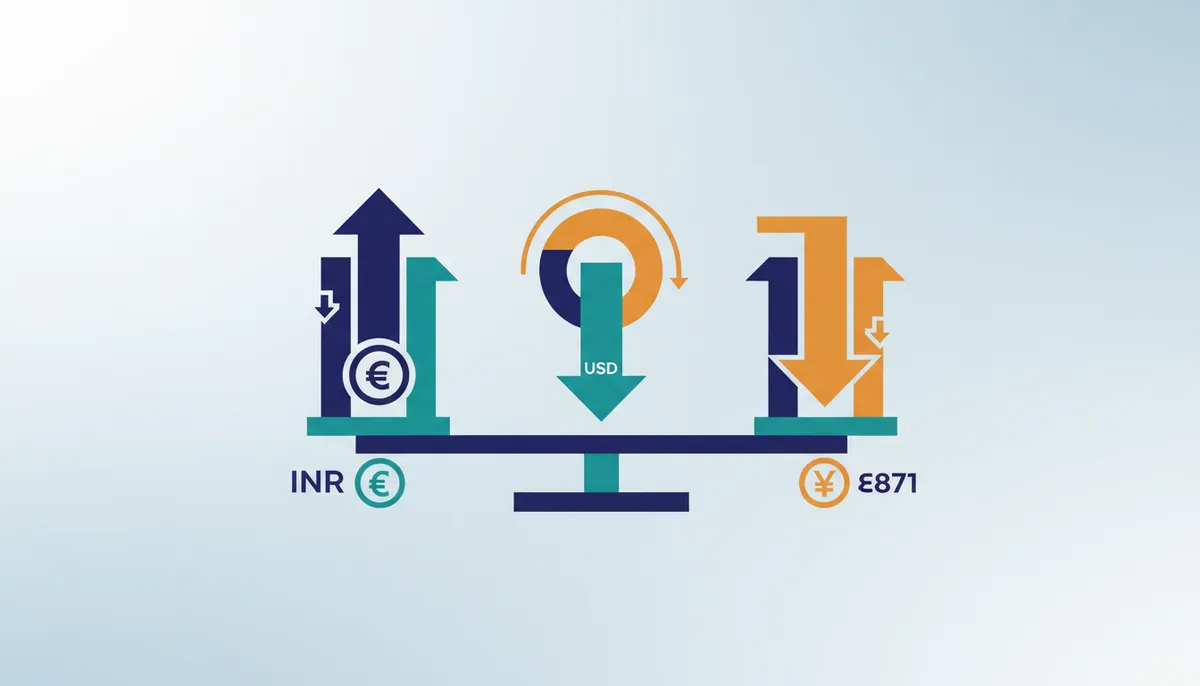
The Indian Rupee demonstrated unique durability by defying regional weakness on a specific Wednesday, holding steady while Asian peer currencies faltered. This divergence establishes a clear baseline where USD/INR held near 94.40, outperforming regional competitors despite a strengthening Dollar. Unlike exporters suffering from revenue compression, India benefits from reduced import bills that ease balance-of-payments pressure. This stability is supported by strong foreign exchange reserves, which provide the Reserve Bank of India with ample capacity to smooth episodes of excessive currency volatility. This divergence shows the structural difference between India, which benefits from reduced import bills as an oil importer, and Canada, where currency valuations remain tied to export revenue dynamics.
Analysts monitor these balance-of-payments shifts to identify range-bound opportunities near the lower end of the 94-96 band. Investors must distinguish between temporary central bank support and fundamental structural shifts driven by commodity pricing.
Applying Oil Price Thresholds to Predict INR Rally Potential
Traders should watch for crude oil sliding below pre-conflict levels as the specific trigger for an INR rally at the market open. This threshold acted as the primary catalyst on June 25, 2026, causing the rupee to buck Asia weakness while regional peers faltered. The mechanism is direct: lower energy costs immediately improve India's terms of trade, prompting foreign capital inflows that strengthen the currency against the Dollar. Investors asking where to allocate capital must recognize that oil price drops benefit importers like India while hurting exporters like Canada, whose dollar hovered near seven-month lows during the same period.
| Factor | Indian Rupee (Importer) | Canadian Dollar (Exporter) |
|---|---|---|
| Oil Price Drop | Bullish Catalyst | Bearish Drag |
| Trade Balance | Improves Significantly | Deteriorates |
| Capital Flow | Inflow Surge | Outflow Risk |
While oil drives sentiment, the Reserve Bank of India maintains ample reserves to smooth excessive volatility, capping runaway gains.
INR vs CAD: Divergent Currency Responses to Falling Oil Prices
Falling crude prices trigger opposite reactions for the Indian Rupee and Canadian Dollar due to their structural trade balances. While the Indian Rupee strengthens as lower energy costs reduce import bills, the Canadian Dollar weakens because energy exports drive its valuation. This divergence was stark recently, with the CAD hovering near seven-month lows as oil prices slid. Conversely, India benefits from the resulting decline in inflation and improved balance-of-payments pressure. Traders must recognize that identical macroeconomic data produces inverted currency outcomes depending on the nation's net energy status. This structural reality means that falling oil prices create a distinct performance gap between the two currencies.
| Feature | India (Importer) | Canada (Exporter) |
|---|---|---|
| Oil Price Impact | Currency Strengthens | Currency Weakens |
| Primary Driver | Reduced Import Bill | Export Revenue Loss |
| Recent Trend | Stable / Gaining | Declining |
| Correlation | Negative to Oil | Positive to Oil |
Strategic Application of Currency Forecasts for Investment Decisions
Defining the 94-96 USD/INR Trading Range Boundaries
Spot rates hover near 94.40 as the USD/INR pair digests a set 94-96 corridor established over the past month. Renewed foreign capital inflows now counterbalance the gravitational pull of a strengthening greenback. This flexible separates the rupee from regional peers, particularly after the sharp drop in oil prices lifted the currency above others in Asia. Strong foreign exchange reserves back the technical floor near 94.00, giving the Reserve Bank of India ample capacity to smooth excessive volatility. Debt inflows buffer against Fed hawkishness, yet external oil shocks remain a persistent threat to stability.
Application: Applying Oil Price Thresholds to Time INR Entry Points
Crude prices sliding below pre-Iran war levels acted as the primary catalyst for the Rupee's recent rally, directly countering typical negative correlations between energy imports and the INR. A significant drop in crude mechanically reduces India's import bill, creating an immediate improvement in terms of trade. Relying solely on energy costs ignores the countervailing pressure of a strengthening US Dollar. The Federal Reserve's hawkish stance maintains upward pressure on the greenback regardless of energy costs. Traders must monitor the 94-96 trading range closely because currency stability results from a complex equilibrium between opposing macroeconomic forces. Oil provides the catalyst, but debt inflows specifically support rangebound performance by offsetting the gravitational pull of a strong dollar. This analysis serves educational purposes only and does not constitute financial advice.
Risk Exposure from Strait of Hormuz Supply Disruptions
Geopolitical tension in the Strait of Hormuz threatens to reverse the sharp drop in oil prices that recently drove the Indian Rupee's gains. Current market optimism benefits from de-escalation and the reopening of the shipping lane, yet prices remain acutely sensitive to shocks that could push energy costs higher. The Rupee's outperformance relative to Asian peers was largely driven by lower crude prices reducing concerns over India's energy import bill; a supply disruption would remove this primary support pillar. Rising import bills could challenge the positive sentiment generated by recent inflow data.
About
Vikram Nair, Emerging Markets & Asia FX Writer at ForexCFD.top, brings specialized on-the-ground expertise to the analysis of the Indian Rupee (INR). Based in India, Nair's daily work focuses intensely on USD/INR dynamics, Reserve Bank of India (RBI) policy shifts, and the specific regulatory environment governing local capital flows. This direct exposure allows him to contextualize how macro drivers like crude oil prices and foreign portfolio inflows technically impact the currency pair for retail traders. His background in dissecting India's unique market structure ensures that the analysis connects global fundamental data with the practical realities faced by traders in Tier-2 and Tier-3 markets. At ForexCFD.top, an independent publication dedicated to FX majors, emerging-market pairs, and trading education, Nair uses this deep regional knowledge to provide clear, regulation-aware insights. His reporting bridges the gap between complex economic thesis statements and actionable market understanding for a global audience seeking factual, vendor-neutral analysis.
Conclusion
Scalability breaks when traders mistake temporary oil-driven relief for structural currency strength. The operational cost of holding long Rupee positions skyrockets if geopolitical friction in the Strait of Hormuz suddenly reverses crude prices, instantly invalidating the import-bill narrative. While debt inflows currently buffer against Federal Reserve hawkishness, this equilibrium is fragile and relies entirely on continued de-escalation in shipping lanes. You must recognize that the 94-96 trading range functions only while external energy shocks remain absent.
Adopt a conditional strategy that treats the current rally as a tactical opportunity rather than a long-term trend reversal. Maintain strict exposure limits until oil prices stabilize well below pre-conflict levels for at least two consecutive weeks. Do not assume foreign exchange reserves provide infinite protection against a synchronized spike in energy costs and dollar strength.
Start by stress-testing your current portfolio against a scenario where crude oil jumps 15 percent overnight due to supply chain blockage. This immediate exercise reveals whether your capital allocation can survive the loss of the primary catalyst driving recent gains. Focus your analysis on how quickly rising import bills would erode the technical floor near 94.00. Only after verifying your risk parameters should you consider adjusting your stance on the Indian Rupee.
Frequently Asked Questions
The Rupee rose 0.6% in June, outperforming all regional Asian currencies against the Dollar. This specific gain indicates strong relative resilience driven by favorable capital flows and reduced energy import costs for traders.
Oil prices slid below pre-Iran war levels, triggering a potential rally for the currency at market open. This drop directly eases pressure on India's balance of payments by lowering the cost of crude imports.
Foreign exchange reserves gained 0.1% to reach USD672.6bn in the week ending 19 June. This accumulation provides the central bank with ample capacity to smooth excessive volatility without depleting critical national assets.
The pair holds near 94.40 after falling 0.8% the prior week due to renewed foreign capital inflows. These inflows offset dollar strength, allowing policymakers to maintain the currency within its recent trading range effectively.
Global oil prices remain the single most important determinant of the rupee's near-term outlook despite other positive factors. Investors must monitor energy costs closely as any spike could reverse recent gains from capital inflows quickly.
References