
Swap free account fees: IC Markets' real costs
IC Markets lists exact holding fees ranging from a minimal amount to a substantial amount per lot depending on the specific currency pair traded. These swap free accounts replace traditional interest payments with fixed administrative charges to satisfy religious prohibitions against riba. While marketed as ethically compliant solutions, the mechanical reality involves a distinct fee structure that applies regardless of market direction.
Traders will learn how these holding fees function as a flat rate applied every calendar day, including weekends, rather than fluctuating with interbank lending rates. The analysis compares the cost efficiency of these arrangements against Raw Spread and Standard models, revealing that commission structures often remain identical to their interest-bearing counterparts. Data indicates that while use can reach 1:5000 under specific conditions, the overnight costs accumulate linearly on open positions.
The discussion extends to the regulatory environment where entities like ASIC and CySEC cap use significantly lower than offshore jurisdictions such as the FSA Seychelles. Readers will examine the specific terms governing MetaTrader 4, MetaTrader 5, and cTrader platforms to understand exactly how brokers enforce these religious constraints. Ultimately, the article dissects whether the removal of swap adjustments truly benefits the trader or simply rebrands the cost of capital.
The Role of Swap Free Accounts in Religiously Compliant Trading
Defining the Swap Free Account for Religious Compliance
A swap free account removes overnight interest charges to satisfy religious prohibitions against usury. This financial structure replaces variable swap rates with fixed administrative costs, keeping capital compliant with Islamic finance principles while maintaining market access. Brokers like IC Markets explicitly configure these ledgers for clients who cannot earn or pay interest due to proven religious beliefs. The configuration applies across both Raw Spread and Standard account types, preserving tight execution speeds without compromising theological constraints. Removing interest does not remove all overnight costs. A flat holding fee typically applies after an initial grace period, shifting the cost basis from time-value-of-money to service maintenance. Regulatory oversight varies; some jurisdictions mandate strict eligibility verification before enabling the feature, while others apply it universally. The operational reality is that holding fees create a predictable cost floor, whereas standard swaps fluctuate with global central bank rates.
Cost predictability conflicts with market alignment. Standard accounts reflect interbank lending rates exactly. Swap free variants decouple overnight costs from global liquidity conditions. This decoupling provides certainty for long-term position holders but may result in higher effective costs during periods of low global interest rates. Traders should verify specific fee schedules before opening positions, as grace periods and flat rates differ by instrument and provider.
Platform Availability and Instrument Access for Islamic Accounts
Swap free accounts operate on MetaTrader4, MetaTrader 5, and cTrader without requiring specialized software interfaces. This broad compatibility ensures traders access over 90 instruments, ranging from substantial forex pairs to indices and energy commodities, using familiar technical analysis tools. Standard accounts accrue variable interest. These configured ledgers apply a flat holding fee for positions kept open overnight.
The grace period in trading defines a specific duration where new positions incur no holding charges, allowing initial market entry without immediate cost penalties. For most currency pairs, this window spans 5 days, though energy instruments like natural gas often face fees from day one. This distinction requires traders to verify specific symbol rules before deployment. Infrastructure providers maintain state-of-the-art execution speeds to ensure religious compliance does not degrade order fill quality or latency.
Account insurance protection for clients using these structures can reach up to $1 million depending on the broker and jurisdiction. A critical operational constraint exists: brokers retain the right to request documentation proving religious necessity, and failure to provide this may result in revoked privileges. Traders must also note that while use caps vary by regulator, the instrument list remains largely identical to standard offerings, preventing liquidity fragmentation for compliant strategies. Full Access Full Access Insurance Up to $1,000,000 Up to $1,000,000 Account insurance prot.
Use Caps: ASIC and CySEC Restrictions vs FSA Seychelles Limits
Regulatory jurisdiction dictates the maximum use available, creating a sharp divide between strict oversight and high-capacity trading. Entities licensed by ASIC or CySEC enforce a hard cap of 1:30, prioritizing capital preservation for retail participants over speculative volume. Conversely, brokers operating under the FSA Seychelles framework can offer limits reaching 1:1000, providing substantial buying power for those willing to accept lighter regulatory supervision. This disparity forces a strategic choice where traders must balance safety protocols against margin efficiency when selecting a provider for their swap-free needs.
Intermediate caps exist elsewhere. S 1:1000 Market Flexibility CMA Kenya 1:400 Regional Growth SCB Bahamas 1:200 Offshore Acc. FXEmpire highlights this massive disparity in use capabilities among competitors as a critical differentiator for high-volume traders seeking religious compliance. The operational reality is that system configurations dynamically adjust these limits based on the client's regulatory bucket, meaning a single broker may present different trading conditions to different users. Accessing higher ratios often requires moving funds to an offshore entity, which may alter dispute resolution pathways or insurance coverage levels. Traders must verify which legal entity holds their account before opening positions, as the swap free status does not override local use laws.
Inside the Mechanics of Holding Fees and Overnight Charges
Flat Rate Holding Fee Calculation Per Lot
Traders face a fixed charge per lot rather than variable interest calculations on swap-free structures. This flat rate holding fee replaces standard overnight financing to maintain religious compliance while covering operational costs. Unlike interest-based swaps that fluctuate with central bank rates, this fee remains a set dollar amount set by the broker's current schedule. The holding fee applies every calendar day including weekends, with weekend charges typically deducted on the next business day. Rates and the specific holding period are subject to change to reflect market conditions when necessary. While some providers offer identical spreads to standard accounts, the primary trade-off is the elimination of the grace period for specific energy instruments like XNGUSD.
| Instrument Category | Fee Trigger | Grace Period |
|---|---|---|
| Substantial Pairs | Day 6 | 5 Days |
| Energy (XNGUSD) | Day 1 | None |
| JPY Pairs | Day 3 | 2 Days |
Operators must monitor logic carefully, as holding positions beyond the grace window incurs daily costs regardless of profit direction. Traders expecting unexpected charges should verify if their specific symbol falls under the standard five-day exemption or an immediate charge rule.
Applying the Five-Day Grace Period to New Positions
New positions benefit from a 5-day grace period where no holding fees are incurred. This grace period enables traders to manage short-term swings without eroding equity through administrative charges. For example, opening a BTCUSD position on a Monday permits holding until Friday close before any fee application occurs. However, energy instruments including XNGUSD, XTIUSD, and XBRUSD incur charges from Day 1 without any grace period. For USDJPY and GBPJPY, holding fees apply on day.
| Instrument Class | Fee Start Day | Grace Duration |
|---|---|---|
| Standard Majors | Day 6 | 5 Days |
| Energy (XNGUSD) | Day 1 | None |
| JPY Pairs | Day 3 | 2 Days |
Weekend fee application creates a specific operational constraint for swing traders using the full window. Since the holding fee charges every calendar day including weekends, a position held over Saturday and Sunday triggers deductions on the next business day if the grace window has expired. Traders must calculate closing times precisely, as holding through a weekend near the grace limit can inadvertently activate charges. Operators should monitor instrument-specific rules closely, as energy and currency exceptions differ significantly from the standard model.
Instrument-Specific Fee Schedule Validation
Validate expected charges against the published fee schedule before opening positions to avoid unexpected debit spikes. Exotic pairs like EURTRY carry a holding fee of 116 US$ per lot, while GBPTRY costs 123 US$ per lot, vastly exceeding standard substantial pair rates. Weekend holding fees will be charged the next business day, consolidating three days of accrual into a single deduction event. Traders must distinguish between the flat holding fee structure and variable interest models to manage liquidity effectively. Some brokers may apply a maintenance fee instead of traditional swaps, requiring manual verification of the specific instrument class.
| Instrument Type | Approximate Cost Driver | Verification Step |
|---|---|---|
| Substantial Pairs | Low base rate | Confirm Day 6 start |
| Exotic Pairs | High per-lot fee | Check per-lot value |
| Energy | Day 1 application | Review grace exclusion |
Always cross-reference the specific symbol against the current fee schedule rather than assuming uniform pricing across all forex instruments.
Comparing Swap Free Conditions Against Standard and Raw Spread Models
Defining Spread Structures in Swap Free vs Standard Accounts.
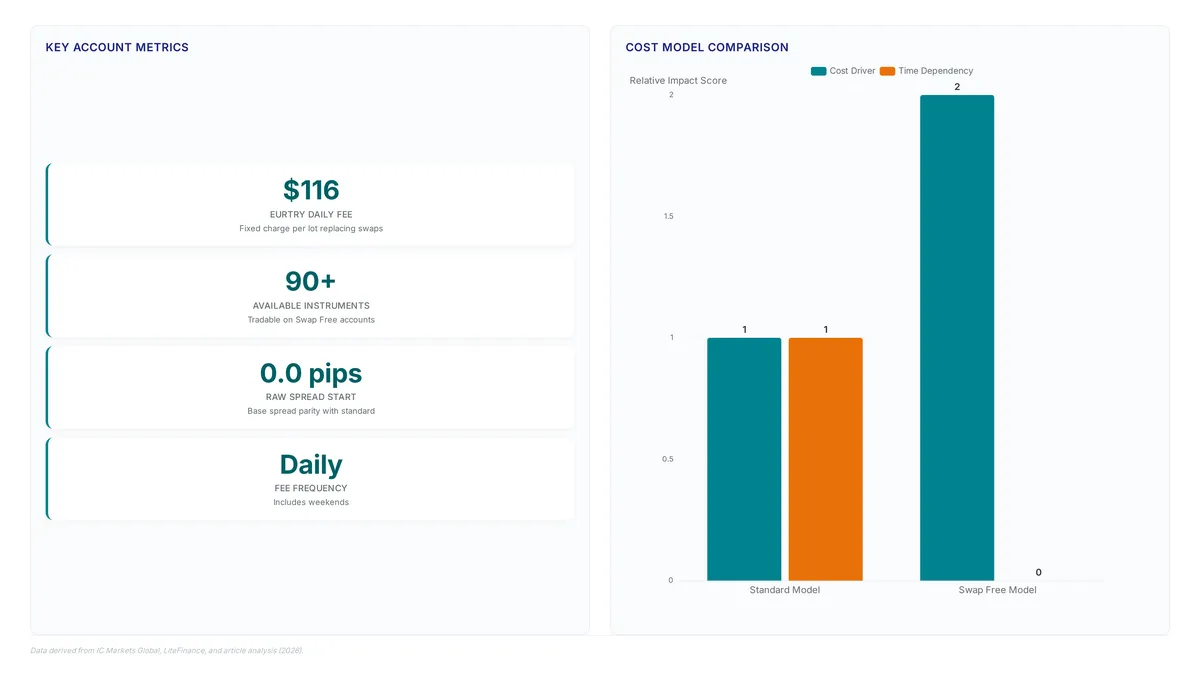
Swap free accounts replace variable overnight interest with fixed holding fees while maintaining spread parity against standard models. The core mechanism eliminates time-based swap calculations, ensuring traders do not pay or earn interest on open positions. Instead, a flat administration charge applies after a set grace period, shifting cost predictability for religious compliance. This structural change means the base spread often remains identical to raw or standard tiers, preserving execution quality without inflating markup to cover interest losses. The Swap Free Account allows users to trade over 90 instruments with spreads as low as 0.0 pips.
| Feature | Standard Account | Swap Free Account |
|---|---|---|
| Overnight Cost | Variable Swap Rate | Fixed Holding Fee |
| Interest Policy | Accrues Daily | Prohibited Entirely |
| Spread Structure | Market Based | Market Based |
| Grace Period | None | Typically 5 Days |
The trade-off is that while spreads stay competitive, the flat fee creates a different break-even horizon for long-term holders. Unlike standard accounts where costs scale linearly with time and position size via swaps, the swap-free model imposes a step-function cost that can erode profits on stagnant trades held beyond the grace window. Traders must recognize that holding fees apply every calendar day, including weekends, fundamentally altering the math for carry strategies. The implication is clear: account selection depends less on spread width and more on the expected duration of open positions.
Calculating Flat Rate Holding Fees Across Asset Classes
The EURTRY instrument incurs a holding fee of 116 US$ per lot, replacing variable swap calculations with a fixed daily charge. This flat-rate structure transforms overnight cost forecasting from a volatility-dependent variable into a known operational expense. Traders comparing raw spread vs standard swap free models must acknowledge that base spreads often remain unchanged, yet the eliminated interest component shifts entirely to this administration fee. While standard accounts accrue time-based financing that fluctuates with central bank rates, the Islamic model applies a static maintenance fee regardless of market interest levels.
Meanwhile, the limitation of this approach is that high-use positions on exotic pairs can accumulate substantial fees quickly if held beyond the grace period. Unlike substantial pairs where swaps might be negligible, exotic instruments like TRY pairs carry heavy premiums that erode profit margins on long-term holds. You should open a swap free account only if your strategy avoids prolonged exposure to these specific high-cost instruments or if religious prohibition mandates it. The operational reality is that brokers reserve the right to deny this status if trading behavior suggests abuse of the system rather than genuine religious need. Consequently, the decision hinges on balancing ethical compliance against the mathematical certainty of fixed daily deductions.
Regulatory jurisdiction dictates the maximum use cap available to swap-free traders, creating a stark divide between offshore capacity and institutional safety. Entities licensed by the FSA Seychelles permit ratios reaching 1:1000, whereas ASIC-regulated firms must adhere to a strict 1:30 limit for substantial pairs. This disparity forces a direct choice between trading power and capital protection protocols.
| Feature | FSA Seychelles Entity | ASIC Regulated Entity |
|---|---|---|
| Max Use | 1:1000 | 1:30 |
| Regulatory Scope | Offshore | Domestic (Australia) |
| Primary Trade-off | High Capacity | Strict Security |
The mechanism here involves distinct licensing tiers where offshore regulators allow higher risk exposure compared to the conservative stance of Australian authorities. Evidence from market guides confirms that this gap defines the available trading environment for religiously compliant strategies. However, the limitation is clear: accessing 1:1000 use requires accepting an offshore license that lacks the compensation schemes found in stricter regimes. This means operators prioritizing capital guarantees must accept significantly reduced margin efficiency.
Consequently, a trader comparing raw spread vs standard swap free models must weigh execution costs against these hard regulatory ceilings. The implication for network operators and brokers is that infrastructure must support flexible profile switching based on client entity selection. Account segregation becomes necessary to maintain compliance without manual intervention. Failure to separate these liquidity pools risks regulatory breach in domestic markets while underutilizing offshore capacity.
Executing Interest Free Trading Strategies Through Proper Account Setup
Application: Religious Eligibility and Account Type Selection for Swap Free Trading
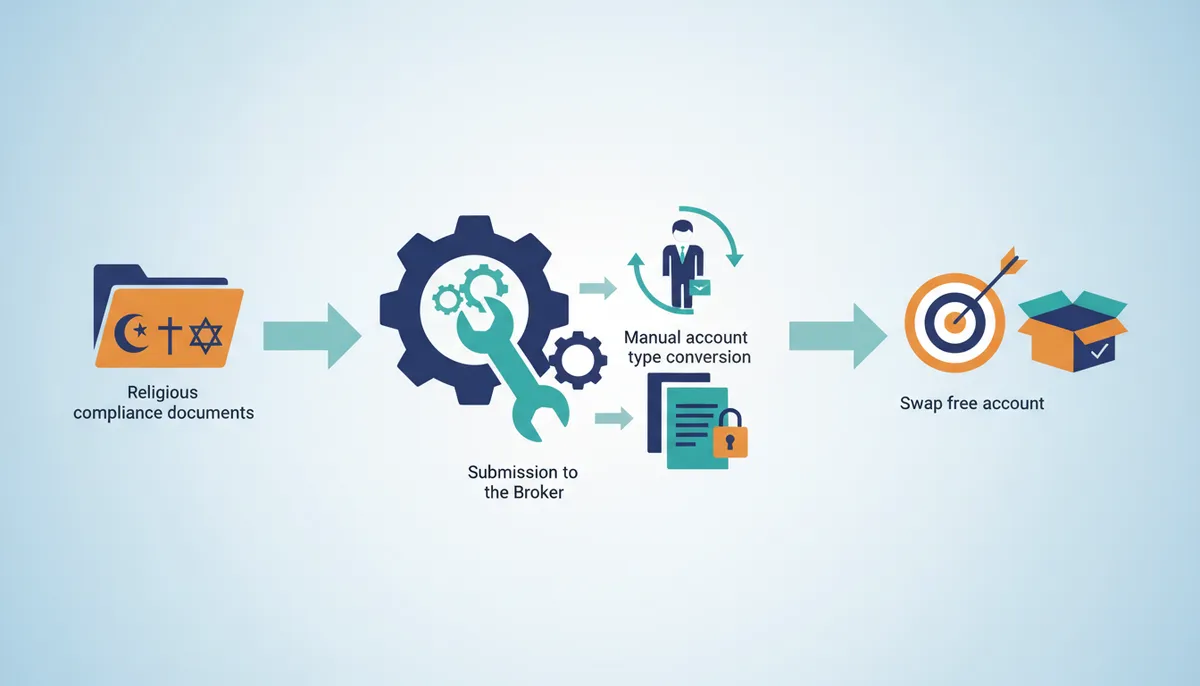
IC Markets Global provides swap-free accounts to clients who cannot earn or pay interest because of proven religious beliefs. This verification process separates eligible traders from those seeking standard speculative advantages without religious necessity. Brokers retain the right to request documentation before granting the swap-free privilege. Both Raw Spread and Standard models support this configuration, though their cost profiles for overnight positions differ substantially. Raw Spread accounts charge commissions per lot, whereas Standard accounts embed costs within wider spreads. Both structures apply a flat holding fee instead of daily swap rates, ensuring zero interest accrues on open positions.
Selecting between these requires analyzing whether lower upfront spreads or simplified commission-free pricing improved suits trading frequency. A critical limitation exists: holding fees apply after a short grace period, altering long-term hold profitability regardless of the chosen tier. Traders must read specific terms to confirm current fee schedules before funding live accounts.
Executing Trades on MetaTrader and cTrader with Zero Swap Adjustments
Swap free accounts do not pay or earn swap or interest on trading instruments; however, a holding fee is applicable for holding open positions overnight. Traders must confirm the specific account classification within platform settings, as standard interfaces on MetaTrader 4, MetaTrader 5, and cTrader do not visually distinguish swap-free status by default. Platform availability across these substantial systems ensures technical integration supports standard order types without specialized software. Removal of overnight interest does not eliminate costs for extended holds. A flat holding fee replaces the traditional swap charge for positions kept open beyond the grace period. This fee structure applies uniformly to the over 90 available instruments, ranging from substantial forex pairs to energy commodities.
Operators should note that while new positions often benefit from a five-day window without charges, specific assets like natural gas (XNGUSD), crude oil (XTIUSD), and Brent oil (XBRUSD) incur fees immediately from Day 1. For USDJPY and GBPJPY, holding fees apply on day 3 following a two-day grace period. The holding fee is charged every calendar day including weekends, with weekend holding fees charged the next business day. Clients using the Raw Spread model retain tight pricing but must monitor equity closely due to these daily deductions. Successful deployment requires manual tracking of hold durations rather than relying on automated swap calculations.
Verification Checklist for Use Caps and Spread Conditions
Confirm terminal displays show use limits reaching 1:5000 before sizing positions. This cap defines maximum exposure but does not guarantee margin relief during volatility spikes. Operators must manually verify these settings as use availability is subject to the specific regulatory jurisdiction of the account.
Validate that spread configurations show values as low as 0.0 pips on substantial pairs. The absence of interest adjustments means transaction costs become the primary drag on profitability. Traders frequently overlook that commission rates on Raw Spread accounts remain active despite the swap-free status.
The structural tension here involves liquidity access versus cost predictability. High use increases gains but accelerates margin calls if the holding fee structure is misunderstood. Strategies must account for flat-rate charges that apply regardless of market movement, as any trades open overnight are charged this fee.
About
Sofia Mendes, Broker Reviews & Trading Education Editor at ForexCFD.top, leads the publication's rigorous analysis of regulated trading environments. Her expertise is directly the to understanding Swap Free accounts, as her daily work involves deep due diligence on broker compliance, fee structures, and regional regulatory adherence. Mendes specializes in evaluating how brokers accommodate specific religious requirements, such as Islamic finance prohibitions on interest, ensuring that recommendations align with strict ethical and legal standards.
At ForexCFD.top, an independent news source focused on global retail traders, Mendes applies a structured, disclosure-first methodology to assess Swap Free offerings across substantial platforms like MetaTrader and cTrader. Her background in comparing FCA, DFSA, and SCA-regulated entities allows her to distinguish genuine Swap Free conditions from marketing hype. By connecting complex trading terms with clear, consumer-protective education, she ensures traders in emerging markets can make informed decisions without compromising their financial or religious principles.
Conclusion
Scaling a swap-free strategy breaks down when traders assume uniform grace periods across all assets. The operational cost here is not merely the fee itself, but the cognitive load of tracking divergent start dates for energy commodities versus substantial currency pairs. Because natural gas incurs charges immediately while JPY pairs allow a two-day window, a blanket hold-all approach guarantees unnecessary erosion of capital. You must treat the five-day grace period as a specific tactical tool rather than a universal account feature.
Deploy this account structure only if your strategy relies on short-term swings under five days or strictly avoids overnight holds on energy instruments. Do not apply these terms for long-term hedging without calculating the cumulative impact of weekend fees applied the next business day. The liquidity advantage of 1:1000 use becomes a liability if daily deductions trigger a margin call before your thesis plays out.
Start by auditing your current open positions this week to map their specific fee commencement dates against the asset class rules. Verify whether your energy trades are bleeding value from Day 1 and close any positions where the holding cost exceeds potential movement. This manual reconciliation ensures your swap-free account terms and conditions align with actual market behavior rather than assumed benefits.
Frequently Asked Questions
Holding fees range from 0.01 US$ to 123 US$ per lot depending on the specific instrument traded. This flat rate applies every calendar day, meaning costs accumulate linearly regardless of market direction or swap rates.
Clients can access account insurance protection up to $1 million depending on their specific broker and jurisdiction. This coverage provides a safety net while traders manage positions under religious compliance rules without interest.
No, new positions benefit from a grace period where no holding fees are incurred initially. Once this window closes, the flat rate charge applies every calendar day including weekends for open trades.
Yes, brokers reserve the right to deny access if clients fail to meet specific eligibility criteria or provide proof. This ensures the feature remains reserved for those with genuine religious prohibitions against interest.
Fees are fixed administrative charges ranging from an undisclosed range rather than fluctuating with interbank lending rates. This provides cost predictability for traders but decouples overnight costs from global liquidity conditions.
References