
Yields Dictate USD/JPY as 162.75 Breaks
The USD/JPY pair hit 162.75, a 40-year high that eclipses levels triggering Japan's last intervention. This surge confirms that diverging Treasury yields now dictate currency valuations more than central bank rhetoric. Investors will learn how labor data shifts Fed probability, why liquidity gaps during the US holiday invite volatility, and what intervention risks remain for the Ministry of Finance.
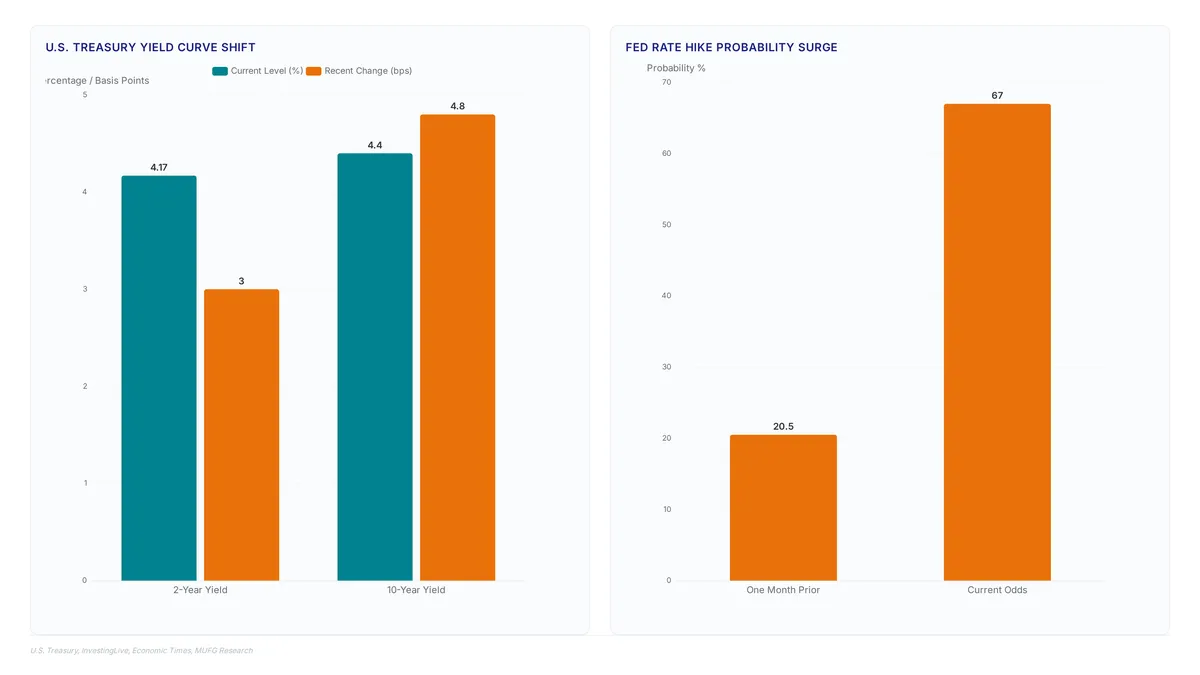
Meanwhile, the primary catalyst remains the US side of the trade, where the 10-year yield jumped 9 basis points intraday before settling 4.8 basis points higher, according to investingLive. Simultaneously, the 2-year Treasury yield rose 3 basis points to close at 4.1702%. These moves reflect a drastic repricing of Federal Reserve expectations, with traders now assigning a 67% probability to a September rate hike, up from just 20.5% a month ago. This shift leaves little room for dovish interpretations of upcoming payrolls data.
Market participants are now monitoring Friday's US public holiday as a tactical window for Tokyo to act, given that thinner liquidity could magnify the impact of any yen-buying operation. While Ministry of Finance warnings have so far fallen short of signaling imminent action, the breach of the 162.75 threshold keeps action risk elevated. The focus remains on whether intervention threats can slow the slide or if the momentum from US Treasury yields will continue to drive the dollar higher despite official resistance.
The Role of Treasury Yields in Driving Yen Depreciation
How US Treasury Yields Drive USD/JPY Valuation Mechanics
Rising US Treasury yields create the primary valuation gap forcing yen depreciation through interest rate differentials. When the 10-year yield climbs intraday, capital flows immediately seek the higher returning dollar asset, mechanically widening the spread against Japanese government bonds. This differential acts as the dominant gravity for the currency pair, pushing exchange rates toward levels like 162.75 where intervention risks historically escalate. The mechanism functions because investors borrow in low-yielding currencies to purchase higher-yielding US debt, a strategy that sustains upward pressure on the dollar regardless of domestic Japanese economic fundamentals. However, this yield-driven momentum creates a fragile equilibrium where rapid repricing of Fed hike probabilities can trigger violent reversals if liquidity thins during holiday sessions. Operators must recognize that while yield spreads dictate the trend direction, the speed of adjustment often outpaces fundamental economic data releases. The cost of maintaining this carry trade exposure is the elevated risk of sudden Ministry of Finance intervention, which can erase months of yield gains in minutes. Traders monitoring the 2-year yield at 4.1702% see a concrete signal of near-term policy expectations driving these flows.
Rapidly shifting Fed rate hike probabilities now dictate the immediate trajectory for USD/JPY valuation. Market participants have aggressively repriced expectations, lifting the statistical likelihood of a September increase to 67% from just 20.5% one month prior. This sharp pivot in sentiment drives capital flows toward the dollar, mechanically forcing the yen to its lowest point since 1986. The resulting pressure pushed the pair near 162.75, a level that significantly elevates the risk of official Japanese intervention.
Momentum chasing now clashes with event risk. Traders face a scenario where thin liquidity during the upcoming US holiday could amplify any sudden Ministry of Finance action. While yield differentials favor the dollar, the speed of the odds surge leaves little room for error if data disappoints. A sudden reversal in labor market perceptions could invalidate the hawkish narrative instantly.
| Driver | Impact on USD/JPY | Risk Factor |
|---|---|---|
| Yield Spread | Widening supports dollar strength | Rapid mean reversion |
| Intervention Fear | Caps upside momentum | Liquidity gaps on holidays |
| Data Dependence | Validates hike pricing | Missed expectations cause volatility |
Used positions on USD/JPY carry high risk due to potential government interference. CFDs are complex instruments; most retail investor accounts lose money when trading with this provider. Check local regulatory status before trading.
Ministry of Finance Intervention Risks Amid Thin Liquidity
USD/JPY trading at 162.75+ exceeds the threshold that triggered previous Japanese Ministry of Finance intervention, creating immediate tactical danger. Market participants identify the upcoming US public holiday as a high-risk window where thin liquidity could amplify the impact of any official yen-buying operation. This specific timing allows authorities to potentially maximize market disruption with minimal capital outlay, a distinct advantage over standard trading sessions.
| Factor | Impact on Intervention Efficacy |
|---|---|
| Liquidity Depth | Reduced volume magnifies price slippage during execution |
| Session Timing | US holiday closures limit counter-party resistance |
| Price Level | Current rates exceed 2022 intervention triggers |
Historical analysis confirms that current exchange rates significantly surpass levels that prompted action in late 2022, suggesting authorities face heightened pressure to act now rather than wait for further deterioration. The Ministry of Finance retains the mandate to stabilize disorderly markets, yet the delay in response creates a volatile tension between momentum traders and policy defenders. A sudden intervention during low-volume hours risks triggering massive, rapid reversals that invalidate technical breakouts instantly. Traders must recognize that while yield differentials drive the long-term trend, the liquidity gap on holidays introduces binary event risk that technical analysis cannot price. The cost of holding used long positions through such windows includes the potential for total position liquidation at unfavorable prices if Tokyo acts decisively.
How Labor Data and Fed Signals Dictate Market Probability
Defining the Labor Data to Fed Rate Hike Probability Link
US job openings edging to a two-year high mechanically tighten the monetary policy transmission curve by signaling persistent labor demand. This statistical surge reflects how raw payroll figures bypass theoretical models to directly alter the cost of capital in real-time.
The mechanism operates through a strict four-step sequence that forex traders must monitor:
- Strong job openings data releases, indicating reduced slack in the labor market.
- Market participants immediately discount the likelihood of a paused interest rate cycle.
- Treasury yields spike to price in the higher-for-longer narrative, widening the yield differential.
- Capital flows rotate into the dollar, forcing pairs like USD/JPY to adjust violently to the new rate reality.
Traders monitor the CME FedWatch interface to gauge how fresh labor prints instantly recalibrate rate expectations. This tool aggregates futures pricing to display the implied probability of Federal Reserve actions at upcoming meetings. When non-farm payroll data surprises to the upside, the algorithmic repricing is immediate and severe. Market participants observe the probability of a September rate hike surge from a modest minority to a dominant majority within minutes. This shift reflects inflation running persistently above target alongside resilient employment figures.
The operational workflow for monitoring these signals involves four distinct steps:
- Access the tool immediately following a scheduled economic release.
2.
The 10-year yield often leads these probability shifts before the tool fully adjusts. ForexCFD.top analysts note that relying solely on the percentage output without checking the raw futures volume can lead to premature entries.
*Gold and commodities involve significant risk due to use and are not suitable for all investors. ForexCFD is a regulated broker; check local legal status. Affiliate relationships may exist.*
Yield Curve Volatility Risks from Non-Farm Payroll Surprises
Unexpected payroll prints trigger immediate yield curve dislocation before liquidity providers can adjust spreads. The 10-year Treasury yield recently demonstrated this fragility with a 9-basis-point intraday surge that forced rapid forex repricing. Such volatility creates a dangerous environment where algorithmic trading amplifies moves in the 2-year note, pushing yields to close significantly higher without fundamental justification beyond position squaring. Traders monitoring Fed signals must recognize that yield spikes often precede actual data releases as markets guess the outcome.
| Scenario | Yield Reaction | Forex Impact |
|---|---|---|
| Payroll Surprise > 200k | Sharp 2-year rise | USD/JPY breakout |
| Payroll Miss < 100k | Curve flattening | Yen recovery attempt |
| Data Inline | Range-bound trading | Liquidity drying up |
The critical limitation here is that stop-loss orders cluster around technical levels, inviting liquidation cascades during these thin moments. A sudden 9 basis point move can breach multiple support layers before human intervention occurs. Consequently, traders should reduce use ahead of non-farm payroll releases to survive the initial volatility spike. Risk Warning: Trading used metals and forex carries high risk; losses can exceed deposits. Islamic accounts are available without swaps for permissible instruments.
Strategic Responses to Intervention Risks and Liquidity Gaps
Defining MoF Intervention Thresholds Beyond Historical Yen Lows

USD/JPY touched 162.75, clearing the barrier that sparked Japan's 2022 intervention. Market participants now eye the upcoming US holiday as a moment where thin order books could magnify official buying pressure. Warning rhetoric from officials remains vague, failing to confirm immediate action despite the currency sinking to depths unseen since 1986.
*Note: Trading used FX and CFDs involves significant risk. This analysis is for educational purposes only and does not constitute financial advice.*
Executing Yen Hedges During Friday US Holiday Liquidity Gaps
Friday offers a specific tactical opening where reduced market depth might increases any yen-buying operation. Prices hovering near 162.75 create a fragile setup where intervention danger climbs while available liquidity shrinks. Aggressive yield repricing fuels the dollar's strength yet simultaneously invites sharp reversals should Tokyo decide to act. Traders face a difficult choice between holding yield-generating long positions and shielding capital from sudden price dislocations. Renewed action from Japanese authorities remains a primary concern for market participants.
*Note for Islamic account holders: Swaps accrue triple charges over the weekend; ensure your hedging strategy accounts for these costs or uses swap-free instruments where available.*
Risk Warning: Used metals and forex trading involve significant risk of loss and are not suitable for all investors. *ForexCFD.top provides education-first analysis. We are regulated by the local authorities. Affiliate relationships may exist.*
Slippage Risks When USD/JPY Breaks 162.75 on Thin Volume
Bid-ask spreads often widen rapidly as liquidity providers pull back, exposing unhedged positions to violent price swings. Execution quality deteriorates for traders trying to adjust exposure during these specific windows. Authorities could exploit the thin US holiday volume to maximize the shock value of a surprise intervention.
| Condition | Normal Liquidity | Holiday Liquidity |
|---|---|---|
| Execution Speed | Milliseconds | Variable |
| Slippage Range | 1-2 Pips | Potentially Higher |
| Order Fill Rate | High | Variable/Partial |
Intervention risk stays high even when price action looks flat, because low volume hides underlying market fragility. Maintaining a position through such an event carries the heavy cost of potential pricing deviations.
Executing Trades Around Payroll Releases and Yield Spikes
Defining Intervention Risk via MUFG FX Warning Signals
Distinguish rhetorical warnings from actionable intervention signals by monitoring official phrasing rather than headline levels. MUFG explicitly noted that Japan's FX warnings fall short of signalling imminent yen intervention, creating a gap between market fear and actual policy execution.
- Track the divergence between verbal warnings and the 10-year yield trajectory, noting that the dollar has pushed well past levels that triggered Japan's last intervention.
- Assess liquidity conditions, noting that thin US holiday sessions offer tactical advantages for authorities seeking maximum impact per dollar spent.
- Validate risk by comparing current rates against historical triggers, recognizing that the yen recently hit a 40-year low near 162.75.
The cost of misinterpreting a warning as a guarantee is significant capital left on the table during momentum drives. Unlike simple threshold breaches, genuine intervention requires coordinated liquidity execution that verbal cues alone do not confirm. Operators assuming rhetoric equals action face the limitation of extended drawdowns while waiting for a reversal that relies on actual MoF deployment. The market prices in fear, but only confirmed flows validate the trade thesis.
Timing Yen Entries Against 10-Year Treasury Yield Spikes
The dollar's advance followed an overnight jump in Treasury yields, with the 10-year U.S. Treasury yield experiencing a 9-basis-point intraday rise before ending the session approximately 4.8 basis points higher. This move in bond yields has been a primary driver for USD/JPY reaching 162.75, comfortably above the levels that prompted Japanese authorities to intervene in support of the currency a few months ago.
- Observe the initial spike where yields jump sharply, indicating institutional flow rather than retail noise.
2.3.
However, relying solely on yield momentum ignores the asymmetric risk of sudden Ministry of Finance intervention during low-liquidity windows. While the yield differential drives the trend, a surprise verbal warning can trigger rapid unwinding regardless of technical setups. Market participants must balance this yield-chasing strategy against the possibility that Japan's FX warnings may escalate into actual market operations without prior notice. ForexCFD.top reminds traders that used metals and currency pairs carry significant risk; losses can exceed deposits.
Pre-Payroll Checklist for Fed Rate Hike Probability Shifts
Validate the Fed hike probability divergence before non-farm payrolls to gauge yield-driven momentum.
- Monitor yield spreads for intraday expansions, noting the 10-year yield recently climbed as much as 9 basis points before settling.
- Assess intervention risk by noting that MUFG warnings currently fall short of signaling imminent action.
- Review liquidity calendars to anticipate thinner trading volumes during US public holidays, which could magnify the impact of any yen-buying operation.
| Factor | Pre-Event Status | Implication |
|---|---|---|
| Rate Odds | Sharp Surge | Supports long USD bias |
| Yield Curve | Steepening | Validates hawkish Fed view |
| MoF Signals | Rhetorical Only | Delays physical intervention |
Kevin Warsh, identified as Fed Chair, is scheduled to appear at the European Central Bank's Forum on Central Banking in Sintra, Portugal, on Wednesday, though fresh guidance is unlikely given his reluctance to offer forward direction last month. The limitation here is that resilient labor data narrows the runway for dovish surprises, forcing traders to respect the momentum despite elevated intervention threats. Traders must balance yield-driven momentum against the specific timing of Japanese intervention risks. ForexCFD.top advises strict adherence to these validation steps. Used metals and FX carry significant risk; capital loss is possible.
About
Aisha Rahman, Gold & Commodities Analyst at ForexCFD.top, brings a critical macroeconomic perspective to this analysis of USD/JPY volatility. While her primary focus remains on gold and commodity flows, her deep expertise in safe-haven dynamics and real yield correlations is necessary for understanding why the yen has collapsed to 40-year lows. As Treasury yields drive the dollar higher, Rahman's daily work tracking the interplay between central bank policies and risk sentiment allows her to contextualize these moves for retail traders. Her background in the Gulf markets also provides unique insight into how Islamic finance principles and swap-free trading conditions influence liquidity during potential Bank of Japan interventions. At ForexCFD.top, an independent publication dedicated to regulation-aware market news, Rahman applies this structured, educational approach to decode complex FX majors like USD/JPY. By connecting broad macroeconomic drivers to actionable technical levels, she ensures traders in emerging markets understand both the risks and the strategic implications of these historic currency shifts.
Conclusion
USD/JPY sits at a breaking point where algorithms pushing the 2-year note override traditional technical resistance. Yield differentials set the trend, but liquidity providers will widen spreads aggressively on any verbal warning from Tokyo, turning minor pullbacks into volatile whipsaws. The market has priced in rhetorical warnings, meaning only actual capital deployment will alter the trajectory.
Maintain a long bias only while the 2-year yield holds above critical thresholds, but strictly reduce position sizing ahead of low-liquidity windows where Ministry of Finance surprises typically occur. Do not assume that a steepening curve guarantees linear profits when political pressure mounts. Start this week by cross-referencing your economic calendar against US holiday schedules to identify specific days where thin volume could magnify a sudden yen-buying operation. This preparation allows you to distinguish between normal yield-driven noise and the precursor to a forced unwind. Protect capital by respecting the asymmetry of a policy-driven shock.
Frequently Asked Questions
Traders watch the 2-year yield at 4.1702% as a concrete signal of policy. This level drives capital flows immediately, forcing the yen lower as investors seek higher returning US debt assets.
Probability for a September hike surged to 67% from just 20.5% one month ago. This sharp pivot mechanically forces the yen to its lowest point since 1986 by driving capital flows.
The pair hit 162.75, exceeding levels that triggered Japan's last intervention in 2022. This breach keeps action risk elevated, especially with thin liquidity during the upcoming US public holiday.
A 9-basis-point intraday jump in the 10-year yield drives dollar strength instantly. Capital flows seek higher returns, widening the spread against Japanese bonds and pushing exchange rates higher.
Traders watch Friday's US holiday as thin liquidity could magnify any yen-buying operation. This environment increases volatility risk, potentially erasing months of yield gains in minutes if intervention occurs.
References