
Real yields above 4% lock in the strong dollar
Core PCE inflation sits above 3%. The US Dollar refuses to budge. Markets are now pricing a potential October Fed hike, discarding hopes for an early pivot. The thesis is stark: elevated real yields and a high-for-longer rate environment under Fed Chair Kevin Warsh will continue to suppress Asia FX while anchoring greenback demand. MUFG analyst Lloyd Chan points out that even with slight easing in nominal yields, the backdrop remains supportive because both the US 2-year and 10-year yields hold above 4% (https://www.fxempire.com/news/article/first-light-news-trump-puts-pen-to-paper-the-fed-comes-in-hawkish-1605193).
The shift in the global market narrative following the 18 June FOMC meeting did more than adjust expectations; it cemented them. We are no longer guessing at sustained rate pressure; we are trading it. This analysis dissects the mechanics of Treasury yield differentials, showing how resilient labor conditions block the dovish pivot that would otherwise weaken the currency. The result is a broad depreciation of Asia FX driven by widening swap differentials.
This trend isn't a temporary spike. It requires incoming data to confirm macro strength. Unless US data deteriorates materially or Fed guidance changes clearly, downside risk for the dollar is contained. Traders face an environment where nominal yield consolidation fails to alter the underlying support for the USD.
Real Yields and the High-for-Longer Rate Narrative
Defining Real Yields and the High-for-Longer Rate Narrative
Real yields represent the actual cost of capital: nominal returns minus inflation expectations. This metric anchors the "high-for-longer" narrative that solidified after the 18 June FOMC meeting. Unlike nominal figures, real yields adjust for purchasing power erosion. This explains why Gold struggles near $4,015 despite geopolitical tensions. The mechanism is mechanical. When central banks maintain restrictive stances to combat inflation above 2%, nonyielding assets face severe opportunity costs that drain investor interest.
Policy rates will stay elevated well past initial market cycles. MUFG Research confirms this shift, noting that even slight easing in US Treasury yields fails to alter the supportive Dollar backdrop. Emerging markets bear asymmetric risk in this setting. US data must deteriorate notably to prompt a dovish pivot, yet inflation persistence alone sustains the hawkish tone.
Capital flows aggressively toward yield-bearing instruments as a result. Asia FX remains exposed to sustained depreciation pressure. The divergence between resilient labor conditions and sticky core PCE inflation creates a floor for rates that nominal data alone cannot signal. Investors ignoring the real yield differential risk underestimating the structural strength of the Dollar. Only a material breakdown in macro data or an explicit policy reversal from the Federal Reserve would invalidate this prevailing high-rate equilibrium.
How Hawkish Fed Policy Under Kevin Warsh Drives USD Strength
Hawkish Fed policy under Kevin Warsh prioritizes inflation containment, forcing real yields higher and strengthening the Dollar. This stance defines hawkish vs dovish policy by signaling a willingness to maintain restrictive rates rather than pivot toward growth support. Incoming data reinforces this bias, with core PCE inflation running above 3% alongside resilient labor conditions. Such persistence keeps market pricing aligned with a potential rate hike around October, limiting downside risk for US assets.
The mechanism transmits directly through interest rate differentials. Elevated US returns attract capital away from lower-yielding regions like Japan. Consequently, the USD/JPY pair trades near multi-year highs, specifically approaching the 162.00 level. The catalyst creates a divergent environment where Asia FX faces sustained pressure from widening swap rate differentials. Unlike previous cycles, the current narrative suggests yields will remain elevated well beyond initial expectations, anchoring demand for the greenback.
Strength relies heavily on the continuity of sticky inflation data. A sudden drop in core readings could rapidly unwind long USD positions. Traders must monitor whether labor durability persists, as any material deterioration in macro data would challenge the high-for-longer thesis. The view flips only if the Fed signals a clear dovish pivot or if US economic indicators show abrupt weakness.
Market Pricing: Limited USD Downside Versus Potential Fed Hike Bets
Market pricing assigns an over 80% probability to a Federal Reserve rate increase by year-end 2026. This aggressive positioning cements the high-for-longer narrative, creating a hard floor for the Dollar even as nominal Treasury yields consolidate slightly above 4%. The mechanism is simple: capital chases absolute yield, and US assets remain the deepest pool for returns adjusted for inflation.
Consensus views carry fragility. Should core inflation data cool unexpectedly, the crowded long-dollar trade would unwind violently. Most market participants overlook that real yields can remain supportive even if nominal rates peak, provided inflation expectations anchor lower. A material deterioration in US macro data that forces the Fed to abandon its hiking trajectory would trigger a trend reversal. Until then, the bias favors the upside.
Mechanics of Treasury Yield Differentials and Market Pricing
Real Yields as the Anchor for USD Demand
The mechanical relationship between nominal Treasury yields and breakeven inflation rates defines the real yield curve that anchors capital flows. This spread generates the opportunity cost that drives non-yielding asset valuations lower, as seen when Gold steadied above $4,000 only after inflation data cooled immediate hike fears. A limitation of this framework emerges if nominal yields consolidate while inflation expectations rise, which would compress real returns and weaken the dollar's foundation. The prevailing view holds that USD downside remains contained unless macro data deteriorates materially or policy guidance shifts. Investors must watch for a clear dovish pivot to invalidate the current high-for-longer pricing structure.
Pricing Fed Rate Expectations via Swap Rate Differentials
Traders quantify the probability of future rate hikes by measuring the spread between Treasury yields and overnight index swap rates. This pricing mechanism translates macro data directly into currency valuations, driving pairs like USD/JPY toward multi-year highs near 162.00.
The transmission mechanism operates through four distinct channels:
- Forward Guidance: Market participants parse Fed Chair Kevin Warsh's hawkish tone for timing clues.
- Swap Pricing: Elevated swap rates imply higher borrowing costs, attracting capital to the dollar.
- FX Reaction: Asian currencies depreciate as the interest rate gap favors USD holdings.
- Labor Durability: Continued strength here prevents the Fed from pivoting, sustaining the cycle.
However, this correlation creates a vulnerability where any unexpected deterioration in US labor conditions could trigger rapid unwinding of long dollar positions. The USD downside remains contained only while inflation data sustains the current hawkish premium. A failure to meet these elevated expectations would force an immediate repricing of the probability curve, invalidating the bullish thesis. The next critical test arrives with the release of upcoming employment figures, which must show continued durability to maintain the current trajectory of dollar strength.
Strategic Risks of Nominal Yield Consolidation
Nominal yield stabilization creates a false sense of security while real yields remain the volatile primary driver of dollar support. This divergence implies that Fed rate outlook assessments relying solely on nominal peaks will miss the persistent strength anchored by inflation-adjusted returns. The mechanism functions through a specific tension: nominal yields may drift lower on technical flows, yet the high-for-longer narrative persists as long as price pressures do not collapse. The Gold reaction to recent PCE data demonstrates how quickly asset classes reprice when inflation expectations shift slightly. Consequently, the dollar remains supported unless US macro data deteriorates materially or the Fed signals a clear dovish turn. Investors must monitor labor market tightness rather than just headline yields to gauge true monetary traction.
Impact of Widening Swap Differentials on Asia FX
Swap Rate Differentials as the Driver of Asia FX Depreciation
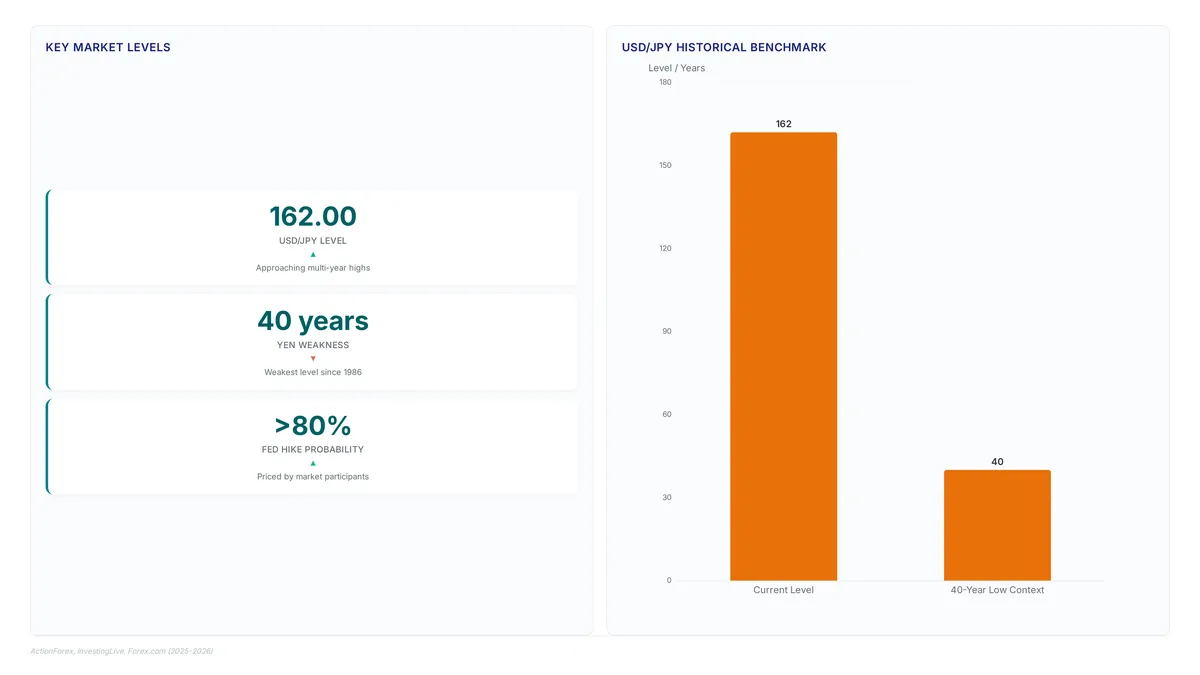
Widening swap rate differentials mechanically force Asia FX depreciation by incentivizing capital outflows toward higher-yielding US assets. The market narrative is currently set by elevated real yields and a high-for-longer US rate environment, which keeps demand for the USD firm while placing regional currencies under pressure. Most Asia FX have depreciated broadly since the FOMC, reflecting these widening gaps and the persistence of restrictive US policy. The USD/JPY pair serves as a primary case study, advancing close to 162.00 as the Yen weakens to 40-year lows due to divergent monetary paths. MUFG analyst Lloyd Chan highlights that US Treasury yields have eased only slightly, leaving the broader rates backdrop supportive for the Dollar.
| Factor | Impact on Valuation |
|---|---|
| Real Yields | Anchor USD demand |
| Swap Differentials | Drive Asia FX sell-offs |
| Policy Divergence | Sustains pressure |
However, this depreciation flexible relies entirely on the continuity of the high-for-longer narrative; a sudden dovish pivot by the Fed would rapidly narrow differentials and stabilize regional pairs. Traders must monitor incoming data, as limited USD downside remains unless guidance turns clearly dovish. The structural tension lies in the durability of US labor markets, which delays any potential policy shift. Consequently, Asia FX remains vulnerable to further volatility as long as real yields stay elevated. Only a material deterioration of US macro data would flip this bearish view for Asian currencies.
USD/JPY Approaching 162.00 Amid Wide Interest Rate Differentials
The USD/JPY pair trades near 162.00 as the primary mechanism transmitting US rate dominance into Asian currency weakness. This advance reflects a direct function of the interest rate differential between the Federal Reserve and the Bank of Japan. The widening gap increases the carry trade appeal for USD holders, mechanically pressuring the Yen lower toward 40-year lows. Market participants observe that the cost of holding Yen has risen sharply relative to the Dollar due to these divergent policy paths.
However, the persistence of this trend relies heavily on market doubts regarding Japanese authorities executing further currency interventions. While technical resistance looms near 163.
Operators must recognize that nominal yield easing offers false comfort if inflation expectations remain unanchored above target levels. The limitation here is strategic: hedging costs rise precisely when liquidity tightens, forcing a choice between accepting volatility or locking in unfavorable forward rates. A clear deterioration in US labor data or a shift in FOMC guidance serves as the only valid trigger to flip this bearish view. Until then, the path of least resistance for regional currencies remains lower. Market participants should focus on the persistence of these returns to gauge dollar durability.
- Isolate real yields by subtracting breakeven inflation from nominal US Treasury rates.
- Observe how widening swap rate differentials reflect pressure on Asia FX.
- Validate that Gold remains suppressed, confirming high opportunity costs for non-yielding assets.
The FXStreet Insights Team notes that even if nominal figures consolidate, the underlying dollar support persists while real rates stay high. This creates a specific tension: traders often exit long-dollar positions on nominal yield dips, missing the sustained bid from inflation-adjusted returns. Such premature exits ignore the structural anchor keeping the currency firm. Until data or guidance pivots clearly dovish, the spread widens.
Implementation: Monitoring Swap Rate Differentials for Asia FX Depreciation
Widening swap rate differentials against the US 2-year yield create the primary signal for Asia FX depreciation. The market narrative indicates that most regional currencies have weakened since the FOMC meeting due to these diverging rates.
- Measure the gap between domestic Asian swap rates and US equivalents to identify stress.
- Confirm that real yields remain elevated, anchoring demand for the dollar despite nominal consolidation.
- Note that USD/JPY has reached multi-year highs as the Yen hits its weakest level in 40 years.
- Recognize that Asia FX depreciation reflects the persistence of a high-for-longer US rate environment.
Most Asia FX have depreciated broadly since the FOMC meeting, reflecting the persistence of a high-for-longer rate environment.
A critical tension exists between yield hunting and capital preservation; chasing higher Asian yields often ignores the principal erosion caused by currency devaluation. Unlike nominal yield comparisons, real yield differentials provide a clearer view of true funding costs. The limitation of this approach is its reliance on stable inflation expectations, which can shift rapidly during geopolitical shocks.
Traders should flip this bearish view only if core PCE inflation falls materially or if the Fed signals a clear dovish pivot. Until then, the FXStreet Insights Team advises maintaining a defensive posture against further dollar strength.
Decision Checklist: Validating USD Investment Timing via Yield Curves
Confirming the high-for-longer narrative requires verifying that real yields remain the dominant anchor for capital allocation. Investors should monitor key thresholds before committing to USD assets.
- Does the Gold price action confirm suppressed demand for non-yielding hedges?
- Is the Fed maintaining a hawkish tone that keeps swap differentials wide?
| Indicator | Bullish USD Signal | Bearish USD Signal |
|---|---|---|
| Real Yields | Elevated | Compressing |
| Gold Price | Suppressed | Rallying |
| Policy Tone | Hawkish | Dovish |
Although US Treasury yields have eased slightly in recent sessions, the broader rates backdrop remains unchanged. The limitation here is that nominal consolidation can mask persistent real strength, trapping premature short sellers. MUFG Research highlights that energy dynamics also support this view. A confirmed dovish pivot in US macro data would invalidate this setup immediately.
About
Marcus Halloran serves as Chief Market Strategist at ForexCFD.top, where he specializes in G10 macro analysis and central bank policy. His deep expertise in monetary policy and interest-rate differentials makes him uniquely qualified to dissect the current strength of the US Dollar driven by elevated real yields. Drawing on his background as a former interbank FX strategist in London, Halloran translates complex Fed narratives and "high-for-longer" rate expectations into actionable insights for retail traders. His daily work involves rigorously analyzing FOMC guidance and Treasury yield movements to forecast USD directionality against substantial and emerging market currencies. At ForexCFD.top, an independent publication dedicated to regulation-aware forex and CFD news, Halloran applies this institutional-level experience to provide clear, data-led analysis. By connecting high-level macro catalysts to practical trading scenarios, he ensures the global retail audience understands the specific risks and opportunities surrounding the Dollar in today's volatile rate environment.
Conclusion
Capital flight into the US Dollar persists not merely from rate differentials but from the sheer absence of viable alternatives as energy costs climb. While gold stagnates near resistance, the real operational risk lies in underestimating how rising energy prices will further entrench dollar demand over the coming months. Investors chasing nominal yields in weakening currencies face a compounding erosion of principal that simple interest cannot offset. This flexible creates a specific window where defensive positioning remains superior to speculative reversal attempts.
Maintain a bullish stance on the greenback specifically while global energy prices trend upward and central banks outside the US remain constrained by weak domestic growth. Do not pivot your strategy until you see a synchronized drop in both oil benchmarks and US inflation metrics. The market has priced in a hawkish Federal Reserve, but it has not fully accounted for the secondary inflationary shock from the energy sector.
Start by reviewing your current exposure to Asian currencies against the us dollar exchange rate to identify any hidden concentration risks before the next energy price report.
Frequently Asked Questions
Gold struggles near $4,015 because high real yields create severe opportunity costs for nonyielding assets. Investors avoid gold when central banks maintain restrictive stances to combat inflation above 2%, draining interest from assets without yield.
The dollar remains supportive because both US 2-year and 10-year yields stay above 4%. This elevated floor anchors demand even when nominal yields ease slightly, preventing a dovish pivot that would weaken the currency.
Core PCE inflation running above 3% alongside resilient labor keeps market pricing aligned with a potential rate hike. This persistence forces the Federal Reserve to maintain a hawkish tone rather than pivot toward growth support.
Asia FX depreciates broadly due to widening swap rate differentials against the US 2-year yield. This mechanical pressure stems from the high-for-longer rate narrative that attracts capital away from lower-yielding regional currencies.
The high-rate equilibrium flips only if US data deteriorates materially or Fed guidance changes clearly. Without a material breakdown in macro data, downside risk for the dollar appears contained despite any nominal yield consolidation.
References