
USD/JPY Breaks 161: Fed-BoJ Gap Widens
USD/JPY punched through 161 after Fed Chair Kevin Warsh hinted at accelerated rate hikes, tagging a weekly high unseen since 1986.
The story here isn't subtle: monetary policy divergence between the Federal Reserve and the Bank of Japan is the only game in town. Geopolitical de-escalation is background noise. While the Bank of Japan lifted its policy rate to 1%, the market yawned; the move was priced in weeks ago. The real displacement came from the FOMC. Titan FX notes that U.S. retail sales beat forecasts, hardening the dollar even as the Nikkei ripped nearly 7% on collapsing energy costs.
We are looking at a specific chain reaction: the reopening of the Strait of Hormuz triggered a violent sell-off in WTI crude, complicating equity and currency positioning. The Bank of England holding rates at 3.75% and the Reserve Bank of Australia staying put mattered little by comparison. With the initial shock of the U.S.-Iran framework deal fading, USD/JPY stands exposed to intervention risks despite robust U.S. data.
Monetary Policy Divergence Drives USD/JPY Volatility
Defining Monetary Policy Divergence Between Fed and BoJ
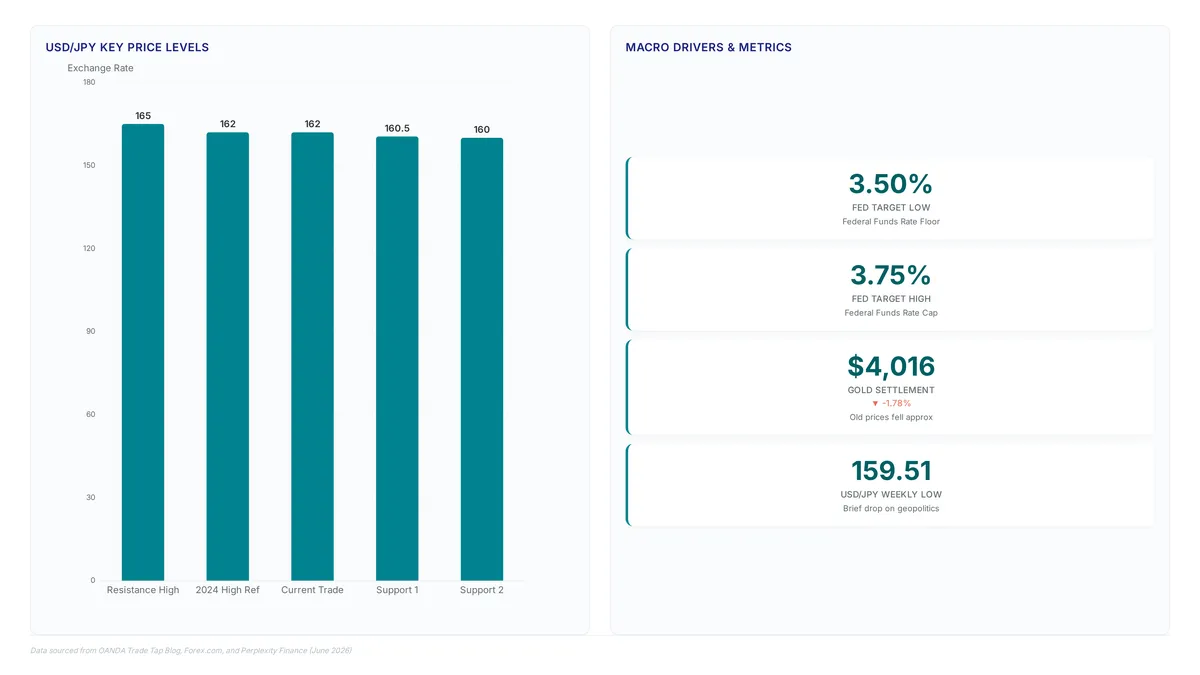
Call it what it is: a yield gap that refuses to close. The Federal Reserve holds the federal funds rate at 3.50% - 3.75%, prioritizing inflation fights over growth fears. Meanwhile, the Bank of Japan nudged its policy rate to 1%. That hike changed nothing for the yen because traders had already bet the farm on it. The result? Yield differentials remain skewed heavily toward the dollar, sustaining record short positions on the Japanese currency.
This structural bullishness for the dollar survives geopolitical noise. We saw prices dip to 159.51 before rebounding, proving that yield spreads dominate sentiment. But there is a trap here. Relying solely on yield spreads ignores the political reality: Japanese authorities get nervous when moves become too disorderly. The trend is strong, but it is fragile. Ignore the intervention risk at your own peril.
Applying Support and Resistance Levels to USD/JPY Trading
History leaves footprints. In USD/JPY, those footprints form a range between 155.00 and 165.00. Immediate overhead supply sits at 162.00, a ceiling that must break before 165.00 comes into play. On the downside, 160.50 offers the first line of defense. Below that, liquidity pools cluster at 160.00, 159.00, 158.00, 157.00, 156.00, 155.50, and finally the psychological floor at 155.00.
| Level Type | Price Zone | Significance |
|---|---|---|
| Resistance | 162.00 | Immediate ceiling |
| Resistance | 165.00 | Multi-year high target |
| Support | 160.50 | Short-term floor |
| Support | 155.00 | Substantial psychological base |
Technical breaks here often align with verbal warnings from Tokyo. A drop below 160.50 could accelerate selling toward the 159.50 pivot. Conversely, holding above 162.00 confirms the interest rate differential is still driving the bus. Watch these thresholds. They are where official intervention or rapid reversals live. The trend is up, but geopolitical noise can spike volatility instantly.
Risks of Geopolitical Whipsawing and Intervention on Yen Positions
Geopolitical whipsawing dropped USD/JPY to 159.51 before risk-on sentiment restored the uptrend. This volatility exposes a brutal truth: markets price out war premiums instantly when conflict probabilities fade, especially after diplomatic breakthroughs regarding the Strait of Hormuz. Static positions get punished when sentiment shifts this fast. The mechanism is simple: the risk premium evaporates, forcing a rapid capital reallocation away from safe havens.
Yet, the structural bullish trend for the dollar remains intact, underpinned by record short positions on the yen. The problem for long-only strategies is the sword of Damocles hanging overhead: intervention. Japanese authorities watch these levels closely. Even with the Bank of Japan raising rates, the divergence with U.S. Policy leaves the yen vulnerable if inflation data surprises upside. Ignoring intervention risk invites liquidity gaps that trigger stop-losses below key support floors. Distinguish between temporary geopolitical noise and enduring monetary divergence before sizing positions near historical highs.
Geopolitical Shifts Trigger Commodities Sell-Off
Geopolitical Supply Resumption Mechanics in WTI Crude
WTI crude crashed after the U.S. And Iran announced a framework deal to end their conflict. This diplomatic breakthrough reopened the Strait of Hormuz, allowing Iranian exports to resume and flooding the market with anticipated supply. The driver? The rapid evaporation of the geopolitical risk premium previously baked into energy contracts. As prolonged conflict odds diminished, the market aggressively repriced assets to reflect restored logistical freedom.
The causal chain is mechanical:
- Sanctions easing permits Iranian barrels to re-enter global trade flows.
- Maritime security assurances reduce insurance costs for tankers transiting the chokepoint.
- Forward supply curves shift downward on expectations of surplus inventory.
| Factor | Pre-Deal Status | Post-Deal Impact |
|---|---|---|
| Chokepoint Access | Restricted/Threatened | Open for commercial traffic |
| Risk Premium | Elevated in price | Evaporated from valuation |
| Market Sentiment | Supply anxiety | Sell-on-strength bias |
Physical logistics lag behind futures pricing, creating temporary volatility spikes. Resistance now sits at $85, $90, $95, and $100, while support has been tested at $75, $70, and $67.50. For network operators managing energy hedges, selling into strength is the only logical play while the short-term trend stays weak. This link between diplomatic accords and commodity valuation shows how quickly supply chain cost pressures can alleviate following a single policy shift.
Applying FOMC Rate Expectations to Gold Price Action
Hawkish commentary from Fed Chairman Kevin Warsh reversed gold sentiment instantly, pushing prices down 1.78% to settle near $4,016 per ounce. Traders recalibrated expectations for higher U.S. Interest rates following the FOMC meeting, killing the metal's appeal as a non-yielding asset. The mechanism is direct: as rate hike probabilities rise, the opportunity cost of holding gold increases, triggering liquidation.
Identifying overbought conditions requires watching price action relative to the 10-day moving average during initial geopolitical spikes. Selling into strength remains the preferred strategy while short-term trends stay weak, but maintaining short positions carries acute reversal risk if negotiation news turns negative. Monitor price action against these technical ceilings alongside shifting sentiment drivers. The cost of holding shorts through a diplomatic failure is measurable; a single headline can evaporate risk premiums instantly. Unlike steady supply increases, negotiation breakdowns trigger discrete jumps in price rather than gradual adjustments.
Distinguish between temporary supply gluts and permanent logistical restoration. Current strategies rely on continuous positive news flow; any interruption forces rapid covering. While the geopolitical risk premium has compressed, it remains latent and capable of repricing assets violently if talks stall. Treat breaches above key resistance levels as potential failure points for bearish theses. The opportunity cost of missing a sharp upward move outweighs marginal gains from chopping sideways. Maintain strict stop-losses near technical floors to mitigate tail risk from unexpected diplomatic regressions.
Strategic Execution for Currency and Commodity Positions
Defining Strategic Execution Triggers for WTI and Gold
WTI crude oil started the week sharply lower after the weekend announcement that Middle East crude supplies would resume. With supply concerns easing and the short-term trend remaining weak, selling into strength becomes the preferred exit strategy rather than holding for new highs.
Conversely, gold faces negative pressure as sellers returned after the FOMC meeting raised expectations for higher U.S. Interest rates. Gold closed back below the 10-day moving average, keeping both the technical and fundamental outlook negative.
| Asset | Strategic Trigger | Action |
|---|---|---|
| WTI Crude | Supply resumption news | Sell into strength |
| Gold | Negative technical close | Monitor support |
Timing is the constraint; the move higher in gold failed as traders raised expectations for higher U.S. Interest rates. Distinguish between temporary dips and genuine policy shifts driven by U.S.-Iran developments. Execution relies on monitoring the negative technical and fundamental outlook following the FOMC comments.
Applying USD/JPY Range Boundaries at the 161 Level
USD/JPY trades near 162.00 as the pair extends gains following the FOMC meeting, with no sign of intervention to curb the advance. The pair rose to new highs for the year and moved close to the highs from 2024. Support is seen at 160.50, 160.00, and 159.00, while resistance stands at 162.00 and 165.00. The absence of Bank of Japan action confirms that the wide interest-rate differential remains the dominant market driver. Capital is rotating into the dollar rather than safe havens.
| Asset Class | Current Bias | Key Technical Level |
|---|---|---|
| USD/JPY | Bullish | Support at 160.50 |
| Gold | Bearish | Resistance near $4,300 |
| Nikkei 225 | Bullish | Support at 70,000 |
The cost of ignoring these range boundaries is exposure to abrupt reversals should sentiment shift. Watch for selling opportunities if the Dow rises well above the 10-day moving average or breaks below it. A key limitation for bulls is the potential for sudden volatility if Japanese authorities decide to test market liquidity, despite current doubts about their willingness to act. Traders will be watching for possible intervention from Japan, as trading may stay nervous at these high levels.
Checklist for Validating Sell Signals Amid Nervous Markets
The resumption of exports creates a structural surplus, making rallies into strength the preferred exit strategy rather than holding for new highs. Verify that the short-term trend remains weak before committing capital to the downside. Real-world diplomatic events result in immediate drops in energy prices, validating the thesis that markets were pricing in prolonged closure. The cost of ignoring these signals is measurable capital erosion as risk-on rotations deepen.
Tactical Approaches for Bitcoin and Nikkei Opportunities
Defining Bitcoin Range Boundaries Between $60,000 and $67,500
Sellers immediately defend the $67,500 ceiling, creating a hard technical barrier that caps upside momentum for now. Traders observing this compression must recognize that resistance held firm after the FOMC meeting as expectations for higher U.S. Interest rates increased.
1.2.3. Watch lower support tiers at $55,000 and $50,000 should the primary floor fail under macro pressure.
This strategy is fragile against macro shocks; a surprise shift in U.S. Interest rate expectations could invalidate the range instantly. Unlike trending markets where momentum carries positions, range-bound conditions demand precise entry and exit discipline to avoid whipsaws.
Executing Nikkei Pullback Buys Above the 70,000 Support Floor
Entry triggers activate when price action tests the 70,000 support floor, a level that helped push the index above this mark following the FOMC meeting.
- Wait for intraday dips to touch the 70,000 level, confirmed by a rejection wick on the hourly chart.
- Scale positions into deeper liquidity pools at 68,750 or 68,000 if volatility spikes during the Tokyo session.
- Maintain long bias only while the medium-term structure stays intact, as buying on pullbacks remains the improved approach while the uptrend stays intact.
Buying on pullbacks may remain the improved approach while the uptrend stays intact, specifically because the initial rally was supported by the sharp fall in WTI crude prices and USD/JPY moving above 161. Distinguish between transient geopolitical noise and the enduring monetary divergence driving the index higher.
A key limitation involves the overbought short-term technicals; the market looks overbought in the short-term, so weakness could create short-term selling opportunities. The cost of premature entry is measurable in widened drawdowns before the next leg up materializes. Operators should note that support is also seen at 68,000, 66,500, and 65,000 should deeper retracements occur. This discipline ensures capital preservation while the broader bullish thesis plays out over coming weeks.
Navigating Bitcoin Resistance Failures and Nikkei Overbought Traps
Sellers immediately returned after the FOMC meeting as expectations for higher U.S. Interest rates increased, invalidating breakout attempts. This specific reaction confirms that resistance failures often coincide with macro-policy shifts rather than technical exhaustion alone. Chasing momentum during these windows invites drawdown when liquidity dries up.
Conversely, the Nikkei appears overbought in the short-term, so weakness could create short-term selling opportunities before the next leg up. Entering long positions without waiting for a pullback confirmation risks buying the exact top of a local cycle.
| Asset | Primary Risk | Tactical Action |
|---|---|---|
| Bitcoin | False breakout above resistance | Wait for close below range |
| Nikkei | Overbought momentum fade | Scale in on dips only |
- Monitor Bitcoin for a failure to hold gains post-announcement.
- Identify Nikkei dip levels that align with structural support.
- Execute entries with caution as trading may stay nervous at these high levels.
Structural trends remain bullish despite short-term volatility whipsawing price action. Caution is advised on entry timing until the market absorbs the policy divergence.
About
Vikram Nair, Emerging Markets & Asia FX Writer at ForexCFD.top, brings specialized expertise to the analysis of USD/JPY volatility following the FOMC meeting. While his daily work focuses on emerging-market currencies and central bank policies in Asia and Africa, this background provides a unique lens for interpreting how Fed rate decisions ripple through global FX pairs, including substantial crosses like USD/JPY. At ForexCFD.top, an independent publication dedicated to retail traders in Tier-2 and Tier-3 markets, Nair translates complex macroeconomic shifts into actionable insights. His experience dissecting RBI and Bank Indonesia moves allows him to contextualize how Kevin Warsh's hawkish stance impacts liquidity and risk sentiment across the entire Asian trading session. This article connects those broader regional dynamics to the specific breakout in USD/JPY, ensuring traders understand not just the price action, but the underlying global forces driving the move.
Conclusion
Chasing momentum during policy shifts invites unnecessary drawdowns, particularly when technical indicators signal overbought conditions. While the broader trend favors strength, the operational cost of entering without confirmation is measured in wasted capital and psychological fatigue during whipsaw events. Resistance failures often precede significant retracements, making patience a quantifiable edge rather than a passive stance.
Adopt a conditional approach: wait for price action to validate support before committing size, specifically watching how the market reacts near established psychological barriers. This discipline prevents buying local tops driven by transient noise rather than structural shifts. The window for reckless aggression has closed, replaced by a need for precise entry timing aligned with liquidity flows.
Start this week by mapping your intended entry zones against the $75 and $70 support levels, refusing to execute a long position until price stabilizes above these thresholds. Do not assume the trend will resume immediately; let the market come to your level. By anchoring your strategy to these concrete floors, you preserve capital for the next confirmed leg up while avoiding the trap of premature exposure.
Frequently Asked Questions
The wide yield gap favors dollar strength despite yen volatility. With the Federal Reserve holding rates at 3.50% while the Bank of Japan sits at 1%, traders should expect continued upward pressure on the pair.
Immediate downside protection appears near the 160.50 price zone. If selling intensifies, liquidity pools exist at lower integers, but a break below key psychological floors could trigger rapid moves toward intervention thresholds seen recently.
Falling energy costs fueled a nearly 7% weekly gain for Japanese equities. The anticipated rate hike to 1% was already priced in, allowing lower oil prices to drive the index to new record highs instead.
Holding the base rate at 3.75% maintains current yield differentials favoring the dollar. This static policy from London reinforces the broader trend where only unexpected Federal Reserve shifts will significantly alter currency trajectories now.
Sellers must push prices below the critical $4,000 support area to confirm a negative outlook. Failure to hold this level opens the door for further declines toward the next identified floor at $3,900 in coming weeks.
References