
Westpac RBNZ: 2026 Growth Lifted to 2.0%
Westpac lifted its 2026 GDP growth forecast to 2.0% from 1.5% following the swift end to the Iran war. Readers will examine how falling oil prices drive inflation forecasts down to 3.5% by year-end, why Westpac expects a unanimous hold at the July 8 meeting, and how widening interest rate differentials threaten the currency despite the upbeat growth revision.
The bank attributes this "moderately dovish" shift to an unexpectedly quick conflict resolution that has pushed headline inflation peak expectations to 4.0% in the June quarter. While Westpac sees the OCR holding at 2.25% immediately, the path forward remains fraught with two-sided risks regarding the speed of underlying disinflation. The narrative has pivoted back toward the trajectory outlined in the February Monetary Policy Statement, effectively erasing the commodity price spikes caused by the recent geopolitical tension.
However, the outlook is not entirely positive for local investors. Despite the constructive growth data, Westpac flags continued downside risk for the New Zealand dollar driven by widening rate gaps against the US and Australia. The bank now anticipates only one further hike in 2026 rather than two, with the OCR peaking at 4% in 2027. This recalibration suggests that while the immediate crisis has passed, the RBNZ faces a complex balancing act between stabilizing prices and supporting an economy still recovering from external shocks.
The Role of Geopolitical Resolution in Shaping Inflation Forecasts
Defining the Moderately Dovish Shift in RBNZ Rate Path
Collapsing energy inputs drive the moderately dovish revision Westpac now applies to its peak policy rate forecast. A swifter than expected resolution of the Iran war altered the inflation baseline without eliminating near-term tightening pressure. Oil and fuel prices fell sharply, dragging the headline inflation trajectory back toward the Reserve Bank of New Zealand's February path. Data indicates headline inflation now peaks at 4.0% before easing to 3.5% by year-end 2026. This shift implies the central bank's rate path has realigned with pre-conflict projections despite lingering upside risks. Fragility defines the current outlook as two-sided risks cloud the recovery timing.
Two-Sided Risks to Disinflation Pace and Oil Price Durability
Westpac warns the economic path remains far from locked in due to two-sided risks surrounding recovery timing. Further disinflation relies entirely on the durability of recent energy price collapses rather than structural demand shifts. Inflation figures could print lower than the base case if the drop in crude holds, yet this outcome faces immediate geopolitical threats. The profit miss reported by Westpac, where net income rose only a portion to Abillions, correlates with CEO concerns that Middle East volatility directly impacts customer behavior and broader economic stability. External geopolitical risks influence banking performance and economic stability through this linkage. Operators must track oil price durability against these flashpoints, as any spike re-anchors inflation expectations upward. A transient peace does not guarantee sustained low costs if supply chains remain fragile, creating a temporal limitation. The path is far from locked in, with risks running in both directions depending on the pace of underlying disinflation and the speed of economic recovery.
Inside Westpac's OCR Projection Mechanics and Peak Rate Timing
Westpac's Revised OCR Peak and Tightening Timeline
Westpac anchors its revised outlook on a 2.25% hold at the Reserve Bank of New Zealand meeting on 8 July. This low-drama event sets the stage for a compressed tightening cycle, shifting the next live decision point to the September Monetary Policy Statement. The bank now forecasts only one further hike in 2026 at the December meeting, a reduction from prior expectations of two increases between September and year-end. Geopolitical de-escalation drives the mechanism behind this revision, trimming the OCR peak forecast to 4% by the end of 2027. Such a specific ceiling reflects a smaller, shorter-lived supply shock compared to initial war-time modeling. Oil price durability dictates the path forward; a resurgence in crude costs would invalidate the single-hike assumption. A dovish rate revision clashes with persistent downside risk for the currency. Domestic rates peak lower while widening differentials against the US and Australia continue to pressure the kiwi. Traders must weigh the reduced hike count against the potential for capital outflow driven by these yield gaps.
Applying the September MPS Trigger for Rate Hikes
The September MPS functions as the definitive technical trigger for initiating the next tightening phase. Investors must treat this specific statement release as the primary signal, replacing earlier assumptions of a summer start. The mechanism shifts focus entirely from the July hold to the policy tone embedded in September's projections. Westpac reduces its 2026 hike count to a single move at the December meeting, compressing the expected tightening window notably. The profit miss reported by substantial banks shows the economic fragility limiting aggressive rate hikes. Tension exists between the need to curb inflation and the risk of stalling a recovery that remains far from locked in. Operators should note that any deviation from this singular hike trajectory implies a fundamental break in the disinflation narrative. Until then, the September MPS remains the sole catalyst for entry.
Previous vs Current Westpac OCR Trajectory Estimates
The reduction to a single 2026 hike defines the dovish shift in Westpac's latest trajectory. This compression reflects a smaller oil shock following the Iran war resolution. The mechanism operates through reduced inflationary pressure, allowing the Reserve Bank of New Zealand to delay tightening. Financial stability risks remain if profit volatility persists across the sector. Earnings sensitivity suggests banks may resist aggressive rate hikes that could further compress margins. The implication for traders is that consensus around the 8 July hold may mask underlying fragility in the transmission mechanism. Monitor the September MPS for confirmation of this singular hike path rather than assuming automatic momentum. A resurgence in crude prices would invalidate this compressed timeline immediately. Data sets the bias; the chart sets the entry.
Interest Rate Differentials Driving NZD Downside Risks
How Widening Rate Differials Drive NZD Downside Risks
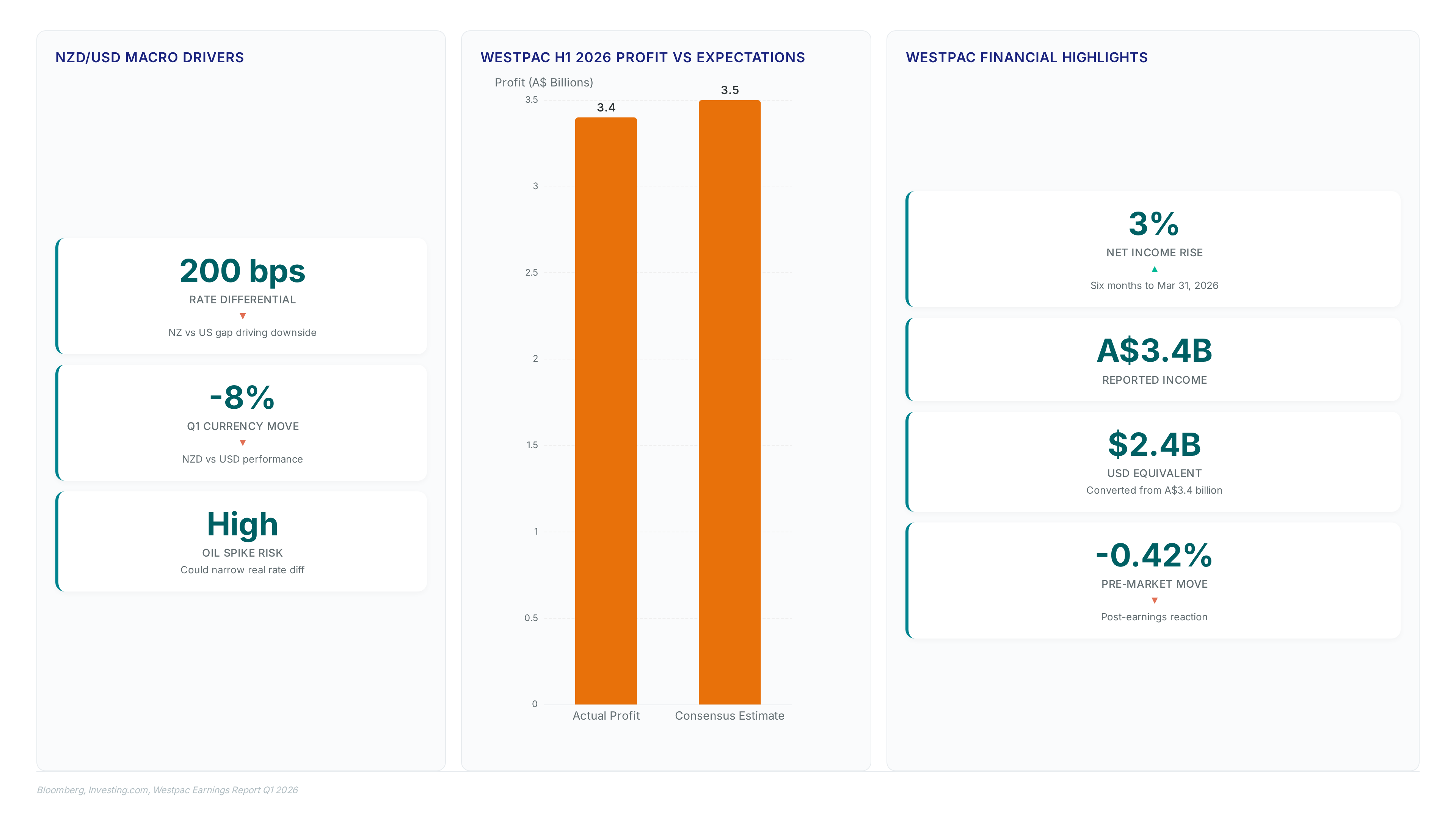
Widening policy gaps between the Reserve Bank and foreign peers create immediate selling pressure on the New Zealand dollar. Capital flows relentlessly toward higher yields, punishing currencies where central banks hold rates materially lower than global alternatives. This mechanical displacement forces FX desks to price in continued depreciation regardless of domestic growth improvements. This downside view sits somewhat at odds with more constructive growth and inflation revisions, validating the caution around carrying low-yielding assets. The structural deficit in yield creates a self-reinforcing loop where hedging costs further depress the spot rate. Operators must watch for a reversal if global oil prices spike again, which would narrow the real rate differential instantly. The current setup assumes stable energy markets, a fragile premise given ongoing Middle East tensions. A sudden surge in crude would invalidate the downside bias by forcing earlier, sharper local tightening.
NZD Weakness Versus Constructive Growth and Inflation Revisions
The currency risk outlook sits at odds with more constructive growth revisions, creating a divergent signal for position sizing. This mismatch represents the primary tension, where widening rate differentials drive NZD weakness despite a recovering domestic economy. The profit miss against consensus estimates highlights the challenging operating environment that complicates the inflation narrative.
| Metric | Currency Signal | Economic Reality |
|---|---|---|
| Driver | Rate Differentials | GDP Recovery |
| Direction | Bearish | Constructive |
| Timeframe | Immediate | Medium-term |
Traders facing this misalignment should prioritize the FX downside signal over domestic growth metrics. The mechanical pressure from yield gaps overwhelms fundamental improvements in the short-term. Capital flight toward higher-yielding jurisdictions persists regardless of local GDP upgrades. However, the divergence creates a specific vulnerability for long-only strategies anchored to economic data. If oil prices remain suppressed, the inflation peak could undercut expectations, accelerating the RBNZ pivot and validating the bearish currency view prematurely. This scenario leaves growth-focused longs exposed to rapid valuation compression. The cost of ignoring the rate differential is measurable in carry losses that outpace capital appreciation. Investors must weigh the constructive revisions against the immediacy of capital outflows driven by yield-seeking algorithms. The data sets the bias toward weakness; the chart sets the entry on failed rallies. A sustained break in oil price trends or a sudden shift in US Federal Reserve policy would flip this view, rendering the differential argument moot.
Two-Sided Economic Risks to NZD Recovery Timing in 2026
Recovery velocity through the second half of 2026 dictates whether underlying disinflation accelerates or stalls. The mechanism hinges on two opposing vectors: a quicker-than-expected economic rebound versus lingering price pressures that resist nominal cooling. Evidence from recent banking performance shows how geopolitical shocks create challenging operating environments that complicate profit stability. The limitation is that rapid growth could reignite demand-pull inflation, forcing the central bank to hesitate on rate cuts despite falling headline numbers. Risks to the economic profile run in both directions depending on how quickly the economy recovers through the second half of 2026.
| Risk Vector | Upside Consequence | Downside Consequence |
|---|---|---|
| Recovery Speed | Accelerated GDP expansion | Stalled momentum |
| Inflation Path | Persistent core pressure | Deflationary spiral |
| Policy Response | Delayed easing cycle | Premature tightening |
However, the cost of misjudging this timing is asymmetric for currency traders. If rate differentials widen further against the US and Australia, capital outflows intensify regardless of domestic growth improvements. This creates a scenario where positive economic data paradoxically strengthens the bearish case for the New Zealand dollar due to yield chasing. The implication for FX desks is a need to decouple growth expectations from currency positioning. These divergent forces keep the outlook far from locked in. A sudden spike in oil prices would invalidate the soft landing thesis immediately.
Applying Westpac's Forecast Framework to Investment Decisions
Application: Defining the Moderately Dovish Shift Amid Rate Hike Expectations
Westpac defines a "moderately dovish" revision as a compressed tightening trajectory that retains hawkish intent while reducing the projected magnitude of rate increases. The mechanism operates through an unexpectedly quick end to the conflict, which lowers commodity inputs and allows the Reserve Bank of New Zealand to delay aggressive action. Evidence suggests this path returns policy toward the pre-conflict February trajectory, though the bank warns the outcome remains far from locked in due to two-sided risks. Rates markets face increased volatility because they must now price in a slower climb to the peak rather than abandoning hikes entirely. Widening differentials against US and Australian peers drive capital outflows even as domestic growth improves.
Operational Risks: Regulatory Penalties and Compliance Failures
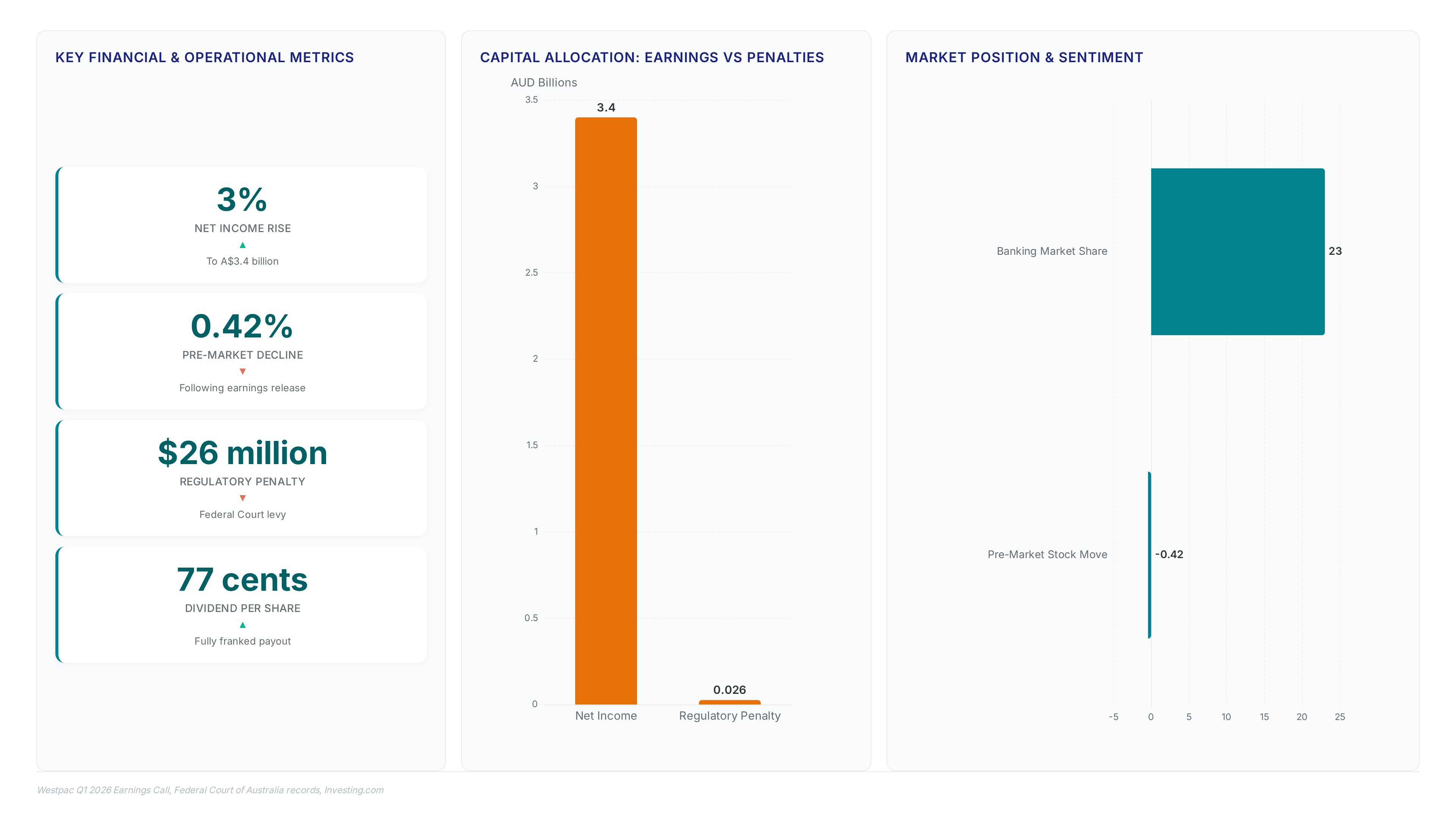
Operational risk models must incorporate the $26 million penalty levied by the Federal Court of Australia for failures to respond to customer hardship notices within mandated timeframes. Compliance system upgrades are no longer optional overhead but critical capital preservation measures for financial institutions. Investors interpreting Westpac economic forecasts should note that while the bank projects a slight pre-market stock decline following earnings, the deeper structural threat lies in recurring regulatory costs attributed to these historical procedural deficiencies. Operational lapses in processing hardship notices between 2015 and 2023 created a tangible liability that erodes shareholder value independent of macroeconomic performance. Profit metrics may initially mask the full cost of required industry-wide upgrades to digital banking infrastructure. Maintaining market share involves significant reinvestment in consumer protection protocols to avoid future pecuniary penalties. Perceived yield advantages get negated by unpriced legal exposures if this regulatory intensity is ignored. Regulatory bodies signal a relaxation in hardship notice enforcement only rarely, and current trends suggest intensifying scrutiny rather than leniency.
About
Marcus Halloran, Chief Market Strategist at ForexCFD.top, brings over a decade of interbank FX experience to his analysis of the Reserve Bank of New Zealand (RBNZ). Having previously served as an FX strategist on a London dealing desk, Marcus specializes in dissecting central bank communications and translating complex monetary policy shifts into actionable insights for retail traders. His daily work involves rigorously modeling interest rate differentials and macroeconomic data, making him uniquely qualified to interpret Westpac's revised outlook on the RBNZ's tightening cycle. At ForexCFD.top, an independent publication dedicated to regulation-aware market news, Marcus applies this institutional-grade framework to explain how geopolitical developments, such as the Iran conflict, influence inflation expectations and currency valuations. This article reflects his commitment to providing clear, data-led analysis on G10 macro events, ensuring traders understand the detailed risks surrounding the RBNZ's future rate path without unnecessary hype.
Conclusion
The divergence between rising GDP forecasts and stagnant bank net income reveals a critical friction point: regulatory compliance costs are now outpacing macroeconomic gains. While output recovery suggests strength, the tangible penalty levied by the Federal Court of Australia demonstrates that procedural failures in hardship processing directly erode capital regardless of broader economic health. Operators must recognize that yield advantages vanish when unpriced legal exposures accumulate, making reliable internal auditing a primary defense rather than a secondary administrative task.
Financial institutions should prioritize upgrading their hardship notice response systems before the next regulatory review cycle begins. Relying on temporary macroeconomic tailwinds to mask structural deficiencies in consumer protection protocols is a fragile strategy. The window to align operational frameworks with intensifying scrutiny is narrowing, and those delaying infrastructure reinvestment face disproportionate risks compared to peers who treat compliance as core capital preservation.
Start this week by mapping your current hardship notice workflow against the specific timeframe failures cited in recent Federal Court rulings to identify immediate gaps. This targeted review ensures you address the exact procedural deficiencies that trigger pecuniary penalties. By focusing on these specific operational vulnerabilities now, you secure your position against the compounding costs of non-compliance while others remain distracted by headline inflation figures.
Frequently Asked Questions
Headline inflation now peaks at 4.0% before falling to 3.5% by year-end 2026. This shift allows the central bank to realign its rate path with pre-conflict projections while monitoring oil price durability.
Westpac lifts the 2026 GDP growth forecast to 2.0% from a previous 1.5%. This tangible recovery in output suggests consumer spending may redirect from fuel pumps to discretionary sectors as input costs fall.
Widening interest rate differentials against the US and Australia drive continuedNZD downside risks. Investors must monitor these gaps closely as they threaten currency stability even amidst constructive domestic growth revisions.
The bank anchors its outlook on a 2.25% hold at the Reserve Bank of New Zealand meeting. This decision is expected to be unanimous, removing near-term event risk for markets before September.
Net income rose only a portion to billions, correlating with CEO concerns about volatility. This modest gain highlights how external geopolitical risks directly impact customer behavior and broader economic stability.
References