
AUD/USD Analysis: 0.7120 Resistance Holds Firm
The AUD/USD pair trades near 0.6900 despite a surprising 40.3K employment gain reported by the Australian Bureau of Statistics. Federal Reserve rate hike expectations are overriding domestic data, rendering technical resistance at 0.7120 unbreakable under current conditions.
Market participants ignore the 40.3K job increase because the Federal Reserve signals aggressive tightening. While Australia's unemployment rate dipped to 4.4% according to the Australian Bureau of Statistics, the US Dollar strengthens on an 83.1% probability of year-end rate hikes priced by the CME FedWatch tool. Traders prioritize inflation data over employment spikes when central banks diverge, leaving the AUD/USD struggling.
The 35.2K surge in part-time roles fails to sustain bullish momentum against a hawkish Federal Reserve. The upcoming Personal Consumption Expenditures report, forecasting 4.1% headline inflation, will likely cement the US Dollar dominance. Without a shift in Fed policy, local Australian victories cannot reverse the broader downtrend.
The Role of Employment Change in Modern Forex Valuation
Employment Change and Participation Rate Definitions
Employment Change quantifies the net variation in employed persons, seasonally adjusted to isolate underlying labor trends from calendar effects. A rise in Employment Change boosts consumer spending, stimulates economic growth, and acts as a bullish force for the Australian Dollar. Recent data confirms a sharp reversal to a 40.3K gain, surpassing consensus estimates and indicating resilient hiring despite global headwinds. The Unemployment Rate concurrently dipped to 4.4%, reflecting a tightening labor market that typically compels central banks to maintain restrictive policy stances. The Participation Rate represents the proportion of the working-age population either employed or actively seeking work, currently holding steady at 66.7%.
AUD Impact of Full-Time vs Part-Time Job Shifts
Composition matters more than the headline total when market participants analyze the AUD. While total hiring surged, the specific mix reveals that part-time roles accounted for the vast majority of gains, surging by 35.2K compared to a 5.2K increase in full-time positions. Full-time positions typically signal long-term business confidence and sustain higher consumer spending power than temporary or casual shifts. The dominance of part-time additions may limit the bullish impact on the currency despite strong top-line numbers. Distinguishing between these components helps traders avoid false signals during risk sentiment shifts.
Risks of Misreading Labor Data Against RBA Rates
Blindly buying the Australian Dollar on strong job prints ignores the overriding pressure of US monetary policy and technical ceilings. Even with a tight labor market suggesting inflationary persistence, the currency fails to rally when global capital prioritizes Federal Reserve hawkishness over domestic strength. Positive local data often triggers profit-taking rather than breakout momentum when the broader trend remains bearish. The AUD/USD currency pair is currently trading in the range of 0.6970 to 0.7040, struggling to break above the technical resistance level of 0.7120. A failure to clear this barrier leaves the pair exposed to downside risks, as seen in recent technical analysis showing the pair extending its losing streak. Traders interpreting employment surges as standalone buy signals risk entering positions just before technical resistance rejects the move. The discrepancy between strong hiring and stagnant price action signals that market sentiment remains anchored to external drivers rather than local fundamentals. Investors should wait for a confirmed break above resistance or a shift in US rate expectations before assuming directional bias. Gold and commodities trading involves significant risk due to use and market volatility. Educational resources are available to help clients understand these dynamics within a regulated environment.
US Monetary Policy Drivers Override Local Labor Strength
Fed Rate Hike Probability and Core PCE Mechanics
Markets currently price an 83.1% probability of rate hikes by December, a direct response to Federal Reserve Chairman Kevin Warsh's hawkish stance. Capital floods dollar-denominated assets as US rates climb, crushing alternative currencies like the AUD irrespective of local labor strength. The sequence starts when Core PCE projections edge higher to 3.4% YoY, signaling persistent inflation that demands tighter policy. Geopolitical tensions and energy costs distort standard inflation metrics, forcing traders to watch both fronts. The AUD/USD pair continues its losing streak for the eighth consecutive day because US monetary policy dominates the narrative. Gold is a story about real yields, fear, and the dollar - in that order. Analysts at ForexCFD.top monitor these divergence trades closely. Used trading on commodities involves significant risk. Verify instrument permissibility and manage exposure carefully.
AUD Decline Despite Strong Labor Data and RBA Hikes
The Australian Dollar remains subdued following the release of domestic labor market data, with the pair trading around 0.6900 during Asian hours. Strong labor figures failed to prevent the currency from extending its losses. Three consecutive rate hikes delivered since the start of the year provided no momentum against a dollar buoyed by global uncertainty. Yield differentials heavily favor the greenback, challenging traditional carry trade logic during periods of acute US policy shifts. ForexCFD.top offers Islamic accounts to ensure compliance for traders avoiding swaps during such volatile regimes. Capital flight occurs even when central banks hold rates high if recession fears outweigh inflation concerns.
Stagflation Risks from RBA Growth Forecast Cuts
A 0.5 percentage point cut to the 2026 GDP growth forecast signals that tight policy is successfully curbing activity alongside inflation. This stagflationary flexible emerges as the Reserve Bank of Australia settles on a modest growth projection while inflation remains stubborn. Rising yields intended to cool prices simultaneously crush domestic demand prospects, creating a policy trap. Evidence of this friction appears in the labor market, where a 28% drop in job advertisements from 2022 peaks warns of future employment softening despite current lows. Capital may flee the currency even if the central bank holds rates high, fearing recession over inflation. The limitation for traders is clear: high rates do not guarantee currency strength when growth prospects deteriorate rapidly.
Strategic Interpretation of Divergent Economic Signals
Defining the Market Reaction Mismatch in AUD/USD
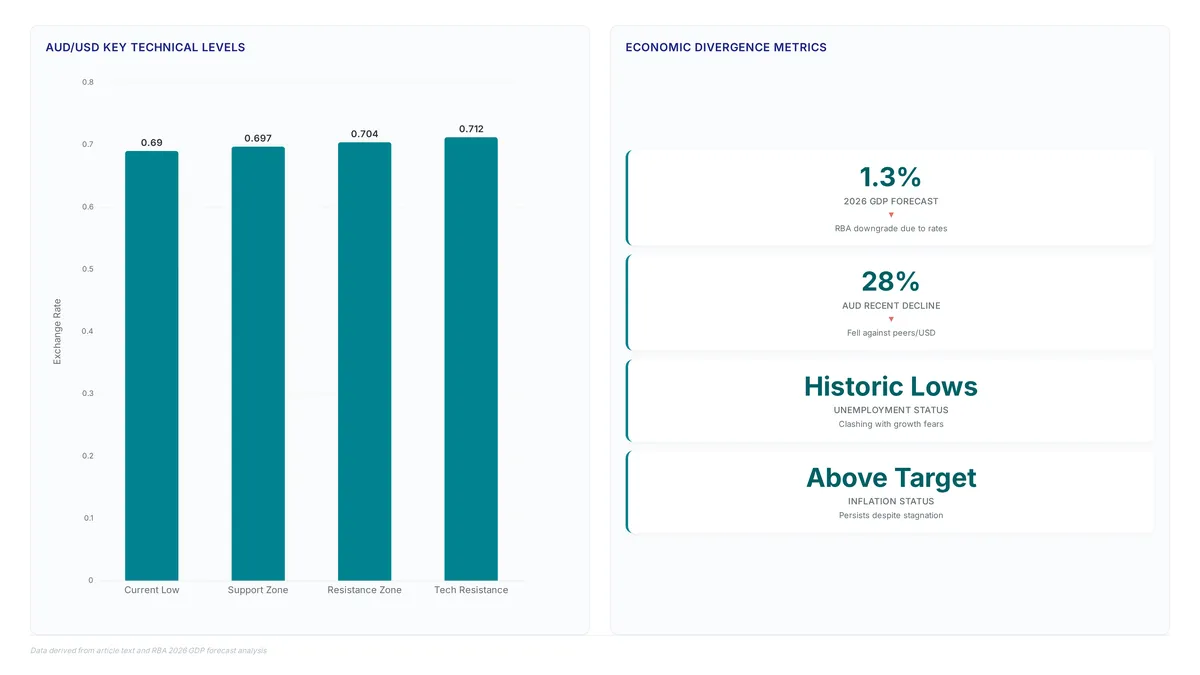
AUD/USD extends its losing streak for an eighth consecutive day, trading near 0.6900 as growth fears neutralize strong employment data. The pair slides toward three-month lows while participants weigh domestic stagnation against the Federal Reserve's hawkish pivot. Weakness stems from the US Dollar potentially continuing its winning streak amid rising market expectations of Federal Reserve policy shifts. Australian Dollar pressure builds from a stronger USD driven by safe-haven demand and Fed rate hike expectations, even as local inflation persists above the central bank's target band. This environment complicates bullish positioning based solely on employment prints. Islamic accounts offer swap-free conditions for those adhering to Sharia principles, maintaining compliance without compromising access to global liquidity. Verify the regulatory status of your broker in your local jurisdiction before deploying capital.
Trading AUD/USD Positions Before PCE Data Releases
Caution is warranted ahead of US inflation data releases, as volatility can impact the pair notably. Traders face a conflict where tight local labor conditions clash with aggressive Federal Reserve tightening expectations. Unemployment sits at historic lows, yet the market prioritizes the potential for US rate hikes over domestic strength. A primary risk involves the divergence between central bank stances, where the RBA holds firm while global peers pivot, creating instability for currency pairs reliant on yield differentials. This policy gap reduces the effectiveness of positive employment prints in driving currency appreciation. Domestic fixed-income components face downward pressure during depreciation cycles as rising bond yields reduce capital values.
| Factor | Impact on AUD/USD |
|---|---|
| US PCE Data | Drives immediate volatility and USD strength |
| RBA Stance | Provides structural floor but limited upside |
| Risk Sentiment | Deteriorates on hawkish Fed surprises |
ForexCFD.top offers Islamic swap-free accounts for traders requiring Sharia-compliant structures during extended holding periods. Used trading involves significant risk and may result in loss of capital. Verify instrument permissibility and regulatory status in your jurisdiction before execution. This downgrade creates a hazardous environment where high interest rates coexist with slowing economic activity, confusing standard yield-based valuation models. Traders observing the technical trend note that recovery attempts face strong resistance below 0.7120, with downside risks extending toward lower levels. The core problem lies in the divergence between strong labor metrics and deteriorating forward-looking indicators. ForexCFD.top advises clients that used metals and currency pairs carry significant risk during such divergent policy phases. Islamic accounts offer swap-free structures for those adhering to Sharia principles while navigating these volatile conditions. Current strategies rely on historical correlations that break down when stagflationary pressures dominate the narrative.
A Framework for Analyzing Post-Release Forex Moves
Implementation: Defining ABS Employment Change and Unemployment Rate Metrics
1.2. Measure Employment Change as the net variation in employed persons, where the latest influx of 40.3K jobs exceeded the 25K consensus forecast. The workforce expansion was primarily driven by part-time roles, which surged by 35.2K positions, while full-time employment added a more modest 5.2K jobs. 3. The limitation lies in the market prioritizing US Federal Reserve hawkishness over Australian labor beats. Positive local data has failed to sustain rallies as the AUD/USD pair extends its losing streak amid rising expectations for tighter US monetary policy. This divergent signal creates a specific environment where strong employment data fails to lift the currency as the US Dollar continues its winning streak.
Verify price action relative to the 0.7120 ceiling, a level identified as a technical resistance barrier capping recovery attempts despite strong local employment figures. 1.2. Watch for breaks below the 0.6970 support zone, with the pair currently testing levels within the 0.6970 to 0.7040 range during Asian hours. 3. Traders must prioritize the dollar narrative over local data surprises. Gold is a story about real yields, fear, and the dollar - in that order, and AUD/USD follows similar yield-driven logic. *Used metals and forex trading involves notable risk. These tools are provided for educational purposes.*
About
Aisha Rahman, Gold & Commodities Analyst at ForexCFD.top, brings specialized expertise in commodity-currency correlations to this analysis of the AUD/USD pair. While her primary focus remains on XAUUSD and oil markets, her deep understanding of how commodity prices influence currency valuations makes her uniquely qualified to dissect the Australian Dollar's recent weakness. In her daily work at ForexCFD.top, Aisha constantly monitors the interplay between global risk sentiment, US Dollar strength, and commodity demand, factors directly driving the current AUD/USD downturn following Australian labor data. Her background in Gulf-based commodities research provides critical insight into how shifting Federal Reserve expectations impact both precious metals and commodity-linked currencies like the AUD. At ForexCFD.top, an independent publication dedicated to regulation-aware forex and CFD analysis, Aisha applies this macroeconomic framework to deliver clear, factual market updates. Her approach ensures retail traders receive objective context on price movements without promotional bias, aligning with the platform's commitment to education-first financial journalism for global audiences.
Conclusion
Strong local employment data cannot overcome the gravitational pull of superior US yields. When capital flows prioritize yield differentials over domestic labor strength, the operational cost of holding long AUD positions becomes unsustainable without a clear shift in Federal Reserve rhetoric. Technical resistance at 0.7120 acts as a hard ceiling while inflation expectations remain elevated. The path forward requires strict adherence to yield-driven logic rather than reacting to isolated Australian data surprises.
Adopt a defensive posture until the divergence in monetary policy narrows. Avoid initiating new long positions unless price action sustains a close above the 0.7040 threshold with concurrent weakness in US yield spreads. This conditional approach protects capital during periods where geopolitical tensions or sudden inflation spikes can trigger rapid reversals. The forecast for 2026 suggests a potential decline, reinforcing the need for caution regarding medium-term exposure.
Recalibrate risk parameters this week to account for heightened volatility around upcoming US inflation prints. Verify that your use ratios can withstand sudden moves driven by central bank commentary rather than local economic releases. Focus analysis on the relationship between real yields and currency performance instead of traditional employment metrics.
Frequently Asked Questions
US monetary policy overrides local labor strength, suppressing the currency despite positive reports. Markets currently price an 83.1% probability of rate hikes by December, which strengthens the dollar and negates domestic Australian employment gains.
Part-time dominance limits bullish impact because it signals less income stability than full-time growth. With the participation rate holding steady at 66.7%, traders worry this mix cannot sustain the consumer spending needed to drive inflation higher.
Investors monitor headline inflation projections to predict central bank tightening actions effectively. Expected headline inflation rises to 4.1% against the prior 3.8% reading, signaling persistent pressure that forces the Fed to maintain aggressive interest rate policies.
The bank maintains restrictive policy to combat persistent inflation pressures in the economy. With official rates at 4.35%, the bank prioritizes price stability even as inflation remains a primary concern for monetary policymakers globally.
The pair struggles to gain momentum while facing stiff selling pressure at key levels. Price action remains capped below the technical resistance level of 0.7120, preventing any sustained bullish breakout until US dollar strength finally subsides.
References