
AUD/USD pair breaks down as core inflation hits 3.6%
Nine of 19 Fed officials are signaling rate hikes to fight sticky inflation, and the AUD/USD pair is collapsing to April lows in response. Divergent central bank mandates are crushing the Australian Dollar, ignoring domestic price pressures entirely. Traders must now focus on how Middle East geopolitical tensions fortify the US Dollar, analyze the specific breakdown mechanics at the 0.6900 support level, and understand why a 0.7% monthly CPI dip fails to stimulate buying interest.
While the Australian Bureau of Statistics notes annual inflation easing to 4.0%, the core rate climbing to 3.6% keeps the Reserve Bank of Australia trapped in a hawkish limbo that the market ignores. This policy disconnect faces a structural shift in global finance; Gartner predicts that by 2028, AI agents will intermediate $15 trillion in B2B spend, fundamentally altering FX demand patterns and reducing the efficacy of traditional inflation hedges like the AUD. (Gartner's strategic predictions for 2026)
The path of least resistance is down. Geopolitical risk premiums are lifting the greenback to May 2025 highs. Daily global FX volume hits $9.6 trillion per BIS records, providing abundant liquidity, yet sellers dominate the North American session. The impending breach of 0.6900 reflects capital fleeing yield-curve anomalies for safe-haven assets amid escalating Iran nuclear tensions.
Divergent Monetary Policies Drive AUD/USD Volatility
Trimmed Mean CPI vs Headline Inflation Metrics
Trimmed mean CPI strips out volatile price swings to expose persistent inflation trends that headline numbers frequently mask. Headline Consumer Price Index figures dropped 0.7% in May, yet the trimmed mean CPI rose 0.4%, lifting the annual core rate to 3.6%. This split clarifies why the Reserve Bank of Australia focuses on the core metric instead of the easing annual inflation rate of 4.0%. Headline data might imply rapid disinflation, but rising core figures show underlying pressures stay firm above the 2% to 3% target band. Substantial lenders like Westpac reflected this stance by raising variable home loan reference rates by 0.25% after the May decision. Markets frequently misprice currency moves by reacting to headline drops while ignoring that the monetary policy board targets the trimmed mean. The AUD/USD pair faces downside pressure as traders realize rate cuts remain distant. Core inflation persistence overrides temporary headline dips, forcing a recalibration of yield expectations. Operators modeling central bank responses must watch core metrics rather than volatile headline spikes.
RBA Rate Decisions Driving AUD/USD Lower
Holding the cash rate at 4.35% fails to support AUD/USD as Federal Reserve divergence intensifies pressure toward 0.6900. The Reserve Bank of Australia maintained its stance on June 16, yet this pause cannot offset the widening policy gap with Washington. Domestic rates remain elevated, but the Federal Reserve's flexible trajectory creates a yield disadvantage that drains capital from Australian assets. Traders discount the local currency despite the central bank's warning that it will not hesitate to tighten further if inflation persists above target. The resulting sell-off pushed the pair to a fresh low since April 7, breaking through the 0.6920-0.6925 resistance zone during Asian trading hours. Transmission of monetary policy remains potent locally, with substantial lenders like Westpac passing through previous hikes to variable home loan reference rates. Such moves tighten financial conditions for households, theoretically cooling demand. Global risk sentiment currently overrides these domestic fundamentals. A tech-driven equity selloff combined with geopolitical friction involving Iran's nuclear program boosts safe-haven flows into the US Dollar.
Consequently, the Reserve Bank of Australia faces a dilemma where further tightening risks economic stagnation without guaranteeing currency support. The market now prices in additional tightening, yet the Australian Dollar remains vulnerable to external shocks. Until the Federal Reserve signals a pivot, the path of least resistance remains downward. Traders must monitor whether the pair accepts levels below the psychological support threshold. Failure to hold this line invites accelerated depreciation as carry trades unwind rapidly.
Safe-Haven Flows and 0.6900 Support Breakdown
A safe-haven currency attracts capital during geopolitical stress, yet the US Dollar strengthens here despite divergent rate paths. Bears target a sustained breakdown below 0.6900, a level where technical acceptance triggers algorithmic selling. This volatility increases within the $9.6 trillion daily FX market infrastructure, where liquidity fails to dampen sharp moves during risk-off events. High-frequency systems react to trade signal forecasting models that prioritize USD accumulation over yield differentials when uncertainty spikes.
The cost of this flexibility is clear: local monetary tightening cannot offset global risk aversion. Even with inflation above target, the Reserve Bank of Australia finds its policy use diminished when capital flees to safety. Operators must recognize that mixed inflation data matters less than the broader flight to quality. A break below 0.6900 opens the path for further depreciation regardless of domestic fundamentals. The sheer volume of global flows ensures that safe-haven demand overrides local rate advantages during periods of heightened tension.
Fed Rate Expectations and Geopolitical Risks Shape USD Strength
Fed Rate Hike Bets and Geopolitical Risk Premiums
Nine of the Fed's 19 committee members signal immediate policy tightening to counter sticky inflation, driving mechanical USD strength. Market participants now price aggressive rate hike scenarios for September or December as mixed US-Iran messages regarding Tehran's nuclear program sustain a geopolitical risk premium. Capital flight lifts the greenback to fresh highs since May 2025, directly pressuring the AUD/USD pair. Divergent central bank trajectories create a yield disadvantage for Australian assets despite local rate holds. The Federal Reserve exhibits flexibility that attracts speculative flows away from the antipodes while the RBA maintains its stance. Weekly foreign exchange rates show USD indexes surging against substantial peers. Rapid repricing of forward curves means even a single hawkish comment triggers algorithmic selling in currency pairs with high correlation to risk sentiment.
The cost of this divergence appears in the widening spread between US and Australian sovereign debt. Currency-based investment strategies increasingly favor the dollar as the Federal Reserve signals further moves in official foreign exchange releases Sudden de-escalation in Tehran could reverse gains instantly, leaving used long-USD positions exposed. Operators must monitor the gap between committee dot-plots and market pricing because misalignment here generates the sharpest intraday moves. A structural bias toward lower lows persists until the policy gap narrows or inflation data forces a Fed pivot.
AUD/USD Price Action at the 0.6920 Resistance Zone
Rejection from the 0.6920-0.6925 zone confirms immediate vulnerability as mixed inflation data fails to sustain buyer momentum. Fresh sellers entered the market following a muted reaction to domestic figures, leaving the exchange rate exposed to deeper slides. Technical weakness persists despite the Reserve Bank's elevated stance, driven by a policy divergence where the Federal Reserve exhibits greater flexibility than its Australian counterpart. Such divergence creates a structural yield disadvantage that drains capital from Australian assets regardless of local rate holds.
Market participants now monitor the 0.6900 support level, where a sustained breakdown could trigger algorithmic selling pressure. Prediction markets imply a 70% probability of further tightening by the RBA, yet this expectation is already priced into the current valuation. Geopolitical risk premiums and sticky US inflation force traders to prioritize USD accumulation over yield differentials.
The Federal Reserve released foreign exchange rates in February that established the baseline for current dollar strength. Consumer price sensitivity has become a structural shift rather than a temporary reaction, complicating the path for disinflation globally. This flexibility limits the upside potential for the Australian dollar even if domestic data improves marginally in coming quarters. Persistent price pressures force Australian officials to hold rates steady, whereas the Federal Reserve retains optionality due to a more favorable inflation trajectory. This divergence creates a structural yield disadvantage for Australian assets, draining capital despite local stability. The resulting rigidity contrasts sharply with US adaptability, where investors price rate hikes for September or December. Mixed US-Iran messages regarding Tehran's nuclear program further sustain geopolitical risk premiums, lifting the USD to fresh highs since May 2025. Consequently, the AUD/USD pair faces immediate downside pressure as safe-haven flows override yield differentials. Traders must recognize that holding rates high fails to support the currency when the counter-party exhibits greater policy divergence. The mechanical outcome is a continued slide toward the 0.6900 support level.
Technical Breakdown Scenarios at the 0.6900 Support Level
Defining the 0.6900 Support Threshold and Weekly Heat Map Metrics
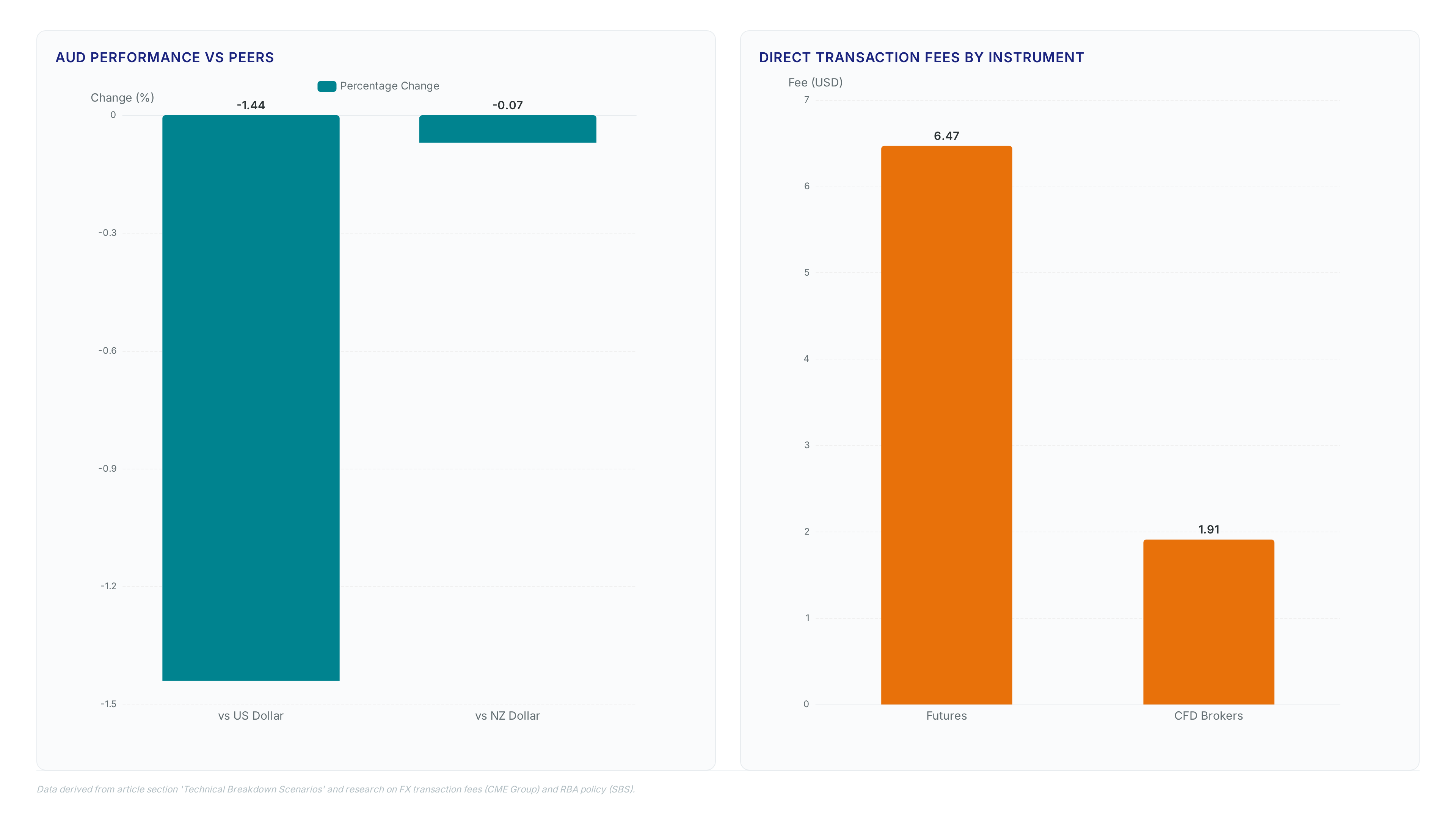
The 0.6900 level acts as the definitive technical trigger where algorithmic selling accelerates upon sustained acceptance below the mark. Market participants interpret the weekly heat map by selecting the base currency from the left column and the quote currency from the top row to determine the exact percentage change. This matrix reveals the Australian Dollar posted a -1.44% decline against the US Dollar, while showing relative durability with only a -0.07% drop versus the New Zealand Dollar. Such granular performance data emerges within a massive FX market infrastructure that processes trillions in daily volume yet remains susceptible to sharp directional moves during risk-off events. Operators must parse these fees against the backdrop of Federal Reserve Board policy shifts that drive the underlying USD strength visible in the heat map. A breakdown below 0.6900 invalidates the current consolidation range, forcing a re-pricing of yield differentials that no amount of local RBA rigidity can immediately offset.
Executing Short Entries on AUD/USD Below 0.6900 After Asian Session Rejection
Short entries below 0.6900 require confirmation of the Asian session rejection at 0.6925 to validate the bearish trend. Traders executing during the North American window must account for direct transaction fees analyzed at a modest fee for futures, a sharp contrast to the $1.91 average seen with CFD brokers This cost disparity dictates that high-frequency scalping strategies remain viable primarily on exchange-traded instruments where liquidity depth supports rapid position adjustments.
Entry execution should align with the 0.6920-0.6925 resistance zone, where previous buyer attempts failed against a firmer US Dollar. Market participants can optimize their execution analytics by benchmarking fill prices against the reported dealer volume, which accounts for roughly a significant share of the daily gross turnover. Failure to filter for this institutional flow often results in premature entries before the 0.6900 support level breaks with conviction. Strategic patience remains the primary edge when trading against the macro backdrop of divergent central bank policies.
Analyzing Liquidity Risks and Transaction Costs in High-Volume FX Markets
High-volume execution below 0.6900 incurs measurable friction that erodes thin margins on every lot traded. The sheer scale of the FX market infrastructure processes trillions daily, yet this depth masks the specific costs embedded in different execution venues. This concentration means liquidity risks spike when substantial players withdraw during volatility, widening spreads beyond historical norms. The limitation remains that broker-marketed "commission-free" CFDs often embed costs in wider spreads, obscuring the true transaction costs.
- Monitor the divergence between headline CPI and core measures to spot false disinflation signals. 2.3. Adjust use downward when core rates breach the upper threshold indefinitely.
Nine of 19 Federal Reserve officials currently favor rate increases, creating a hawkish split that overrides divergent RBA policy. Traders must first quantify this policy divergence. The second step involves assessing liquidity shifts as the Federal Reserve Board releases weekly data that often triggers abrupt trend reversals. Operators should then evaluate execution venues, noting that AI-driven fraud detection now manages significant portions of the $6.6 trillion daily volume.
- Track committee dot-plot shifts to anticipate sudden USD strength before geopolitical headlines break.
- Correlate nuclear negotiation updates with real-time option flows to gauge risk premium expansion.
- Deploy algorithmic hedges when sentiment indicators diverge from the core inflation trajectory.
The limitation is that nine hawks do not guarantee a hike if inflation data cools unexpectedly. Consequently, relying solely on committee counts without monitoring digital transformation
About
Marcus Halloran serves as the Chief Market Strategist at ForexCFD. Top, where he uses his background as a former interbank FX strategist in London to decode complex G10 macro trends. His specific expertise in monetary policy and interest-rate differentials makes him uniquely qualified to analyze the current struggle of the AUD/USD pair. In his daily work, Halloran translates critical central bank decisions and economic data, such as the recent mixed Australian inflation figures, into clear directional calls for retail traders. This article's focus on the pair's vulnerability near 0.6900 directly reflects his routine analysis of how a firmer US Dollar impacts substantial currency crosses. At ForexCFD. Top, an independent publication dedicated to vendor-neutral market news, Halloran applies his deep understanding of macro positioning to help traders navigate volatile sessions without hype, ensuring readers receive factual insights grounded in real-time market liquidity and fundamental drivers.
Conclusion
Market reliance on divergent inflation metrics fails when global liquidity tightens, creating a false sense of security for long AUD positions. The real break point occurs when algorithmic execution venues prioritize Fed committee sentiment over local core data, triggering rapid deleveraging that headline rates cannot predict. Operational costs surge as manual hedging strategies lag behind AI-driven order flows that react to geopolitical risk premiums in milliseconds. Traders must shift focus from domestic CPI releases to the differential in central bank rhetoric and the specific volume of safe-haven flows entering the market.
Adopt a strict protocol of monitoring Fed dot-plot shifts and weekly liquidity data before committing capital to carry trades, specifically waiting for confirmation that US hawkishness is not being offset by broader risk-off sentiment. This approach is critical over the next two quarters as AI agents begin intermediating the majority of B2B transactions, fundamentally altering traditional FX demand patterns and volatility clusters.
Start by auditing your current execution venue's latency and fraud detection capabilities this week to ensure your infrastructure can withstand algo-driven flash crashes triggered by sudden shifts in US-Iran nuclear negotiation headlines.
Frequently Asked Questions
Headline CPI fell 0.7%, but core inflation rose 0.4% to 3.6%. Traders ignore temporary headline drops because rising core figures show underlying pressures stay firm above the target band.
Major lenders like Westpac raised variable home loan reference rates by 0.25%. This move reflects the central bank's focus on the trimmed mean CPI rather than the easing annual inflation rate.
Bears target a sustained breakdown below the 0.6900 support level. Acceptance below this mark triggers algorithmic selling and positions the pair for an extension of the recent pullback from four-year peaks.
The US Dollar strengthened against the Australian Dollar by 1.44% this week. This surge occurs as geopolitical risks and Fed hawkishness boost safe-haven flows into the greenback.
Daily global FX volume hits $9.6 trillion according to BIS records. Despite this abundant liquidity, sellers currently dominate the North American session as capital flees toward safe-haven assets.