
Core inflation drives ECB rate hikes in 2026
Eurozone core inflation climbing to 2.6% settles the debate: central banks now chase persistent price pressures, not transient energy spikes. We are living through a 2026 defined by divergence. The European Central Bank grapples with sticky domestic costs while the Federal Reserve navigates resilient growth. The thesis is simple. Core inflation dynamics, not energy shocks, drive strategic rate decisions in substantial economies.
ECB officials like Simkus are weighing another hike even as Brent crude moderates below USD 80/bbl. The disconnect is stark. The ECB raised its deposit rate to 2.25%, while the Federal Reserve likely holds its target range at 3.50%-3.75%. Why? Conflicting data. Eurozone wage growth slows to 2.6% even as US retail sales surge 0.9% month-over-month.
These signals force portfolio adjustments. Eurozone yields find equilibrium with minimal curve movement. US yields face pressure from PCE inflation staying well above the 2% target. Central banks must distinguish between temporary commodity spikes and entrenched price dynamics. The 0.1% m/m headline figure reflects recent energy calm, yet upward revisions in core metrics signal that second-round effects are embedding in the broader economy. Ignoring war-driven price increases is no longer a valid strategy. Oil costs filter through wages and services whether policymakers like it or not. The European Central Bank adjusted its forecast for headline inflation to average 3.0% in 2026, acknowledging that supplyside disruptions require active intervention. Ignoring this split risks underestimating inflation persistence. Hedging based solely on headline data fails against stickier core realities. Headline numbers offer a snapshot; the core rate dictates policy longevity. Traders must monitor wage trackers and services data to anticipate moves that headline volatility obscures.
Oil Supply Disruptions Driving ECB Rate Hikes to 2.25%
Oil prices surged 84% between December 2025 and February 2026. The European Central Bank responded by raising its main deposit rate to 2.25% in June 2026. This move proves energy shocks now transmit directly to monetary policy. Central banks have abandoned "look-through" strategies for war-driven inflation. Unlike previous cycles where temporary spikes were ignored, the ECB determined that preventing second-round effects required immediate tightening via the deposit rate facility. Rising energy costs elevate production expenses across the supply chain, creating cost-push inflation.
ECB member Simkus indicated an additional rate hike may still be necessary if wage pressures persist alongside elevated commodity prices. This stance contrasts sharply with the Bank of Canada, which held rates steady as its domestic inflation metrics remained within target ranges despite the same global shock. Tightening monetary policy into a supply-side shock can deepen recessions without fully restoring output levels. Network operators and treasury managers must recognize that monetary doctrine has shifted; ignoring geopolitical energy risks is no longer a viable strategy for price stability. Portfolios anchored on steady rates face renewed volatility as central banks prioritize inflation containment over growth support.
ECB Hikes vs Fed Pause: Divergent Responses to Energy Shocks
Identical oil supply disruptions triggered opposite policies. The ECB prioritized immediate inflation containment while the Federal Reserve weighed growth risks. The European Central Bank became the first substantial institution to raise rates, rejecting the notion that war-driven price spikes should be ignored monetary doctrine. This aggressive stance contrasts sharply with the Federal Reserve, which maintained a restrictive but steady posture despite internal projections hinting at future hikes. Similarly, the Bank of England held its benchmark rate at 3.75%, illustrating a clear divergence in how substantial economies address the problem of forecasting oil market equilibrium.
Risks of Misinterpreting Inflation Data Impact on Policy
Misreading the May CPI surge to 4.2% y/y as a universal mandate for tightening ignores the divergent mandates protecting global growth.
| Region | Primary Risk | Policy Response |
|---|---|---|
| Eurozone | De-anchored expectations | Immediate hike |
| United States | Growth suppression | Data patience |
Conflating these distinct inflationary drivers leads to premature positioning against the dollar. Core readings near 2.9% y/y appear elevated, yet they reflect supply constraints rather than overheating demand. Operators must distinguish between transient commodity spikes and persistent wage-price spirals before altering duration exposure. Assuming a single global reaction function creates vulnerability when central banks prioritize different stability metrics. Headline-focused models often fail to isolate services inflation from volatile energy components. Market participants relying on aggregate numbers without decomposing the basket will likely overestimate the probability of a US rate hike.
Strategic Portfolio Adjustments Amid Oil Demand Revisions and Currency Trends
Defining Strategic Portfolio Triggers: IEA Demand Forecasts and DXY Resistance
Market positioning has adjusted to reflect some improvement in supply disruptions and a moderation of inflation pressures following the US-Iran agreement. Brent crude holding below USD 80/bbl serves as a key barometer of this view. While economic data remains somewhat outdated, reflecting conditions prior to the announcement, the current setup suggests a distinction between temporary supply shocks and broader economic conditions. The mechanical link between revised flow data and asset allocation requires careful monitoring rather than immediate recalibration of long-only commodity mandates.
Traders must monitor the DXY Index as it hovers near 99.65. The 100.00-100.56 zone acts as a critical resistance ceiling for USD bulls. A break above this technical threshold would likely test the dollar's durability, irrespective of the underlying oil narrative. The cost of ignoring this currency trend is measurable: gold recently fell below $4,000 as prospects for higher rates outweighed safe-haven bids. Geopolitical headlines can invalidate technical setups instantly, requiring strict stop-loss discipline. Global demand is now expected to decline by 1.1 million barrels per day in 2026 to 103.3 million barrels per day. This specific divergence between sticky domestic price pressures and falling sovereign borrowing costs creates a complex environment for GBP pairs as algorithmic rebalancing occurs.
| Data Point | Market Reaction | Trade Action |
|---|---|---|
| Services Inflation | Accelerates to 3.7% y/y | Monitor for volatility |
| Gilt Yields | Fall 4-5 bps | Assess duration demand |
| Headline CPI | Holds steady at 2.8% y/y | Avoid broad shorting |
Monitoring inflation data for release requires distinguishing between transient energy effects and persistent wage-driven pressures that compel central bank attention. Investors asking should I adjust portfolio before Fed decision must recognize that UK-specific data now drives local currency volatility more than US commentary in the immediate aftermath of release. The cost of hedging against such inflation spikes increases as market participants price in potential policy errors. However, chasing the initial spike carries execution risk if headline figures remain anchored, limiting the central bank's ability to hike aggressively despite sectoral heat. Traders must verify that the yield fall reflects genuine demand for duration rather than liquidity gaps, as false breaks in Gilt yields frequently reverse within the same trading session.
Navigating Execution Risks in Oil Supply Disruptions and US-Iran Agreement Volatility
Mispricing execution risks surrounding the US-Iran agreement invites severe portfolio drawdowns despite apparent market calm. Brent crude holding below USD 80/bbl remains a key barometer of this fragile view, yet supply disruptions remain a primary concern for the broader economy. While inventory data is not explicitly detailed in the immediate report, the focus remains on how higher oil and commodity prices filter through. Global oil inventories have fallen by an average of 3.8 million barrels per day since the start of the conflict. Steps for assessing currency market trends require monitoring physical supply chain indicators, such as reported fuel shortages at retailers like Asda, as tangible signals of fracture.
| Risk Factor | Market Signal | Operator Action |
|---|---|---|
| Inventory Draws | Supply disruptions | Hedge long exposure |
| Price Barometer | Brent < USD 80/bbl | Monitor breakdown levels |
| Supply Chain | Retail fuel gaps | Reduce cyclical weight |
The cost of ignoring these physical constraints is measurable in sudden liquidity evaporation during geopolitical flare-ups. Unlike pure financial metrics, physical inventory data reveals a supply deficit that price action has not yet fully discounted. Portfolio managers relying solely on forward curves risk underestimating the premium required for immediate delivery. Distinctions must be made between temporary diplomatic progress and the structural reality of depleted strategic reserves.
Operational Framework for Monitoring Geopolitical Risk and Inventory Data
Defining the Inventory Draw Metric: IEA Conflict Baselines
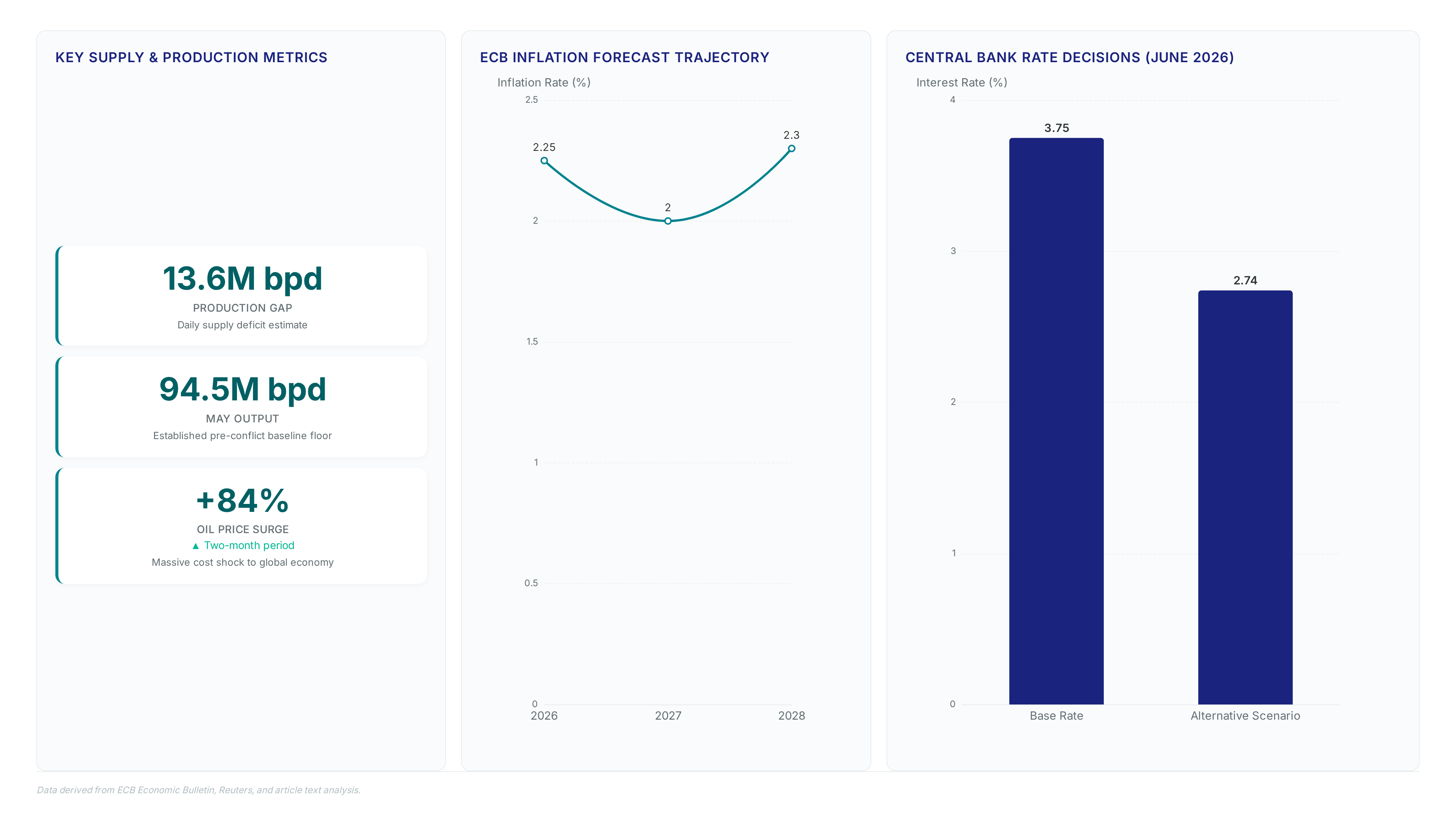
Measure the inventory draw against the 13.6 million barrels per day production gap to quantify the true supply deficit. May output fell to 94.5 million barrels per day, establishing a concrete floor for calculating pre-conflict baselines. Operators must distinguish between this structural hole and the average daily decline observed since hostilities began.
- Calculate the production delta using May data as the reference point for missing volumes.
- Compare current stock levels against the 163 million barrel OECD reduction to gauge emergency release efficacy.
- Monitor Asda fuel shortages as a leading indicator of physical tightness before price signals emerge.com/article/4917885-us-pce-inflation-remains-sticky-in-may- bearish demand outlook and the immediate reality of vanishing stocks. Operators focusing solely on the lowered 2026 forecast risk underestimating the volatility premium required for near-term contracts. While long-term models suggest a surplus, the physical market currently rewards those who prioritize immediate availability over theoretical supply curves. Ignoring this divergence leaves portfolios exposed to sudden spikes when paper markets reconnect with physical delivery constraints.
Implementation: Mitigating Execution Risks in US-Iran Agreement Volatility
Stale economic data reflect conditions before the US-Iran agreement, creating dangerous lag in trade execution. Traders must recognize that current prints ignore the diplomatic shift, leading to mispriced volatility when Brent crude holds below key levels.
- Validate supply assumptions against real-time inventory draws rather than relying on backward-looking reports.
- Adjust position sizing immediately if fuel shortages like those at Asda stations signal physical tightness despite calm headlines.
- Monitor central bank rhetoric for hints that inflation targeting frameworks may force reactive hikes despite easing geopolitical tension.
The critical flaw in standard models is their failure to account for the "war premium" embedded during stalled negotiations, which distorts inflation forecasts even after deals are signed. This creates a false sense of security where traders under-use hedges against sudden supply shocks. Operators ignoring this lag face asymmetric risk where downside protection evaporates exactly when geopolitical sentiment shifts. The cost of relying on outdated economic indicators is measurable slippage during rapid repricing events.
About
Vikram Nair, Emerging Markets & Asia FX Writer at ForexCFD.top, brings specialized insight to global central bank policy analysis through his deep focus on developing economies. While the article examines ECB decisions and Eurozone inflation, Vikram's daily work tracking the RBI, CBN, and Bank Indonesia allows him to contextualize how substantial Western monetary shifts impact emerging-market currencies like USD/INR and USD/NGN. His expertise lies in translating complex macroeconomic data into actionable intelligence for retail traders in Tier-2 and Tier-3 regions. At ForexCFD.top, an independent publication dedicated to regulation-aware market news, Vikram ensures that coverage of inflation pressures and supply disruptions includes critical local legal nuances and funding realities. This unique perspective bridges the gap between high-level G7 policy and the practical trading conditions faced by investors in India, Nigeria, and Southeast Asia, providing a grounded view of global financial interconnectivity.
Conclusion
Divergent monetary paths between the ECB and Bank of England create a fragile environment where static hedging strategies fail. While the ECB projects a slow return to target by 2028, the immediate 84% surge in oil prices forces reactive policy shifts that lag behind physical market reality. Traders relying on averaged inflation forecasts ignore the volatility premium required when paper markets disconnect from delivery constraints. This mismatch exposes portfolios to sudden repricing events as central banks adjust rates to match supply-side shocks rather than theoretical curves.
Market participants must prioritize real-time inventory data over backward-looking economic prints to navigate this divergence. Do not wait for official rate announcements to adjust exposure; the window for effective hedging closes before policy changes are formalized. Operators should treat current calm in diplomatic headlines as temporary and price in the risk of sudden supply interruptions regardless of negotiated agreements.
Begin this week by validating your current supply assumptions against real-time inventory draws instead of relying on stale monthly reports. This immediate audit reveals whether your positions reflect actual physical tightness or merely optimistic modeling. Aligning execution with tangible fuel availability rather than forecasted averages protects capital when geopolitical sentiment shifts abruptly.
Frequently Asked Questions
The ECB raised rates to 2.25% to combat sticky core inflation. Conversely, the Fed held its range at 3.50% to 3.75% due to resilient growth data. This divergence forces investors to adjust bond portfolios for varying yield curves across major economies.
Oil prices surged 84% recently, forcing central banks to address cost-push inflation directly. Policymakers now fear second-round effects rather than ignoring temporary spikes. Consequently, treasury managers must hedge against prolonged restrictive stances that prioritize price stability over short-term growth support.
Core inflation rose to 2.6%, signaling entrenched domestic price pressures despite calm energy markets. This persistence compels officials to consider additional hikes beyond the current 2.25% deposit rate. Traders should monitor wage trackers closely as they dictate the longevity of tight policy.
Retail sales jumped 0.9% month-over-month, confirming economic resilience and reducing the need for rate cuts. This strength keeps the Fed's target range steady at 3.50% to 3.75% while inflation remains above the 2% target. Markets now expect fewer easing measures this year.
Eurozone wage growth slowed to 2.6% while US core inflation hit 3.3%, creating conflicting signals for global capital. This split means US yields face pressure from persistent prices while European yields seek equilibrium. Portfolios must account for these distinct regional inflation dynamics.
References