
Australia Employment Data: The Part-Time Trap
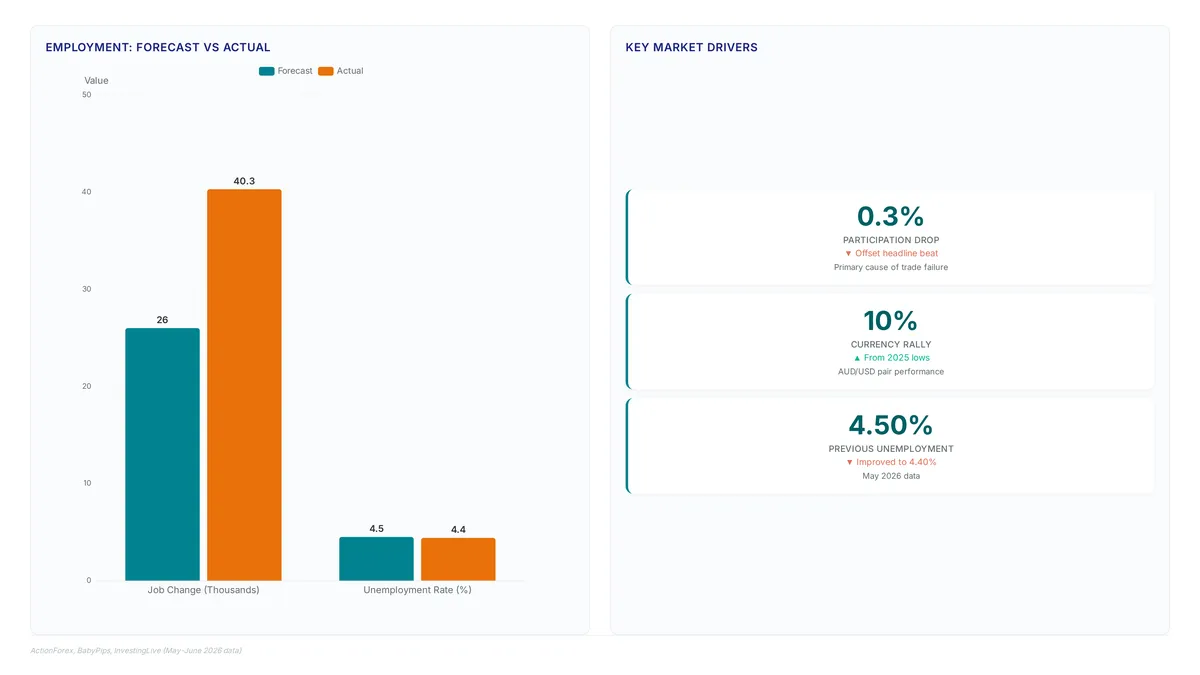
Australia's labor market added 40,300 jobs in May 2026, beating the 26,000 consensus while dropping unemployment to 4.4%.
Do not let the headline fool you. Beneath that beat lies a fracture: part-time hiring drove the gains while total hours worked contracted. This is the reality of the current AUD trading environment. The Australian Bureau of Statistics reported a rebound, sure, but the engine room is cooling even as the dashboard lights flash green. Investors who stare only at the job count miss the signal entirely. The RBA tightening path depends on labor intensity, not just headcount, and methodological noise in the survey system is making that distinction harder to see.
We are here to map the gap between full-time stagnation and part-time expansion. That divergence creates the forex opportunities standard charts miss. When central bank expectations clash with soft underlying data, currency correlation breaks down, offering an edge to those who read the raw numbers instead of the spin.
The Role of Labor Market Divergence in Modern Forex Analysis
Defining Underemployment and Part-Time Skew in Labor Data
Look at the underemployment rate. It climbed to 5.9% even as jobs were added. This metric exposes the slack unemployment rates hide during skewed hiring cycles. In May 2026, full-time hiring contributed only 5,200 jobs. Part-time roles added 35,200 positions instead. That is not strength; it is a statistical illusion masking fragility. The unemployment rate fell to 4.40%, yet the divergence implies workers remain economically insecure.
A forex watchlist functions as a curated inventory of these setups, prioritizing catalysts where market pricing diverges from economic reality. Traders monitoring core inflation data at 3.6% must weigh this against the quality of employment growth. Currency movements depend heavily on whether markets prioritize headline job counts or the underlying quality of those roles. ForexCFD.top solutions emphasize decomposing these aggregate figures to identify genuine policy pressure points before entry. Ignoring the part-time skew risks misinterpreting the Reserve Bank of Australia's tightening capacity. Algorithms often miss the nuance in the initial surge, chasing the headline while the foundation crumbles.
Interpreting Headline Beats Against Declining Hours Worked
A +40,300 employment surge paired with a 1.1% drop in hours worked signals hidden labor slack. Headline figures often mislead forex participants by masking the intensity of economic activity beneath raw job counts. Australia printed a massive beat against consensus in May 2026. Yet the hours worked metric contracted sharply during the same period.
This specific displacement indicates that more individuals entered the workforce while aggregate demand for labor time softened. Traders analyzing how employment data affects AUD must prioritize this intensity gauge over the headline tally. A rally in the currency pair toward 10% from 2025 lows may reflect initial algorithmic overreaction to the job count. The part-time skew suggests the underlying engine is cooling rather than accelerating. This creates a fragile bullish bias prone to rapid reversal upon further data releases. Market narrative may shift if future reports show full-time hiring recovering to match the headline expansion. ForexCFD.top traders should monitor the next participation rate print for confirmation of this structural weakness. Data sets the bias; the chart sets the entry.
Methodology Noise and Statistical Distortions in ABS Surveys
The Australian Bureau of Statistics flagged ongoing methodology changes as a potential source of noise in recent labor figures. This statistical distortion creates immediate risk for traders reacting to the headline unemployment rate falling to 4.4%. The jobless figure matched consensus expectations, but the underlying collection system transition introduces variance that masks true economic momentum.
Raw job counts diverge from actual labor intensity. Methodology noise complicates the assessment of labor tightness. ForexCFD.top analysts note that such transitional periods require careful scrutiny once the initial algorithmic response fades. Trusting the headline without adjusting for these collection artifacts is a recipe for false signals.
Translating Part-Time Job Surges into AUD Price Action
The AUD/USD pair initially rallied on the headline beat. Then, the composition of employment growth triggered an immediate reversal. Total gain reached 40,300. Part-time roles accounted for the vast majority of gains at 35,200. Full-time hiring contributed only 5,200. This specific data quality failure demonstrates how risk sentiment can sap currency strength even when headline numbers exceed consensus.
Initial bullish bias flips to neutral as traders recognize the underlying weakness masked by the aggregate figure. A sustained breakdown below key technical support levels confirms the market is weighing labor slack against inflation fears. The level sits at 0.6895 where longer-term uptrends and short-term downtrends collide.
Executing Trades When Part-Time Composition Skews Data
The specific part-time composition of the May print immediately invalidated the headline-driven bullish bias for AUD/CHF. Traders asking if they should trade AUD after jobs data must recognize that a risk-off environment increases selling pressure on weak underlying metrics. Safe-haven flows into CHF overwhelmed the superficially strong Australian numbers. The pair pushed through the 0.5600 support level.
Operators must separate the headline figure from the quality of employment growth to analyze economic data releases effectively. ForexCFD.top provides the institutional-grade execution infrastructure required to navigate these cross-currents without slippage. A return to positive hours growth would be required to flip the view back to bullish AUD. De-escalation in Middle East tensions is also necessary. Path of least resistance remains lower despite headline strength until these conditions meet.
Validating AUD/NZD Rate Gap Trades Against Risk Backdrops
Validating a rate-gap trade requires confirming that the RBA 4.35% yield advantage over the RBNZ 2.25% policy rate aligns with a supportive risk environment. Operators must distinguish between a valid fundamental bias and an executable technical trigger. Divergence between strong domestic data and external geopolitical risks often creates false signals. Currency fails to rally despite positive news in such scenarios.
Entering prematurely based solely on the interest rate differential exposes capital to volatility driven by unrelated equity market moves. Cost of ignoring the risk context is a stalled position that ties up margin without momentum. Traders should wait for price action to confirm the environment matches the fundamental thesis before deploying capital.
Strategic Lessons from Mixed Employment Data and Trade Failures
Defining Catalyst Override in Mixed Employment Data
External drivers like U.S. Core PCE releases and AI-related tech valuation concerns often cap the price impact of a primary headline beat. A correct fundamental bias on Australian employment figures might fail to generate immediate follow-through when overshadowed by external risk-off flows. Traders expecting an immediate AUD surge encountered limited momentum instead. Inflation data shifted the narrative toward dollar profit-taking, restricting follow-through despite these headline beats.
Market participants often misinterpret this failure as a flaw in their fundamental analysis rather than a reflection of competing liquidity flows. Geopolitical risks regarding Hormuz escalations pulled the AUD between domestic fundamentals and external pressure. Recognizing this catalyst hierarchy helps prevent premature entry during conflicting data releases. The market narrative remains sensitive to whether secondary catalysts lose intensity or if primary data revisions are substantial enough to reignite central bank pricing divergence.
Pitfalls of Ignoring Part-Time Job Composition
The May print of 40,300 jobs against a 26,000 forecast initially suggested strong growth, yet the composition revealed a labor market dominated by part-time hiring. This divergence between employment counts and actual hours worked explains why bullish AUD setups failed to sustain momentum despite the headline beat. Ignoring this composition creates a risk of premature long entry that gets trapped when the market prices in the weaker underlying data.
Broader risk sentiment sapping AUD strength exacerbated the downside as global investors favored safe havens over commodity currencies linked to mixed economic signals. The market view may shift if full-time employment re-accelerates alongside rising average hours, confirming true labor market tightness rather than statistical noise from methodology changes.
Applying Divergence Analysis to AUD/CHF and AUD/NZD
Mixed employment prints demand strict divergence analysis to fix misaligned trade expectations. AUD/CHF found temporary buyers at the.5600 floor but lacked momentum as risk-off flows persisted. Conversely, AUD/NZD from the bullish side was the most positive outcome, holding technical support despite broader weakness. Traders must distinguish between temporary liquidity grabs and genuine structural shifts. The table below contrasts the technical behavior of these pairs during the release.
| Pair | Technical Reaction | Fundamental Driver | Outcome |
|---|---|---|---|
| AUD/CHF | Defended.5600 briefly | Safe-haven demand | Failed breakout |
| AUD/NZD | Held support firmly | Regional rate differential | Bullish retention |
Divergence analysis proves that headline beats do not guarantee follow-through when composition data deteriorates. Relying solely on unemployment figures ignores the part-time dominance that characterized the May report. Traders who ignored the quality of job growth faced false signals.
About
Marcus Halloran, Chief Market Strategist at ForexCFD.top, brings over a decade of interbank FX strategy experience to the analysis of Australia's employment change. Having formerly managed macro positioning at a London dealing desk, Marcus specializes in translating complex labor data into actionable insights for retail traders. His daily work involves dissecting central bank mandates and economic calendars, making him uniquely qualified to interpret the nuances of the Australian Bureau of Statistics' latest report. At ForexCFD.top, an independent publication dedicated to forex and CFD market news, Marcus applies this rigorous, data-led approach to every macro event. This expertise ensures that ForexCFD.top readers receive clear, vendor-neutral analysis on how employment shifts impact G10 majors and commodity currencies. By focusing on factual interpretation rather than hype, Marcus helps traders navigate market volatility with a structured understanding of global macro forces.
Conclusion
The persistent gap between rising employment counts and falling total hours signals that labor market slack remains hidden beneath headline improvements. When firms hire staff but cut average hours, the operational cost shifts from fixed wages to variable inefficiency, creating a fragile foundation for currency strength. This structural weakness suggests that any rally driven solely by unemployment Rate drops to 4.40% lacks the momentum to sustain breakout levels against safe-haven assets. Traders must recognize that part-time dominance dilutes the impact of job creation numbers on central bank policy expectations until hours worked re-accelerate.
Treat headline employment beats as low-confidence signals until full-time hiring constitutes the majority of new roles for two consecutive months. The market often overreacts to initial prints before pricing in the underlying deterioration seen in hours data. Do not assume a tightening labor market based on job counts alone when the composition skews heavily toward temporary or reduced-hour positions.
Start this week by filtering your economic calendar to highlight "Average Hours Worked" releases alongside headline employment figures before entering any AUD positions. This specific metric provides the necessary context to distinguish between genuine economic tightening and statistical noise that traps premature traders.
Frequently Asked Questions
The currency rallied because headline jobs beat forecasts significantly. Markets initially ignored the 1.1% drop in hours worked, focusing instead on the strong employment count before reassessing underlying labor weakness later.
Rising underemployment indicates hidden slack in the labor market. The metric climbing to 5.9% suggests workers want more hours, warning traders that the headline unemployment rate may not reflect true economic strength.
Part-time roles drove most gains while full-time hiring stagnated. With only 5,200 full-time jobs added compared to massive part-time gains, the data suggests fragile growth rather than the robust expansion headlines imply.
Methodology changes by the statistics bureau introduced noise into recent figures. This statistical distortion means the 4.40% unemployment rate might mask true momentum, requiring traders to wait for confirmation before entering positions.
Persistent core inflation pressures support further central bank tightening. With core inflation at 3.6%, policymakers must weigh price stability against the mixed quality of recent employment gains when setting future interest rates.
References