
Australia inflation relief: Why 4.0% isn't victory
Australia's headline CPI eased to 4.0% in May, missing the 4.3% forecast while core inflation unexpectedly rose to 3.6%.
Do not mistake this divergence for victory. The drop in headline numbers reflects mechanical relief in volatile sectors, not a durable shift in aggregate demand. Falling transport costs and seasonal lulls in recreation drove the deceleration, yet sticky services inflation remains unresolved. TD Securities and the Big Four Banks now converge on a single view: the Reserve Bank of Australia will hold rates steady in August, regardless of upside surprises. Softening PMI signals contrast sharply with the reality that the cash rate sits at 4.35% well into 2026.
Forecast misses do not equal policy success. While actual figures suggest cooling, the Trimmed Mean exceeding expectations warns against premature celebration. Investors must look past the mechanical drop to understand why the central bank maintains a steady-rate bias despite market repricing.
The Mechanics of Australia's Inflation Deceleration to 4.2 Percent
Defining Mechanical Relief in Australia's CPI Forecast
Temporary price deceleration driven by volatile components rather than durable shifts in aggregate demand or wage growth defines mechanical relief. TD Securities forecasts the Australian May headline Consumer Price Index will ease to 4.2% year-on-year. This decline stems primarily from retreating fuel costs and a seasonal lull in domestic travel activity. These drivers create a statistical distortion where falling transport prices flatter the headline reading without resolving persistent pressure in the services sector. Unlike structural disinflation, which requires broad-based cooling across the economy, this mechanical reduction offers only transient respite for households facing elevated living costs.
Recreational prices are expected to reverse lower in May, identified as a typical lull month for domestic travel, providing temporary relief in service sector costs recreational prices. Fuel price dynamics are creating a distortion in cost calculations; a monthly decline in May flatters the headline inflation number, temporarily reducing the perceived cost of living pressure in transport sectors fuel price dynamics. Policymakers face a specific hurdle: mechanical relief masks the stickiness of underlying non-tradables inflation, complicating the path to the 4.0% target. Operators must distinguish between these transient drops and genuine trend breaks to avoid mispricing duration risk in fixed income portfolios.
How Falling Fuel Prices Distort Headline CPI Metrics
Retreating global crude costs drive a mechanical decline in transport prices, artificially suppressing the headline inflation reading without altering underlying demand pressures. Volatile energy components heavily weight the monthly calculation, creating a temporary illusion of broad-based price stability. Fuel price dynamics create a scenario where a single month's drop flatters the aggregate number, masking persistent stickiness in non-tradable services. Simultaneously, recreational prices ease as May represents a seasonal lull for domestic travel activity, further compounding the downward pressure on the index. Analysts must differentiate this transient relief from genuine disinflationary trends to avoid premature policy conclusions. The divergence between the headline figure and the trimmed mean reveals that core pressures remain elevated despite the surface-level cooling. Investors relying solely on the top-line data risk misinterpreting the Reserve Bank's subsequent inertia as a signal of victory rather than caution.
Capital allocation strategies require a sharper focus on core metrics than headline figures suggest. ForexCFD.top emphasizes that regulatory bodies prioritize sustained reductions in services inflation over volatile commodity swings. Traders should anticipate continued rate holds until core metrics align with the temporary relief seen in energy sectors. Policy inertia remains the most probable outcome given the mixed signals from current data releases.
Risks of Persistent Underlying Pressures in Domestic Services
Headline relief masks the Trimmed Mean CPI recorded at 3.6%, which slightly exceeded expectations and signals sticky domestic costs. This divergence between the headline figure and underlying metrics reveals that volatile fuel declines do not equate to broad disinflation. The mechanism here involves non-tradables inflation remaining elevated even as transport prices fall, creating a complex signal for the Reserve Bank.
Premature policy easing could re-ignite inflation expectations if underlying pressures are ignored. Services prices rarely reverse quickly once embedded in wage contracts, unlike goods inflation which fluctuates more freely. Investors must distinguish between transient price drops and durable trend changes when assessing asset allocation. The underlying trajectory of non-tradables inflation remains the critical variable for medium-term stability. ForexCFD.top analysts note that relying solely on headline deceleration risks mispricing the duration of restrictive monetary conditions.
*Risk Warning: Trading CFDs involves significant risk of loss to your capital.* *Disclosure: ForexCFD.top may receive compensation from mentioned partners.*
Forward-Looking PMI Signals Versus Sticky Services Inflation
S&P Global Flash Composite PMI as a Leading Inflation Indicator
Falling new orders within the S&P Global Australia Flash Composite PMI often signal contracting demand before official price indices register the shift. This metric isolates price pressures inside the survey to reveal whether firms retain the power to pass costs onto consumers. When new orders decline alongside easing input prices, the data suggests domestic inflation momentum is cooling independent of volatile fuel distortions. TD Securities highlights this softening as necessary corroboration that the inflation pulse is losing strength beyond temporary transport relief. Purchasing managers report real-time sentiment rather than lagging transactional records, creating a distinct advantage for early detection.
Relying solely on this survey ignores the stickiness of actual services invoices, which may not reflect softening sentiment immediately. Speed comes at the cost of precision; the PMI offers an early warning but lacks the statutory weight of the CPI basket. Operators weigh this leading signal against the lagging reality of contracted service rates that often remain elevated despite cooling sentiment. Sustained drops in the price sub-index reduce the probability of further rate hikes, even if headline figures remain elevated by past contracts. Market analysts monitor these divergences to anticipate policy pivots before they appear in backward-looking government data.
Interpreting PMI Signals for RBA Medium-Term Policy Paths
Policymakers use the S&P Global Australia Flash Composite PMI to distinguish between temporary distortions and genuine shifts in domestic demand before official CPI releases arrive. Early warning signals on price pressures allow for a clearer view of the economic environment. When new orders contract while price pressures ease, the data corroborates a cooling inflation pulse independent of volatile fuel costs. A monthly decline in fuel prices can flatter the headline number, masking the stickier trajectory of services inflation. PMI-based indicators add necessary depth to the view that momentum is waning beyond what energy movements explain. Market pricing via Overnight Index Swaps currently assigns only a low probability to a rate hike occurring in June, reflecting this cautious sentiment.
The divergence between headline and underlying metrics complicates the decision matrix for the Reserve Bank. This tension forces a choice between reacting to transitory relief or waiting for broader disinflation. Operators recognize that the underlying trajectory of domestic services and non-tradables inflation remains the more closely watched signal for the RBA's medium-term policy path. The true test lies in whether the easing observed in survey data translates to actual transaction prices over the coming quarters. Market participants monitor these divergences to assess the probability of an August hold accurately.
Forward-Looking PMI Data Versus Lagging Services Inflation Metrics
Real-time cooling in new orders appears in the S&P Global Australia Flash Composite PMI before official statistics reflect the shift. This forward mechanism contrasts sharply with Trimmed Mean CPI, a lagging metric that retains historical price shocks long after market conditions change.
Domestic services act as the critical signal because a monthly decline in fuel prices often flatters the headline figure while masking deeper non-tradables pressure. The technical breakdown of survey components reveals falling new orders, confirming that demand destruction is occurring independently of energy costs. Reliance on soft survey data carries execution risk if wage growth remains decoupled from these early warning signs. The RBA cash rate holding steady at 4.35% reflects this tension between forward easing and backward stickiness. Temporary transport relief does not equate to structural disinflation. Policy will remain restrictive even as headline numbers improve mechanically. Analysts advise monitoring the persistence of services inflation rather than transient fuel-driven dips.
Consensus Building Among TD Securities and the Big Four Banks
Defining the Shift from Open Call to Confirmation Exercise
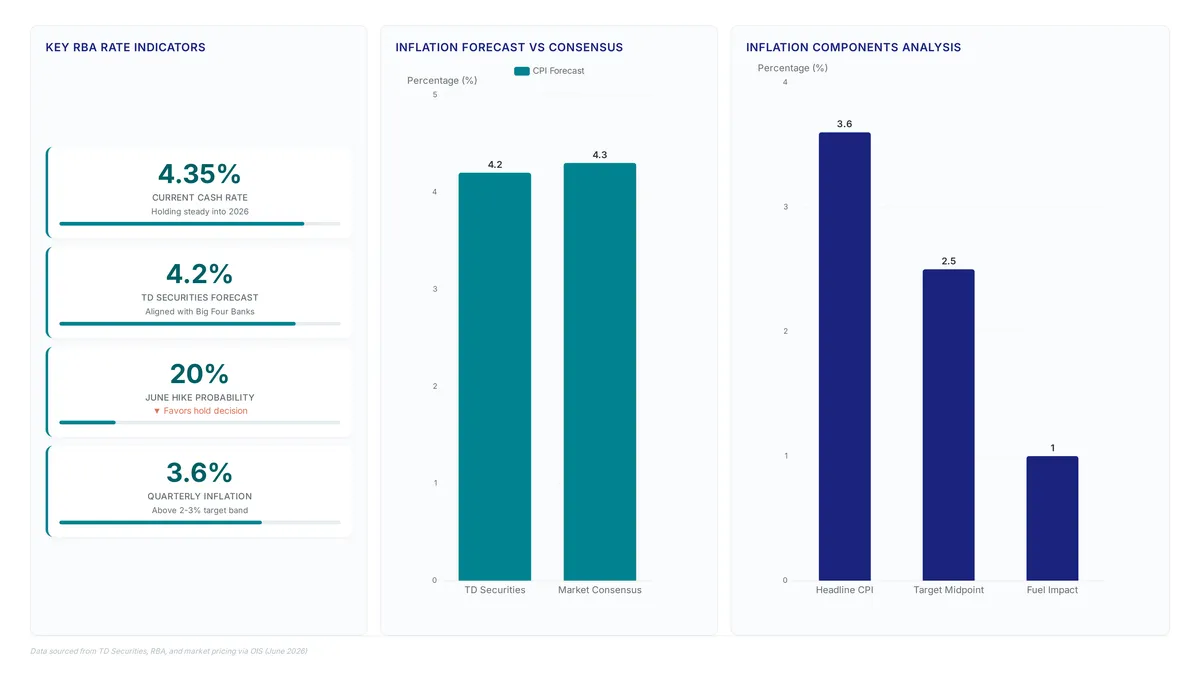
May CPI data functions as a confirmation exercise rather than an open call now that TD Securities aligns with the Big Four banks. This unified front turns the release into a verification of underlying inflation stabilization instead of a source for volatile surprise. Market pricing for a steady-rate bias solidifies when substantial institutions like National Australia Bank, Commonwealth Bank of Australia and Westpac converge. Conviction for an August hike is waning which reinforces the view that the Reserve Bank will hold regardless of minor upside surprises. Reduced volatility in rate markets is the benefit while heightened scrutiny on services inflation becomes the cost since it remains the primary concern for policymakers.
*Disclosure: ForexCFD.top may receive compensation from partners mentioned.* This divergence hinges on fuel price relief that broader models weight less heavily creating a tangible gap in near-term inflation expectations. Temporary factors like transport costs are providing relief while underlying pressures in domestic services and non-tradables remain persistent which complicates the Reserve Bank's decision-making process. Operators must distinguish between this temporary headline relief and the structural stickiness driving long-term yields. Ignoring the services component in favor of headline numbers invites significant basis risk in inflation-linked portfolios according to analysts.
Application: Risks of Persistent Underlying Pressures in Domestic Services
Position for an RBA hold in August by prioritizing underlying inflation metrics over temporary headline relief. Fuel dynamics may drive the headline figure lower yet the trajectory of domestic services remains the primary concern for policymakers due to persistent price stickiness. This divergence creates a specific tactical risk where headline data masks the true temperature of the economy potentially delaying necessary policy adjustments. Investors must recognize that a steady-rate decision does not equate to resolved inflationary pressures within the non-tradables sector. Relying solely on headline deceleration ignores the structural rigidity keeping core inflation elevated which is the limitation of such an approach. Portfolio positioning should account for a prolonged period of restrictive policy even if the central bank pauses. Ignoring these persistent pressures could lead to mispriced duration risk should services inflation re-accelerate once energy effects fade. Market participants should treat the August pause as a confirmation of the current stance rather than a pivot maintaining awareness of upside surprises in services data which is the clear strategic implication. Analysts advise monitoring trimmed mean data closely for signs of renewed momentum.
About
Sofia Mendes, Broker Reviews & Trading Education Editor at ForexCFD.top, brings a disciplined, risk-aware perspective to the analysis of Australian headline CPI data. While her daily work focuses on broker due diligence and trader education, understanding macroeconomic drivers like inflation is critical for evaluating market volatility and execution quality across regulated platforms. As substantial banks forecast a softening in Australian prices, retail traders must interpret how these shifts impact central bank decisions and subsequent price action in AUD pairs. Mendes connects these fundamental developments to practical trading realities, ensuring readers understand how inflation reports influence spread widening and liquidity conditions. Her analysis avoids speculative hype, instead grounding economic forecasts in the risk management principles that underpin ForexCFD.top's educational mission. By contextualizing TD Securities' findings within the broader framework of market stability, she helps traders navigate potential RBA policy holds without compromising on regulatory safety or capital preservation.
Conclusion
The divergence between easing headline numbers and sticky core inflation creates a specific operational hazard where duration risk becomes mispriced. While the market prices a modest chance of a rate hike, relying on this consensus ignores the structural rigidity within domestic services that keeps the Trimmed Mean elevated. This environment demands a shift from reactive trading to proactive scenario planning, as the cost of maintaining a purely headline-focused strategy is exposure to sudden volatility spikes when services data re-accelerates. The path forward requires operators to treat the current steady cash rate not as a resolution, but as a pause that masks unresolved underlying pressure.
Traders must immediately recalibrate their models to weight Trimmed Mean CPI inputs higher than headline prints for all Australian dollar positions this week. Start by stress-testing your current AUD portfolios against a scenario where energy effects fade but services inflation remains static, ensuring your exposure aligns with the reality of prolonged restrictive policy rather than optimistic market pricing.
Frequently Asked Questions
Falling fuel costs drive the headline down, but core prices remain sticky at 3.6%. This divergence means mechanical relief masks persistent service sector pressure, requiring traders to focus on trimmed mean data rather than volatile transport components.
With the cash rate steady at 4.35%, investors should position for continued policy inertia despite any single month's upside inflation surprise.
Retreating fuel costs create a statistical distortion that flatters the headline figure to 4.2%. This temporary drop hides underlying non-tradables inflation, so analysts must separate these volatile components from genuine trend breaks in aggregate demand.
No, TD Securities expects the RBA to hold rates even if data surprises higher. This steady-rate bias reduces two-way risk for rate markets, as the central bank prioritizes sustained services cooling over volatile monthly fluctuations.
Softening PMI signals show new orders falling and price pressures easing. These forward-looking metrics reinforce the hold case alongside the 4.35% cash rate, suggesting the domestic inflation pulse is losing momentum beyond immediate data points.
References