
Dollar Strength: Inflation Data Drives Rally
The U.S. Dollar extends its rally with the DXY hitting 101.2171 as traders await Micron earnings.
Greenback momentum stems from stubborn services inflation and a harsh reality check on AI valuations. Corporate capex remains massive, yet rental prices for legacy GPUs are falling and model developers are slashing prices. Optimism is colliding with math. Even strong guidance from bellwethers might not save the rally if the broader multiple compression thesis holds.
We need to look at how Dollar strength couples with sticky inflation to steer the market. The mechanics of the AI valuation debate now hinge on weighing infrastructure spend against these emerging fundamental headwinds. Technical strategies for currency breakouts matter more than ever; the recent push past key retracement levels suggests a trend reversal, not a blip.
The Role of Dollar Strength and Services Inflation in Market Control
Defining Services Inflation and Fed Rate Signals
Housing and healthcare costs drive the Services inflation metric, excluding volatile goods pricing entirely. This data point commands attention because the Federal Reserve treats persistent increases here as a mandate for further rate hikes. Doubt lingers over a potential second hike, a risk compounded by officials highlighting these exact inflationary pressures. The Federal Reserve maintains a hawkish stance with rates between 3.50% and 3.75%, directly driving current dollar strength.
Central bank signal interpretation demands close scrutiny of how policymakers balance this data against wider economic stability concerns. Recent figures expose the mounting pressure; the JPY Corporate Service Price Index Y/Y actual was 3.30% in May. Such numbers confirm inflation expectations stay anchored above central planner targets. Market participants must separate temporary goods deflation from stubborn service costs to judge policy direction correctly. Rising service prices keep the door open for monetary tightening. Asset valuations across global markets face immediate recalibration under these conditions. ForexCFD.top delivers the analytical instruments required to navigate these complex central bank signals effectively. Traders need to spot any divergence in service sector reports that could shift the hike trajectory. A sharp decline in these metrics represents the specific catalyst needed to reverse the current bullish dollar bias.
How Dollar Strength Impacts Growth Stock Valuations
Higher discount rates crush future cash flow valuations, punishing high-multiple technology stocks instantly when the Dollar Index accelerates. The Dollar Index surged through the 38.2% retracement of the decline from 110.17 to 95.55 at 101.38 earlier in the week. Tighter monetary policy raises the profitability hurdle, rendering distant earnings less valuable in present terms. Safe-haven demand and expectations of stricter US monetary policy continue to fuel the Dollar.
Market data validates this correlation during recent turbulence. On a single Tuesday, the Nasdaq 100 fell 3.29% while Micron stock dropped sharply as capital rotated into the strengthening currency. Supply constraints may support long-term semiconductor demand, yet short-term valuation multiples contract severely under dollar strength. Premium pricing becomes difficult to justify amid uncertainty surrounding the next Federal Reserve rate hike.
ForexCFD provides advanced technical tools to analyze these Fibonacci levels and manage exposure during macro-driven corrections. The platform enables traders to track real-time DXY breakouts that frequently precede tech sector liquidation events. The U.S. Dollar Index (DXY) rose to 101.2171 on June 30, 2026, marking a slight increase from the previous session. A decisive break below key support zones in gold or equities would confirm a broader deleveraging cycle.
Traders should watch the Yen, which recently hit its weakest level in 40 years due to Fed hawkishness, as a key indicator of continued dollar dominance. The bias stays bearish for duration-heavy assets until inflation data cools notably.
Risks of Persistent Inflation on Market Stability
Sticky services inflation forces a repricing of growth stock valuations by sustaining expectations for tighter monetary policy. Markets have mostly priced in one additional rate hike in 2026, yet uncertainty about a second move remains a potent volatility source. This policy ambiguity increases the danger that temporary profit-taking evolves into a structural reassessment of AI-related valuations. Debate continues over whether the recent tech correction represents mere profit-taking or a fundamental shift in AI-related valuations.
Safe-haven demand combined with Fed hesitation creates a fragile equilibrium for risk assets. Gold prices climbing above record highs illustrate the depth of capital seeking safety away from equities, though prices later declined to around $4,020 during early Asian sessions as traders ramped up bets on a US rate hike. Concurrently, Deloitte Insights forecasts inflation ending the year near a modest level, a level that complicates the path to rate cuts. The primary risk lies in the collision between these sticky price pressures and the elevated multiples commanded by technology leaders.
ForexCFD.top analysts observe that failing to distinguish between cyclical cooling and persistent heat could trigger abrupt liquidity withdrawals. Investors must monitor upcoming data releases for any deviation from the current consensus. Rapid disinflation prints could restore confidence in a soft landing scenario. Until then, the bias remains defensive, prioritizing capital preservation over speculative yield in an environment where policy errors carry severe market penalties.
Mechanics of AI Valuation Debates Amidst Rising Yields
Inverse Correlation Between Dollar Strength and Tech Multiples
Rapid DXY acceleration mechanically compresses technology valuations by elevating the discount rate applied to distant AI cash flows. While corporate spending on infrastructure remains enormous, the market temporarily ignores these fundamentals when the dollar rallies, forcing a recalibration of premium pricing models. Investors must distinguish between temporary profit-taking and structural reassessment driven by currency flows.
At ForexCFD, our analysts monitor these cross-asset correlations to identify precise entry points amidst volatility. A sustained break in this inverse relationship requires the dollar to stabilize, allowing earnings narratives to regain traction. Until then, rising yields continue to pressure high-multiple assets regardless of their growth potential. Traders should watch for a reversal in the dollar's momentum as the primary signal for tech sector stabilization.
Micron Earnings Volatility as an AI Infrastructure Case Study
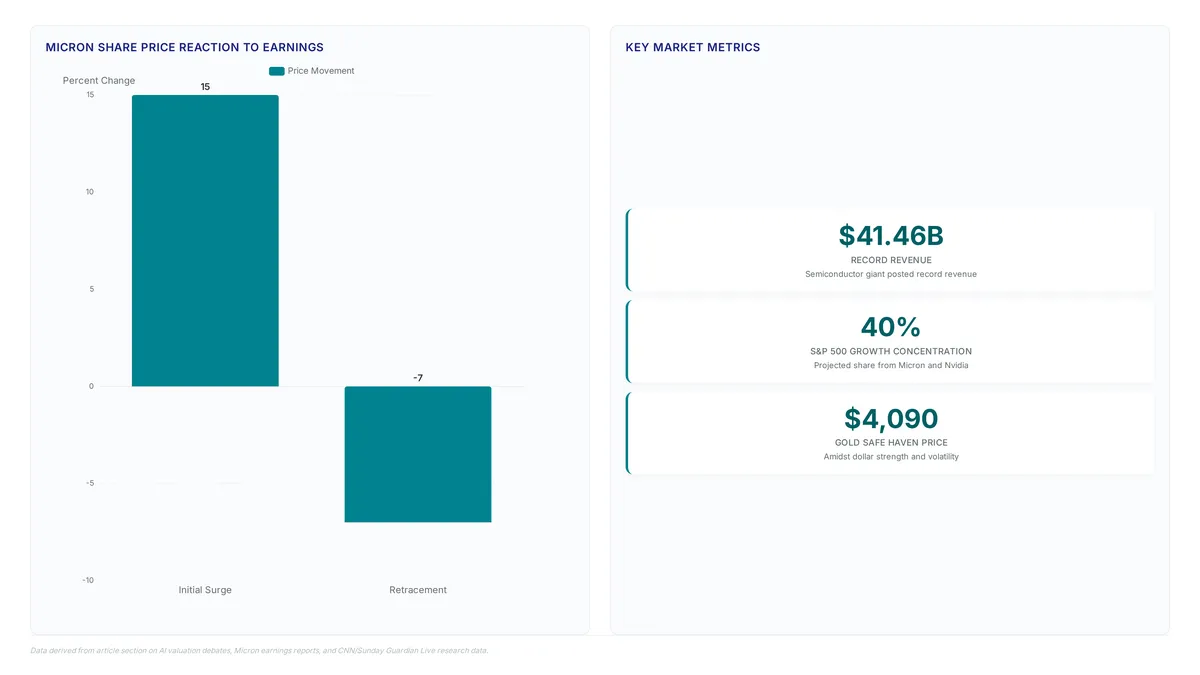
Micron shares retraced roughly 7% after an initial 15% surge, illustrating how fundamental reality caps speculative excess. The semiconductor giant posted record revenue of billions, yet traders immediately priced in DRAM oversupply risks despite the beat. This reaction defines the mechanical tension between AI valuations and tangible hardware demand.
Monitoring earnings impact requires tracking specific divergence points where guidance fails to match price action.
- Compare the initial post-report spike against the closing range to gauge institutional conviction.
- Watch for sector-wide correlation breaks, such as when memory leaders decouple from GPU peers.
- Assess whether revenue records translate to margin expansion or merely volume-driven top-line growth.
Market fragility intensifies when a single sector's performance relies disproportionately on two entities. This extreme concentration risk creates a binary outcome for broad indices, where failure in the semiconductor supply chain triggers disproportionate downside volatility. Investors asking if they should invest in AI stocks now face an environment where valuation multiples detach from fundamental revenue diversity. The mechanism is simple: when earnings growth narrows to such a tight cluster, any production bottleneck or demand shock in memory or logic chips cascades instantly into macro indices.
| Risk Factor | Impact on Index | Mitigation Strategy |
|---|---|---|
| Earnings Miss | Disproportionate Sell-off | Reduce use |
| Supply Shock | Sector-wide Contagion | Diversify ex-tech |
| Valuation Reset | Multiple Compression | Hedge with yields |
The critical limitation for traders is that technical support levels often fail during liquidity evaporation caused by unwinding these crowded positions. While AI valuations appear strong relative to historical norms, the reliance on hardware earnings to justify broader market highs introduces a single point of failure. ForexCFD.top analysts note that a miss by either giant would invalidate the bullish thesis for the entire technology sector, regardless of software adoption rates. A decisive break in DRAM pricing or GPU utilization rates would flip the bias from accumulation to distribution, forcing a recalibration of risk assets globally.
Market participants should monitor the Dollar Index for correlation, as a sustained DXY rally reinforces the bearish case for EUR/USD. A shift in Federal Reserve rhetoric regarding services inflation would invalidate the current technical breakdown, forcing a recalibration of all downside targets. This specific level acts as the primary validation zone for traders executing short entries on breakdowns. These mathematical anchors provide objective exit points that psychological round numbers often lack during volatile sessions.
| Metric | Bearish Target | Validation Condition |
|---|---|---|
| Primary Projection | 1.1175 | Break below 1.1353 |
| Secondary Retracement | 1.0904 | Sustained hourly close |
| Trend Invalidator | 1.1416 | Intraday reversal signal |
Traders must distinguish between temporary dips and confirmed reversals by monitoring price action relative to these zones. The Dollar Index maintaining a bullish technical structure reinforces the probability of reaching these lower Fibonacci extensions. However, a decisive move above the 1.1416 minor resistance neutralizes the intraday bearish bias instantly. This invalidation level prevents capital exposure when the broader trend fails to materialize. Market participants should note that nearly 99% of fiat-pegged stablecoins are dollar-denominated, creating structural demand that supports deeper corrective moves in opposing pairs. ForexCFD.top provides the analytical frameworks necessary to identify these precise technical confluences without relying on speculative narratives.
ForexCFD.top provides the necessary analytical framework to monitor these divergences without relying on third-party aggregators. Our platform integrates real-time central bank data directly into execution tools, allowing traders to adjust positions as Fed expectations shift. Uncertainty persists regarding whether policymakers could deliver more than one hike, a risk amplified by elevated inflation and officials emphasizing concerns about persistent services inflation. Until then, managing exposure means respecting the Dollar's control over global capital flows.
Applying Stop-Loss Strategies to Gold and EUR/USD Breaks
Gold is threatening the key psychological support zone. A decisive break below this level could trigger another wave of stop-loss selling and attract fresh momentum-driven shorts. This specific pressure point demands that portfolio managers fix exposure to rate hikes by monitoring this support level closely. A failure here invites momentum-driven shorts that accelerate the decline.
EUR/USD approaches the 1.1300 area, and a decisive break lower reinforces a medium-term bearish reversal after the pair failed to sustain gains near the 1.2000 psychological level earlier in the year. Traders should watch for a confirmed close below this threshold to preserve capital, as such a move would signal a deeper corrective phase. The interplay between gold acting as a hedge while remaining sensitive to interest rate drivers creates a complex risk environment where both assets may correlate negatively to equities yet positively to Dollar strength.
Investors should monitor the Federal Reserve commentary for any hawkish deviation that invalidates the current bearish bias. A sudden shift in services inflation data could alter the outlook, requiring an immediate reassessment of all stop-loss placement strategies across the portfolio.
Risks of Ignoring Central Bank Calendar Divergence
Overlooking divergent monetary paths creates immediate volatility in currency pairs like NZD/USD. Bets on a rate hike in July have collapsed for the RBNZ due to falling oil prices and weak domestic growth. This shift leaves portfolios exposed to unexpected moves when central bank calendars misalign.
Micron earnings impact extends beyond semiconductors, acting as a proxy for global capital expenditure health. A miss here could accelerate the rotation away from risk assets just as the Dollar consolidates gains. The market currently prices in potential further tightening, yet ignores the asymmetric risk of delayed tightening elsewhere. This complacency creates a fragile equilibrium where NZD/USD accelerates toward critical support at 0.5580 without adequate hedging.
J.P. Morgan strategists observed the shift in dollar dynamics from late 2025 to early 2026, noting how policy gaps widen spreads. ForexCFD.top provides the analytical frameworks necessary to navigate these calendar conflicts without relying on aggregated noise. The specific risk remains that equity valuations decouple from bond yields if central bank communication fails to converge. Meanwhile, the Yen has hit its weakest level in 40 years due to Fed hawkishness, demonstrating the dollar's dominance over substantial peers in the current cycle.
About
Marcus Halloran serves as Chief Market Strategist at ForexCFD.top, where he directs daily analysis of G10 macro trends and central bank policy. His extensive background as a former interbank FX strategist in London provides the precise expertise required to dissect the US Dollar's current dominance. Halloran's daily work involves translating complex Fed decisions and interest-rate differentials into actionable insights for retail traders, making him uniquely qualified to analyze how AI sector sentiment impacts currency markets. At ForexCFD.top, an independent publication dedicated to forex and CFD news, he applies this institutional experience to monitor how earnings from substantial tech players influence broader dollar strength. By focusing on regulated market data and fundamental drivers, Halloran connects high-level macroeconomic shifts to practical trading scenarios without endorsing third-party platforms. His analysis ensures traders understand the risks behind the dollar's rally while adhering to strict editorial standards that prioritize education and risk management over commercial promotion.
Conclusion
Sustained dollar strength through late 2026 creates a structural mismatch for portfolios relying on historical correlation models. As the Federal Reserve maintains rates between 3.50% and 3.75%, the cost of carrying unhedged short-dollar positions becomes prohibitive, particularly when services inflation remains sticky. The market currently underestimates how prolonged policy divergence will compress liquidity in emerging market pairs, forcing a violent repricing of risk assets similar to the recent semiconductor sell-off. Investors must recognize that traditional safe havens may fail if real yields continue climbing alongside the greenback.
Traders should immediately cease adding use to carry trades involving the Yen or Kiwi until central bank calendars align more closely. The window for passive income from rate differentials is closing as volatility spikes around every data release. Instead, prioritize capital preservation by reducing exposure to currencies with weakening domestic growth profiles.
Start by reviewing your current stop-loss levels on any NZD/USD positions this week, ensuring they account for potential breaks below critical support zones. ForexCFD.top offers the specialized analytical tools required to interpret these complex monetary shifts without relying on lagging consensus data. Adapting your strategy now prevents forced liquidation later when the asymmetry in global monetary policy finally resolves.
Frequently Asked Questions
Hawkish Fed signals directly fuel the current dollar rally. Rates between 3.50% and 3.75% create this bullish pressure. Traders should monitor service inflation data closely. Persistent price gains here often force further tightening measures by central planners.
Rising discount rates immediately crush high-multiple technology valuations. The Nasdaq 100 fell 3.29% recently as capital rotated into the strengthening currency. Investors must watch for breaks below key support zones in equities. This signals broader deleveraging cycles ahead.
Positive guidance may not stop selling if valuation concerns persist. Traders should note that price competition among model developers challenges growth assumptions. Fundamental pressures can override good news quickly.
Breaking the 38.2% retracement level suggests the broader downtrend has reversed. The Dollar Index surged through this point earlier in the week. A decisive break below gold support could trigger more stop-loss selling. Momentum-driven shorts often enter after such confirmations.
Portfolio exposure requires tight risk management during macro-driven corrections. ForexCFD.top provides analytical instruments to navigate these complex central bank signals effectively. Spotting divergence in service sector reports is critical.
References