
Economic data releases: Why 52.8% matters
Japan's Machine Tool Orders surged to 52.8% against a 37.4% consensus. That gap rewrote asset valuations instantly. The economic calendar acts as the central nervous system for global liquidity, converting raw statistical releases into immediate market volatility.
Traders use this infrastructure to separate high-impact events from background noise. Platforms like Investing.com categorize releases using a star system: three stars signal potential price explosions, while one star denotes negligible movement. The interface displays Actual figures alongside Forecast and Previous data points, letting users gauge sentiment shifts in real-time. German Trade Balance data recently beat expectations at 19.1B versus a 14.9B forecast, creating an instant arbitrage window.
This article dissects the mechanical role of these calendars in modern market infrastructure. You will see how volatility mechanics react when actual numbers diverge from expert predictions. We outline strategic workflows for implementing event-driven trading based on severity ratings found on platforms like TradingView. Understanding these timing nuances is the only way to navigate live data streams without getting crushed by slippage.
The Role of the Economic Calendar in Global Market Infrastructure
Economic Calendar as a Real-Time Streaming Schedule
An economic calendar operates as an auto-updating ledger ingesting global macro releases without manual page refreshes. This streaming schedule synchronizes trader expectations by displaying consensus forecasts against live actuals for indicators like GDP, inflation, and employment figures. Market infrastructure relies on this continuous data feed to price assets instantly when deviations occur. Platforms distinguish their utility by offering real-time indicators and immediate global market impact data so speed dominates static lists. Technical implementation requires monitoring the Actual column, which populates in green or red based on its variance from the Forecast.
A Japanese machine tool order print of 52.8% against a 37.4% consensus illustrates how sharp deviations trigger algorithmic repricing. Data streams are sometimes indicative rather than binding. This creates friction between speed and absolute accuracy during initial prints. While the tool eliminates latency from manual updates, it does not eliminate the risk of erroneous first prints that later undergo revision. Three distinct layers of data quality exist within these feeds.
*Risk Warning: Trading used commodities and forex involves significant risk of loss and is not suitable for all investors. ForexCFD.top provides educational analysis only.*
Interpreting Actual vs Forecast Data for NFP Releases
Traders quantify Non-Farm Payrolls volatility by measuring the deviation between consensus forecasts and released actual figures. The Bureau of Labor Statistics publishes this high-impact report on the first Friday of each month, instantly populating the actual column against the pre-set expectation. Market participants specifically monitor how the actual print diverges from the forecast to gauge immediate sentiment shifts. Algorithms parse the numerical difference quicker than humans can read headlines. ForexCFD.top provides educational resources on managing exposure during such events. Always verify broker regulatory status before trading volatile news. One missed decimal place changes everything.
Filtering High-Impact Events Using Volatility Stars
Isolating high-impact releases involves identifying events rated with three stars, signaling a high likelihood of significant price movement. Economic calendars typically categorize event importance into three distinct levels: low, medium, and high impact. Some platforms, such as ForTraders, apply a specific 3-star volatility scale where 1 star represents low impact, 2 stars represent moderate impact, and 3 stars represent high impact. The interface allows users to filter by country, event category, and importance level to isolate volatility stars that drive execution strategies.
Industrial production data serves as a key gauge of factory activity. Consumer confidence indices explain sentiment regarding future spending. These factors account for a significant portion of economic activity. Four specific filters help narrow the noise. Over-filtering removes context. Moderate two-star events indicate moderate expected volatility that can contribute to broader market trends. Narrow focus risks missing the buildup in moderate impact data that validates the primary signal. Two errors compound quickly.
Mechanics of Market Volatility Through Data Discrepancies
Defining Data Discrepancy Mechanics in Economic Releases
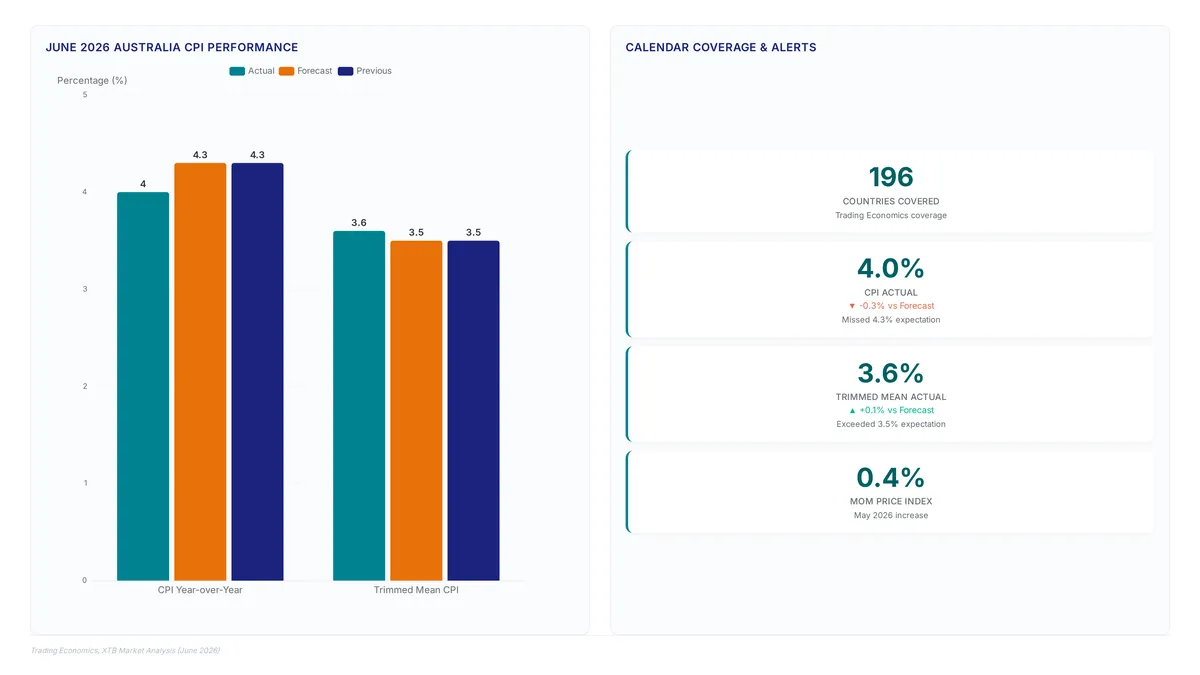
Data discrepancy mechanics quantify the immediate volatility spike when an actual release diverges from the consensus forecast. Markets price in expectations before the event, so the magnitude of the surprise determines the liquidity shock rather than the absolute value itself. A miss of 0.1% in China's June CPI triggered a sharper repricing than a larger but anticipated move would have. When Australia's CPI Year-over-Year missed at a lower-than-expected rate against a 4.3% expectation, algorithms instantly recalibrated rate probability curves forecast. This creates a temporary vacuum in order book depth as market makers widen spreads to manage inventory risk.
Not all deviations generate sustained trends; some simply exhaust weak hands before reversing. The challenge lies in distinguishing between a data error and a genuine structural shift in the economic narrative. Traders must monitor the display time remaining until announcement to avoid slippage during the initial surge. Enter after the initial spike settles or use limit orders away from the mid-price. ForexCFD.top reminds clients that used metals trading carries significant risk during high-discrepancy events.
Applying Volatility Impact Ratings to Real-Time Data Streams
Traders execute live strategies by mapping impact ratings to streaming data feeds that update without manual refresh. Platforms implement a visual three-star scale where one star signals low volatility and three stars denote high-impact releases capable of shifting liquidity pools instantly. A two-star event like the Japan 5-Year JGB Auction moved yields from 1.905% to 2.020%, forcing rapid position squaring despite moderate expectations. High-impact unemployment data often triggers algorithmic cascades because labor metrics directly influence central bank rate trajectories. Conversely, low-impact releases may show deviations but fail to sustain momentum beyond the initial spike.
| Rating | Volatility Expectation | Typical Reaction |
|---|---|---|
| One Star | Low | Negligible price deviation |
| Two Stars | Moderate | Temporary liquidity squeeze |
| Three Stars | High | Sustained trend initiation |
The Japan Machine Tool Orders surprise demonstrates how beating consensus drives immediate repricing even when the headline seems obscure. Some traders apply specialized tools offering FOMC rate-change probability analysis to contextualize these moves within broader monetary policy shifts. Color-coded alerts on free platforms may lag institutional feeds by seconds, a critical delay during high-frequency events. Retail participants must recognize that actual values appearing in green or red reflect deviation from consensus rather than absolute economic health.
*Risk Warning: Used metals trading involves significant risk of loss and is not suitable for all investors. Gold prices can be highly volatile during substantial data releases.*
Checklist for Validating Consensus Deviations Before Trading
Verify the star rating immediately to gauge if the release carries sufficient volatility potential for execution. Platforms like ForTraders apply a 3-star volatility scale where three stars signal high-impact events capable of shifting liquidity pools instantly.
- Compare the actual figure against the consensus estimate to quantify the deviation magnitude.
- Check the previous period data to determine if the trend is accelerating or reversing.
- Confirm the color coding on your terminal, as green indicates a beat while red signals a miss.
| Deviation Type | Market Reaction | Action Required |
|---|---|---|
| Actual > Forecast | Bullish Spike | Validate momentum before entry |
| Actual < Forecast | Bearish Drop | Wait for liquidity stabilization |
| Actual = Forecast | Range Bound | Avoid false breakout trades |
Central bank speeches require a different validation approach than hard data, demanding attention to tonal shifts rather than numerical misses. Distinguish between scheduled commentary and unscheduled remarks that often catch algorithmic traders off guard. Relying solely on color-coded alerts fails to account for revised historical data which can alter context. Traders on ForexCFD.top should wait for the second candle close to confirm the direction before committing capital. This discipline prevents entering during the initial spike where spreads widen significantly.
Strategic Implementation of Event-Driven Trading Workflows
Defining the Three-Star Volatility Scale for Event Filtering

The 3-star volatility scale functions as a primary filter. Specific platforms like ForTraders apply a system assigning one star to low-impact releases, two stars to moderate events, and three stars to high-volatility occurrences like Federal Reserve announcements. This heuristic helps traders distinguish routine data from market-moving shocks, effectively categorizing risk before execution. While some interfaces rely on color coding, the numeric star system offers a standardized visual cue that transcends language barriers in global trading desks. Operators must cross-reference the star rating with the magnitude of the forecast deviation to gauge true liquidity risk, as actual values appearing significantly different from consensus figures often drive market movement.
| Stars | Impact Level | Typical Events |
|---|---|---|
| ★ | Low | Minor speeches, secondary data |
| ★★ | Moderate | Regional PMI, trade balances |
| ★★★ | High | Fed decisions, GDP, NFP |
Ignoring this hierarchy leads to misallocation of attention during quiet windows versus high-impact releases. Disciplined filtering preserves liquidity for genuine volatility spikes associated with substantial data points.
Executing Trades Around NFP Releases on the First Friday
Market participants execute strategies around the Non-Farm Payrolls report, a high-impact event released on the first Friday of each month by the Bureau of Labor Statistics. This fixed schedule allows traders to prepare liquidity filters well before the data stream updates. While the event remains significant, its ability to drive volatility has dimmed somewhat in recent years relative to central bank decisions, requiring detailed risk management protocols. Traders should monitor the discrepancy between consensus forecasts and actual prints rather than trading the headline number alone.
| Data Point | Impact Mechanism |
|---|---|
| Payroll Count | Drives immediate USD direction |
| Unemployment Rate | Confirms labor market tightness |
| Wage Growth | Influences inflation expectations |
Operators often filter calendars to display only portfolio-relevant events, ignoring noise from lower-tier releases. Gold and commodities traders must remember that used metals carry explicit risks during these windows. Always verify instrument permissibility and adjust use ratios before the first Friday bell rings.
Configuring Real-Time Alerts and Country Filters
Align your local time zone within the calendar interface to synchronize global release times with your specific trading session. Narrow your focus by excluding irrelevant macro categories, such as filtering for housing data while ignoring industrial production. Real estate investors often customize watchlists to track construction spending exclusively, discarding noise from unrelated sectors. The system streams updates automatically without requiring a page refresh, maintaining low-latency data integrity during high-volatility windows.
| Filter Type | Configuration Goal | Operational Benefit |
|---|---|---|
| Country | Select specific economies | Reduces cognitive load |
| Importance | Show 3-star events only | Isolates market movers |
| Category | Housing, Employment, Rates | Aligns with strategy |
A sudden shift in a 2-star European indicator can invalidate a thesis built solely on US data. Traders must balance specificity with situational awareness of the broader global system. Platforms provide these streaming tools, often under a freemium model, allowing basic access without immediate subscription fees. This accessibility democratizes real-time streaming but requires disciplined configuration to avoid analysis paralysis.
Operational Reliability and Data Integrity Challenges
Defining Data Stream Gaps and Timezone Display Errors
Numbers flow onto the Economic Calendar without manual refreshes, updating instantly as central banks and statistical bureaus publish their findings. A "Display Time" counter ticks down the seconds remaining until an announcement hits the wire, giving traders a precise countdown to volatility. Global participation requires flexible timezone settings, so the interface lets users toggle between "Yesterday," "Today," "Tomorrow," "This Week," "Next Week," or "Custom dates" to match their specific trading session.
Green text signals an actual figure beating the forecast, while red indicates a miss, offering immediate visual confirmation of market direction relative to consensus.
- Real-time streaming removes the latency of page reloads during high-frequency events.
- Timezone adjustments align release clocks with local exchange hours.
Reliable feeds separate themselves by delivering global impact data quicker than static lists ever could. Full descriptions accompany each event, detailing relative importance to help anticipate moves. Data streams automatically, yet the source explicitly warns that information "is not necessarily real-time nor accurate" and often comes from market makers, rendering prices "indicative and not appropriate for trading purposes."
Troubleshooting Missing GDP and Inflation Data Streams
Visibility hinges entirely on active filter settings that sort by country, event category, and importance level. The Economic Calendar contains full descriptions of events and their relative importance, alongside previous, forecast, and actual figures as they're announced. If GDP or inflation releases vanish from the view, selected filters likely excluded those specific categories or regions from the active display.
Stars rate the expected market impact: one star denotes low volatility, two stars suggest moderate movement, and three stars signal a high-impact event capable of shifting trends. Traders customize views to isolate these impact levels or broaden the scope to include every scheduled economic occurrence.
- Filter settings dictate which countries and event categories populate the list.
- Impact ratings prioritize high-volatility events like central bank decisions.
- Custom date ranges isolate specific reporting periods for historical analysis.
- Stream health monitoring minimizes gaps where data might otherwise stall.
Platforms emphasizing freshness watch these streams constantly to catch deviations the moment they appear. Immediate visibility serves as the only defense against adverse selection when actual inflation diverges from consensus. The calendar lists specific economic events including actual results, consensus forecasts, and previous figures where available, covering a wide range of global indicators.
Verification Steps for NFP Release Timing and Values
Release schedules demand cross-referencing against listed dates, especially since the calendar tracks Initial Jobless Claims and Existing Home Sales with their each consensus and previous figures. The Non-Farm Payrolls report stands as a critical high-impact event typically released on the first Friday of each month, though holidays can shift the specific date. Operators must verify the Display Time countdown matches their local exchange session to prevent missed entries caused by silent timezone configuration errors.
| Checkpoint | Verification Target | Failure Mode |
|---|---|---|
| Timing | Scheduled release date | Misaligned trading window |
| Timezone | Local exchange sync | Missed entry window |
| Values | Actual vs Forecast | Reliance on outdated consensus |
Cross-reference the consensus figure against independent feeds before the release window opens. Some traders focus solely on the headline number, yet the divergence between forecast and previous values often dictates the initial liquidity spike more than the absolute result. Filtering views by impact rating creates a common pitfall, inadvertently hiding revised prior figures necessary for proper context. Ignoring these verification steps carries a measurable cost: executing a trade based on an un-updated Previous value skews risk calculations instantly.
Notification toggles enable specific alerts for high-impact events, keeping the terminal active during critical update cycles. Actual values appear in green or red depending on their relation to the forecast, providing a clear visual indicator of market sentiment. Always validate the data source directly if the Actual figure seems inconsistent with immediate price action, noting the disclaimer that data may be indicative and not appropriate for trading purposes.
About
Aisha Rahman serves as the Gold & Commodities Analyst at ForexCFD.top, where she leads the publication's flagship XAUUSD coverage. Her deep expertise in commodity fundamentals and central bank policies makes her uniquely qualified to guide traders through the complexities of the economic calendar. In her daily work, Aisha analyzes how critical data releases, such as inflation figures, GDP reports, and interest rate decisions, directly impact gold prices and broader market volatility.
This article connects directly to her routine analysis of macroeconomic drivers that move the markets she covers. As ForexCFD.top provides independent news and education to retail traders globally, understanding these scheduled events is necessary for managing risk and identifying opportunities. Aisha's background in linking real yields to safe-haven flows ensures that readers receive practical insights on how to interpret economic indicators effectively. By using her experience with global market reactions, she helps traders navigate the noise of real-time data streams to focus on high-impact events that truly matter for their trading strategies.
Conclusion
Market stability fractures not when data misses expectations, but when the magnitude of that miss defies statistical probability. The Japanese machine tool shock proves that deviation velocity matters more than the headline number itself. Algorithms do not merely react to inflation prints; they punish any disconnect between pricing models and reality with immediate liquidity withdrawal. This creates an operational environment where standard hedging strategies fail during the very seconds they are needed most. Traders must stop treating all scheduled releases as equal volatility events and start weighting them by their potential for consensus rupture.
Prioritize cross-referencing consensus figures against independent feeds before any substantial auction window opens. Relying on a single terminal view invites execution errors when yields gap from 1.905% to 2.020% in moments. The Non-Farm Payrolls report may see diminished singular dominance, yet its power to force rapid position squaring remains undiminished when surprise elements emerge. You cannot afford to discover a timezone mismatch or an outdated previous figure after the market has already moved.
Start by auditing your notification settings this week to ensure they distinguish between standard variance and outlier events. Configure your terminal to highlight discrepancies between forecast and previous values specifically, as this gap often dictates the initial liquidity spike more than the absolute result. Validating your data source directly prevents skews in risk calculation that occur when actual figures appear inconsistent with immediate price action.
Frequently Asked Questions
Sharp deviations between actual and consensus figures instantly revalue assets. A Japanese machine tool order print of 52.8% against a 37.4% consensus illustrates how sharp deviations trigger algorithmic repricing immediately.
Unexpected auction results force rapid position squaring and yield shifts. The Japan 5-Year JGB Auction moved yields from 1.905% to 2.020%, forcing rapid position squaring despite the event having only two stars.
Traders isolate high-impact releases by filtering for three-star events. Economic calendars typically categorize event importance into three distinct levels, allowing users to ignore low-impact data that lacks significant price movement potential.
Algorithms react to the deviation size rather than the absolute value. A miss of 0.1% in China's June CPI triggered a sharper market reaction than larger misses in other regions due to sensitivity.
Users must compare Actual figures against Forecast and Previous data points. This interface design allows traders to gauge sentiment shifts in real time as the Actual column populates in green or red.
References