
Forex Factory Calendar: Filter High-Impact Events
Launched in 2004, Forex Factory still dominates the free resource landscape for high-impact economic data in 2026. Its longevity proves that robust market infrastructure doesn't need a price tag to beat paid competitors. Traders sticking to fragmented news feeds miss the edge of combining live market data with raw community sentiment on a single dashboard.
This guide breaks down how data flow mechanics sort events by currency and impact to cut the noise. We'll look at time-zone customization and forecast values as tools for executing news strategies without burning cash on subscriptions.
TradingView lets you pick a specific week via the upper toolbar, sure. But Forex Factory wins on raw speed and zero gatekeeping. We will detail how high-impact event notifications and employment data releases signal volatility before it hits retail accounts. Ignoring these fundamental trading strategies for pure technical analysis leaves capital exposed to predictable macroeconomic shocks.
The Role of Forex Factory in Modern Forex Market Infrastructure
Forex Factory Platform Origins and Core Economic Calendar Definition
Forex Factory opened in 2004, building a venue where foreign exchange participants access aggregated financial news and economic data. This architecture delivers the timely information fundamental strategies need, skipping the friction of paid subscriptions. The economic calendar is the engine, cataloging global events that ignite currency volatility.
| Feature | Description |
|---|---|
| Data Source | Official reports and market news |
| Access Model | Free to public |
| Primary Utility | Risk management around events |
Participants use this free access to track high-impact events like central bank decisions that shift sentiment instantly. Unlike brokerage tools capped at beginner levels, this independent hub serves a global audience seeking raw macroeconomic intelligence. The calendar does more than keep dates; it structures market expectation by presenting forecast, previous, and actual figures side-by-side. Its popularity endures because it combines real-time economic data, high-impact event notifications, and clear value presentation. Speed matters, but data reliability is priority one for traders managing multiple positions. The platform consolidates market news, discussion forums, and live market data into a single definitive infrastructure component.
Used metals and currency trading involve significant risk of loss and are not suitable for all investors.
Applying High-Impact Event Filters and PMI Thresholds in Trading
Traders isolate volatility by filtering the calendar for high-impact events that drive price action. The platform categorizes events into exactly three distinct impact levels: high, medium, and low. This lets participants filter by significance and ignore noise. A high-impact event usually shows red icons and holds the greatest potential to move currency prices, such as Federal Reserve interest rate decisions or US Non-Farm Payrolls. Market impact hinges on the deviation of actual data from consensus forecasts, with Non-Farm Payrolls representing a primary catalyst for USD pairs. This employment report measures job creation outside the farming sector, serving as a critical gauge for labor market health.
Beyond binary event flags, specific indicator thresholds provide directional bias. Readings for leading economic indicators, such as the PMI, are interpreted with a threshold of 50. Values above 50 indicate economic expansion; values below 50 indicate contraction.
| Indicator Type | Threshold Logic | Market Implication |
|---|---|---|
| PMI | > 50.0 | Expansionary signal |
| PMI | < 50.0 | Contractionary signal |
Rigid threshold trading fails when headline data conflicts with internal components, creating false signals. A single miss against the 50 mark does not guarantee trend reversal if underlying sub-indices remain strong. Gold is a story about real yields, fear, and the dollar - in that order, and used positions on XAUUSD require strict invalidation levels below recent swing lows. Traders should always perform independent research before opening a trading account or relying solely on automated signals.
*Risk Warning: Trading used commodities like gold involves significant risk of loss.*
Verification Checklist for Real-Time Data and Time-Zone Customization
Validate the local time setting immediately to prevent scheduling errors during global releases. The interface allows users to select a specific week via the upper toolbar or pick a single specific day to view scheduled events, ensuring precise temporal alignment for your trading session.
| Parameter | Verification Step | Critical Risk |
|---|---|---|
| Time Zone | Match server clock to local exchange hours | Missed entry signals |
| Data Stream | Confirm near real-time refresh rates | Stale liquidity quotes |
| Event Scope | Filter by currency and impact level | Over-trading noise |
Operators must verify that actual values populate against consensus figures to gauge true market shock. The demand for real-time updates has become a standard expectation, with providers emphasizing delivery speed to match modern algorithmic trading requirements. Most platforms operate on a near real-time basis, updating 24 hours a day to reflect the latest global financial events continuously. Traders should cross-reference the displayed forecast with the released number to determine if the deviation justifies volatility. This manual confirmation step remains a key defense against feed delays during peak load.
Inside the Economic Calendar Data Flow and Impact Categorization Mechanics
Defining Red, Orange, and Yellow Impact Event Classifications
Red icons mark High Impact Events capable of driving immediate currency volatility across substantial pairs. This classification applies strictly to core data releases like Federal Reserve interest rate decisions and Non-Farm Payrolls reports. Traders using the economic calendar rely on these clear visual cues to isolate periods of maximum liquidity risk. Orange indicators denote Medium Impact Events, which influence market direction but typically generate smaller price fluctuations than their red counterparts. Releases such as Manufacturing PMI and Retail Sales fall into this tier, offering secondary signals for trend confirmation rather than primary reversal triggers. Yellow flags represent Low Impact Events, serving as informational updates that rarely alter established technical structures.
Gold is a story about real yields, fear, and the dollar - in that order, yet currency markets often hinge on whether a specific number misses consensus expectations by a wide enough margin to trigger automated selling. The distinction between a red Federal Reserve announcement and an orange PMI release lies in the consensus deviation threshold required to spark algorithmic trading responses. High-impact data often triggers stop-loss cascades due to sudden liquidity gaps, whereas medium-impact news usually results in grind-like price action. Filtering exclusively for red events misses the cumulative trend pressure built by consecutive orange data points. Reacting to every yellow release introduces noise that degrades strategy performance. Effective risk management demands that traders align position sizing with these specific impact levels, reducing exposure during red windows while maintaining baseline monitoring for orange developments.
Applying PMI Thresholds and Official Data Sources for Trade Execution
The PMI 50 threshold acts as the binary switch distinguishing economic expansion from contraction. Readings above this benchmark signal growth, while values below indicate a shrinking economy, providing a clear fundamental bias for currency pairs before price action confirms the trend. Traders often misalign entries by reacting to the headline number alone, ignoring that a miss against consensus drives volatility more than the absolute reading.
Official data sources sometimes delay updates during heavy server loads, creating a scenario where reliance on a single feed risks executing on stale prices during high-frequency windows. Unlike High Impact Events marked by red icons, medium-tier releases require tighter stop-losses due to potentially lower liquidity depth. The categorization of events into distinct impact levels allows operators to noise-filter effectively, yet the delay between data release and platform update remains a hidden execution risk. Traders must anticipate that algorithmic systems react to the data feed milliseconds before the visual calendar updates. This latency gap means manual traders entering on the first candle often provide exit liquidity for quicker participants. Always verify the timestamp on the official source if the calendar display seems stagnant during a scheduled release.
Risks of Misinterpreting Low Impact Informational Releases
Low Impact Events function as informational releases that typically generate limited market volatility rather than sustained trends. Traders often mistake these minor data points for actionable signals, leading to over-used positions that quickly reverse when liquidity thins. The primary danger lies in applying high-impact strategies to releases that lack the fundamental weight to drive price discovery.
Market impact is determined by the deviation between forecast and actual results, yet informational releases rarely contain enough surprise to overcome transaction costs. Filters for impact levels are becoming necessary features because traders need to noise-filter the overwhelming amount of global data to focus only on market-moving events tradefundrr.com. Ignoring this distinction causes operators to chase false breakouts during quiet sessions.
Time zone synchronization presents a secondary failure mode where global events appear clustered or misaligned on local charts. During periods of geopolitical tension, such as the Brexit negotiations, traders utilized real-time tools to monitor key events impacting GBP and EUR, demonstrating the necessity of precise temporal alignment tradingonramp.com. A mismatched clock causes missed entries or accidental exposure to unrelated regional volatility.
Strategy integrity degrades through frequent, unjustified trades when traders misclassify these events. Forex Factory categorizes these events specifically to prevent such analytical errors. Recognizing the difference between a headline that moves billions in capital and one that merely fills a spreadsheet column separates profitable accounts from those that bleed out slowly. The 50 basis point move in yields matters more than the headline itself.
Executing a High-Impact News Strategy Using Calendar Filters
Defining the Five-Step Routine for Calendar Setup
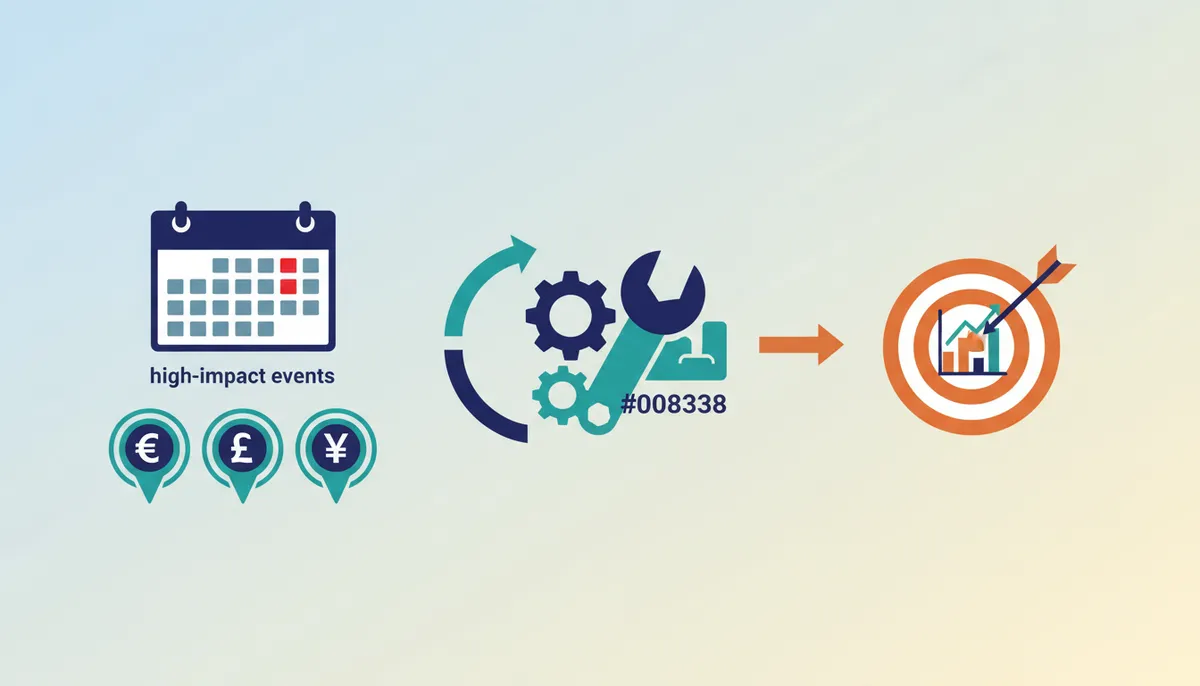
Establish your local time zone immediately so every economic release aligns with your trading session. Step 1 prevents costly scheduling errors when global data drops. Step 2 isolates EUR/USD, GBP/USD, or USD/JPY events to remove visual noise from unrelated regions. Platforms offering highly interactive interfaces allow traders to visually highlight these specific currencies against a backdrop of global data. The core mechanism involves suppressing low-impact data to focus solely on volatility drivers. However, over-filtering can hide correlated moves in cross-currency pairs that indirectly affect your primary targets.
Every entry displays an impact rating alongside forecast, previous, and actual figures to gauge potential market reaction. Traders must filter for high-impact news because these events generate the liquidity required for substantial price displacement. The ability to filter events by impact levels is now a standard requirement for managing information overload. This configuration ensures you react only to data capable of shifting central bank expectations. The implication for operators is clear: a disciplined setup routine transforms raw data into a actionable risk map. Without this structural filter, traders often mistake random noise for signal during quiet sessions.
Analyzing Forecast Versus Actual Data for NFP and CPI Releases
Markets react violently when actual results deviate from forecast consensus, creating the volatility traders seek. The mechanism relies on rapid algorithmic repricing as machines digest the delta between expectation and reality. Evidence from Brexit negotiations shows traders using real-time feeds to track such GBP and EUR shocks during geopolitical stress demonstrating. A limitation exists because liquidity often vanishes seconds before the release, widening spreads beyond reasonable risk parameters. This means entering positions before the number prints invites slippage that invalidates tight stop-losses.
You should avoid trading during the initial release unless your strategy explicitly accounts for erratic price spikes. The Non-Farm Payrolls report releases monthly and frequently generates enough volume to trigger margin calls on used accounts. Gold acts as a story about real yields, fear, and the dollar - in that order, so USD shocks transmit instantly to XAUUSD.
| Scenario | Action | Rationale |
|---|---|---|
| Actual beats Forecast significantly | Wait for pullback | Initial spike often retraces before trending |
| Actual matches Forecast | Avoid entry | No surprise means no directional fuel |
| High uncertainty | Reduce size | Volatility can exceed historical averages |
Used metals carry a high risk of losing money rapidly due to use. Islamic accounts avoid swap charges but still face execution risk during these events. The invalidation for a long bias occurs if the actual figure misses the forecast while the dollar strengthens.
Waiting for Confirmation After Initial Volatility Settles
Immediate entry during Non-Farm Payrolls spikes often traps traders before liquidity stabilizes. The dominant driver shifts from raw data to order book reconstruction as market makers re-quote. You must allow this initial volatility to settle before seeking technical trade setups. Platforms enable users to filter the display to show only HIGH IMPACT NEWS, reducing visual noise entirely. This clarity helps identify when the market reaction transitions from panic to trend. However, waiting for confirmation means accepting a wider entry price than the initial spike extreme. The cost is missed momentum if the move continues without a pullback. Conversely, chasing price creates exposure to violent reversals common in thin liquidity. Gold traders specifically watch real yields and the dollar for the true directional signal. Entering before the dust clears ignores the mechanical reality of spread widening. Risk management demands patience until the price action respects key technical levels. Only then does the probability favor a sustainable move over a false breakout.
Comparative Advantages of Forex Factory Over Competing Trading Tools
Defining Forex Factory's Unique Community and Trade Explorer Features
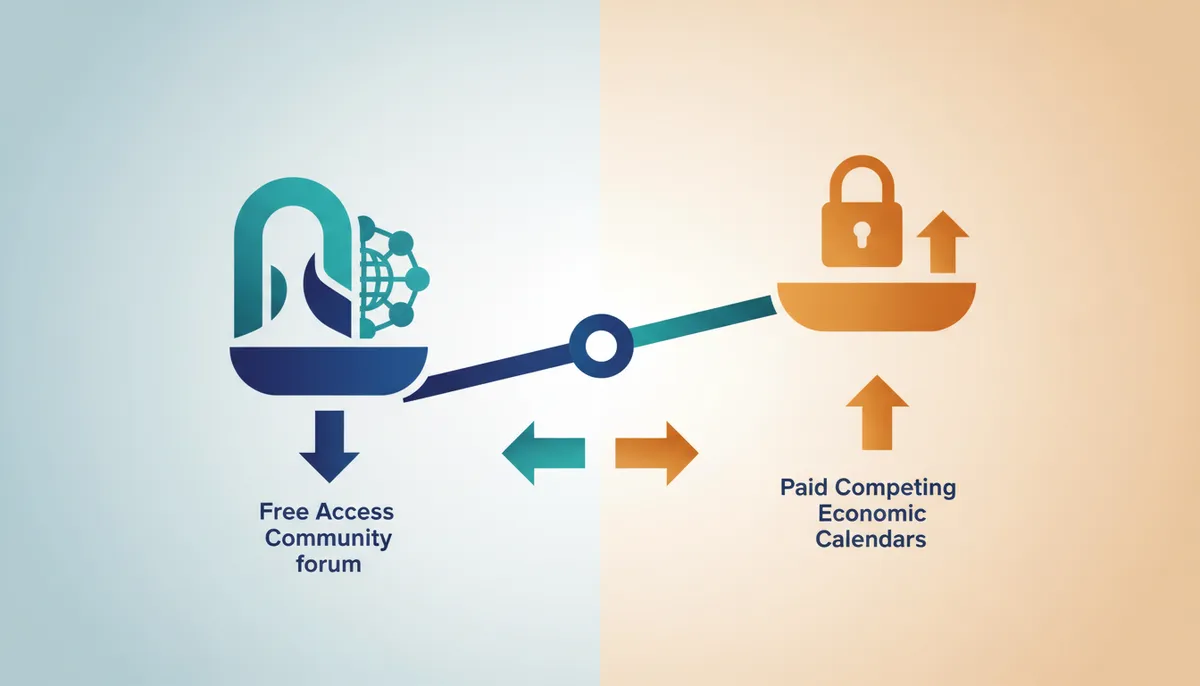
Massive Trading Community forums sit directly beside data feeds, a structural choice that separates Forex Factory from standard economic calendars. Competitors like TradingView offer strong filtering for high impact economic events, yet they often miss an embedded social layer where traders debate strategy in real-time. News triggers immediate peer analysis here rather than isolated interpretation.
| Feature | Forex Factory | Typical Competitors |
|---|---|---|
| Trading Community | Large, active forum | Limited or absent |
| Trade Explorer | Included | Usually unavailable |
| Access Model | Free | Often paid tiers |
A Trade Explorer tool tracks performance metrics typically absent in free calendar utilities. Most alternative tools force traders to switch contexts between news sources and brokerage dashboards, fracturing focus during volatile releases. Consolidating these functions reduces the latency between data consumption and strategy execution. This integration relies on the user manually connecting accounts, introducing a setup barrier that simpler calendars avoid. The analytical tension lies between the depth of integrated data and the simplicity of a read-only view. Beginners benefit from the educational highlights found in such thorough ecosystems, yet the sheer volume of community noise can obscure signal for novices. The Trade Explorer transforms the calendar from a passive reference into an active management console.
Using Broker Directories and Free Access for Strategy Execution
Using the integrated Broker Directory allows traders to validate execution venues before committing capital, effectively bypassing paid subscription barriers. This tool remains rare on competing platforms, where similar vetting often requires premium tiers or external research. While RoboForex provides a financial calendar as part of its service bundle, standalone access to such thorough broker data without an account is uncommon. The platform maintains Free Access to these critical resources so cost does not dictate the quality of due diligence.
| Dimension | Forex Factory | Typical Paid Tools |
|---|---|---|
| Broker Directory | Included free | Often bundled or paid |
| Forum Access | Open registration | Restricted or absent |
| Data Latency | Real-time | Variable by tier |
Speed of free news clashes with the depth of paid analytics; however, the sheer volume of peer review in the Trading Community often surfaces counter-arguments quicker than solitary algorithmic feeds. Newcomers asking how to join trading forums find immediate entry without gatekeeping, supporting a transparent environment for strategy debate. Relying solely on free tools demands higher personal discipline to filter noise from actionable intelligence. The Trade Explorer further bridges this gap by allowing performance tracking usually reserved for institutional dashboards. The zero-cost model democratizes access but shifts the burden of synthesis entirely onto the operator.
Forex Factory Versus Paid Tools: Interface Customization and Event Coverage
Core Time Zone Customization and Currency Filters match paid competitors while global event scope exceeds their reach. Typical economic calendars provide similar filtering mechanics, yet standalone sites often lack the visual integration found in modern charting suites. Paid tools like TradingView allow users to see pop-ups directly on price charts, a feature Forex Factory does not replicate natively. Structural depth competes with visual fluidity. Forex Factory prioritizes a dense, text-based dashboard that loads instantly across all devices without complex widget configurations.
| Feature | Forex Factory | Paid Charting Tools |
|---|---|---|
| Interface Style | Static list view | Interactive timeline |
| Visual Integration | None (external tab) | On-chart markers |
| Global Coverage | Thorough | Often filtered by region |
Traders relying solely on visual pop-ups may miss the sheer volume of low-tier data available on the factory floor. The static list format forces a manual review process that actually improves situational awareness for fundamental analysts. This friction prevents the oversight common when automated highlights dominate the screen real estate. Interactive interfaces offer sleekness, yet they frequently obscure minor events that trigger unexpected liquidity spikes. Raw data density matters more than aesthetic integration for many operators.
About
Aisha Rahman, Gold & Commodities Analyst at ForexCFD.top, brings necessary macroeconomic context to the discussion of economic calendars. As the lead analyst covering XAUUSD and oil, her daily workflow relies heavily on tracking high-impact data releases like CPI and NFP to interpret safe-haven flows and commodity price action. This article reflects her professional routine, where understanding the timing and potential volatility of central bank decisions is critical for both technical and fundamental analysis.
Her expertise extends to the unique needs of traders in the Gulf and Southeast Asia, particularly regarding how economic events influence swap-free trading conditions. By using ForexCFD.top's independent, regulation-aware platform, Aisha connects raw calendar data to actionable market insights. Her analysis ensures that retail traders understand not just when an event occurs, but how it specifically impacts gold, currencies, and risk management strategies in a global context.
Conclusion
Static, text-based dashboards feel clunky until market velocity spikes. Then, they become strategic assets. Interactive charts offer visual convenience, but they often filter out the low-tier data points that trigger sudden liquidity spikes. Relying on automated highlights creates a blind spot where minor events accumulate into significant volatility. The Trade Explorer model democratizes access to raw data density, yet it demands that the operator manually synthesize this information rather than depending on algorithmic curation. This shift requires a disciplined approach to filtering noise that sleek, paid interfaces frequently obscure for the sake of aesthetics.
Traders should prioritize mastering the manual review process inherent in dense data lists before integrating automated visual markers. Start this week by disabling all pop-up notifications on your primary charting suite and cross-referencing price action against the raw global and US Economic Calendar for one full trading session. This deliberate practice forces you to engage with the chronological order of events and linked indicators directly. You will likely discover that the supposed clarity of visual integration actually hides the context needed for accurate fundamental analysis. True situational awareness comes from understanding the full scope of global events, not just the ones a platform decides to highlight. Focus on building the discipline to interpret unfiltered data streams effectively.
Frequently Asked Questions
Events are categorized into exactly three distinct impact levels: high, medium, and low. This system allows traders to filter by significance and reduce visual noise by a portion when focusing on major market movers.
Readings for leading indicators like the PMI use a threshold of 50 to signal direction. Values above 50 indicate economic expansion, while values below 50 indicate contraction, helping traders gauge market health.
The platform provides free access to data from official sources rather than third-party providers. This ensures actual values are direct reports, allowing traders to avoid expensive subscriptions while maintaining data reliability.
While some interfaces let users select a specific week via the upper toolbar, this tool focuses on raw speed. Traders can still pick single days to view scheduled events without mandatory gatekeeping barriers.
The calendar presents forecast, previous, and actual figures side-by-side for every listed event. This layout helps traders anticipate volatility by comparing consensus forecasts against real-time results during high-impact news releases.
References