
Euro inflation drop to 2.3% kills ECB hike hopes
Germany's CPI inflation dropping to 2.3% in June 2026 directly undermines immediate European Central Bank rate hike expectations.
Cooling price growth in Germany removes the primary catalyst for aggressive ECB tightening, leaving the Euro under sustained downward pressure. Market participants now price a policy hold following data from Destatis showing inflation falling from 2.6% in May. Claus Vistesen at Pantheon Macroeconomics calls this move decisive for July outcomes. This shift forces a recalibration of monetary forecasts across the Eurozone as energy costs stabilize.
German inflation data now dictates ECB mechanics. Christine Lagarde explicitly dismissed the need for forceful action, highlighting a widening gap between Fed and ECB trajectories. US futures indicate a significant probability of hikes while European bets fade. Navigating the resulting EUR/USD volatility requires understanding these divergent policy paths.
Softening HICP readings combined with central bank rhetoric define the current trading environment. With market expectations missing the actual 2.3% print, the path of least resistance for the single currency remains constrained by domestic economic realities in Europe's largest economy.
The Role of German Inflation Data in Euro Valuation
Defining HICP as the ECB's Primary Inflation Gauge
The Harmonized Index of Consumer Prices (HICP) is the standardized inflation metric for the European Union. It separates itself from national Consumer Price Index (CPI) calculations through strict methodological uniformity. Divergent weighting creates a complex signal for market participants monitoring the EUR/USD pair. Differences in basket composition and weighting schemes can lead to scenarios where headline domestic data suggests cooling prices while the policy gauge indicates persistent heat. Traders observing the national figure might incorrectly anticipate a dovish shift, ignoring the stickier reality that dictates actual monetary policy.
Relying on local CPI without adjusting for harmonization rules introduces measurable basis risk in Euro valuation models. Investors must prioritize the harmonized output because rate decisions respond to the aggregate trajectory rather than isolated national softness. Ignoring this technical distinction leaves capital exposed to sudden volatility when policy announcements fail to align with softer domestic headlines.
How German CPI Deviations Drive Euro Market Sentiment
Consumer Price Index deviations from consensus forecasts influence positioning in EUR/USD liquidity pools. When recent prints missed targets, the Euro slipped as traders priced out aggressive tightening. This reaction reflects how downside surprises weigh on the currency during disinflationary cycles. The divergence between national data and HICP expectations creates a specific context for market participants. Headline figures cooled, yet underlying sectoral pressures remain uneven across the bloc. Energy costs have shown significant volatility, while services inflation suggests sticky core components resist rapid cooling.
| Data Scenario | Market Expectation | Typical EUR/USD Reaction |
|---|---|---|
| Print > Forecast | Hawkish ECB repricing | Immediate bullish spike |
| Print < Forecast | Dovish ECB repricing | Sharp liquidity drain |
| Print = Forecast | Status quo maintenance | Range-bound noise |
Traders interpreting HICP data must weigh external monetary pressures against stalling Eurozone momentum. Single-month misses may not alter the structural inflation trajectory if wage growth remains unanchored.
Euro Trading Volume Dominance Versus Other Substantial Pairs
The Euro functions as the primary liquidity vehicle for global forex. In 2022, it accounted for 31% of all foreign exchange transactions, with an average daily turnover of over $2.2 trillion a day. This depth creates a structural dependency where EUR/USD alone absorbs a significant portion of global flow, dwarfing cross-pairs like EUR/JPY.
| Currency Pair | Global Share | Liquidity Profile |
|---|---|---|
| EUR/USD | 30% | Deepest spreads, highest sensitivity |
| EUR/JPY | 4% | Moderate volatility, Asian session focus |
| EUR/GBP | 3% | Regional correlation, tight range |
| EUR/AUD | 2% | Risk-sensitive, commodity linked |
A sudden drop in inflation triggers significant moves as market participants adjust EUR/USD positions. Regulatory oversight remains strict given this systemic importance. The structure means national data from Germany directly impacts monetary policy for twenty nations. High-frequency participants monitor these flows closely, as the dominance of the primary pair dictates risk parameters for the entire block.
ECB Monetary Policy Mechanics and Rate Decision Drivers
ECB Governing Council Composition and Rate Decision Authority
The ECB Governing Council executes monetary policy mandates during eight scheduled annual sessions. This body comprises six permanent Executive Board members and the governors of national central banks from the Eurozone. Christine Lagarde, serving as President, leads the Executive Board in synthesizing diverse national perspectives into a unified stance. While inflation data from substantial economies like Germany influences the broader market sentiment, the Council's voting structure ensures that local economic shocks do not dictate the entire currency bloc's direction.
| Role Group | Composition | Primary Function |
|---|---|---|
| Executive Board | Six permanent members | Prepare meetings and implement decisions |
| National Governors | Heads of Eurozone banks | Represent specific national economic conditions |
A critical tension exists between national representation and collective stability, as governors may prioritize domestic recovery over aggregate price controls. This structural flexibility means that rate decisions often reflect a complex compromise rather than a pure reaction to any single data point. Traders observing the Council must parse the consolidated message for clues on future moves, as the final vote obscures the intensity of internal debates. The outcome directly impacts liquidity conditions across the region.
This figure came in softer than anticipated, contributing to receding bets for aggressive tightening by the European Central Bank. The deviation has prompted a recalibration of yield curves across the Eurozone, as traders anticipate a pause rather than an increase in borrowing costs.
- Signs of easing price pressures across substantial European economies have reduced expectations for restrictive ECB policy, weighing on the Euro.
- Policymakers cite falling energy prices and a lack of "second-round" effects to justify avoiding forceful action despite sticky core pressures.
The European Central Bank prioritizes aggregate stability, meaning a single large economy like Germany influences but does not dictate the final vote.
| Data Scenario | Policy Implication | Market Reaction |
|---|---|---|
| CPI Below Expectation | Hold rates likely | Euro loses momentum |
Analysts note that unless oil prices stage a spectacular rebound, the path of least resistance favors a hold decision. The ECB relies on this data to avoid second-round wage effects while acknowledging that forceful action is currently unnecessary. Traders should watch for shifts in this narrative as the next meeting approaches.
Oil Price Rebound Risks and the Threat of Second-Round Effects
A spectacular rebound in crude costs remains the primary catalyst capable of derailing the expected ECB policy hold. Claus Vistesen from Pantheon Macroeconomics warns that such an energy shock would invalidate current cooling trends before the July meeting. This specific risk highlights how second-round effects, particularly rising wage demands, could reignite inflation despite falling headline prices.
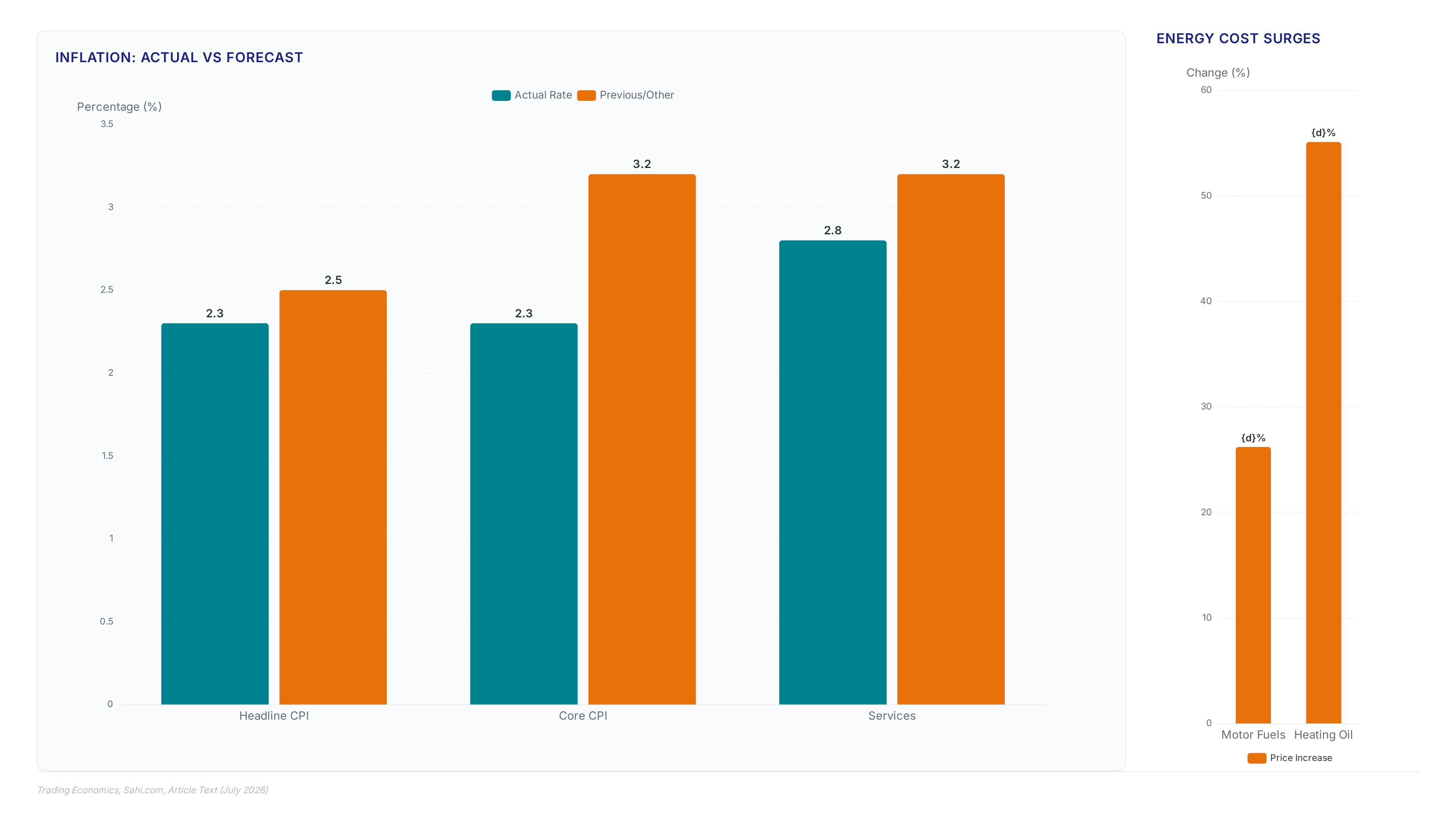
Operators must monitor statistical base effects that may cause inflation to dip temporarily before rebounding toward its target later in 2026. The divergence between national prints and broader Eurozone metrics creates a fragile window for stability. If fuel costs surge, the ECB Governing Council faces a dilemma between supporting growth and anchoring expectations. Unlike transitory spikes, persistent energy inflation directly impacts consumer purchasing power across the bloc. Notably, heating oil prices soared by 55.1% and motor fuel costs surged by 26.2%, highlighting volatility within the energy component. Traders should note that Christine Lagarde explicitly cited the absence of these feedback loops as justification for avoiding forceful action.
Divergent Fed and ECB Policy Paths Driving EUR/USD Volatility
Fed Funds Futures and the CME FedWatch Tool Mechanism
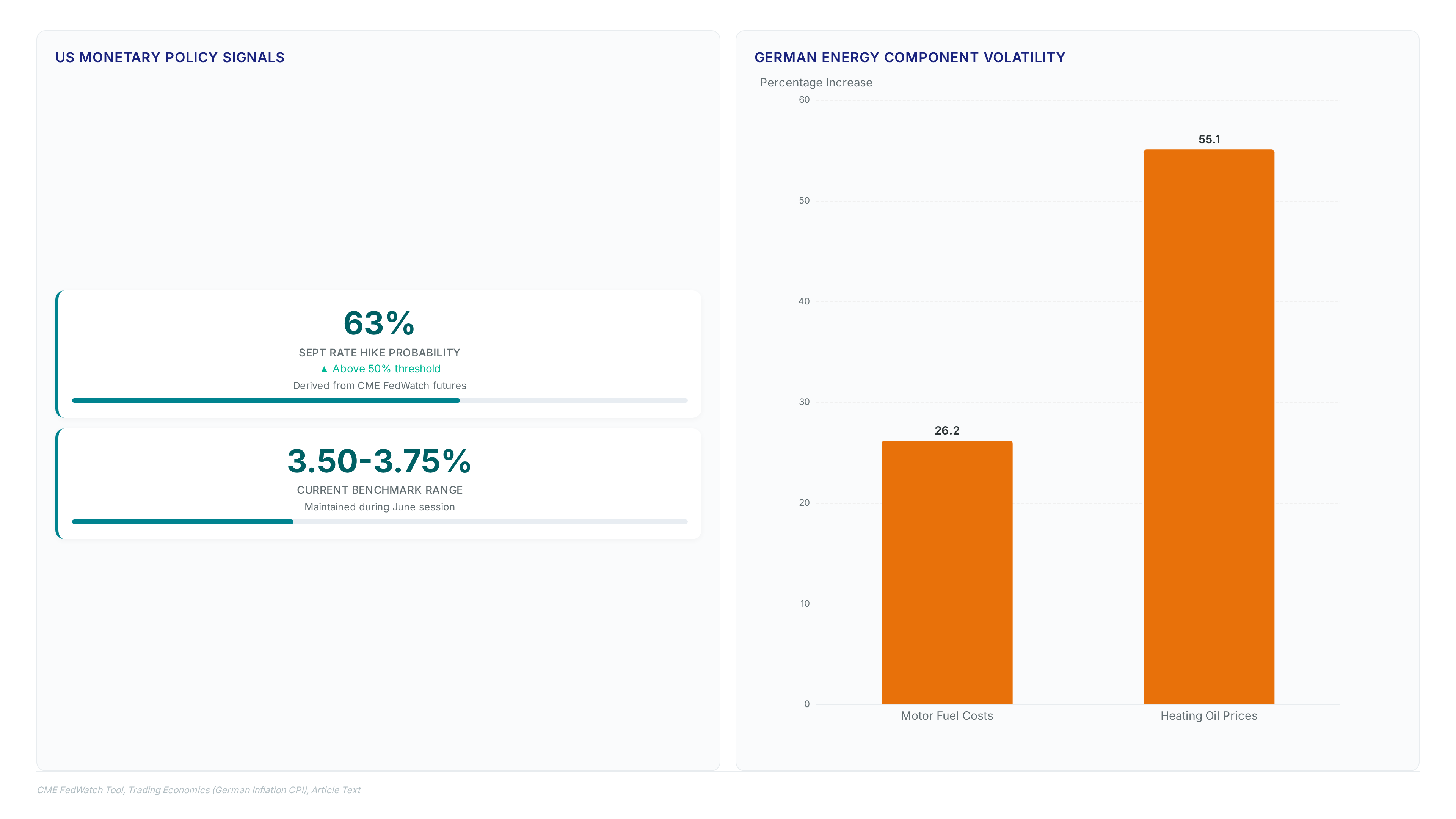
Market pricing for US monetary policy currently indicates a 63% probability of a rate increase by September. The CME FedWatch tool derives this specific percentage by analyzing the implied rates of Fed funds futures contracts traded on the exchange floor. These derivatives reflect the collective market consensus on where the overnight lending rate will settle at future Federal Open Market Committee meetings. The US Federal Reserve maintained its benchmark rate within the 3.50% to 3.75% corridor during the June session, yet the removal of dovish language altered the trajectory. This creates a tangible tension where static rate levels coexist with rapidly changing forward guidance.
- Monitor the gap between futures-implied rates and the current target range.
- Adjust position sizing when the probability of a hike exceeds 50%.
- Cross-reference German inflation trends to gauge the width of the policy divergence.
EUR/USD volatility expands not on actual rate changes, but on the velocity of probability shifts within the CME FedWatch mechanism. A rapid swing in these odds forces algorithmic rebalancing before any official policy announcement occurs.
Trading EUR/USD Momentum Using US Manufacturing PMI and HICP Data
Momentum shifts in EUR/USD often hinge on the divergence between US Manufacturing PMI surprises and Eurozone inflation prints. When the US Manufacturing PMI exceeds expectations, capital flows toward the dollar, pressuring the pair lower toward technical supports like 1.1410. Conversely, softer German data reduces pressure on the European Central Bank, capping upside momentum for the single currency. A key limitation is that energy volatility can distort headline numbers, masking underlying trends in core services.
The practical takeaway for eur usd analysis is that momentum trades require confirmation from both data points rather than isolated releases. A strong US PMI combined with soft Eurozone HICP creates a powerful bearish convergence for the pair.
Strategic Trading Approaches for Current EUR/USD Market Conditions
Trade Balance Mechanics and Currency Valuation Drivers
Export demand must offset cooling German inflation to justify immediate EUR/USD entries. The Trade Balance quantifies the difference between national earnings from exports and expenditures on imports over a specific period. Strong export performance drives currency value higher through foreign buyer demand. A deficit signals capital outflow exceeding inflow, creating downward pressure on the exchange rate.
Goods prices could rise if the EU defends itself more strongly against imports, potentially reversing current disinflationary trends in goods. This flexibility complicates the standard valuation model by introducing volatility unrelated to pure volume metrics. Traders must weigh this risk against immediate price action near 1.1410. A positive balance supports the Euro, yet geopolitical defense mechanisms may artificially inflate import costs, distorting the typical correlation between trade flows and currency strength. Economic data from the four largest Eurozone economies accounts for a significant portion of the region's output, making their individual balance sheets critical for pair direction.
Executing EUR/USD Trades Amid Receding ECB Tightening Bets
The EUR/USD pair lost momentum to near 1.1410 during early Asian trading hours on Wednesday, 1 Jul 2026, pressured by receding bets for aggressive tightening by the European Central Bank (ECB). Market participants are awaiting the preliminary reading of the Harmonized Index of Consumer Prices (HICP) from the Eurozone and the US Manufacturing Purchasing Managers Index (PMI) report, both due later in the day. The immediate market reaction saw the Euro decline as softer German data undercut expectations for restrictive policy, creating a divergence from the Federal Reserve's stance.
Timing matters most with the US Manufacturing PMI release. A strong reading could accelerate dollar gains before European traders assess the broader inflation picture. Liquidity conditions during the Asian session overlap often differ from peak trading hours, which can influence how headline numbers impact price. Executing trades now carries risk without the confirming signal from the upcoming HICP data. Investors awaiting further clarity on the Fed rate decision context must recognize that any surprise upside in American manufacturing activity could widen the yield differential further. Many market participants prefer to wait for volatility to settle before committing capital to either side of the pair.
Volatility Risks Pending Eurozone HICP and US Manufacturing PMI Releases
Holding EUR/USD positions before key data releases exposes portfolios to abrupt price movements as liquidity fluctuates ahead of the data drop. This divergence increases uncertainty around the 1.1410 level, where sellers have recently defended supply zones aggressively. US Manufacturing PMI data can trigger significant moves, particularly when it conflicts with the prevailing narrative priced into futures. Standard stop-loss orders may fail to protect capital during the release window due to such hidden variance. The discrepancy between national data and the aggregate Eurozone dynamics complicates the ECB's policy path, adding a layer of uncertainty that pure technical analysis cannot quantify.
Operators may consider reducing use or hedging exposure until probabilities stabilize post-release. Monitoring real-time market depth and order flow is necessary. The cost of being wrong on direction is magnified when volume evaporates. Patience becomes the primary risk management tool today.
About
Sofia Mendes serves as the Broker Reviews & Trading Education Editor at ForexCFD.top, where she oversees market analysis and educational content for global retail traders. Her expertise in central bank policies and macroeconomic drivers makes her uniquely qualified to dissect the Euro's recent decline. While her primary focus includes rigorous broker due diligence, her daily work requires deep immersion in fundamental analysis, specifically tracking how data like German inflation influences ECB rate decisions. This article connects directly to her role in educating traders on navigating volatility caused by shifting monetary expectations. At ForexCFD.top, an independent publication dedicated to regulation-aware news, Sofia ensures that complex market moves are explained with clarity and factual precision. Her analysis helps traders in emerging markets understand the real-world impact of Eurozone economic indicators on substantial pairs like EUR/USD, bridging the gap between raw data and actionable trading knowledge without hype.
Conclusion
Holding EUR/USD positions through conflicting data releases invites unacceptable slippage, as liquidity evaporates precisely when volatility peaks. While German inflation data suggests a cooling trend, the broader Eurozone picture remains fragmented, creating a scenario where technical levels like 1.1410 become unreliable without fundamental confirmation. The operational cost of guessing the direction of the US Manufacturing PMI or the upcoming HICP report far exceeds the potential reward of early entry. Traders must recognize that standard risk parameters often fail during these specific windows of uncertainty.
Adopt a defensive posture until the yield differential narrative stabilizes post-release. Specifically, reduce use or hedge existing exposure immediately if your strategy cannot withstand a 50-pip spike in either direction. The window for speculative aggression closes when data conflicts with price action. Start by reviewing your open orders today to ensure stop-losses are placed outside typical noise ranges or convert them to manual execution to avoid slippage during the announcement. This approach preserves capital while the market digests the divergence between national German figures and aggregate Eurozone dynamics.
Frequently Asked Questions
The drop to 2.3% inflation makes a July rate hold nearly certain for policymakers. This shift removes aggressive tightening bets that previously supported the currency value.
EUR/USD commands a 30% share of global transactions, offering the deepest liquidity pools available. Traders rely on this volume to execute large orders without significant price slippage.
Germany represents the largest economy, so its 2.3% inflation print heavily skews aggregate Eurozone expectations. Markets treat this national data as the primary signal for broader regional monetary policy shifts.
While Fed futures show a 63% hike chance, ECB expectations have faded due to cooling prices. This policy gap creates volatility as capital flows toward higher yielding US assets.
EUR/JPY holds only a 4% market share versus the dominant 30% seen in EUR/USD pairs. This lower liquidity results in moderate volatility and a specific focus on Asian trading sessions.
References