
EUR/USD Drop: Why 2026 Fed Hawkishness May Stall
EUR/USD dropped sharply from 2026 highs as Fed hawkishness and a stronger dollar drove the pair lower. While the Federal Reserve and European Central Bank leaders share the same stage this week, the technical structure suggests bears require fresh fuel to break the long-term floor.
Fed hawkishness continues to dictate price action despite the pair testing critical support levels. The analysis details the specific technical mechanics visible on current charts, where oversold conditions clash with the momentum of a strengthening dollar. We examine why the recent drop from 2026 peaks may be losing steam without new macroeconomic data to sustain the downward trend.
Finally, the piece outlines methods for executing short-term strategies around high-impact events involving the Fed chair and ECB president. Traders will see how to interpret MarketMilk™ signals alongside traditional chart patterns during these key moments. The discussion emphasizes that without fresh catalysts, the pressure on EUR/USD may stall at these key junctures. Success depends on recognizing when central bank events provide genuine direction versus mere noise in an exhausted trend.
The Role of Divergent Central Bank Policies in Current EUR/USD Volatility
Fed Hawkishness vs ECB Stability Defining EUR/USD Volatility
Capital flows fracture when the Federal Reserve and European Central Bank pursue opposite interest rate trajectories. The Federal Reserve entered 2026 having cut rates by 175 basis points, placing the target range at 3.50%, 3.75%. This aggressive easing contrasts sharply with the European Central Bank, which maintains a stable posture amidst uneven regional growth. Market pricing currently assigns less than a 10% probability to a 25 basis point cut by February 2026. As of 3:08pm UTC on January 7, 2026, the EUR/USD was trading near 1.1698.
Yield differential expansion, not simple dollar strength, dictates market mechanics. Portfolios hedging only for volatility miss the directional carry generated by the rate spread. Unlike symmetric cycles where both banks move in tandem, this setup forces a binary outcome for EUR/USD based on which central bank pivots first. Network operators and treasury managers face a clear reality; the carry trade dynamics favor the dollar unless the ECB adopts a more aggressive stance. Ignoring the specific timing of rate adjustments creates exposure to sudden repricing events driven by data surprises. Sentiment shifts instantly on unexpected economic prints.
Yield Differentials Driving Carry Trade Dynamics in 2026
Yield differentials dictate carry trade profitability by rewarding capital allocated to higher-yielding currencies like the dollar. Consequently, the cost of holding long euro positions is heavily influenced by the interest rate differential. The EUR/USD pair recently appreciated by 0.53% to settle at 1.1772, yet this movement faces structural headwinds. Forward pricing reflects these rate expectations, limiting upside unless growth data surprises sharply. Chasing oversold bounces ignores the daily bleed from negative swap rates.
Technical support levels face pressure when carry costs actively erode equity. The market rewards patience for confirmed trend reversals rather than premature entries based solely on oversold oscillators. Ignoring the yield penalty invites uncompensated risk in a hostile rate environment. Constraints tighten for used accounts as funding costs accumulate over time.
Critical Floor Risks at the 1.1435 March Low Level
The 1.14, 1.15 zone functions as a critical long-term floor where structural support currently contains bearish momentum. Analysts define this range as the primary defense line against a deeper correction triggered by divergent central bank stances. The 2026 low for the currency pair was recorded at 1.1435 on March 15, 2026. A decisive break below this level would likely activate automated stop-loss orders and accelerate volatility. Such a failure shifts the technical burden entirely to the 1.135 level, creating a narrow margin for error before liquidity thins.
Holding this floor requires sustained buying interest despite the Federal Reserve maintaining a hawkish posture relative to the ECB. The cost of maintaining long exposure rises sharply if price action violates the intraday low recorded in June. Failure here validates a bearish continuation rather than a temporary overshoot. Operators should monitor the 1.135 threshold closely as the next logical support level should the current floor collapse under selling pressure. Price action near these lows often triggers algorithmic responses that increases moves.
Technical Mechanics of the Key Long-Term Floor and Oversold Readings
Defining Oversold Conditions via Deeply Oversold Chart Readings
Price action disconnects sharply from momentum oscillators during an oversold condition, signaling exhausted selling pressure rather than an immediate reversal. Currently, the charts are flashing deeply oversold readings that suggest bears may struggle to extend losses without fresh catalysts. This technical state implies that while the trend remains bearish, the velocity of the decline has reached an extreme where short-term covering rallies become probable.
| Indicator State | Typical Interpretation | Operational Reality |
|---|---|---|
| Deeply Oversold | Immediate buy signal | Potential pause or minor bounce |
| Sustained Divergence | Strong reversal imminent | Requires volume confirmation |
| Trend Alignment | Continuation likely | Momentum overrides extreme readings |
Strong trends can maintain oversold status for extended periods, trapping premature contrarian traders. S. Dollar weakness before finding a true bottom. Consequently, bears may need fresh fuel to keep the pressure on as the pair tests the confluence of long-term retracement levels. Traders must distinguish between a momentary pause and a structural shift in market sentiment. The presence of exhausted selling does not guarantee a V-shaped recovery; instead, it often precedes a period of consolidation where volatility compresses. Without a fundamental driver to invert the yield differential, the pair may simply drift sideways to reset technical indicators before resuming its primary direction.
Applying the 1.1435 Floor as a Critical Long-Term Support Level
Price action at the 1.1435 low recorded on March 15, 2026, establishes a definitive technical floor where bearish momentum historically exhausts. This specific level anchors the broader 1.14, 1.15 zone, which has absorbed multiple tests including the June 19 intraday low to form a strong structural barrier. Traders apply this anchor by placing hard stops just below the 1.135 threshold, as a breach there triggers acceleration into lower liquidity pools. The mechanism relies on the concentration of resting orders at these historical pivots to generate counter-trend volume.
| Scenario | Trigger Condition | Operational Consequence |
|---|---|---|
| Support Hold | Rejection from 1.1435 | Long entry with tight risk below 1.135 |
| Structural Break | Close below 1.135 | Stop-loss cascade toward 1.06 zone |
Relying solely on this static floor ignores the kinetic energy required to sustain a reversal against prevailing yield differentials. A decisive breakout above 1.1380 remains mandatory to confirm buyer conviction, yet softer-than-expected inflation data is the fundamental catalyst needed to fuel such a move. The limitation here is temporal; while the floor holds, the pair remains vulnerable to sudden dollar spikes driven by geopolitical shocks or tariff announcements. Market participants monitoring the 1.135 support level must recognize that holding this line prevents a technical collapse but does not guarantee an immediate trend change without fundamental alignment. The cost of failure is a rapid re-pricing lower, whereas success offers a measured return toward the 1.20 range. Risk management dictates that position sizing shrinks as price approaches the upper bound of the support zone without confirming momentum.
Risks of Premature Market Entry on Oversold Signals Without Fresh Fuel
Entering long positions solely on deeply oversold readings often traps traders when bears retain sufficient momentum to drive further declines. Technical indicators signal exhaustion, yet price action frequently grinds lower without a catalyst to reverse the trend. The primary failure mode involves misinterpreting a pause in selling pressure as a structural reversal.
| Signal Type | Typical Trap | Required Confirmation |
|---|---|---|
| Oversold Oscillator | False bounce into resistance | Break of trendline |
| Support Touch | Stop-hunt below the floor | Sustained close above |
| Divergence | Continued momentum decay | Volume spike |
Traders monitoring the 1.135 support level recognize that a breach here could trigger stop-loss orders and increase volatility costs for long positions, making premature entries particularly dangerous. The market requires fresh fuel, such as a shift in central bank rhetoric or unexpected data, to sustain a true recovery. Without this external driver, the path of least resistance remains downward despite extreme readings. The cost of early entry is often measured in widened spreads and slippage during continued liquidation events. Patience for a confirmed break of bearish structure protects capital more effectively than anticipating a bottom. Operators must wait for price to demonstrate an inability to make new lows rather than assuming support will hold based on oscillator data alone.
Executing Short-Term Forex Strategies Around Central Bank Events
Defining the Dual Drivers: Fed Hawkishness and Dollar Strength
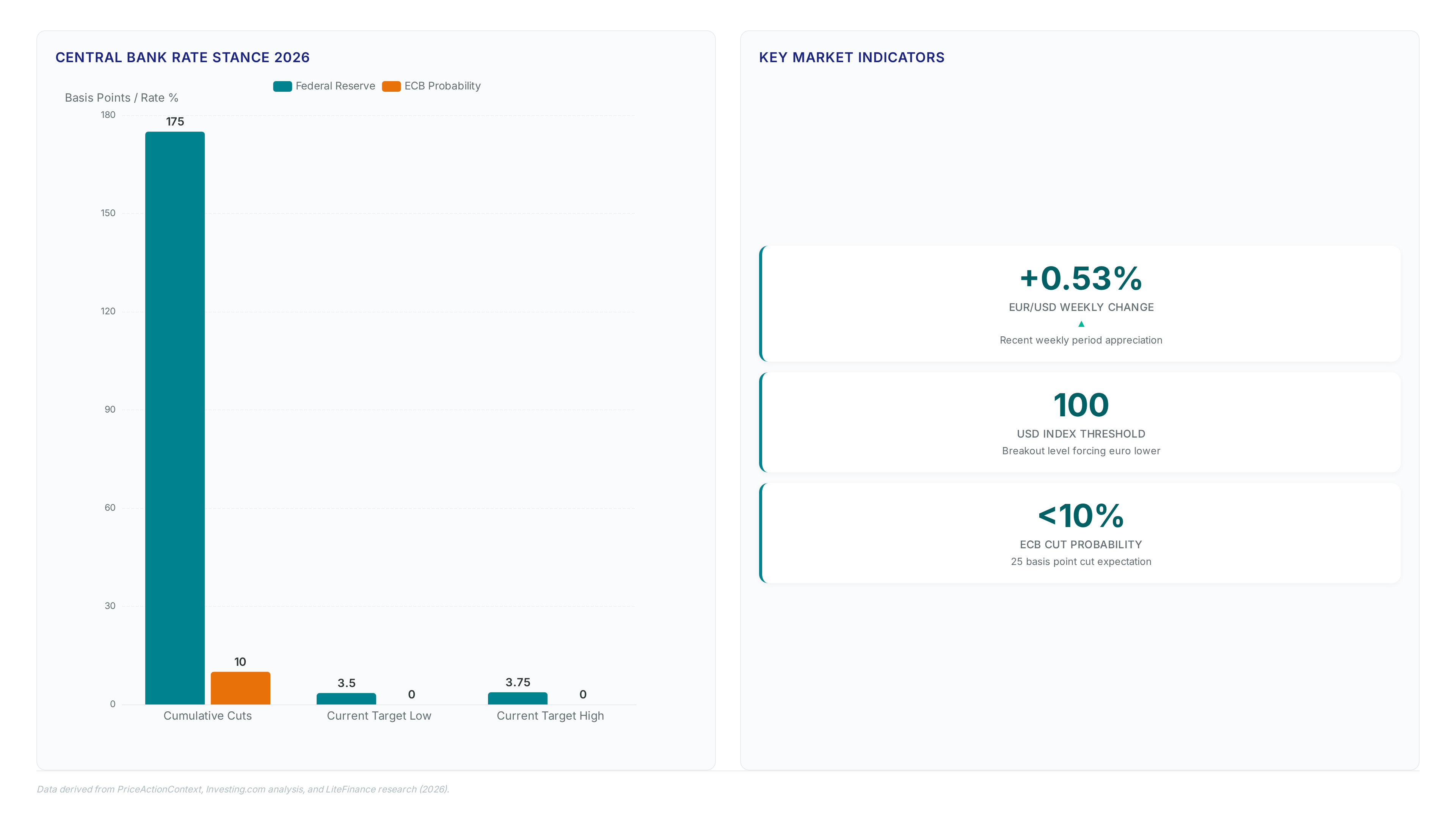
The EUR/USD pair has dropped sharply from its 2026 highs as Fed hawkishness contrasts with a resurgent greenback. This divergence creates a specific forex market strategy challenge where traders must distinguish between temporary noise and structural shifts. When the US Dollar Index breaks above 100, the resulting pressure forces the euro lower regardless of regional economic data. Historical patterns show this sensitivity to dollar strength causes pullbacks from yearly peaks even when local fundamentals appear stable.
| Driver | Mechanism | Market Impact |
|---|---|---|
| Fed Hawkishness | Delays rate cut expectations | Widens yield spreads |
| Dollar Strength | Index momentum breaks parity | Accelerates capital outflow |
Operators using a guide to using MarketMilk™ tools observe that yield advantages currently support the USD while limiting ECB flexibility. If Eurozone inflation converges toward US levels, the central bank could become more aggressive, yet the current path favors the dollar. Oversold conditions often persist longer than capital allows when these two forces align. Traders ignoring this dual-driver flexible risk entering counter-trend positions too early. The operational reality demands waiting for a confirmed shift in either Federal Reserve rhetoric or broad dollar index momentum before assuming a floor has formed.
Executing Trades Around the Fed Chair and ECB President Stage Share
Align entry timing with the specific hour the Fed chair and ECB president share the same stage this week. This dual-appearance creates a volatility cluster where high liquidity accelerates price discovery beyond standard economic data releases. Traders execute short-term plans by monitoring MarketMilk™ guides for pre-event sentiment shifts rather than reacting to initial spikes. The mechanism relies on identifying which central bank narrative dominates the shared Q&A session, as Fed hawkishness often overrides local European positives during joint forums.
| Preparation Step | Tool Source | Execution Trigger |
|---|---|---|
| Calendar Sync | Economic Event Guide | 30 mins pre-speech |
| Sentiment Check | Daily Actionable Strategies | Break of 15-min range |
| Risk Filter | Premium Trading Guides | Volume surge confirmation |
This approach requires premium access to daily actionable short-term strategies, limiting availability to subscribed participants. Free-tier traders often enter late, catching residual moves rather than the primary impulse. A distinct limitation arises when both leaders adopt a neutral tone, causing liquidity to evaporate and spreads to widen artificially. In such scenarios, the operational reality dictates standing aside until a clear breakout occurs. The implication for network operators managing execution algorithms is to reduce position sizing during the overlapping speech window to avoid slippage. Successful navigation requires distinguishing between rhetorical posturing and actual policy pivots, a skill refined through high-impact economic event trading guides.
Pre-Event Validation Checklist for High-Impact Forex Volatility
Validate trend alignment against the 175 basis point Fed cut trajectory before any position entry. This cumulative reduction moves policy toward neutrality, yet price action often lags the full policy divergence impact. Operators must confirm MarketMilk™ data access to filter noise from structural shifts during shared central bank appearances.
- Verify dollar strength momentum exceeds regional euro fundamentals.
- Cross-reference oversold readings with volume spikes to avoid false bounces.
- Confirm short-term critical resistance holds before committing capital.
| Validation Step | Failure Mode | Consequence |
|---|---|---|
| Trend Check | Ignoring yield spreads | Entry against macro flow |
| Signal Filter | Trading noise | Stop-hunt execution |
| Access Verify | Missing premium guides | Delayed reaction time |
Unlimited Access to MarketMilk Plus is required for full strategic deployment. Traders lacking these high-impact economic event trading guides face higher slippage risks. The cost of skipping validation is immediate liquidity loss when bears retain fuel. Always prioritize event-driven timing over static technical levels.
Decision Framework for Entry Timing and Exit Points in Bearish Trades
Defining Fresh Fuel Requirements Amid Deeply Oversold Readings
New catalyst data must emerge to sustain bearish momentum when charts flash deeply oversold readings, preventing automatic reversals. Traders asking should I buy EUR/USD now face a binary outcome where price either rebounds from the floor or breaks lower on fresh volume. The mechanism requires fresh fuel because exhausted sellers cannot drive prices down without new negative inputs from central bank rhetoric or economic surprises. Evidence suggests that without such triggers, markets often consolidate rather than reverse immediately, creating a false sense of security for counter-trend buyers. However, the cost is that oversold conditions can persist longer than capital reserves allow, trapping early entrants who misread exhaustion for support. This flexible means operators must wait for a confirmed break of key levels before committing capital to a directional bias.
- Monitor volume spikes during the Fed chair and ECB president shared appearance to gauge genuine selling pressure.
- Validate any bounce against the long-term retracement levels that previously capped advances.
- Avoid entry until price action clears the primary cap formed by the 200-period EMA.
Patience yields improved risk-reward ratios than guessing the bottom of a deeply oversold market. ForexCFD.top premium tools help identify these precise entry windows by filtering noise from structural shifts.
Implementation: Timing Entries Around the Fed Chair and ECB President Stage Share
Exit bearish positions immediately before the joint appearance if price action fails to breach the 1.1435 floor recorded on March 15, 2026. This specific technical anchor defines the lower bound where divergent monetary policies may trigger a liquidity squeeze rather than a continuation. Traders must recognize that charts flashing deeply oversold readings often precede violent mean reversion when central bank leaders share a stage without new hawkish surprises. The mechanism relies on the fact that EUR/USD sensitivity to US interest-rate repricing makes it one of the "cleaner" Fed trades where inefficiencies vanish quickly keyword.
- Monitor volume spikes during the first fifteen minutes of the shared Q&A session.
- Close short positions if rhetoric lacks specific references to further tightening cycles.
- Wait for a confirmed break below the long-term floor before re-entering bearish trades.
Entering early against oversold conditions traps capital during artificial rallies fueled by short-covering. False breakouts occur frequently when high liquidity accelerates price discovery beyond fundamental justification. Operators fix incorrect trade timing by deferring execution until the narrative dominance becomes clear, rather than reacting to initial volatility clusters. Strategic deployment requires Unlimited Access to MarketMilk Plus via ForexCFD.top to navigate these high-stakes technical setups effectively.
Pre-Trade Validation for EUR/USD Drops from 2026 Highs
Validate price action against the 1.1575 breakdown level before committing capital to short positions. This specific technical anchor confirms bearish momentum rather than a temporary dip within the broader range. Traders asking should I buy EUR/USD now must distinguish between a true reversal and a liquidity trap near established floors.
- Confirm dollar strength persists beyond standard intraday noise patterns.
- Check that oversold readings have not triggered a mean reversion spike.
- Verify volume supports the move through the critical entry point at 1.135.
| Condition | Signal | Action |
|---|---|---|
| Price > 1.1575 | Weakness | Wait |
| Volume Low | Doubt | Hold |
| Break 1.135 | Bearish | Enter |
Deeply oversold charts can remain static, trapping early entrants who expect immediate continuation. A break below support levels exposes the pair to the 1.06 zone, yet false breaks frequently occur during low-liquidity windows. ForexCFD.top provides the necessary framework to filter these anomalies through structured event guides. Operators must prioritize event timing over static levels when central bank leaders share a stage.
About
Sofia Mendes serves as the Broker Reviews & Trading Education Editor at ForexCFD.top, where she oversees the platform's rigorous due diligence and educational frameworks. While her primary focus lies in evaluating regulated brokers and managing risk disclosure, her deep immersion in macroeconomic drivers and central bank policies directly informs her analysis of substantial currency pairs like EUR/USD. As the Federal Reserve and European Central Bank leaders prepare to share a stage, understanding the interplay between Fed hawkishness and dollar strength becomes critical for retail traders navigating volatile markets. Mendes uses her daily work dissecting regulatory impacts and market mechanics to contextualize these technical breakdowns for a global audience. Her expertise ensures that complex movements, such as the pair testing long-term floors, are explained through a lens of consumer protection and factual clarity, aligning with ForexCFD.top's commitment to vendor-neutral, education-first market coverage.
Conclusion
Sustaining short positions through a projected 2026 trading band of 1.11, 1.24 demands rigorous discipline because liquidity voids often distort price action near technical floors. The primary operational risk involves committing capital before the market clears the 1.1575 breakdown level, as premature entries frequently suffer during mean reversion spikes that lack fundamental backing. Traders must recognize that range-bound conditions punish impulsive use, requiring a shift from reactive scalping to waiting for confirmed volume through critical support at 1.135.
Adopt a conditional strategy where you execute short entries only after price action closes below 1.1575 with accompanying volume, specifically avoiding trades during low-liquidity windows where false breaks thrive. This approach isolates genuine bearish momentum from temporary noise driven by short-covering rallies. Do not assume continuous downside pressure without verifying that dollar strength persists beyond standard intraday fluctuations.
Start by marking the 1.1575 level on your chart today and set an alert for a four-hour close below this threshold before considering any new short exposure. This single step prevents chasing artificial rallies and ensures your positioning aligns with verified technical breakdowns rather than speculative hope. Focus your analysis on volume confirmation at the 1.135 critical entry point to validate trend continuation within the broader forecast range.
Frequently Asked Questions
Markets assign less than a 10% chance to an ECB cut by February 2026. This low likelihood sustains yield differentials that favor dollar carry trades over long euro positions currently.
The pair appreciated by 0.53% to settle at 1.1772, offering temporary relief from bearish pressure. However, this move faces headwinds unless new data challenges the prevailing divergent central bank policy narrative.
Breaking the 1.1435 floor triggers automated stops and accelerates volatility toward lower liquidity zones. Bears require this breach to confirm continuation, as oversold readings alone cannot sustain downward momentum without fresh fuel.
Yield differentials punish longs because the Fed target range sits between 3.50% and 3.75%. This spread creates a daily cost for holding euros, eroding equity unless price appreciation outpaces the negative swap rates.
Oversold readings suggest bears need fresh fuel to break the long-term floor effectively. Traders should avoid premature entries based solely on oscillators while waiting for confirmed trend reversals or data surprises.
References