
Fed rate hike odds shift as Warsh targets 3.8%
With the median federal funds rate projection climbing to 3.8%, Kevin Warsh is aggressively rewriting the Federal Reserve playbook while markets remain paralyzed by uncertainty. This isn't a technical adjustment; it's a desperate pivot toward geopolitical survival in a fragmenting global order. As the FOMC maintains its ample-reserves stance with a $6.7 trillion balance sheet, the central bank is increasingly forced to prioritize inflation mandates over growth, effectively ignoring the 35% recession probability flagged by J. P. Morgan Global Research.
We need to talk about how geopolitical mechanics drive oil volatility, specifically looking at Japan's 94% dependence on Middle Eastern crude and the fragile peace resulting from the recent US-Iran MOU.
Finally, we translate these macro shifts into actionable trading signals by examining GDP data anomalies, such as New Zealand's unexpected 1.5% annual growth contrasting with global stagnation. CITIC Securities warns that political pressure may keep the Fed on hold all year, creating a divergent path from market expectations of a December hike. Understanding these monetary instruments is no longer about parsing economic reports but decoding the new rules of a fractured financial system where geopolitical competition overrides standard doctrine.
The median estimate for the federal funds rate at the end of 2026 has risen to 3.8%, up from a slightly lower level in prior projections, defining Warsh's hawkish pivot. This strategic shift contrasts with the Federal Reserve maintaining the interest rate paid on reserve balances at 3.65%, effective June 18, 2026. The divergence signals that committee members see at least one rate hike as necessary this year despite current holds. Policy implementation relies on the ample-reserves framework adopted in January 2019, which uses the interest rate on reserve balances as the primary control tool. Analysts remain split on the Fed path, with December hike odds near 50%. The cost of this ambiguity is measurable: market participants must price in volatility that the previous steady-state framework avoided. While the US-Iran MOU aims to stabilize oil flows, the inflation mandate now explicitly accounts for supply-side shocks that previous models treated as transitory.
Formalizing the 14-point US-Iran memorandum anchors geopolitical risk as a direct input for monetary policy calibration. Confirming the deal stabilizes supply expectations, yet the Strait of Hormuz remains a volatility vector the its role in global trade flows. Markets initially priced the signing as a resolution, but lingering threats to infrastructure keep inflation hedges active. The FOMC faces a divergence between immediate stability and long-term price pressures. Even with December hike odds hovering near half, the committee must weigh transient supply shocks against entrenched inflation expectations. A single member dissenting for lower rates highlights the friction within the ample-reserves framework when external shocks collide with domestic mandates.
Operators monitoring Fed hike odds after a policy hold must distinguish between signal noise and structural shifts. The path forward requires parsing diplomatic finality from physical reality. If the Hormuz corridor sees renewed disruption, the 35% recession probability attributed to geopolitical tension could materialize rapidly.
| Diplomatic Signing | Moderate oil price dip | Temporary pause in hawkish rhetoric |
| Physical Closure Threat | Spike in Brent crude | Accelerated timeline for rate adjustments |
| Reconstruction Deals | Sector-specific equity gains | Neutral impact on broad monetary stance |
Diplomatic texts function as live data feeds rather than historical footnotes under this new strategic shift. Ignoring the gap between signed paper and open shipping lanes invites miscalculation in duration targeting. J. P. Morgan Global Research assigns this probability to a scenario where consumption downshifts across developed markets. This statistical reality forces a divergence between immediate inflation fighting and growth preservation. CITIC Securities argues the Federal Reserve will remain on hold throughout the year as Warsh navigates these political and inflation crosswinds. The cost of ignoring this drag is measurable; tightening into a slowing economy accelerates the path to contraction.
The Federal Reserve maintains an ample-reserves framework with a balance sheet near $6.7 trillion, indicating high liquidity remains a structural priority. Operators monitoring Fed hike odds must recognize that crosscurrents often result in policy paralysis rather than clear directional shifts. Unlike the aggressive tightening cycles of previous decades, the current environment demands patience amid conflicting data points. The limitation of this hold strategy is that inflation expectations may become unanchored if supply shocks persist. However, raising rates now increases the likelihood of triggering the very downturn the FOMC seeks to avoid. Portfolio recalibration toward defensive assets becomes the logical response to this stalemate.
Geopolitical Mechanics Driving Oil Prices and Currency Volatility
Defining the Oil-Currency Transmission via Hormuz Fees
Baghaei's explicit warnings on Hormuz fees create a direct cost-push mechanism threatening Japan's 94% oil dependence. The 14-point agreement stabilizes diplomatic channels, yet the physical chokepoint remains vulnerable to unilateral fee imposition or closure. Roughly 20 million barrels. This exposure forces a transmission where energy costs bypass domestic wage growth and directly degrade the yen via terms-of-trade shock.
| Risk Vector | Mechanism | Currency Impact |
|---|---|---|
| Fee Hikes | Transit tariff increases | Immediate JPY depreciation |
| Closure Threat | Supply stoppage fear | Volatility spike in USD/JPY |
| Logistics Delay | Rerouting costs | Sustained import inflation |
The transmission logic operates through the current account rather than interest rate differentials. When geopolitical tensions escalate, insurance premiums on energy logistics Unlike previous cycles, this shock hits a household sector already burdened by weak currency purchasing power. Investors assessing geopolitical risk must prioritize fee structures over simple barrel counts. The limitation of this framework is its reliance on transparent tariff data, which Tehran may obscure. Consequently, portfolio recalibration requires assuming worst-case transit costs rather than hoping for diplomatic adherence. The yen remains the primary casualty of this opacity.
Household Impact: Yen Weakness at the 160.50 USD/JPY Level
Chief Cabinet Secretary Kihara acknowledged the household burden of yen weakness without signaling fresh intervention, leaving USD/JPY static around 160.50. This stagnation forces Japanese families to absorb higher import costs as the currency fails to recover. Unlike corporate entities that hedge geopolitical risk through derivatives, households face immediate price shocks on energy and food. The lack of policy movement suggests officials prioritize export competitiveness over domestic purchasing power parity. Investors monitoring preferential financing trends see capital fleeing retail sectors for hard assets. Reaction to intervention cues remains muted because verbal warnings lack the kinetic force of actual market operations. Storage costs for necessary goods rise alongside total cost of ownership metrics, squeezing disposable income further. Without coordinated fiscal relief or rate divergence closure, the 160.50 level becomes a floor rather than a ceiling. Markets interpret silence from Tokyo as tacit acceptance of degraded living.
Strait Access Risks and the 27% Global Seaborne Oil Share
Missile threats persist despite the Versailles signing, endangering the 27% of global seaborne oil trade passing through the strait. Goldman Sachs flags this ceiling if the waterway remains blocked. The mechanism is simple: physical denial of passage overrides diplomatic accords. Baghaei's warnings confirm that missile ranges still cover the transit lane.
| Scenario | Supply Impact | Price Target |
|---|---|---|
| Partial Disruption | Reduced throughput | a moderate range |
| Full Closure | 20M bpd lost | $130 spike |
Operators must adjust portfolios when missile telemetry indicates launch readiness rather than waiting for physical blockage. Unlike standard supply shocks, this risk vector ignores market fundamentals until the moment of impact. The limitation lies in reaction time; once the strait closes, liquidity evaporates. Commercial banks already reduce cross-border lending to regions with elevated geopolitical risk tightening credit further. This credit contraction amplifies the initial price shock.
Energy logistics costs become the primary inflation driver for import-dependent economies. Input costs for energy-intensive sectors rise immediately upon any threat escalation. The IMF notes that such intensifying risks downgrade global growth forecasts. Portfolio adjustments require shifting from yield-seeking assets to hard commodities before the physical flow stops. Waiting for confirmation ensures capital loss.
Translating GDP Data and Stimulus Measures into Trading Signals
Defining the NZ GDP Miss vs Annual Beat Signal
New Zealand's Q1 GDP printed 0.8% q/q, missing the 0.9% consensus while the annual 1.5% y/y beat the 1.1% forecast. This divergence creates a statistical noise floor where currency markets ignore domestic prints in favor of broad dollar flows. The RBNZ 1.0% quarterly expectation failure suggests domestic demand remains fragile despite the yearly headline strength. Global capital allocation increasingly favors regions with explicit public investment mandates, leaving small open economies like New Zealand vulnerable to external risk-off sentiment. The annual beat offers little insulation when substantial central banks pivot based on geopolitical friction rather than local growth metrics. Investors parsing mixed signals must weigh quarterly momentum against structural spending forecasts that favor defense-heavy economies over tourism-dependent exporters. Unlike larger blocs, New Zealand cannot rely on infrastructure spending alone to offset external headwinds. Traders should treat the annual beat as a lagging indicator while monitoring quarterly trends for early warning signs of policy failure.
Applying China's substantial yuan trade-in tranche to equity positions
China's NDRC announced a third consumer goods trade-in tranche of a substantial amount of yuan by end-June, directly targeting weak retail data with fiscal injection. This specific tranche size signals a shift toward financial statecraft where bilateral mechanisms drive domestic stability rather than pure market liquidity. The PBOC set the USD/CNY reference rate for the day at 6.8130, compared to an estimate of 6.7752, creating a controlled devaluation that supports exporters while funding these stimulus measures. Unlike the Fed's market-based operations, this approach uses bilateral swap agreements to achieve foreign policy goals alongside economic support.
Equity positions should rotate into consumer durables sectors benefiting from the trade-in fund, as the reference rate deviation confirms policy priority. However, the cost of this stimulus is measurable: rising storage prices and memory chip crunches may dampen total demand for end devices. Apple warned that price rises are unavoidable, creating a tension between state-subsidized demand and supply-constrained costs. Investors must distinguish between volume growth driven by the tranche and margin compression from hardware bottlenecks. The PBOC continues to prioritize strategic autonomy over strict exchange rate parity, contrasting with Western central bank models. This divergence requires portfolio recalibration away from broad emerging market indices toward specific Chinese consumer equities insulated by the tranche. Global liquidity concerns often miss how strategic considerations
Apple Price Rises and the Memory Chip Crunch Risk to IT Infrastructure
Apple warned that a memory chip crunch makes price rises unavoidable, with Cook telling the WSJ that supply constraints dictate immediate cost adjustments. Rising storage prices are noted as a factor that will dampen demand for end devices, impacting the total cost of ownership for IT infrastructure in 2026. This flexible forces operators to reconsider hardware refresh cycles as memory chip costs erode capital budgets.
A counter-intuitive outcome emerges as enterprises migrate workloads from global public clouds to sovereign infrastructure due to geopatriation trends driven by data residency laws. This shift increases the pain of local storage costs, contradicting assumptions that on-premises migration insulates against vendor pricing power. The limitation is clear: avoiding cloud egress fees exposes firms to volatile hardware markets. Investors asking should I invest in Japanese equities must weigh this hardware inflation against the Nikkei's recent surge, noting that export-driven gains may not offset domestic input cost spikes. The infrastructure bill grows heavier even as geopolitical tensions ease. PwC forecasts global spending rises, yet memory constraints create a bottleneck that pure capital injection cannot immediately resolve. Operators must now model storage pricing volatility as a primary variable in their 2026 fiscal planning rather than a secondary concern.
Mitigating Portfolio Risks from Infrastructure Spending and Supply Shocks
Defining Geopatriation and Defense Infrastructure Spending Shifts
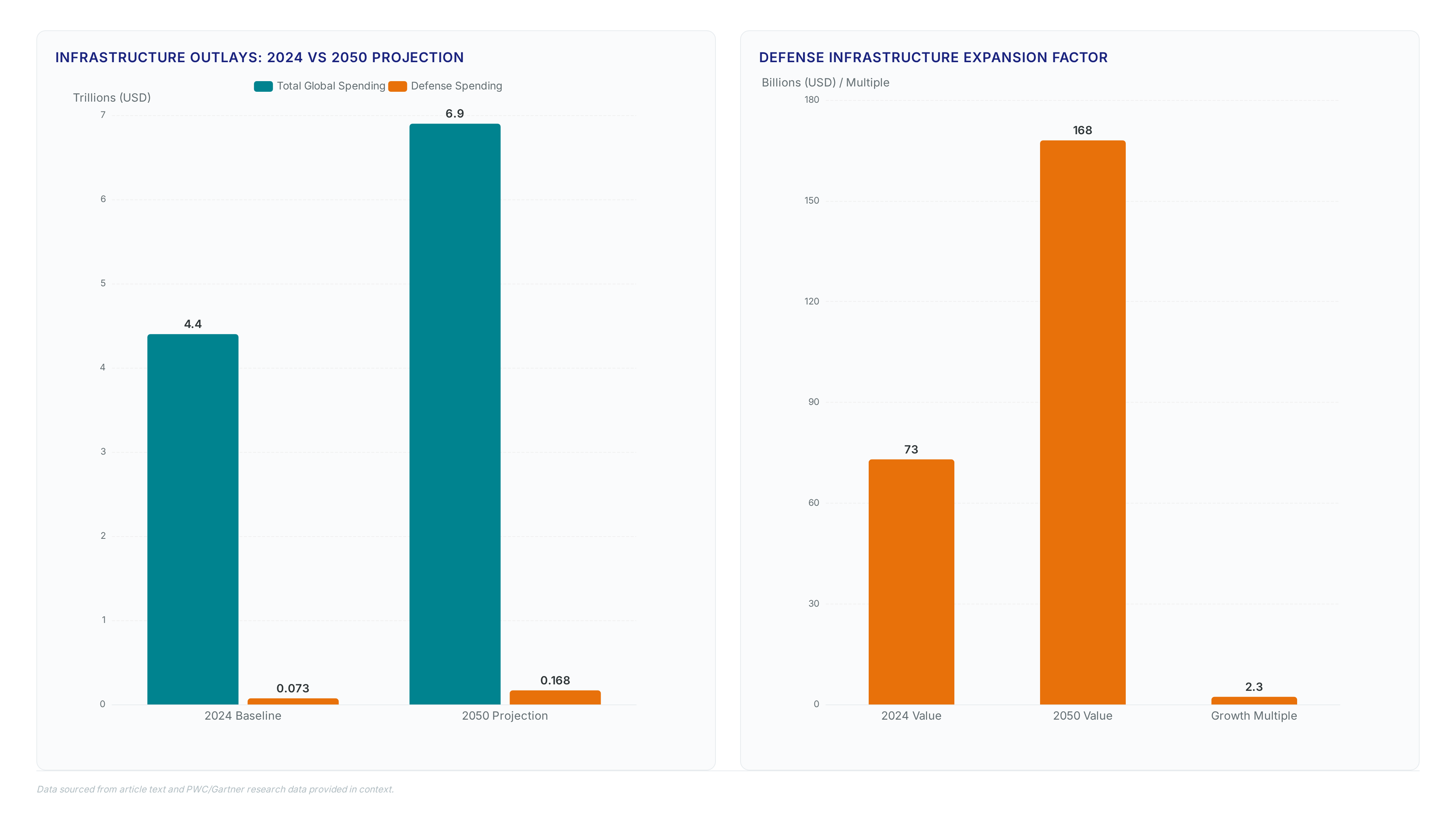
Migrating workloads from global clouds to sovereign infrastructure defines geopatriation, a move designed to reduce geopolitical exposure. This digital shift mirrors the physical hardening of assets where defense infrastructure acts as the main hedge against supply chain breaks. Total global infrastructure outlays are forecast to climb from US$4.4 trillion in 2024 to US$6.9 trillion annually by 2050. Defense installations form the fastest-expanding segment within this expansion because state-level risk assessments are intensifying. Annual expenditure on defense infrastructure is projected to reach US$168 billion in 2050, a figure that stands 2.3 times higher than the US$73 billion baseline recorded in 2024. Operators must view this capital reallocation as a source of persistent inflationary pressure rather than a temporary shock. Markets often misprice these long-duration liabilities by focusing on immediate output gaps while ignoring the multi-decade funding floor.
Hidden costs embedded in this transition include:
- Elevated materials pricing due to constrained supply chains.
- Increased insurance premiums for assets in contested zones.
- Higher cost of capital for projects lacking explicit sovereign guarantees.
- Operational friction from divergent data residency mandates.
- Delays in project timelines caused by regulatory divergence.
Fiscal dominance might cap spending according to some critics, yet the trajectory suggests otherwise. Current portfolio models fail because they do not account for the structural inflation inherent in duplicating supply chains for security. Ignoring the defense surge leaves portfolios exposed to a regime where geopolitical durability outweighs efficiency metrics. This expenditure growth alters the cost structure for financial institutions rapidly adopting these technologies. KPMG data indicates decision-making quality improves by 70% alongside a 64% gain in forecasting accuracy for adopters of agentic AI. These efficiency metrics suggest current market prices for infrastructure enablers fail to reflect operational.
Hidden costs distort initial return calculations for portfolio managers ignoring supply constraints:
- Rising storage prices dampen end-device demand, inflating the total cost of ownership.
- Geopolitical friction forces data migration to sovereign clouds, fracturing legacy efficiency models.
- Compliance overhead increases as nations enforce stricter data localization laws.
- Legacy system integration costs rise when bridging old and new sovereign networks.
Aggressive capital deployment invites bubble comparisons to previous tech cycles according to critics. The divergence between physical infrastructure spending and software valuation implies a structural repricing rather than speculative excess. Short-term margin compression from high capex conflicts with long-term dominance in a consolidated market. Ignoring the geopatriation trend risks mispricing assets exposed to global public cloud dependency. Portfolios weighted toward defense-hardened digital infrastructure capture the upside of this mandatory migration. Failure to adjust for these specific efficiency gains leaves capital exposed to obsolescence risk.
Federal Reserve Warnings on Oil Shocks and Private Credit Exposure
Geopolitical friction and energy volatility stand as primary stability threats in the view of the Federal Reserve, overshadowing secondary anxieties around private credit. Market pricing for an oil price forecast often ignores the asymmetric risk of supply chain rupture, assuming static flow rates despite active conflict zones. This miscalculation leaves portfolios exposed to sudden repricing events that standard models fail to capture. Maintaining liquidity while hedging against tail risks creates a critical tension for investors. Investors attempting to fix mispricing due to geopolitical assumptions frequently overlook how artificial intelligence adoption exacerbates energy demand, compounding supply shocks. Distorted asset valuations across infrastructure-heavy sectors manifest as the cost of this oversight.
Hidden costs undermine portfolios that neglect these interdependencies:
- Elevated borrowing costs from sustained inflation.
- Reduced capital availability for non-necessary projects.
- Accelerated depreciation of carbon-intensive assets.
- Stranded asset risks in regions with unstable energy grids.
- Higher volatility premiums demanded by bond markets.
The potential for a stock market correction remains the most severe consequence of unaddressed geopolitical exposure. Diversification arguments often fail because concentrated exposure to energy-sensitive debt instruments creates a fragile feedback loop. Geopolitical risks now dictate macro liquidity conditions more than traditional monetary levers according to operators. Ignoring this shift invites significant drawdowns when physical supply constraints collide with financial.
About
Vikram Nair, Emerging Markets & Asia FX Writer at ForexCFD. Top, brings critical perspective to the evolving Fed framework. While headlines focus on Warsh and potential rate hikes, Nair's daily analysis of emerging-market currencies reveals the downstream impact of these FOMC decisions. His expertise in pairs like USD/INR and USD/PHP allows him to trace how a hawkish Fed directly pressures local liquidity and broker funding rails across Asia and Africa. At ForexCFD. Top, an independent publication dedicated to factual central-bank coverage, Nair connects high-level policy shifts to tangible trading realities for retail investors. By monitoring how inflation mandates ripple through Tier-2 and Tier-3 economies, he provides the contextual depth necessary to understand why Fed framework overhauls create volatility far beyond US borders. This ground-level view ensures readers grasp the global stakes of monetary policy changes.
Conclusion
Liquidity abundance masks a fragile reality where physical supply constraints override monetary signaling. The divergence between projected rates and actual reserve costs creates a structural friction that standard hedging models fail to address, specifically when geopolitical events alter throughput. Investors relying on static volatility assumptions will face immediate margin pressure as energy demand from AI infrastructure collides with supply chain ruptures.
You must pivot from broad diversification to liquidity-specific stress testing immediately. Do not wait for the next geopolitical flashpoint to reveal your exposure to carbon-intensive debt instruments. By Q3 2026, any portfolio lacking explicit hedges against energy-driven rate spikes will suffer unacceptable drawdowns. The window to reposition before the next pricing dislocation is closing rapidly.
Start by auditing your fixed-income duration against scenarios where oil prices breach $130 per barrel this week. Identify which holdings lack pricing power in high-energy cost environments and reduce exposure to issuers with unrefinable short-term maturities. This specific adjustment protects capital when the cost of ambiguity finally manifests as realized loss.
This uncertainty exists despite CITIC Securities warning that political pressure may keep the Fed on hold all year.
Frequently Asked Questions
The median federal funds rate projection has climbed to 3.8% by the end of 2026. This represents a significant increase from the prior projection of 3.4%, defining the current hawkish pivot.
The FOMC maintains its ample-reserves stance with a massive balance sheet near $6.7 trillion. This high liquidity level remains constant even as geopolitical fragmentation dictates capital flows more than interest rates.
J.P. Morgan Global Research flags a 35% probability of recession driven by geopolitical tension. This risk persists even as the central bank prioritizes inflation mandates over growth in this fragmenting order.
Japan faces severe exposure due to its 94% dependence on Middle Eastern crude oil. This reliance makes the economy highly vulnerable to volatility vectors like the fragile peace resulting from the recent US-Iran MOU.
Analysts remain split on the Fed path, with December hike odds currently near 50%. This uncertainty exists despite CITIC Securities warning that political pressure may keep the Fed on hold all year.