
GBP/USD Technicals: Why Political Wins Feel Fragile
GBP/USD jumped 0.40% on Monday as Andy Burnham's fiscal pledge calmed markets.
Political stability, not fundamental economic shifts, drives the British Pound's recent durability. This creates a fragile bullish case. Andy Burnham secured a temporary reprieve by committing to Rachel Reeves' fiscal rules, yet the broader technical picture remains hostile. Traders face an environment where political reassurance clashes with bearish moving average resistance and looming macroeconomic data.
Market participants will soon test this optimism against hard data, specifically the upcoming Q1 2026 GDP print and US employment figures. The US Dollar Index shows cracks, dipping 0.20% to 101.15, yet GBP/USD struggles below the critical 1.3424 resistance cluster. A shifting FX procurement landscape looms; Gartner predicts that by 2028, AI agents will intermediated 90% of B2B buying, potentially destabilizing traditional execution models long before current political cycles resolve. (Gartner's strategic predictions for 2026)
This analysis dissects the disconnect between Burnham's political maneuvering and the harsh technical realities capping price action. We outline strategic approaches for navigating the volatility surrounding the Fed Chair's upcoming comments at the ECB Sintra Symposium and the delayed US jobs report.
Fiscal Discipline Drives GBP Strength Amid Market Uncertainty
Fiscal discipline binds government spending to revenue targets, directly calming market sentiment when public debt reaches a high level of GDP. This constraint limits sovereign borrowing, reducing the risk premium investors demand on Sterling assets. Andy Burnham's adherence to Rachel Reeves' rules signals a commitment to lowering the UK's net financial liabilities rather than expanding them through unfunded mandates. Political consistency stabilizes the currency by removing uncertainty regarding future inflation or default risks inherent in loose fiscal policies.
Broad dollar weakness provides the counter-weight via the DXY index, which tracks the US dollar's value against six substantial currencies. Federal Reserve technical specifications define these weights to reflect current trade flows across advanced and emerging economies. When the DXY falls 0.40%, it indicates broad dollar weakness that mechanically lifts the GBP/USD pair even without domestic UK catalysts. The Federal Reserve Board maintains these indexation standards, ensuring the benchmark reflects real-time economic shifts rather than static historical data.
Distinguish between political rhetoric and the mechanical reality of index rebalancing. A decline in the DXY often masks underlying volatility in individual currency pairs, creating false signals of strength. The Labour Party's fiscal rules provide the fundamental floor for Sterling, while the DXY trajectory sets the immediate ceiling for gains. Ignoring the indexation updates from the Federal Reserve leaves operators blind to the structural headwinds facing the greenback.
Burnham's No 10 North Pledge Impact on GBP/USD Rates
Fiscal credibility drove the GBP/USD pair from 1.3191 to 1.3244 after Andy Burnham confirmed plans to establish 'No 10 North' in Manchester. This specific commitment to regional rebalancing signaled strict adherence to Chancellor Rachel Reeves' fiscal rules, immediately calming market anxiety regarding unfunded spending. The Pound Sterling advanced 0.40% on Monday, 29 Jun 2026, as traders priced in the clarity that global FX volume reached trillions of dollars per day in April 2025 according to spending data.
Market reaction demonstrates how political clarity functions as a liquidity trigger during periods of macro uncertainty. By anchoring expectations to existing manifesto constraints, the announcement removed ambiguity surrounding the UK's debt trajectory. However, this strength relies entirely on sustained political discipline rather than fundamental economic shifts. The cost of such reliance is exposure to external shocks, particularly given that global FX volume reached a staggering amount per day in April 2025 according to recent reports.
Regional policy coordination introduces another variable for currency stability. While Shona Robison manages Scottish budget delivery, divergent regional fiscal priorities could strain the central narrative of unity. Operators must monitor whether localized spending pressures undermine the broader message of austerity. The limitation here is structural; political promises do not alter immediate balance sheet realities if GDP growth stalls. Traders now face a binary outcome where further gains require tangible economic data to support the political optimism currently priced into the exchange rate.
UK Cash Requirement Risks Versus Dollar Weakness
High central government net cash requirement creates immediate refinancing pressure that fiscal pledges alone cannot eliminate. The UK faced a substantial cash need in May 2026, forcing gilt issuance even as political rhetoric promises austerity. This structural deficit contradicts the narrative of pure stability, introducing a tension between short-term liquidity needs and long-term debt reduction goals.
Sustained GBP/USD gains depend heavily on the relative weakness of the counter-party rather than domestic strength. The Greenback recently lost ground, with the index falling to 101.15 amid shifting expectations around US inflation drivers like the 4.2% headline CPI recorded in May 2026. Traders monitoring the Federal Reserve Board releases note that dollar softness often masks underlying Sterling fragility. Historical volatility confirms this dependency, as the pair dropped from 1.34269 just weeks prior despite similar political posturing.
| Risk Factor | Impact Mechanism | Market Signal |
|---|---|---|
| Cash Requirement | Increases gilt supply | Higher yield spreads |
| Dollar Weakness | Lowers exchange baseline | Artificial GBP lift |
| Inflation Data | Dictates rate path | Volatility spikes |
Distinguish between genuine capital inflows and currency devaluation effects. Relying on Dollar weakness to mask high cash requirements leaves portfolios exposed to sudden reversals in US monetary policy.
Technical Indicators Signal Bearish Tone Below Moving Average Resistance
Defining the Bearish SMA Cluster Resistance at 1.3424
Current GBP/USD trading sits at 1.3249, pinned under a heavy resistance zone where the 50-, 100-, and 200-day simple moving averages converge near 1.3424. This specific alignment generates a flexible ceiling that intensifies selling pressure as market participants across multiple timeframes exit positions simultaneously. The mechanism depends on mathematical averaging of past closes; when short, medium, and long-term averages compress into one zone, they validate unified bearish sentiment among algorithmic traders using deep learning technologies to spot such congestion. Price action staying below this triple average confirms buyers lack the momentum needed to reverse the prevailing downtrend. Technical divergence appears stark when contrasting current spot levels against the bullish 1.47 projection some institutions model for late 2026 assuming US growth deceleration Morgan Stanley. The immediate constraint of this configuration is a capped upside, forcing range-bound strategies until a decisive break above 1.3424 occurs. Chart analysts must recognize that the Relative Strength Index reading of 41.9 supports this bearish structure by remaining under the neutral midline. A break above the cluster would invalidate the signal, yet current volume profiles suggest continued rejection at these averaged price points.
Applying RSI 41.9 and Trend Line Breaks to Identify Momentum
Subdued bullish momentum persists despite recent price advances because the RSI 14 reading of 41.9 sits below the neutral midline. This oscillator value indicates buyers lack the force required to breach the overhead supply zone immediately. A common error in chart analysis involves misreading the broken downward resistance at 1.3529 as immediate support rather than a distant ceiling. Price action remains trapped well below this level, invalidating any assumption of a completed trend reversal. Traders must distinguish between temporary relief rallies and structural breakouts when the spot price hovers near 1.3249. Institutional forecasts diverge sharply, with some projecting a path to 1.47 by year-end assuming US growth deceleration 1.47 Historical volatility suggests that without clearing the moving average cluster, the pair remains vulnerable to renewed selling pressure.
| Indicator | Current Status | Operational Implication |
|---|---|---|
| RSI (14) | 41.9 (Sub-bearish) | Rejects long entries below 50.0 |
| Trend Line | Broken at 1.3529 | Acts as hardened resistance |
| SMA Cluster | Overhead at 1.3424 | Defines the reversal trigger |
Premature positioning based on political headlines rather than technical confirmation poses the primary risk for operators. This macro backdrop complicates the technical picture, as currency strength often overrides local chart patterns. Traders should wait for a daily close above the 1.3424 resistance cluster before validating any bullish thesis. Failure to clear this zone leaves the GBP/USD exposed to a retest of lower supports near 1.3159.
Risks of Ignoring Structural Support Near the 1.3159 Trend Line Origin
Breaching the 1.3159 support level invalidates the current bullish thesis and exposes traders to accelerated downside volatility. Misreading this structural floor as a temporary dip rather than a critical trend-line origin creates significant technical vulnerability. Uncertainty surrounding delayed government appointments introduces political risk that algorithms may interpret as instability, triggering automated sell-offs below the pivot. Historical data indicates the pair previously traded higher near 1.34269 Institutional forecast divergence.
| Scenario | Trigger Condition | Consequence |
|---|---|---|
| Support Hold | Price rebounds above 1.3160 | Consolidation continues near moving averages |
| Structural Break | Close below 1.3159 | Accelerated decline toward liquidity vacuums |
Measurable loss of capital efficiency occurs as stop-loss orders cluster below the trend origin if this breakdown is ignored. Fiscal discipline pledges cannot offset technical damage if the upward trend line fails to hold against selling pressure.
Strategic Trading Approaches for Upcoming GDP and Fed Events
Defining the 30 Basis Point Fed Tightening Expectation

Money markets price 30 basis points of Federal Reserve tightening by late 2026, setting a volatility ceiling for GBP/USD positioning ahead of Kevin Warsh's Sintra appearance. This quantification suggests a shallow hiking cycle where the Federal Reserve prioritizes inflation targeting over aggressive rate hikes, a departure from historical tightening phases. Policy watchers must account for transaction costs that erode margins on small moves. The total direct fee for futures across the trade lifecycle sits at $6.47, while Contract for Difference trading averages $1.91 per execution. A shift in narrative renders the current currency volatility models obsolete instantly. Operators face a binary outcome: data either confirms the shallow path, sustaining the range, or a single hawkish deviation triggers rapid repricing. Ignoring the fee structure relative to expected move magnitude creates a negative expectancy trap for retail participants.
Applying GBP/USD 1.3191 Daily Low as an Entry Trigger
Execute a long position only after price action confirms a rejection of the 1.3191 daily low with a close above 1.3200 flat. This trigger captures immediate liquidity injection following Burnham's fiscal comments, distinguishing a genuine reversal from a transient spike. Algorithmic systems parse political speech to adjust country risk models, often amplifying volatility before human participants react to the ambiguous human knowledge embedded in the rhetoric. Overhead supply near the moving averages remains untouched, limiting upside potential. A premature entry below 1.3191 exposes capital to a deeper test of the 1.3159 structural support origin. Market participants seeking precision should reference official monthly average rates to contextualize current spot levels against tax-year baselines rather than intraday noise.
| Condition | Action | Target |
|---|---|---|
| Close > 1.3200 | Enter Long | 1.3244 |
| Break 50 | Hold | 1.3424 |
The Cable pair remains vulnerable to a failed breakout if US jobs data surprises to the upside.
Risks of Trading US GDP Data During Independence Day Closures
Holding positions through the US Independence Day closure exposes traders to gap risks when US Nonfarm Payrolls data releases while markets remain shut on Friday. Liquidity traps frequently form before the long weekend as spreads widen beyond typical ranges. Instrument choice dictates cost exposure here. Futures carry higher fixed lifecycle fees compared to the lower average direct fee found in CFD trading. Missing the ISM Manufacturing PMI print creates an information vacuum where pricing dislocations occur without immediate arbitrage correction. Traders focused on the total direct transaction fee for futures must weigh this against the danger of being unable to exit during the holiday-induced blackout. A sudden shift in jobs data sentiment while exchanges are closed forces a repricing at the next open, often bypassing stop-loss levels entirely. Structural gap risk overrides technical support or resistance logic derived from pre-holiday price action. Operators should reduce exposure size qualitatively rather than relying on tight stops that cannot execute during the closure. The inability to react to Thursday data releases until markets reopen represents a binary event risk distinct from standard volatility.
Risk Assessment of Volatility Around Q1 GDP and Political Appointments
Q1 2026 GDP Print Volatility Mechanics
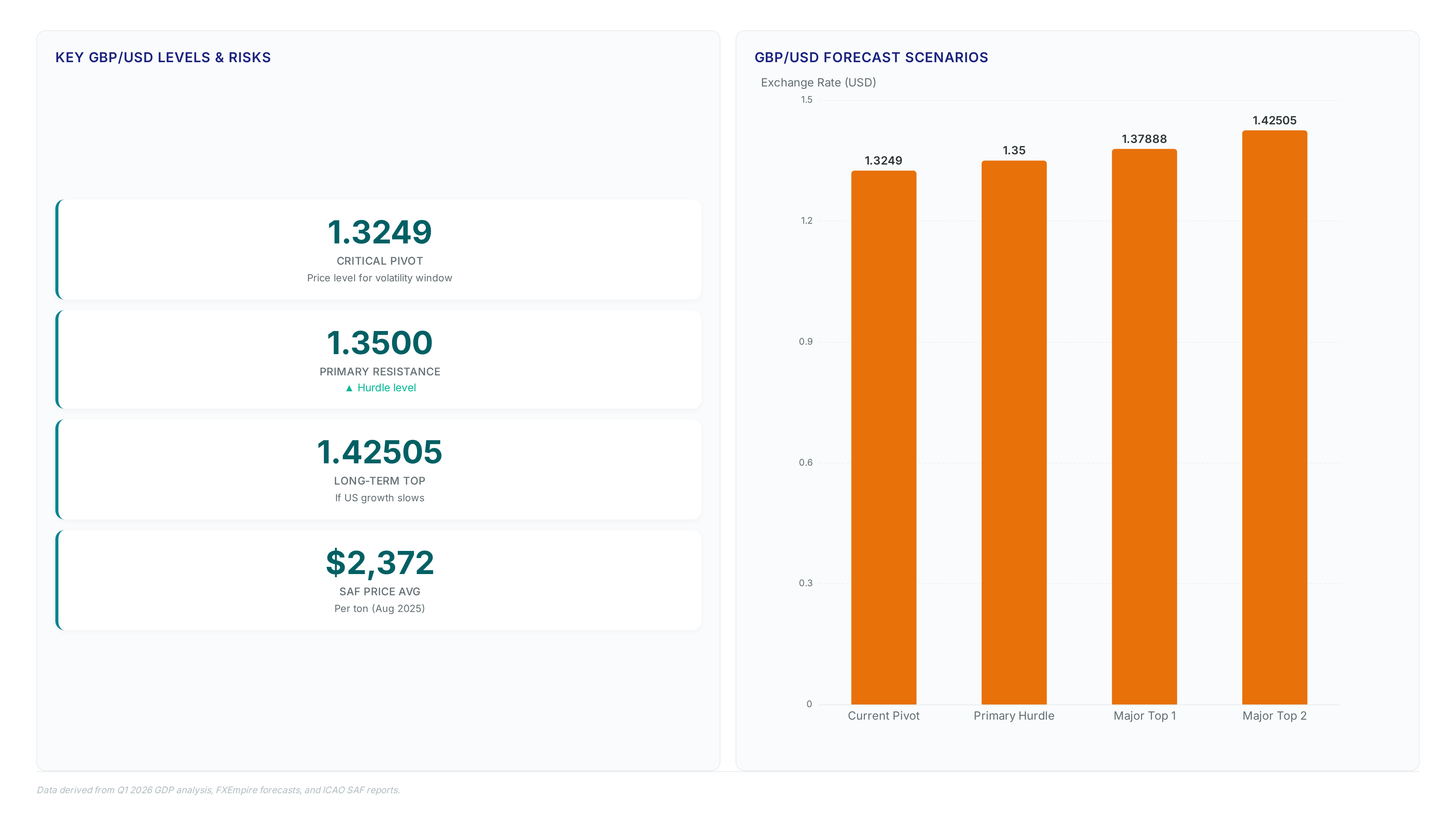
Market focus narrows to the Q1 2026 GDP release as a tight volatility window opens between Monday's quiet schedule and Thursday's Nonfarm Payrolls report. Liquidity evaporates quickly before the Friday Independence Day holiday, magnifying price swings around the 1.3249 pivot. Algorithms overreact to minor order flow imbalances when the GBP/USD. Traders encounter hidden costs including widened spreads during the Thursday/Friday transition. Gap risk emerges if US data deviates from consensus while UK markets sleep. Use decay accelerates when holding positions through the holiday void. Political noise from 'No 10 North' distracts some observers, yet fiscal discipline remains the primary anchor for sterling sentiment. The absence of Monday data creates an information vacuum that heightens sensitivity to Thursday's releases. Volatility ceilings depend entirely on whether the GDP print breaks the current consolidation range. Forecast models suggest potential challenges to substantial tops if US growth slows, but immediate resistance remains formidable. Holding through the holiday invites gap risk, while flattening positions sacrifices potential breakout gains. Prudent management requires reducing exposure before the Thursday data dump to avoid being trapped by Friday's illiquidity.
Risks: Trading Liquidity Gaps During US Independence Day
Cmegroup. Html). Wiley.com/doi/full/10.1002/tie. 22369) embedded in fiscal announcements. Automated reactions accelerate price moves into thin order books. A single connectivity failure during these windows can cost millions per hour, a reality highlighted by enterprise reliance on mission-critical internet outage protections for FX platforms. Specific hidden costs emerge during this convergence of holiday thinning and data releases:
- Spreads expand disproportionately on the Thursday/Friday transition.
- Gap risk materializes if US data prints while domestic books are closed.
- Slippage increases as market makers withdraw ahead of the holiday.
- Financing costs rise as use ratios tighten overnight.
Technical resistance near moving averages compounds these liquidity issues. The GDP print looming over Thursday's session forces a choice between holding risk or accepting certain exit costs. Coverage Pillars recommends reducing position sizes by half when trading into a holiday weekend with pending high-impact data. Tension exists between maintaining fiscal rules set by Reeves and managing the substantial liability burden inherited from the Labour government. Should political will fracture, the US Dollar weakness currently supporting GBP momentum could reverse violently as traders price in sovereign risk premiums rather than growth differentials. Failed adherence manifests through specific liquidity channels:
- Widening gilt spreads increase borrowing costs for regional projects like 'No 10 North'.
- Currency volatility spikes as algorithms detect divergence between rhetoric and bond market signals.
- Capital flight accelerates toward safe-haven assets if the Finance Minister loses credibility.
- Yield curve steepening raises refinancing pressures across short-term instruments.
Manifesto pledges lack statutory force until budget legislation passes parliament. This legal gap creates a window where sentiment drives price action more than fundamentals. GBP/USD gains resting solely on political reassurance remain fragile against hard data misses. Position sizing must account for abrupt reversals if upcoming GDP figures contradict the narrative of stability. Reliance on verbal commitments without legislative backing exposes portfolios to asymmetric downside risk.
About
Marcus Halloran, Chief Market Strategist at ForexCFD. Top, brings deep interbank experience to his analysis of the GBP/USD rally. Having previously served as an interbank FX strategist in London, Halloran specializes in decoding how UK political developments and fiscal pledges impact currency valuations. His daily work involves translating complex central bank dynamics and macroeconomic shifts into clear directional calls for retail traders. This specific expertise is critical when analyzing reactions to figures like Andy Burnham, whose commitment to fiscal rules directly influences Sterling's performance against the US Dollar. At ForexCFD. Top, an independent publication dedicated to unbiased market news, Halloran uses his background in G10 majors to explain why market sentiment shifted following Burnham's speech. His insights connect high-level political stability with tangible price action, helping traders navigate volatility in substantial pairs like Cable without the hype often found in commercial broker research.
Conclusion
Liquidity fractures when political narratives collide with hard data gaps, specifically as algorithmic execution speeds outpace legislative ratification. The real operational cost here slippage, but the asymmetric capital erosion that occurs when sentiment-driven rallies reverse instantly upon GDP misses. As we approach 2028, AI agent-intermediated trading will dominate B2B exchanges, rendering manual reaction times to political rhetoric obsolete and punishing those holding fragile positions based on verbal commitments.
Traders must shift from reactive hedging to structural position limits immediately. Do not wait for the next holiday weekend or GDP print to adjust exposure; the window for manual mitigation closes as AI agents begin pricing sovereign risk premiums in milliseconds. If your strategy relies on the continuity of current fiscal promises without statutory backing, you are effectively betting against automated market surveillance that detects divergence quicker than any human can parse a headline.
Start by auditing your current GBP/USD use ratios against a hypothetical modest yield spike in gilts before Friday's close. Reduce any exposure that cannot withstand this specific refinancing shock without triggering a margin call. This mechanical stress test forces a realistic assessment of portfolio durability against the coming wave of agent-driven volatility, ensuring capital survival rather than speculative hope.
Frequently Asked Questions
The Pound Sterling advanced 0.40% following the political announcement. This gain occurred as global FX volume reached $9.6 trillion daily, reflecting heightened liquidity during the market's reaction to the new fiscal clarity.
Broad dollar weakness of 0.20% mechanically lifts the currency pair. This decline in the US Dollar Index offsets domestic uncertainties while global FX volume hits $9.6 trillion, providing ample liquidity for the upward price movement.
Price action stays capped below the moving average cluster resistance. Although political news drove a 0.40% spike, the pair remains under pressure with global FX volume at $9.6 trillion, indicating heavy trading activity near resistance.
Public debt reaching 84.7% of GDP increases the risk premium demanded. Fiscal discipline aims to stabilize this metric, even as daily global FX volume reaches $9.6 trillion, showing massive capital flow sensitivity to such sovereign debt levels.
The pair dropped to a daily low of 1.3191 before rebounding. This recovery of 0.40% happened amidst $9.6 trillion in daily global FX volume, demonstrating how quickly liquidity can return following clear political fiscal commitments.