
Inflation's New Reality: Why UK Rates Stay High
Structural changes have made UK inflation more persistent, complicating the return to the Bank of England's 2% target.
Brexit-induced frictions have fundamentally altered the economy, creating self-sustaining pricing momentum that standard demand management cannot easily fix. In Tashkent, Huw Pill, Chief Economist at the Bank of England, stated explicitly that policymakers are still digesting how these shifts in labor and goods markets drive inflation dynamics. This is not a temporary shock but a structural reality where supply constraints limit the efficacy of traditional tools.
The distinction between cyclical shocks and deep-rooted inflation persistence defines the current economic landscape. Brexit has cemented higher trade frictions and reduced labor flexibility, forcing a reevaluation of monetary strategy. Consequently, restrictive monetary policy remains necessary despite its limited ability to solve supply-side bottlenecks. Recent Danske Bank Research updates highlight how the interplay between resilient labor markets and persistent underlying inflation keeps this issue central to global FX Forecast discussions. Structural supply constraints now dictate a harder path forward for UK economic stability.
The Distinction Between Cyclical Shocks and Structural Inflation Persistence
Defining Self-Sustaining Pricing Momentum and Sticky Core Inflation
Past price increases now mechanically drive future costs, creating a feedback loop independent of initial shocks. This is self-sustaining pricing momentum. Huw Pill identifies this flexible as the result of structural changes within UK labor and goods markets that have fundamentally altered inflation dynamics. Unlike temporary cyclical spikes, the economy has become increasingly prone to internalizing price rises.
Core measures reveal underlying pressure that refuses to dissipate even when headline rates fluctuate with energy volatility. Data indicates a 1.2 per cent rise in retail volume suggests demand durability despite high borrowing costs, reinforcing the stickiness of domestic prices. Market participants watch the 1.3250 GBP/USD level as a signal that currency valuation now prices political risk over traditional differentials.
Monetary policy tools primarily address demand rather than these entrenched supply-side constraints. If structural frictions like reduced labor mobility persist, standard tightening measures may fail to restore the 2% target without severe output loss. Central banks cannot easily unwind supply chain reconfiguration through interest rate adjustments alone. The Bank of England must maintain a restrictive stance longer than historical cycles suggest to prevent temporary momentum from becoming permanent.
Assessing Real Cost of Living via Retail Sales Volume Growth
Retail sales volume growth serves as the primary gauge for distinguishing cyclical demand shocks from structural inflation persistence. Analysts monitor this metric to determine if high borrowing costs effectively suppress consumption or if self-sustaining pricing momentum dominates household behavior. Recent observations indicate a 1.2 per cent increase in volumes, suggesting that aggregate demand has not collapsed despite restrictive financial conditions. Consumers are absorbing higher prices rather than reducing quantity, a hallmark of entrenched inflation dynamics.
Policymakers are currently assessing how shifts in labor and goods markets have altered the country's inflation dynamics, moving beyond temporary energy shocks. The persistence of spending at these levels validates the view that structural frictions, such as reduced labor mobility, prevent rapid disinflation.
Relying on volume data carries execution risk. A breach of the 1.3250 GBP/USD level critical technical signal could import further cost pressures, invalidating the assumption that domestic demand alone drives pricing power. Currency depreciation accelerates the real cost of living crisis independently of local wage growth if it occurs. Such a scenario forces a more aggressive policy response than volume data initially suggests.
Risk of Political Risk Premiums Distorting Currency Valuation Signals
The breach of 1.3250 GBP/USD serves as a critical technical signal that political risk premiums now dominate traditional interest rate differentials. Market participants increasingly price currency valuation based on geopolitical stability rather than pure yield spreads, creating a distortion where inflation dynamics appear more severe than domestic data suggests. This shift complicates efforts to assess whether price pressures remain cyclical or have become structural, as exchange rate pass-through effects increases imported costs independently of local demand.
Resulting volatility masks the true severity of underlying inflation persistence. The Bank of England might maintain restrictive stances longer than necessary to anchor expectations because of this noise.
- Investors must distinguish between transient political spikes and enduring economic shifts.
- Avoid overestimating the need for aggressive rate hikes based on currency noise.
- Structural labor constraints require different policy tools than demand suppression.
- Supply chain reconfiguration proceeds regardless of interest rate adjustments.
ActionForex notes that distinguishing these factors prevents policy errors during periods of high uncertainty.
Brexit-Induced Frictions Driving Self-Sustaining Pricing Momentum in the UK
Brexit-Driven Labor and Goods Market Frictions
Reduced labor mobility and elevated trade barriers function as the specific structural mechanisms driving persistent pricing momentum. Huw Pill, speaking in Tashkent, Uzbekistan, identified these Brexit-induced frictions as primary catalysts rendering the economy prone to self-sustaining inflation, specifically citing changes brought about by Brexit as an example of these structural shifts. The mechanism operates through supply-side constraints that limit the ability of firms to absorb cost shocks without passing them to consumers. Unlike cyclical demand spikes, these structural shifts reduce the elasticity of both labor supply and goods distribution networks. However, monetary policy tools primarily address demand, leaving supply-side structural deficits unaddressed by rate adjustments alone. This creates a tension where restrictive policy must remain in place longer to compensate for the lack of supply-side flexibility. The implication for market strategists is that inflation data will exhibit slower mean reversion following external shocks. A significant relaxation of trade barriers or a restoration of labor fluidity would be required to flip this structural view, yet current policy trajectories suggest no such near-term relief.
Transmission of Supply Constraints to Sticky Services Pricing
Structural changes in labor and goods markets have increased inflation persistence, making the economy more prone to self-sustaining momentum in pricing. When structural frictions limit the available workforce and goods distribution, the economy's underlying inflation mechanism alters. This supply rigidity means that while monetary policy can restrain demand, it has limited ability to address these structural supply constraints. Consequently, standard monetary tightening faces challenges because the root cause involves entrenched supply-side factors rather than excess demand alone.
The transmission of these constraints suggests a distinct flexible:
- Structural changes to labor and goods markets create persistent bottlenecks.
- Policymakers are still assessing how these shifts alter inflation dynamics.
- Inflation may fade more slowly following future supply shocks if constraints become entrenched.
- Consumers face elevated prices as the economy adjusts to reduced labor mobility and higher trade frictions.
| Constraint Type | Policy Sensitivity | Inflation Outcome |
|---|---|---|
| Demand Shock | High responsiveness | Temporary spike |
| Supply Constraint | Low responsiveness | Persistent momentum |
Policymakers are still digesting how these Brexit-induced changes alter the efficacy of rate decisions. The critical insight often overlooked is that aggressive hiking in this environment carries risks, as structural factors may continue to require a restrictive policy stance even as cyclical inflation pressures gradually ease. If the central bank suppresses demand too sharply while supply remains fixed, the path to price stability becomes more complex. This flexible renders inflation less responsive to policy levers that historically managed cyclical fluctuations. Markets must recognize that self-sustaining pricing momentum requires supply-side solutions alongside monetary restraint. Ignoring the structural nature of these frictions leads to premature easing expectations. The economy remains vulnerable to fresh shocks while operating below potential capacity. Only restored labor flow can normalize the pricing mechanism.
Complications for Restoring Inflation to Target Levels
Structural rigidities now prevent standard demand cooling from restoring price stability efficiently. Senior Bank of England officials confirm that deep-seated economic shifts have fundamentally complicated the restoration of sustainable inflation targets. Governor Andrew Bailey has acknowledged these consequences, arguing that closer ties with the European Union remain necessary to mitigate friction. The mechanism operates through reduced labor mobility and trade barriers that sustain pricing momentum regardless of monetary tightening. Unlike cyclical shocks, these supply-side constraints limit the central bank's ability to lower inflation without severe output costs.
| Constraint Type | Impact on Inflation | Policy Limitation |
|---|---|---|
| Labor Mobility | Sustains wage pressure | Rate hikes cannot create workers |
| Trade Barriers | Elevates import costs | Tightening worsens supply bottlenecks |
The cost of this environment is a prolonged period of restrictive policy even as growth stalls. Markets currently price a potential reduction in the bank rate to 3.50% by year end, yet structural persistence suggests such easing could reignite expectations prematurely. The limitation is clear: monetary tools address demand, not the fractured supply chains driving current prices. A failure to recognize this distinction risks embedding high inflation permanently. The view flips only if data shows labor market fluidity returning or trade frictions ease significantly. Until then, the path to the target remains obstructed by non-monetary forces.
The Necessity of Restrictive Monetary Policy Amidst Structural Supply Constraints
Defining Structural Supply Constraints and Monetary Policy Limits
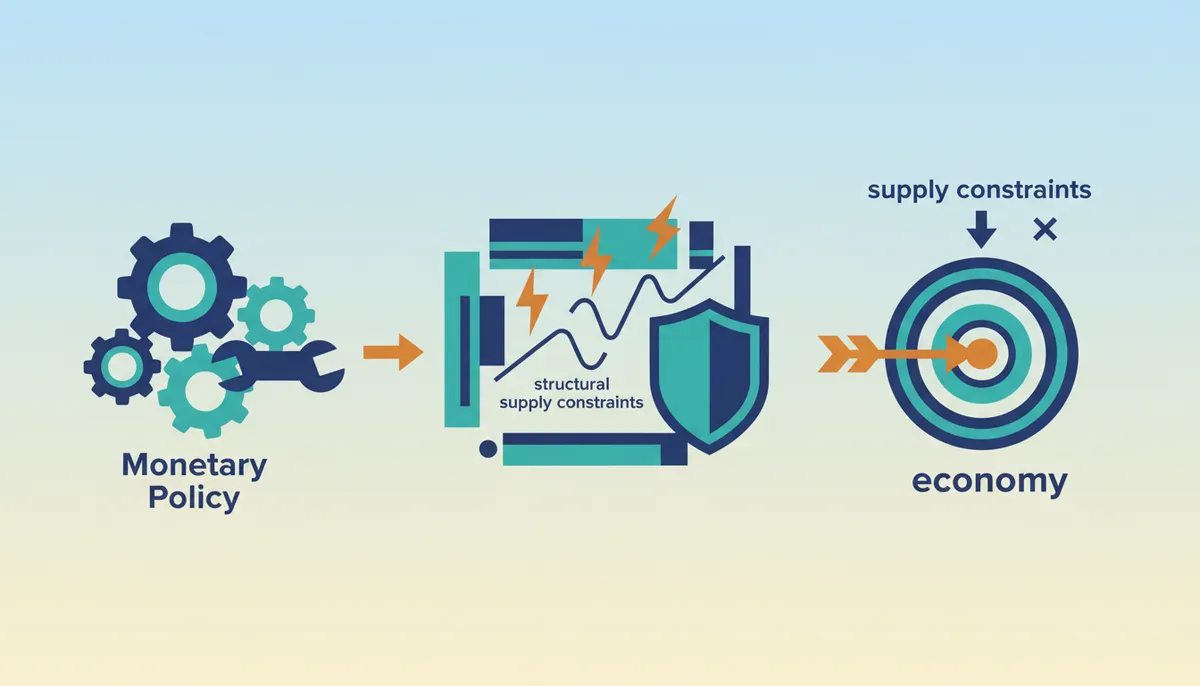
Hard capacity ceilings define the operating range for modern UK monetary policy because interest rate simply cannot lower them. Deep-seated issues like reduced labor mobility and higher trade frictions limit the economy's ability to expand output regardless of borrowing costs. When such constraints become entrenched, the mechanism for price stabilization shifts fundamentally away from standard cyclical models. Future supply shocks will see inflation fade more slowly because the underlying supply curve remains inelastic. This reality forces a divergence between cyclical cooling and structural stagnation. Standard restrictive tools yield diminishing returns on supply-side bottlenecks. The cost of this flexible is a prolonged period of elevated rates to anchor expectations rather than stimulate growth. Policy errors could cement self-sustaining pricing momentum if the Bank misidentifies these structural limits as temporary. Monetary policy can restrain demand but cannot manufacture labor flexibility or remove border frictions. The path to price stability requires accepting slower disinflation while supply-side adjustments gradually take effect. Structural changes to the UK economy have complicated the task of restoring inflation sustainably to target. This complexity reinforces a cautious policy stance across the committee.
Applying Restrictive Stance to Counteract Self-Sustaining Pricing Momentum
Sterling trades near recent levels as markets price a prolonged restrictive stance to suppress self-sustaining momentum in services. Aggressive demand restraint prevents these supply-side scars from permanently elevating the inflation floor despite the inability to repair reduced labor mobility directly. The central bank faces a challenging environment where inflation is becoming less responsive to tighter financial conditions following pandemic disruptions and energy shocks. Huw Pill indicates that structural factors may necessitate this tight stance even as cyclical pressures fade. The cost of capital must remain punitive to offset supply constraints. Tightening financial conditions today addresses tomorrow's price spirals rather than yesterday's shocks.
Risk of Persistent Services Inflation Under Entrenched Supply Frictions
Services inflation remains sticky because structural barriers prevent the Bank from repairing supply chains through interest rate adjustments alone. Self-sustaining momentum in pricing emerges when reduced labor mobility and trade frictions become permanent features rather than temporary shocks. Pill warns that policymakers are still digesting how these entrenched constraints alter the transmission mechanism of monetary policy. Misidentifying this structural persistence as cyclical weakness creates danger. Premature easing allows inflation expectations to unmoor. Inflation may fade more slowly following future supply shocks if structural factors dominate. A prolonged restrictive stance becomes necessary even as headline figures cool. Maintaining restrictive policy is necessary to crush pricing power. Doing so risks unnecessary pain if the supply side remains unresponsive. Markets must monitor whether future data reflects genuine cooling or merely a pause in entrenched supply frictions. A failure to distinguish between these regimes could validate fears that inflation is becoming less responsive to tighter financial conditions. Senior officials continue to emphasize that structural changes to labor and goods markets have increased inflation persistence. This reality necessitates a cautious approach to policy normalization.
Strategic Risks of Premature Policy Easing in a Structurally Changed Economy
Defining Premature Policy Easing Risks in a Structurally Changed Economy

Lowering interest rates before structural inflation pressures dissipate constitutes premature policy easing. Brexit-driven frictions represent exactly the kind of supply-side rigidity that monetary tools cannot repair. Temporary price spikes harden into self-sustaining momentum within the pricing mechanism when policymakers act too quickly. Cyclical shocks fade as demand cools, yet structural constraints persist because central banks lack the power to fix reduced labor mobility.
- Delayed correction forces a more severe economic contraction later to restore price stability.
- Credibility erosion increases the cost of future restrictive policy interventions.
- Wage-price spirals become embedded in long-term contracts.
- Market expectations decouple from official targets permanently.
Huw Pill observes that the economy remains prone to this pricing persistence, implying that cyclical inflation relief does not guarantee a return to target. Governor Andrew Bailey has similarly highlighted how structural changes complicate the path to stable prices. The danger extends beyond keeping rates higher for longer; it necessitates maintaining a restrictive stance even as headline metrics improve. Misidentifying the source of price pressure leads policymakers to halt tightening too early. This error leaves the underlying inflation mechanism intact, requiring even more aggressive action subsequently to re-anchor expectations. The Bank of England must therefore distinguish between fading cyclical energy shocks and enduring labor market tightness. Failure to maintain this distinction invites a scenario where inflation becomes unmoored from fundamentals. Structural shifts demand a higher-for-longer rate environment to prevent a second wave of price increases.
Risks: Applying Restrictive Stance to Counteract Self-Sustaining Pricing Momentum
Bank rate stability at 3.75% anchors the immediate defense against self-sustaining pricing momentum. This hard line addresses the core problem where persistent services inflation refuses to fade despite broader cooling. Unlike cyclical spikes, this momentum stems from structural rigidities in labor and goods markets that demand-side tools cannot fix. Supply constraints require time to resolve, and impatience here creates future volatility.
The hidden costs of maintaining this restrictive stance include:
- Delayed investment cycles due to elevated borrowing expenses.
- Increased sensitivity to external shocks from the US Federal Reserve.
- Potential erosion of growth if supply constraints deepen unexpectedly.
- Reduced fiscal space for government spending initiatives.
- Higher debt servicing costs across the private sector.
Critics argue that tightening further risks unnecessary recession when cyclical pressures are already easing. However, ActionForex reporting confirms that policymakers view structural changes as a distinct mechanism requiring prolonged restraint. Ignoring this distinction allows temporary price spikes to harden into permanent wage-price spirals. The Bank of England faces a tension between supporting growth and preventing expectations from decoupling entirely from targets. Premature easing invites a more severe corrective contraction later. The data sets the bias; the chart sets the entry. A definitive flip in this view requires evidence that labor mobility has improved or that trade frictions have materially decreased. Until then, the restriction remains the only viable tool to manage the inflation flexible.
Misidentifying structural inflation as cyclical invites premature easing that cements inflation expectations above target. Markets have focused on whether pricing behavior is becoming less responsive to tighter financial conditions following pandemic disruptions and energy shocks. This disconnect creates a dangerous feedback loop where temporary relief in headline data masks underlying momentum in the pricing mechanism. Firms facing permanent costs will simply raise prices again if they believe the central bank will pivot early.
The specific danger lies in the lag between policy action and structural reality. If the Bank reduces rates believing supply frictions are transient, firms facing permanent Brexit-induced costs will simply raise prices again. This flexible forces a choice between accepting higher inflation or inducing a deeper recession later to re-anchor sentiment. Trust takes years to build and moments to lose.
Hidden costs of this policy error include:
- Decoupling of long-term expectation metrics from the 2.0% objective.
- Loss of central bank credibility requiring disproportionately harsh future tightening.
- Persistent services inflation resisting standard demand-side cooling measures.
- Entrenchment of adaptive expectations in wage bargaining.
- Reduced effectiveness of forward guidance tools.
Critics argue that maintaining restrictive stances stifles growth unnecessarily, yet the alternative risks a wage-price spiral that monetary tools cannot easily reverse. The structural shift implies that self-sustaining momentum now dominates traditional cyclical signals. OANDA analysis highlights the global desync, noting the Federal Reserve expects only limited cuts in 2026 amidst sticky inflation. Premature pivot fails because it treats a supply-side constraint with demand-side stimulus. The view flips only if labor mobility restrictions ease or trade frictions with the European Union demonstrably decline. Patience remains the primary requirement for navigating this altered environment.
About
Marcus Halloran, Chief Market Strategist at ForexCFD.top, brings critical interbank experience to the analysis of UK inflation dynamics. Having previously served as an FX strategist on a London dealing desk, Halloran possesses deep, practical expertise in interpreting Bank of England policy shifts and their immediate impact on GBP/USD volatility. His daily work involves dissecting structural economic changes, such as those highlighted by Chief Economist Huw Pill, to forecast how persistent inflation alters interest-rate differentials. This background allows him to translate complex macroeconomic data into actionable insights for retail traders navigating volatile currency markets. His analysis bridges the gap between high-level monetary policy and practical trading strategy, ensuring readers understand the real-world implications of structural economic shifts.
Conclusion
Scaling restrictive policy reveals a brutal truth: monetary tools cannot fix supply-side fractures caused by Brexit or trade barriers. The operational cost of this mismatch slower growth, but the very real risk that long-term expectation metrics permanently decouple from the 2.0% objective. If the Bank misreads temporary headline relief as structural victory and cuts rates to 3.50% prematurely, firms facing entrenched costs will simply re-price, forcing a far more damaging correction later. Credibility, once fractured, demands disproportionately harsh measures to rebuild.
Market participants must treat the key GBP/USD level as a critical defense line for sterling, reflecting anxiety over prolonged restrictiveness versus premature easing. Do not assume a soft landing is guaranteed while services inflation remains sticky. The strategic imperative is clear: maintain the 3.75% anchor until there is irrefutable evidence that pricing power has broken, even if this delays recovery. Investors should verify current inflation report data against wage settlement trends before adjusting portfolio duration. Start by auditing your exposure to rate-sensitive assets this week, specifically stress-testing portfolios against a scenario where the central bank holds rates higher for longer than current forecasts suggest.
Frequently Asked Questions
Supply constraints limit how much demand tools can lower prices effectively. Structural frictions mean hitting the 2% goal could cause severe output loss without solving root causes.
Reduced labor mobility and trade frictions create self-sustaining price increases. These structural shifts make the economy prone to momentum that standard policy cannot easily reverse.
A falling pound imports higher costs, worsening the real cost of living crisis. This dynamic forces policymakers to maintain restrictive stances longer than usual cycles suggest.
Underlying inflation persistence requires keeping the bank rate at 3.75% to anchor expectations. Premature easing risks letting temporary momentum become permanent in the economy.
Current price rises are driven by structural supply issues rather than temporary demand spikes. This makes inflation harder to reverse using traditional monetary tightening measures alone.
References