
Swapfree trading rules: Avoid overnight interest
Overnight interest charges vanish in swap-free Islamic accounts designed for Sharia compliance. These structures replace prohibited riba with administrative fees or grace periods to ensure ethical trading. Exness automates this status for specific regions, while other brokers demand manual conversion. The analysis below dissects the fee models substituting standard swaps and compares execution quality across firms like FP Markets and IC Markets.
Standard forex trading triggers a swap fee when positions roll over daily, charging interest based on currency differentials. Dan Blystone notes that FXEmpire verified account availability and measured financing fees to identify the best options for 2026. FP Markets offers access to 10,180 tradable instruments while maintaining regulation by ASIC and CySEC. IC Markets provides tight spreads across 2000+ instruments without financing fees on many assets for compliant users.
Regional policies vary significantly regarding documentation and automatic eligibility. Exness automatically grants swap-free status to accounts registered from Islamic countries without requiring extra paperwork. This coverage extends to Forex pairs, metals, energies, indices, and cryptocurrencies. Traders must understand these distinctions to avoid accidental violations of Islamic law while managing overnight risk effectively.
The Role of Swap-Free Structures in Sharia-Compliant Finance
Defining Riba Prohibition and Swap-Free Mechanics
Charging or receiving interest violates riba, the core prohibition under Islamic law that standard overnight positions typically incur via swap fees based on interbank rates. Swap-free trading removes these interest components entirely. Instead of accruing interest, brokers apply a transparent administration fee or apply grace periods to maintain account viability without violating Sharia principles. The market environment shows a critical shift towards identifying genuinely compliant structures that avoid hidden interest charges disguised as swap-free labels.
Some providers debit an administration fee on positions held overnight but waive this cost if the duration remains under a specific threshold. This approach aligns with the prohibition on time-based money growth by limiting fee accumulation. While some brokers automatically grant swap-free status based on registration location, others require manual conversion or documentation. The core distinction lies in replacing speculative interest with fixed, known costs that do not compound over time. Understanding the precise definition of riba in finance allows operators to distinguish between legitimate hedging tools and prohibited gambling mechanisms. Compliance requires name; it demands structural integrity in how overnight costs are calculated and applied.
Applying Use Limits in USDT and Fiat Accounts
Use represents borrowed capital that magnifies both potential profits and losses on margin positions. Regulatory frameworks dictate maximum exposure, creating distinct operational environments for fiat and crypto-native accounts. FP Markets illustrates this variance by offering maximum use of 1:1000 under FSA Seychelles, 1:400 under CMA Kenya, 1:200 under SCB Bahamas, and 1:30 under ASIC and CySEC regulations. This tiered structure ensures compliance with local financial laws while providing flexibility for international traders.
Conversely, crypto-denominated structures apply stablecoins to bypass traditional banking constraints while enforcing strict risk controls. Certain providers offer fixed use up to 500:1 on Forex within Tether (USDT) accounts but restrict substantial cryptocurrencies to lower ratios. These specific caps differentiate digital asset exposure from traditional forex instruments within Islamic account structures. The administration fee model often replaces overnight interest charges in these specific configurations to maintain Sharia compliance.
| Account Type | Max FX Use | Crypto Cap | Regulatory Framework |
|---|---|---|---|
| Global Fiat | 1:1000 | Varies | FSA Seychelles |
| Strict Fiat | 1:30 | Varies | ASIC / CySEC |
| USDT Native | 500:1 | Varies | Offshore / Crypto |
Beginners asking what does use mean must understand that higher ratios increase both potential returns and potential losses. Identifying the best broker for beginner Muslim traders requires matching these technical limits to personal risk tolerance rather than seeking maximum power. Different brokers apply varying use restrictions based on account balance and net exposure; for instance, some reduce use on large net exposures exceeding specific lot sizes.
Risk of Hidden Costs in Admin Fee Structures
Administration fees replace prohibited interest but often mask similar economic costs through opaque pricing models. These charges usually replace overnight swap calculations with a flat rate, which varies significantly by the instrument you are holding. Brokers are increasingly replacing traditional swap charges with transparent administrative fees or slightly widened spreads to maintain compliance while managing operational expenses.
Fee transparency clashes with execution quality; some providers widen spreads indefinitely rather than applying a fixed nightly charge. This structure means the cost of holding a position may be embedded in the entry price, differing from explicit fee schedules where costs are disclosed per lot after a grace period. For instance, while some firms charge a disclosed amount per lot after a grace period, others bake the cost into the pip value from the first second. The environment shows a shift towards identifying genuinely Shariah-compliant accounts that avoid these hidden interest charges disguised as swap-free labels. The principle of Taqabud requires immediate transfer of ownership to distinguish permissible trading from gambling-like speculation. Traders must scrutinize whether the fee is a genuine service charge for credit risk or a disguised interest mechanism. Alternative charges in swap-free accounts can change arbitrarily, impacting long-term trading strategies if not monitored closely.
Inside the Mechanics of Overnight Positions and Fee Models
Standard vs Raw Spread Fee Architectures in Islamic Accounts
The defining structural difference lies in whether the broker replaces overnight interest with an explicit administration fee or embeds the cost within the spread. In a Standard account, the spread is typically wider to cover operational costs, whereas the Raw spread model offers tighter pricing but charges a commission per trade.
FP Markets illustrates this duality by offering both Islamic Standard and Islamic Raw structures, with financing fees applicable from the 11th night. Conversely, some brokers automatically grant swap-free status to accounts from specific regions, removing the need for manual documentation often required elsewhere. Exness automatically grants swap-free status to accounts registered from Islamic countries, covering Forex pairs, metals, energies, indices, and cryptocurrencies.
| Feature | Standard Architecture | Raw Spread Architecture |
|---|---|---|
| Primary Cost | Widened Spread | Commission + Tight Spread |
| Fee Trigger | After grace period | Immediate or post-grace |
| Transparency | Embedded in price | Explicit line item |
| Best Use Case | Low frequency trading | High frequency scalping |
However, a critical limitation emerges: holding positions beyond the grace period on a Standard account can incur fees, eroding profits on stagnant pairs. Long-term holders benefit from the predictability of fixed admin fees, while short-term scalpers prefer the raw model despite the immediate commission drag.
Brokers are increasingly replacing opaque swap charges with these transparent administrative fees to maintain Shariah compliance while managing liquidity risks. The view flips if regulatory bodies reclassify these fixed fees as disguised interest, forcing a return to strict spot-settlement models only.
*Disclaimer: CFDs are complex instruments. ForexCFD.top is an educational resource. Affiliate relationships exist. Check local regulations (e.g. SEBI/RBI) before trading.*
Executing Overnight Positions Using Grace Periods and Fee Triggers
Traders minimize costs by aligning position duration with specific broker grace periods before administration fees activate. IC Markets new positions have a 5-day grace period before financing fees apply, allowing short-term swings to escape charges entirely. Conversely, FP Markets financing fee is applicable from the 11th night for overnight positions, offering a wider window for medium-term strategies. This structural variance dictates whether a trader uses a scalping approach or holds for weekly trends.
The core operational risk involves arbitrary fee conversions that alter long-term profitability without warning. Unlike standard accounts, swap-free accounts rely entirely on broker-imposed alternatives for overnight costs, which can change arbitrarily and affect long-term strategies. Some providers like ACY debit an administration fee on each position held overnight instead of charging swaps or interest, but waives this fee entirely if the position is held for less than 4 days.
| Broker | Fee Trigger Night | Cost Structure |
|---|---|---|
| IC Markets | 6th Night | Admin fee post-grace |
| FP Markets | 11th Night | Fixed lot charge |
| ACY | 4th Night | Waived under limit |
Seeking low spreads often conflicts with securing extended grace periods. IC Markets spreads are 0.8 pip in EUR/USD and 17 cents in gold, yet the shorter grace window demands precise exit timing. The limitation is clear: holding a position one day past the trigger converts a free trade into a costly liability. Data confirming a change in fee schedules would flip this strategic bias toward fixed-spread providers.
Mitigating High Administration Fees and Use Caps
Traders face immediate capital erosion when regulatory use caps force larger margin requirements while administration fees accumulate on prolonged holdings. Global entities often access 1:500 use, yet ASIC and CySEC regulated accounts suffer strict 1:30 limits that magnify the impact of fixed nightly charges. This disparity creates a structural vulnerability where reduced buying power makes fixed fee thresholds disproportionately expensive per unit of exposure. Certain providers restrict use to 100:1 for account balances above a high threshold and may reduce it further on large net exposures, compounding the cost pressure on large portfolios.
The shift toward replacing traditional swaps with transparent administrative fees introduces opacity if the fee schedule lacks clear escalation clauses. Unlike interest-based swaps that fluctuate with central bank rates, administrative fees vary by broker and market conditions but are disclosed upfront to ensure transparency and Shariah compliance.
| Regulatory Jurisdiction | Max Use | Fee Sensitivity |
|---|---|---|
| Global Entities | 1:500 | Low |
| ASIC / CySEC | 1:30 | High |
| FSA Seychelles | 1:1000 | Moderate |
Brokers like AvaTrade convert swap obligations fully within the MT4/MT5 platform into daily charges, ensuring no direct interest but locking in fixed costs. The critical risk lies in the "problem with Islamic account conversion," where traders misjudge the breakeven point needed to offset these rigid fees against capped use. Without calculating the implied annualized cost of these fixed fees under 1:30 use, strategies may become mathematically unviable regardless of directional accuracy.
Comparing Top Brokers for Compliance and Execution Quality
Regulatory Frameworks Defining FP Markets and IC Markets Compliance
FP Markets launched in 2005 and is based in Sydney, Australia, regulated by top-tier regulators including ASIC and CySEC. IC Markets was founded in 2007 and is regulated by CySEC, ASIC, FSA Seychelles, CMA Kenya, and SCB Bahamas. ASIC and CySEC mandates cap use at 1:30 for retail clients under these jurisdictions. This strict regulatory environment enforces rigorous client protection standards that override global operational flexibility. FP Markets operates under these top-tier licenses while maintaining transparency regarding administration fees. In contrast, IC Markets uses FSA Seychelles oversight to offer use up to 1:1000 for eligible international entities. The divergence in licensing directly dictates the maximum use caps available to traders in specific jurisdictions. Lower use limits under ASIC reduce risk exposure but constrain capital efficiency for large positions. Conversely, offshore regulations permit higher use ratios yet offer reduced statutory compensation protections.
| Feature | FP Markets | IC Markets |
|---|---|---|
| Primary Regulator | ASIC, CySEC | ASIC, CySEC, FSA, CMA, SCB |
| Max Use (Retail) | 1:30 | 1:30 |
| Max Use (Offshore) | 1:500 | 1:1000 |
| Fee Transparency | Published | Published |
Traders must recognize that shifting an entity to access higher use inherently alters the legal recourse available during insolvency events. Brokers adjust use offerings based on the specific regulatory license under which a client is onboarded.
Executing Trades on MT4 and MT5 with FP Markets and IC Markets
Platform architecture dictates execution fidelity for swap-free strategies on MetaTrader 4 and MetaTrader 5. FP Markets offers 10,180 tradable instruments while IC Markets offers 2,239 tradable instruments. FP Markets clients access CFDs across forex, commodities, and cryptocurrencies via MetaTrader 4, MetaTrader 5, cTrader, and TradingView. This breadth supports diverse instrument access required for sector rotation without leaving the terminal. IC Markets users similarly navigate their available instruments through identical platform interfaces, ensuring technical consistency for algorithmic traders.
Regulatory constraints create a tangible tension between use availability and capital protection standards. While global entities permit maximum use up to 1:1000, ASIC and CySEC mandates cap retail exposure at 1:30 regardless of the broker. This regulatory ceiling limits position sizing for compliant traders in substantial jurisdictions despite the platform's technical ability to support higher ratios. A valid Islamic strategy requires verifying the specific entity holding the account to confirm fee schedules and use caps. Traders must scrutinize the broker's terms as administration rates fluctuate with market volatility. Some brokers apply swap-free conditions for specific pairs for limited durations before charging fees.
Risk Warning: CFDs are complex instruments with a high risk of losing money rapidly due to use.
FP Markets vs IC Markets: Spread Costs and Financing Fee Triggers
FP Markets charges 1.2 pip spreads on EUR/USD whereas IC Markets undercuts this with tighter pricing. This spread differential creates an immediate execution advantage for high-frequency scalpers favoring IC Markets. However, the financing fee structure dictates long-term holding costs more than entry prices. Conversely, IC Markets initiates fees from the first night, accelerating cost accumulation on stalled positions.
The data sets the bias; the chart sets the entry. Traders holding positions beyond five nights face a tangible trade-off between tight entry spreads and delayed fee triggers. FP Markets provides transparency by publishing these administration fees directly, reducing hidden cost risks. IC Markets compensates for earlier fee application with superior liquidity depth on substantial pairs. The choice depends entirely on whether your strategy prioritizes initial spread savings or extended holding periods without penalty. Alternative charges in swap-free accounts can vary by broker and market conditions, impacting long-term strategies.
Regulatory Status: FP Markets and IC Markets are regulated by ASIC and CySEC; local legal status varies by jurisdiction. Disclosure: Affiliate relationships may exist with mentioned brokers. Education First: This content is for educational purposes only and does not constitute financial advice.
Implementing a Compliant Trading Strategy with Modern Tools
Converting Existing Accounts to Swap-Free Status
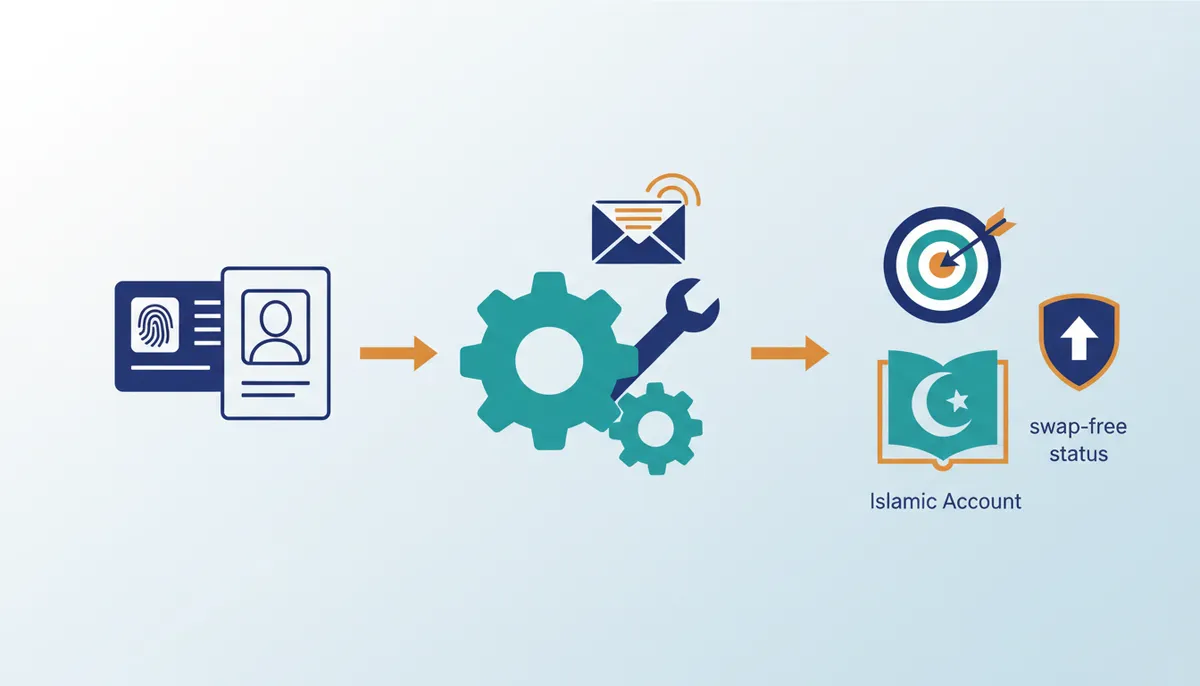
Geographic location dictates the conversion protocol for many retail traders seeking compliance. Exness applies status instantly to registrations from Islamic countries, covering all account types without documentation. Other platforms demand explicit user action to validate religious adherence before altering fee structures. IC Markets Global requires clients to prove their beliefs, creating a friction point absent in auto-grant systems. Manual processes introduce latency that automatic systems eliminate entirely. JustMarkets offers a distinct model where Islamic account holders outside the EU avoid both swap fees and administration costs. Traders on TIOmarkets can request conversion on verified existing accounts, applying swap-free treatment to eligible instruments immediately. Automatic systems prevent this leakage by design, whereas manual conversion leaves a window for unintended riba accumulation. Understanding your broker's specific trigger mechanism is necessary to maintaining compliance from the first tick. ForexCFD.top reminds traders that capital is at risk when trading CFDs.
Deploying Autochartist and VPS for Sharia-Compliant Trading
Chart pattern recognition initiates the entry bias before administrative costs accumulate. Autochartist scans multiple timeframes to identify classical formations, allowing traders to execute based on technical structure rather than overnight financing incentives. This analytical layer compensates for the shorter holding periods often required in swap-free environments. The FXTM platform supports custom indicators like the Pivot SR Levels indicator to enhance this technical analysis. Execution latency determines whether a theoretical entry becomes a filled order at the intended price. Fast order execution helps ensure that stop-loss orders trigger precisely, protecting capital from gaps that could otherwise erode equity quicker than administration fees. Reliance on automated patterns introduces a specific compliance risk if the strategy drifts into prohibited carry trading. Some brokers reserve the right to revoke Islamic terms if they detect long-term positions designed purely to avoid fees rather than capture market movement. Speed and analysis must serve genuine market speculation, not fee arbitrage. Traders should verify that their chosen broker discloses any administrative fees upfront to maintain full transparency. Unexpected charges can alter the risk-reward profile of a technically sound setup. The view flips if a broker fails to provide clear fee schedules or restricts tool access for swap-free users.
Validating Broker Transparency and Fee Replacements
Fee structures require confirmation before funding any account. A compliant broker discloses these financing costs upfront rather than burying them in variable spreads. Sometimes there is a grace period before fees are applied, allowing short-term positions to remain cost-neutral. For instance, FXTM applies a swap-free charge where the duration varies by instrument, requiring users to check specific asset rules. In contrast, some providers like XBTFX charge no administration fee at all on their Islamic MT5 accounts. Transparency standards differ notably across the industry, as seen in this comparison:
| Feature | Standard Disclosure | Transparent Model |
|---|---|---|
| Fee Timing | Applied nightly | After grace period |
| Cost Visibility | Hidden in spread | Published rate card |
| Instrument Scope | Substantial pairs only | All CFDs covered |
Fee variability by instrument creates hidden exposure for traders holding diverse portfolios. A single fixed percentage rarely covers the true cost of financing across gold and forex pairs equally. FP Markets is noted for being highly transparent about its swap-free Islamic account and publishes administration fees directly on its website. Failure to locate this data implies the broker may not be fully compliant. Always confirm the exact calculation method to avoid unexpected equity erosion. Thorough education materials, including over 250 videos, are available to help traders understand these mechanics. ForexCFD.top advises checking the specific terms for your jurisdiction. Your capital is at risk.
About
Marcus Halloran, Chief Market Strategist at ForexCFD.top, brings critical macroeconomic expertise to the complex environment of Islamic forex trading. With a background as an interbank FX strategist in London, Halloran specializes in monetary policy and interest-rate differentials, making him uniquely qualified to analyze swap-free accounts. His daily work involves dissecting central bank decisions that drive the very financing costs Islamic accounts seek to avoid under Sharia law. At ForexCFD.top, an independent publication dedicated to regulation-aware broker reviews, Halloran applies this deep understanding of funding mechanics to evaluate administration fees and grace periods accurately. This article connects his professional experience in G10 macro analysis with the specific needs of traders requiring compliant instruments. By using his structured approach to market catalysts, the review ensures that recommendations for Islamic accounts are not only religiously sound but also financially transparent for retail traders in emerging markets.
Conclusion
Scaling a Shariah-compliant portfolio reveals that administrative fees often replace interest charges without mimicking their predictability. While some brokers offer a brief window before charging, the long-term cost of holding positions varies wildly by instrument, creating a hidden drag on equity that standard backtests miss. The industry is shifting toward verifying genuine compliance rather than accepting vague "swap-free" labels that may hide inflated spreads or arbitrary nightly rates. Traders must treat opaque fee structures as a critical failure point, as unclear costs invalidate the risk-reward profile of any strategy.
You should prioritize brokers that publish a fixed rate card for all assets immediately, rejecting any provider that buries financing logic in legal disclaimers. This distinction becomes vital as regulatory scrutiny increases globally. Do not wait for your first monthly statement to discover that your "interest-free" account incurs higher costs than a standard one.
Start by requesting the specific fee schedule for gold and substantial pairs from your current broker before opening new positions this week. Compare their published rates against the best swap-free Islamic forex accounts for 2026 to ensure your capital is not silently eroding through disguised charges.
Frequently Asked Questions
You need at least $100 to start trading with a compliant broker. This low entry point allows new traders to access regulated markets without needing significant upfront capital.
Fees typically range from $1 to $80 depending on the instrument held. Traders must calculate these potential costs beforehand since they replace standard interest charges entirely.
No, some charge $6 per lot while others might charge $9 per lot. You should compare specific fee schedules because regulatory constraints create tangible cost differences between firms.
Yes, some brokers waive fees if positions are held for less than 4 days. This grace period helps traders manage short-term strategies without incurring extra administrative costs.
Costs can vary starting from the 1st night up to the 11th night of holding. Understanding this timeline is crucial as the fee amount often increases the longer you hold.
References