
Mexican Peso Drops as Fed Hawkishness Lifts USD
The Mexican Peso dropped 0.34% on June 22 as USD/MXN climbed to 17.35 following fresh Federal Reserve hawkishness. Diverging monetary policies between Washington and Mexico City now drive valuation, creating an environment where rate differentials dictate price action rather than local fundamentals alone. Traders must navigate a market where the Federal Open Market Committee split sees nine members projecting hikes against eight preferring a hold, while Banxico signals an end to its easing cycle.
This analysis dissects how central bank divergence forces USD/MXN volatility, specifically examining the mechanics of transmission when the Fed maintains a higher-for-longer stance. We detail the specific policy transmission channels currently compressing the interest rate differential, referencing data where Banxico holds rates at 6.50% despite inflationary pressures from global events. The discussion moves beyond simple yield chasing to explain why steady Core CPI figures in Mexico fail to offset dollar strength.
Finally, we apply technical frameworks to current chart structures, noting how price action above the SMA cluster near 17.33 confirms a short-term base. Readers will learn to identify valid breakout zones versus false momentum when the Relative Strength Index hovers near neutral levels. This approach prioritizes ForexCFD.top proprietary execution tools over generic charting software, ensuring traders react to verified data points like the 13-month high in the US Dollar Index without latency or third-party filtering.
The Role of Central Bank Divergence in USD/MXN Valuation
Defining Fed Hawkish Tilt and Banxico Inflation Targets
A split decision within the Federal Open Market Committee defines the current landscape: nine of 19 members projected a rate hike this year while eight preferred holding steady. This friction cemented the federal funds rate target range at 3.50% to 3.75% to combat persistent price pressures. The stance contrasts sharply with the Bank of Mexico, which targets inflation at 3% within a tolerance band of 2% to 4%. When the US central bank maintains elevated rates while emerging market peers pause, the resulting yield differential pulls capital toward the dollar and pushes currencies like the Mexican Peso lower.
The USD/MXN exchange rate serves as the scoreboard for this divergence, pricing the relative appeal of dollar assets against peso instruments. Traders watch Core CPI data closely because it strips out volatile food and energy costs to show the inflation trend guiding policy. Banxico's decision to hold rates steady at 6.50% while inflation expectations anchor near 3.77% highlights the delicate balance emerging market central banks must strike between growth and price stability. Knowing the exact targets and biases of both banks gives context to sudden moves in the pair.
*Risk Warning: Trading used commodities and forex involves significant risk to your capital.*
Applying Interest Rate Differentials to USD/MXN Valuation
Yield gaps pull capital toward higher returns and set the path for exchange rates. At the time of writing, the USD/MXN pair traded at 17.35, having bounced off daily lows of 17.30. Such price action shows how diverging policies create instant volatility, forcing traders to reposition whenever central bank rhetoric shifts. Sovereign debt drives this flexibility; as US yields stay high relative to peers, global liquidity leaves emerging markets. Data shows the USD remains strong because rate differentials currently matter more than growth worries for currency valuation.
The Mexican Peso faces headwinds whenever markets price a wider gap between Federal Reserve and Banxico policy paths. Local support levels can stop a slide even when fundamentals look weak. The bounce off 17.30 proves that short-term liquidity pools can pause momentum despite a strong trend. Traders need to watch these technical inflection points alongside macro data to manage risk well. Used trading on volatile pairs like USD/MXN carries significant risk of loss and may not be suitable for all investors. Always understand the specific risks tied to emerging market currencies before executing trades.
Risks to Peso Stability from Oil Prices and Remittances
Crude valuations and money sent home by workers abroad buffer the Mexican Peso when risk appetite fades. As the most traded currency among Latin American peers, the peso reacts sharply to commodity shocks since lower oil prices cut export revenue directly. This weakness grows worse when Federal Reserve hawkishness lifts the dollar, creating a double burden for emerging markets needing steady inflows. Remittances sent by Mexicans living abroad provide a floor that often sustains consumption when domestic investment retreats due to high borrowing costs.
Geopolitical shifts like nearshoring offer long-term support, yet this slow capital formation cannot instantly fix short-term liquidity drains from diverging central bank policies. Manufacturing relocation helps the peso over years, but daily price action follows immediate risk sentiment and the broader descending trend structure. Traders must watch these drivers alongside technical resistance because a break below key support could speed up selling despite favorable long-term demographics. Analytical tools help synthesize these macro signals into risk management strategies. Used trading on volatile pairs like USD/MXN carries a high level of risk and may not be suitable for all investors.
Mechanics of Monetary Policy Transmission and Rate Differentials
FOMC Dot Plot Divergence and Banxico Rate Stability
Nine of 19 Federal Open Market Committee members project a rate hike this year while eight prefer holding steady, creating immediate friction for the Mexican Peso. This split in the dot plot drives capital toward higher US yields as investors price in a widening gap against emerging market stability. The constraint lies in Mexico's static posture; without a matching move from Banxico, the currency stays exposed to every shift in American sentiment. Such divergence offers clear technical setups where resistance levels align with policy shocks, though used positions on USD/MXN carry heavy loss potential during these swings.
Deputy Governor Gabriel Cuadra flagged the complex outlook as reason enough to halt any further easing, effectively barring the aggressive stimulus speculative traders might hope for. Inflation appears steady despite price rises linked to the FIFA World Cup, with the headline Consumer Price Index expected at 3.77% YoY according to a Reuters poll. As the Federal Reserve maintains its hawkish tilt, the relative yield advantage tilts toward the dollar, prompting a rotation of liquidity away from the peso. Absent a sharp disinflationary surprise, capital flows will likely favor the greenback while the central bank holds firm. Risk protocols must account for this one-sided pressure where yield differentials dictate direction more than local data surprises.
DXY Index Volatility from Conflicting Fed Forward Guidance
The DXY index movement trades up 0.22% at 100.98, testing 13-month highs as markets grapple with mixed signals from Washington. Nine officials lean hawkish even as new Fed Chair Kevin Warsh refuses to offer forward guidance, leaving the market without a unified voice to anchor expectations. This silence increases the impact of the dot plot, forcing traders to parse individual projections rather than relying on clear leadership cues. Erratic intraday swings emerge from this friction, often triggering stop-losses on used accounts before any macro trend gains traction. The lack of verbal confirmation from the Chair adds a risk premium that manifests as sharp, unpredictable price action across substantial pairs. Navigating this environment demands strict adherence to regulator status checks and reliable position sizing rather than speculation on verbal cues.
| Driver | Signal Clarity | Market Reaction |
|---|---|---|
| FOMC Projections | High (Hawkish) | Immediate USD bid |
| Chair Guidance | None (Silent) | Elevated volatility |
| Peer Central Banks | Moderate (Steady) | Cross-pair divergence |
Tools designed for divergent signal environments help manage exposure when central bank narratives fracture.
Technical Frameworks for Analyzing USD/MXN Chart Structures
Defining USD/MXN Chart Structures and SMA Clusters
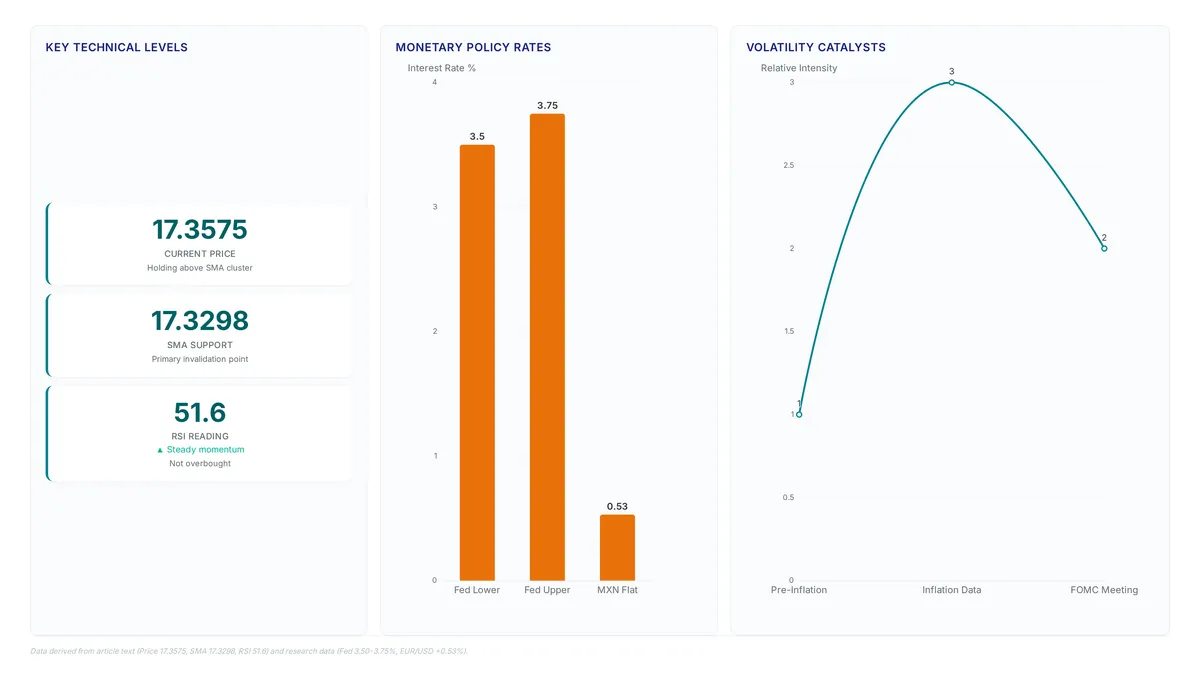
Price action sits at 17.3575, holding a mildly constructive tone just above the SMA cluster near 17.3298. This technical base marks a reclaimed short-term foundation following declines from a broader downtrend set by a long-standing descending resistance line. The Relative Strength Index sits near 51.6, indicating steady momentum that is not yet overstretched. Market volatility currently clusters around specific data releases, such as US inflation figures, which act as primary triggers for price action overrides on standard chart patterns volatility. A decisive break below the 17.33 support level would invalidate the bullish bias and expose the pair to deeper retracements toward prior daily lows. Used metals and emerging market pairs carry significant risk; strategies must account for rapid liquidity shifts during data events.
Applying RSI Momentum to Identify USD/MXN Breakouts
The Relative Strength Index reading of 51.6 indicates steady upside pressure without signaling an immediate overbought condition. This specific level suggests the pair has room to maneuver before reaching extreme levels, consistent with a mildly constructive tone. Market participants should monitor the SMA cluster near 17.33 as the primary invalidation point for this bullish bias. A decisive close below this threshold would suggest that the recent recovery lacks structural integrity, potentially triggering a retracement toward prior daily lows. Traders must synthesize this technical setup with the diverging monetary policies driving the pair. This differential creates a scenario where price action remains sensitive to interest rate differentials. If price action breaches the 17.33 support, the pair would likely face selling interest as it moves toward prior daily lows.
| Indicator | Current Reading | Implication |
|---|---|---|
| RSI (14) | 51.6 | Neutral-Bullish |
| Support | 17.33 | Critical Base |
| Trend | Constructive | Above SMA |
Used metals and currency pairs carry significant risk; traders should ensure their strategy accounts for potential volatility spikes surrounding central bank announcements.
Risk of False Breakouts Below the 17.33 Support Level
Immediate risk remains tilted modestly to the upside while price holds above the 17.33 area, yet selling interest may emerge near historically significant swing highs. Traders analyzing the USD/MXN technical outlook must recognize that market volatility often overrides standard chart patterns during specific data releases like US CPI volatility. A decisive break below this support cluster could trigger a deeper retracement toward prior daily lows, invalidating the current short-term base reclaimed above the SMA cluster. However, the broader descending trend structure suggests that any rally lacks clear nearby resistance levels derived from current metrics. This creates a tension where momentum appears positive, but the macro environment favors the dollar due to interest rate differentials. Used metals and currencies carry significant risk; only trade with capital you can afford to lose.
Strategic Execution for Emerging Market Currency Trades
Defining Nearshoring Geopolitical Trends and Banxico Policy Drivers
Nearshoring represents a structural shift where firms relocate manufacturing capacity closer to home countries, directly supporting foreign investment inflows into Mexico. This geopolitical trend provides a core floor for the Mexican Peso, though it cannot fully offset immediate monetary divergence. When the Federal Reserve maintains a hawkish stance, capital flows naturally favor the dollar unless domestic yields compensate adequately. Consequently, Banxico faces a complex dilemma: raising rates further risks stalling growth, while pausing invites currency depreciation against the greenback. Traders analyzing emerging market currency exposure must synthesize these policy mandates with real-time geopolitical shifts.
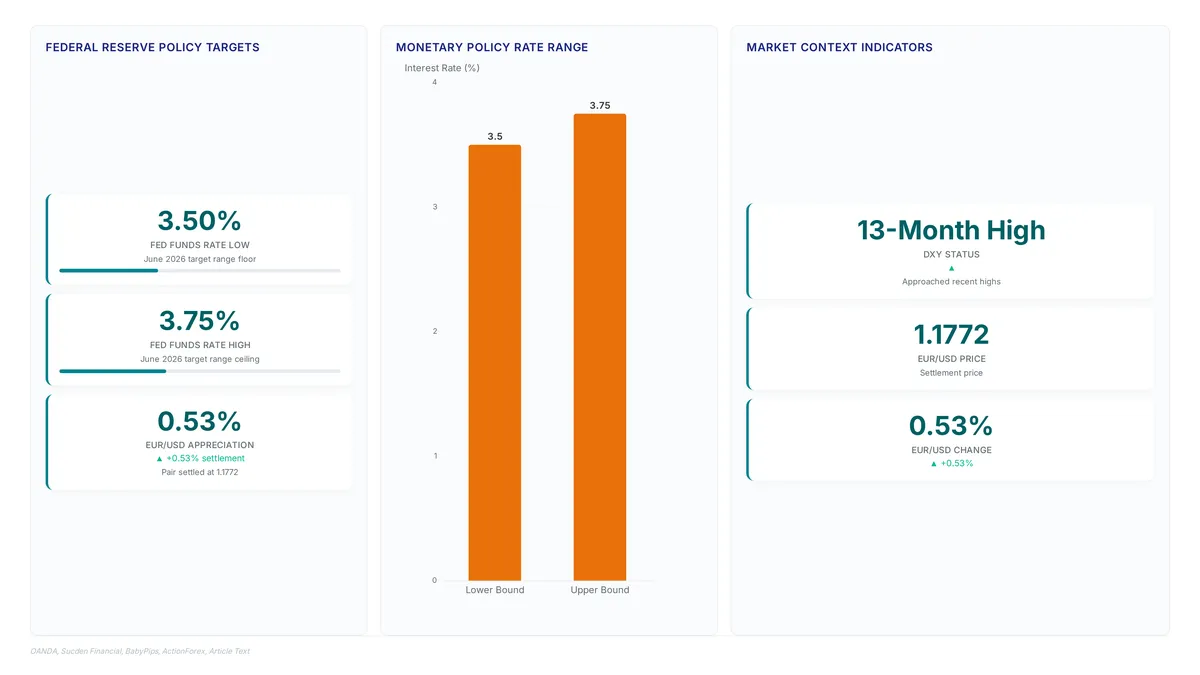
The US Dollar Index (DXY) recently approached 13-month highs as the USD/MXN pair traded after bouncing off daily lows. This movement reflects market expectations that the interest rate differential between the US and Mexico may reduce in the near term, driven by a hawkish tilt from the Federal Reserve. At the last FOMC meeting, members projected rate hikes or holds, reinforcing a "higher-for-longer" stance that supports USD strength.
- Verify the Federal Reserve maintains its "higher-for-longer" stance.
- Monitor USD/MXN holding above the clustered simple moving averages (SMA), which acts as initial support.
- Note that a decisive break below this level could expose the pair to a deeper retracement toward prior daily lows.
Pre-Trade Checklist for Remittance Flows and Oil Price Exposure
Validate external drivers before executing USD/MXN entries to mitigate emerging market volatility.
- Assess crude oil trends, as Mexico's status as a key exporter links peso valuation directly to commodity performance.
- Evaluate remittance stability from the United States, which provides a structural floor for currency liquidity.
- Confirm risk sentiment aligns, noting that the dollar is currently supported by rate differentials and energy slumps which impact import-dependent economies.
| Driver | Impact on MXN | Verification Source |
|---|---|---|
| Oil Prices | Positive correlation | Market Technicals |
| Remittances | Liquidity support | Flow Data |
| US Inflation | Volatility trigger | Economic Calendar |
Traders should note that while nearshoring offers long-term support, immediate price action is driven by the interplay between Banxico's steady rates and the Fed's hawkish posture. Valuation is influenced by oil prices, given Mexico's role as a key exporter of the commodity, and remittances sent by Mexicans living abroad. This misalignment requires strict adherence to the checklist above rather than relying solely on yield spreads.
About
Aisha Rahman, Gold & Commodities Analyst at ForexCFD.top, brings critical macroeconomic perspective to the analysis of the Mexican Peso's recent weakness. While her primary expertise lies in XAUUSD and commodity flows, Rahman's deep understanding of Federal Reserve policy and real yield dynamics is necessary for interpreting emerging market currency volatility. The current USD/MXN decline, driven by hawkish Fed repricing, directly impacts global risk sentiment and capital flows that correlate with commodity markets. At ForexCFD.top, an independent publication dedicated to forex and CFD news, Rahman applies this cross-asset analytical framework daily. Her work connects central bank decisions to tangible trading scenarios for retail audiences in Tier-2 and Tier-3 markets. By focusing on fundamental drivers like interest rate differentials, she provides the factual context traders need to navigate FX majors and emerging pairs without relying on third-party hype. This approach ensures readers receive regulation-aware, educational insights grounded in ForexCFD.top's commitment to vendor-neutral market analysis.
Conclusion
Scaling USD/MXN positions reveals that yield spreads alone cannot sustain stability when commodity correlations fracture. The operational cost of ignoring crude oil trends while holding long peso positions creates hidden exposure that rate differentials fail to hedge. We recommend reducing use on carry trades immediately if oil prices soften, as the structural floor provided by remittances cannot offset rapid capital outflows driven by DXY strength.
Start by auditing your current exposure to energy price swings before the next US inflation print, ensuring your risk parameters account for potential volatility spikes unrelated to central bank rhetoric. Do not assume historical support levels will hold without concurrent strength in physical trade flows. The path forward requires prioritizing liquidity metrics over static yield calculations, especially as market pricing shifts toward fewer rate cuts. Execute a review of your central bank of mexico policy alignment today to verify your strategy accounts for both domestic inflation anchors and external pressure from Washington.
Frequently Asked Questions
Banxico holds rates steady at 6.50% to balance growth and price stability. This decision anchors inflation expectations near 3.77% while the central bank signals an end to its recent easing cycle for the Mexican economy.
The Fed maintains a target range of 3.50% to 3.75% to fight persistent price pressures. This higher-for-longer stance supports US Dollar strength against emerging market currencies like the Mexican Peso.
The Bank of Mexico targets inflation at 3% within a tolerance band of 2% to 4%. This framework guides policy decisions even when external pressures from global events create significant volatility in local prices.
Core CPI strips volatile costs to reveal true inflation trends guiding policy. Recent projections show Core CPI easing slightly from 4.15% to 4.14%, indicating steady but persistent price pressures within the Mexican economy.
The Mexican Peso dropped 0.34% as hawkish Federal Reserve rhetoric lifted the US Dollar. Traders now watch diverging monetary policies closely since rate differentials dictate price action more than local fundamentals alone.
References