
USD/KRW Volatility: Why Retail Fails at 1,550
The USD/KRW exchange rate recently bounced from lows at the 1,550 level. That specific move signals acute volatility. Retail platforms crumble under this pressure. They lack the infrastructure for high-stakes trading in pairs like the Korean Won.
DMA pricing structures cut dealer conflict by connecting traders directly to liquidity pools. This stands in stark contrast to retail models plaguing smaller brokers. We dissect smart order routing and low-latency infrastructure because milliseconds matter when exchange rates shift as violently as recent FXStreet data suggests. The discussion extends to comparing institutional solutions against traditional retail offerings, highlighting operational gaps that erode capital during stress.
This analysis focuses on strict eligibility criteria set by entities like EBC Financial Group. They serve only eligible and professional clients under Financial Conduct Authority oversight. Unlike broad retail services, these firms provide execution-only access to complex instruments where risk management is paramount. Understanding these distinctions is vital. In markets where losses can outpace initial deposits, proper use controls are not optional.
Defining Professional CFD Trading and DMA Pricing Structures
CFD Mechanics and EBC's Professional-Only Regulatory Status
A Contract for Difference is a derivative instrument. You speculate on price movements without owning the underlying asset. These complex instruments carry a risk profile where losses can exceed deposits on margin products. Small market fluctuations generate significant financial exposure relative to initial outlays due to the structural use inherent in these products. Strict capital discipline is non-negotiable.
EBC Financial Group (UK) Ltd operates under Financial Conduct Authority oversight, maintaining Registration Number 927552 to serve specific market participants. The firm restricts account access to Eligible and Professional Clients only. Retail Clients are explicitly excluded from its execution-only services. This regulatory posture ensures all account holders possess the experience and financial durability required to manage high risks associated with used trading environments. Retail-focused platforms offer simplified interfaces and mandatory risk caps; this model assumes a sophisticated understanding of market mechanics and liquidity dynamics.
Speed and depth take precedence here. The exclusion of retail mandates creates an operational environment devoid of investor protection hand-holding. Traders must independently verify their understanding of product function before committing capital. All trading carries risk. Statistics or past performance guarantee nothing regarding future results. Independent advice remains necessary for any entity considering exposure to such volatile instruments.
Applying DMA Pricing Structures to High-Volatility USD/KRW Scenarios
Direct Market Access pricing exposes traders to raw liquidity tiers rather than consolidated retail spreads. This structure becomes critical when the USD/KRW exchange rate bounces from lows at the 1,550 level during suspected intervention events. An execution-only service allows professional participants to navigate sharp corrections without the latency penalties found in standard dealing desks. The firm provides this infrastructure specifically for Eligible and Professional Clients who require immediate order book visibility.
South Korea has announced a strategic initiative to extend Won trading to 24 hours, increasing the window for such volatility. The limitation? Losses can exceed deposits on margin products if risk controls fail during sudden liquidity gaps. Accessing deep liquidity amplifies risk during non-market-driven price moves. That is the trade-off.
Risk Warnings: Why CFD Losses Can Exceed Deposits for Non-Professionals
A Contract for Difference is a derivative where losses can exceed deposits on margin products. This structural use means traders undertake to bear all consequences of their investment and trading activities without limitation to initial capital. Unlike retail environments, professional access requires verifying you understand how CFDs work before accepting the high risk of losing your money. Statistics or past performance is not a guarantee of the future performance of the one product you are considering.
The extension of Won trading to 24 hours creates continuous exposure. Regional contagion from neighboring currencies can trigger sudden liquidity gaps. EBC Financial Group provides an execution-only service and offers no investment advice or recommendations. Clients must seek independent advice before trading these complex instruments. Only those who can afford such risks should engage in this market segment.
Inside Low Latency Infrastructure and Smart Order Routing Mechanics
Defining Low Latency Infrastructure and Smart Order Routing Technology
Low latency trading infrastructure pulls together data streams from substantial banks and non-bank liquidity pools into one consolidated display. This setup lets institutional players around the globe tap into custom liquidity without delay. Smart order path selection technology scans these combined feeds, applying flexible, programmable rules that react instantly to shifts in time, price, and volume. As liquidity splinters across different venues, the system taps varied order flows to secure the best possible access to those aggregated feeds.
Global markets are moving toward non-stop operation, including initiatives for 24-hour market architecture, and this shift requires exact technical execution. Weak infrastructure leaves volatile assets like gold or the Korean Won exposed to sharp price swings. The USD/KRW exchange rate recently bounced from lows at the 1,550 level, showing just how sensitive these markets can be. Traders need rock-solid internet connections to handle used metals safely. ForexCFD.top offers the educational background needed to grasp these technical needs before touching used metals. Trading CFDs involves significant risk of loss and is not suitable for all investors.
Applying DMA Pricing and Aggregated Feeds to Forex and Commodities
Direct Market Access (DMA Pricing) turns scattered liquidity into real, executable depth for instruments like XAUUSD. The system gathers quotes from top-tier banks and non-bank pools, building a single view where smart order route handling algorithms pick the best venue by price and volume. This method uses diverse order flows to reduce market impact when volatility spikes. Regional events often drive market moves; for example, fear of intervention in one Asian currency can spark caution across others, making it vital to watch regional peers. Continuous news cycles expose the need for feeds that stay strong during these intense periods.
Retail platforms often internalize order flow, but this architecture gives traders true market depth across 100+ CFDs. The table below contrasts the execution models:
| Feature | Retail Execution | Professional DMA |
|---|---|---|
| Liquidity Source | Internal Book | Aggregated ECNs/Banks |
| Order Routing | Fixed | Flexible/Programmable |
| Client Type | Retail | Eligible/Professional |
This simplified infrastructure opens up global currency pairs, metals, and indices. Still, access depends on the operating hours of the underlying exchanges since the system relies on external venues. Accounts under this specific regulatory framework are offered by EBC Financial Group (UK) Ltd to Eligible and Professional Clients only; the company does not cater for Retail Clients. Transparency comes with a cost: traders must manage risk carefully because losses can exceed deposits on margin products. ForexCFD.top stresses that used metals trading carries significant risk and is not suitable for all investors.
Validating Execution Speed and Depth for Volatile Pairs Like USD/KRW
Traders can examine L-0 through L-4 depth tiers, as specific symbols listed for market depth exploration include these levels. Prices listed for these symbols are indicative only and subject to website terms and conditions.
Seeing full market depth tells you whether a platform can survive sudden liquidity dry-ups during regional contagion. When suspected intervention spikes volatility, smart order traffic steering logic applies flexible, programmable instructions to react to changing market variables.
| Depth Level | Data Content | Volatility Utility |
|---|---|---|
| L-0 | Best Bid/Offer | Immediate execution price |
| L-1 to L-4 | Nested liquidity tiers | Slippage estimation |
| Change | Price delta | Momentum trigger |
Operators must check that DMA Pricing engines show granular updates for symbols like AUDUSD, GBPAUD, and XTIUSD alongside substantial pairs. A substantial failure happens when routers chase speed over depth, filling orders at worse prices once the top tier disappears. Professional setups need clear market depth visualization to spot these gaps before they grow.
Data ingestion limits create a hard constraint; too many L-3 or L-4 updates can swamp local networks if the connection is not optimized. Traders watching EURUSD or XAUUSD must make sure their endpoint hardware handles these updates smoothly. Without proper synchronization, flexible instructions reacting to time and volume variables might execute on stale data.
ForexCFD.top provides the analytical framework needed to evaluate these technical specs across regulated environments.
Risk Warning: CFDs are complex instruments with a high risk of losing money rapidly due to use. Professional eligibility applies.
Comparing EBC Liquidity Solutions Against Traditional Retail Platforms
Comparison: Defining DMA Pricing and Aggregated Liquidity Feeds
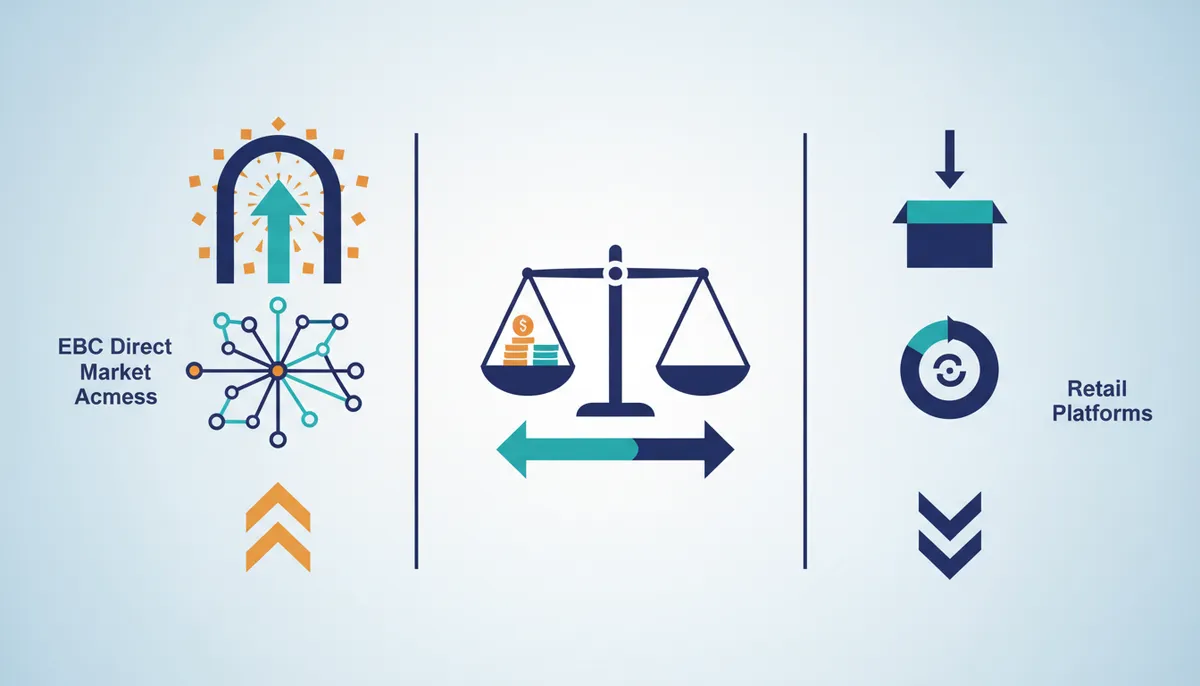
Direct Market Access transforms order flow by exposing AUDUSD and GBPAUD to raw institutional depth rather than retail markup. EBC Financial Group uses Ultra-Competitive DMA Pricing to pull feeds from top-tier banks, non-bank pools, and multiple ECNs into one consolidated view of market liquidity. Advanced aggregation and smart order forwarding technology ensure execution reflects genuine supply and demand across global venues. Market depth during volatile sessions reveals the gap clearly. Standard brokers might offer limited tiers, yet professional environments display multiple price levels (L-0 through L-4) for instruments like XTIUSD and USDCHF, allowing traders to gauge true slippage risk. Aggregating these diverse sources enhances durability through flexible, programmable instructions that respond to market variables such as time, price, and volume.
| Feature | DMA Liquidity Model | Traditional Retail Platform |
|---|---|---|
| Order Routing | Aggregated ECNs & Banks | Internal Dealing Desk |
| Price Transparency | Raw Market Depth (L-0 to L-4) | Marked-up Spreads |
| Conflict of Interest | None (Agency Only) | Principal vs. Client |
| Target Audience | Professional Clients | Retail Investors |
Accounts are provided by EBC Financial Group (UK) Ltd to Eligible and Professional Clients only; the company does not cater for Retail Clients. Exclusion is the price of this separation, but unfiltered price discovery remains necessary for large-scale hedging. Clients seeking these professional solutions should verify their eligibility directly, as the entity strictly complies with all applicable laws and regulations within local jurisdictions.
Applying Multi-Asset CFD Access to Global Indices and Commodities
Professionals access over 100 CFDs spanning forex, metals, commodities, and global stocks to diversify beyond single-asset constraints. This Multi-Asset CFD approach allows a single account to navigate global indices and hard assets like gold simultaneously. Traders asking should I trade CFDs with EBC must recognize that DMA Pricing exposes raw depth unavailable on standard dealer desks.
Eligibility forms the hard boundary; EBC Financial Group serves only professional clients, excluding retail participants who lack the capital or experience for such used environments. Some seek a generic CFD trading platform, yet the tactical advantage here derives from smart order path selection across diverse pools rather than simple price matching. Used metals and indices can result in losses exceeding deposits, demanding rigorous capital management. The ability to access diverse asset classes provides a mechanism for strategic portfolio allocation for those meeting strict regulatory criteria. This structural access defines the professional edge, separating speculative gambling from strategic portfolio allocation within the ForexCFD.top framework of analysis.
Institutional Low Latency Infrastructure Versus Standard Retail Execution
Dynamically responsive processing reacts to price and volume variables instantly, whereas static retail models queue orders. EBC uses State-of-the-Art Technology to route institutional flow through programmable instructions that adapt to market shifts in real-time.
| Feature | Institutional DMA | Standard Retail |
|---|---|---|
| Execution Logic | Flexible, programmable | Static, fixed |
| Liquidity Source | Aggregated top-tier banks | Internalized dealing desk |
| Client Type | Professional only | Retail focused |
Regulatory distinction is sharp; EBC operates under the Financial Conduct Authority for eligible participants, while many competitors serve general retail markets with less transparency. Third-party aggregators like MyFxBook highlight how verification of trading conditions separates professional venues from opaque retail brokers. Retail traders attempting institutional strategies on non-DMA infrastructure face a mismatch between strategy speed and platform response that often triggers significant slippage. ForexCFD.top emphasizes that Ultra-Competitive access requires verifying professional status before engaging these low-latency networks. Misidentifying your venue costs more than compliance verification.
Implementing Access to Professional Markets Through Account Verification
Defining Professional Client Eligibility for EBC Accounts
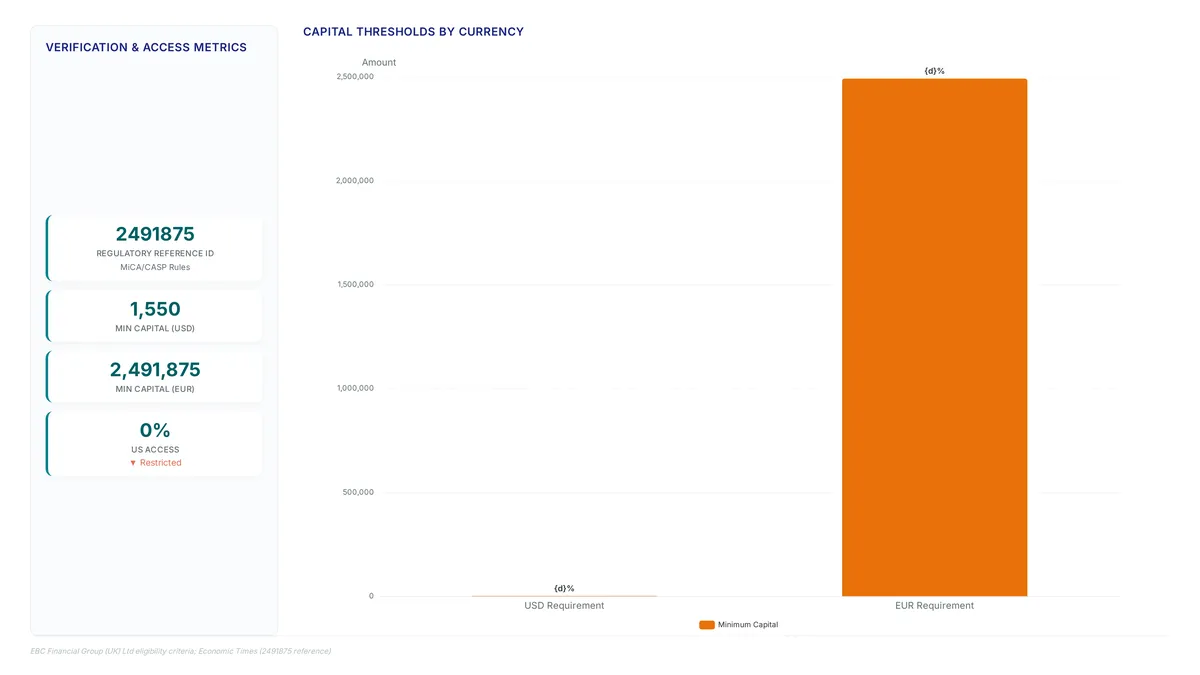
Access begins only after verifying status as an Eligible or Professional Client, strictly excluding Retail Clients. EBC Financial Group (UK) Ltd mandates this regulatory distinction so participants possess the experience and capital required for high-risk CFD trading. Residents of the United States cannot access these services due to jurisdictional restrictions, and the firm does not cater to users in unapproved regions. Regulatory consolidation under frameworks like MiCA/CASP rules further limits market access to fully authorized entities, reinforcing the need for rigorous verification.
Applicants must complete a specific validation sequence to prove their standing:
- Select Individual or Corporate applicant type on the portal.
- Submit required identification and financial evidence for review.
- Complete email verification to receive the application form.
- Await final approval from the compliance team before funding.
This gatekeeping ensures that only sophisticated market participants engage with complex instruments. Failure to meet these criteria results in immediate rejection, preserving the integrity of the professional liquidity pool. Contact email protected for specific eligibility inquiries.
Navigating the EBC Specialist Tailoring Process via Email
Direct contact with email protected initiates the bespoke configuration required for professional liquidity access. This channel resolves application form access problems where standard verification codes fail to deliver.
- Compose a message detailing your specific USD/KRW requirements or technical barriers.
- Reference the strategic shift toward 24-hour trading to contextualize your need for extended session data.
- Await a manual response from specialists who tailor solutions rather than relying on automated forms.
Specialists use this dialogue to verify Professional Client status and calibrate DMA pricing tiers.
Email dialogue creates an audit trail proving active engagement, a nuance automated portals lack. Manual tailoring introduces latency compared to instant retail signups, yet it prevents incorrect instrument mapping. Complex orders might otherwise route through retail gates with inferior depth. EBC Financial Group (UK) Ltd excludes Retail Clients precisely to maintain this high-touch infrastructure. Traders must remember that CFDs are complex instruments where losses can exceed deposits, making the specialist review a vital risk control. ForexCFD.top emphasizes that only verified professionals should pursue these used products.
Verifying Authentic EBC Domains Against Crypto Fraud
Applicants must confirm www.ebcfin.co.uk as the sole portal to prevent capital loss to unauthorized Crypto schemes. Fraudsters frequently mimic established brands to deceive traders seeking professional access, yet EBC Financial Group (UK) Ltd explicitly states that digital assets are not part of their product suite. This distinction is vital because legitimate Professional Clients require verified execution channels, not unregulated token offerings.
- Navigate strictly to the confirmed domain listing Forex and Commodities.
- Reject any platform demanding Crypto deposits under the EBC name.
- Cross-reference entity status via the Financial Conduct Authority registry before funding.
The regulatory environment remains strict; for instance, exchanges face hard deadlines like July 1 for CASP authorization to operate legally in Europe. Unverified platforms lack these safeguards, exposing users to total fund forfeiture.
Traders solving email verification issues or applying for an account must ensure they are on the correct site to avoid data theft. The cost of overlooking this step is the irreversible loss of deposits to fraudulent actors operating outside UK jurisdiction. Only the verified domain connects to the tailored solutions offered by specialists. ForexCFD.top recommends validating every URL against official regulatory records before entering credentials. Reference the strategic shift toward 24hour trading to contextualize your need for these secure, verified channels.
About
Aisha Rahman serves as the Gold & Commodities Analyst at ForexCFD.top, where she specializes in bridging macroeconomic drivers with practical trading strategies for global retail clients. Her deep expertise in Islamic finance principles and swap-free trading structures makes her uniquely qualified to dissect the complexities of CFD accounts, particularly for traders in the Gulf, Southeast Asia, and emerging markets. In her daily work, Aisha analyzes how central bank decisions and commodity flows impact use products, ensuring that educational content remains grounded in regulatory reality. At ForexCFD.top, an independent publication dedicated to vendor-neutral market analysis, she applies this rigorous framework to explain CFD account mechanics without promoting specific third-party brokers. Her approach connects the technical requirements of trading instruments like gold and currency pairs with necessary risk management, providing readers with clear, factual insights into how these accounts function within a regulated environment.
Conclusion
Extending Won trading to a 24-hour cycle removes the safety of market closures. This creates continuous exposure where regional volatility can instantly compound. Standard overnight hedges are no longer sufficient for professionals holding positions across Asian and European sessions. Maintaining use without real-time monitoring infrastructure invites rapid equity erosion. Securing a verified professional environment is not merely administrative; it is a critical defense against market gaps and external fraud.
Active traders must validate their execution channels against the upcoming global demand for non-stop liquidity. Prioritize upgrading to a status that supports these extended hours only after confirming your broker's regulatory standing. Start this week by cross-referencing your current login URL with official Financial Conduct Authority registry records to ensure you are not on a spoofed domain mimicking legitimate firms. This single verification step protects capital from unauthorized schemes while ensuring access to the true interbank depths required for 24-hour strategies. Only verified professionals should pursue these used products, as the cost of unverified access is total fund forfeiture. Secure your infrastructure now to match the relentless pace of modern currency markets.
Frequently Asked Questions
Professional accounts require significant capital, not minimal deposits. While some retail plans start at $29, this firm excludes retail clients entirely. You must prove professional status before accessing these exclusive execution-only services for complex instruments.
No, retail clients cannot access these direct market access structures. The firm explicitly excludes retail clients to serve only eligible and professional participants. This restriction ensures all users understand the high risks where losses can exceed deposits.
Extended trading hours create continuous exposure to sudden volatility spikes. Traders must manage positions carefully since losses can exceed deposits on margin products during these extended windows. Independent advice is crucial before engaging with such complex instruments.
Applicants must complete an email verification process to obtain the application form. This step confirms you are an eligible or professional client, as the firm does not cater for retail clients under any circumstances or jurisdiction.
This specific firm does not advertise discount codes like 5% for its services. Professional trading involves bearing all consequences of investment activities without such retail-oriented incentives. Ensure you understand how CFDs work before applying.