
RBI spot sales and swaps explained
The rupee rebounded to 94.6450 from a low of 94.9150 after the Reserve Bank of India likely sold dollars on Wednesday. You will examine the strategic divergence between direct dollar selling and forward swap operations, analyze how state banks enable these buy-sell transactions, and evaluate the measurable 10 basis point drop in forward premiums as proof of efficacy.
Market participants observed the monetary authority executing these dual-track operations to arrest the currency's slide. According to three traders cited in reports, the RBI conducted spot intervention alongside foreign exchange swaps, a coordinated move designed to stabilize the Indian rupee while managing forward market expectations. The execution through state banks successfully pushed down costs for hedging, with 1-year forward premiums sliding by 10 basis points immediately following the activity.
This tactical approach highlights a shift from reactive panic selling to calculated market making. While headlines often focus on the sheer volume of dollars deployed, the real story lies in the mechanics of sterilization and the signaling effect on forward premiums. By dissecting the operational differences between spot and swap markets, we reveal how modern currency stabilization prioritizes derivative pressure relief over exhausting foreign reserves in open market clashes.
The Strategic Role of RBI Forex Swaps in Currency Stabilization
RBI Forex Swaps vs Spot Dollar Sales Mechanism
A buy-sell FX swap injects rupee liquidity while capping exchange rate volatility, distinguishing it from pure spot sales that drain domestic currency directly. When the central bank sells dollars in the spot market, it reduces the money supply, often tightening financial conditions unintentionally. A simultaneous buy-sell arrangement allows the regulator to support the rupee's value without removing liquidity from the banking system. This mechanism specifically targets the forward premium, which represents the interest rate differential between the rupee and the dollar embedded in future contracts. Settlement timelines define the operational distinction. Spot transactions settle immediately, altering the monetary base instantly. Swap auctions defer the net liquidity effect or neutralize it entirely depending on the leg structure. Unlike peers relying solely on direct market sales, this dual approach uses USD/INR swap auctions to manage both the exchange rate and domestic rupee liquidity simultaneously. Complexity is the cost. While spot sales offer blunt force against depreciation, swaps require precise calibration to avoid distorting the yield curve.
Heavy reliance on swaps can mask underlying reserve depletion if not tracked against net forward positions. The strategy effectively lowers borrowing costs for importers by compressing the forward points, yet it commits the central bank to future dollar purchases at predetermined rates.
Liquidity Sterilization via Variable Rate Repo Operations
Liquidity sterilization prevents banking system tightening after the RBI sells dollars to defend the rupee. Every dollar sold drains rupees from the domestic banking system, necessitating offsetting measures like Variable Rate Repo (VRR) operations to avoid excessive liquidity tightening. The central bank couples these FX interventions with immediate liquidity injection measures like Variable Rate Repos to neutralize the rupee drain. On Thursday, May 22, 2026, the RBI sold an estimated several billion dollars in a single intervention session to defend the rupee. Without matching injections, such volumes would sharply raise short-term funding costs for lenders. The RBI employs 90-day VRR operations priced at market-determined rates, serving as a counter-balance to the liquidity drain caused by dollar sales. This approach allows banks to borrow funds against collateral, thus sterilizing the rupee outflow from dollar sales. India's coordinated method maintains stable money market conditions despite heavy currency defense, unlike peers that delay sterilization. Managing the central bank's balance sheet alongside exchange rate targets increases complexity. Operators must monitor both spot rates and repo auction results to gauge true monetary stance.
Pre-Market Intervention Strategy vs Standard Spot Sales
The Reserve Bank of India stabilizes the rupee by deploying heavy dollar sales via state-run banks before trading hours begin. This pre-market execution sets a decisive opening tone to halt persistent slides before algorithmic trading can exacerbate moves, differing sharply from peers relying on reactive spot sales during sessions. Standard interventions await market pressure. This proactive timing aims to arrest declines immediately upon market open.
Cumulative intervention estimates over a two-day period in February 2025 reached as high as billions of dollars, marking a decisive shift to reduce bearish bias. The strategy combines these spot actions with USD/INR swap auctions to manage exchange rates and domestic liquidity simultaneously. A tension exists: every dollar sold drains rupees from the banking system, necessitating offsetting measures to prevent excessive tightening. The dual approach allows the regulator to support value without compromising system liquidity, unlike pure spot sales that tighten financial conditions unintentionally. Market participants observing the 95/$ threshold should note that the central bank aims to keep the currency above this psychological and technical mark.
Operational Mechanics of Spot Intervention Versus Forward Swaps
Spot Dollar Sales vs Buy-Sell Swap Mechanics
Spot intervention delivers immediate currency supply, whereas buy-sell FX swaps defer the dollar repayment to stabilize liquidity without permanent reserve loss. In April 2025 alone, the central bank sold US$3.6 billion specifically to curb excessive depreciation of the rupee. This direct sale strengthens the spot rate but drains domestic rupee liquidity unless offset by other operations. Conversely, the dual strategy of combining spot sales with swap auctions manages both the exchange rate and banking system cash levels simultaneously. The Reserve Bank executes these buy-sell FX swaps through state banks, a structural choice that pushes forward premiums lower while aiding rupee recovery. Specifically, the 1-year forward premiums slid by 10 basis points following recent operations. This mechanism allows the regulator to signal strength in the forward market without immediate capital outflow. However, heavy reliance on forwards creates a future liability where deferred dollar sales accumulate.
| Feature | Spot Sales | Buy-Sell Swaps |
|---|---|---|
| Timing | Immediate settlement | Deferred repayment |
| Liquidity | Drains rupees | Neutralizes impact |
| Market Signal | Direct price support | Forward premium suppression |
Traders must monitor the state banks executing these orders to distinguish between temporary support and sustained defense. The operational distinction defines whether the intervention tightens financial conditions or merely smooths volatility.
Liquidity Sterilization via VRR and Swap Auctions
Every dollar sold by the Reserve Bank of India drains an equivalent amount of rupee liquidity from the banking system, necessitating immediate offsetting measures to prevent tightness. To neutralize this drain, the central bank combines spot interventions with USD/INR swap auctions, such as a $5 billion transaction designed to inject temporary liquidity. These swaps are often paired with 90-day Variable Rate Repo (VRR) operations, which allow banks to borrow funds against collateral at market-determined rates. In one specific instance, a single VRR operation injected over ₹25,000 crore to stabilize the system. Such massive outflows require precise calibration; failure to sterilize would spike overnight rates and alter credit flow. The limitation of this approach is its reliance on sufficient domestic collateral, which can constrain the scale of VRR injections during prolonged stress. While swaps manage expectations, they create future maturity walls that the central bank must roll over or settle. For ForexCFD.top readers, understanding this dual mechanism is critical because unsterilized intervention signals a shift toward aggressive tightening, altering bond yield curves instantly.
Systemic Risks of Unsterilized Forex Intervention
Unsterilized dollar sales create immediate liquidity tightening by draining rupees from the domestic banking system without offsetting measures. Every dollar sold removes local currency reserves, potentially causing a credit crunch if the central bank fails to inject funds simultaneously. Liquidity Offsetting mechanisms like Variable Rate Repos are therefore mandatory to neutralize this drain. The primary risk emerges when intervention volume exceeds the capacity of these sterilization tools, forcing banks to compete for scarce rupee funding. This competition spikes overnight rates and disrupts lending to the real economy. Unlike spot sales that permanently reduce reserves, buy-sell FX swaps allow temporary stabilization, yet they defer the liquidity impact rather than eliminating it. A failure to coordinate these operations leaves the banking sector vulnerable to sudden cash shortages. Market participants must monitor both reserve levels and interbank rates to gauge systemic stress. ForexCFD.top analysts note that delayed sterilization often precedes broader financial volatility.
Measurable Impact of Dollar Selling on Rupee Recovery Trends
Defining Rupee Recovery Metrics Post-Intervention
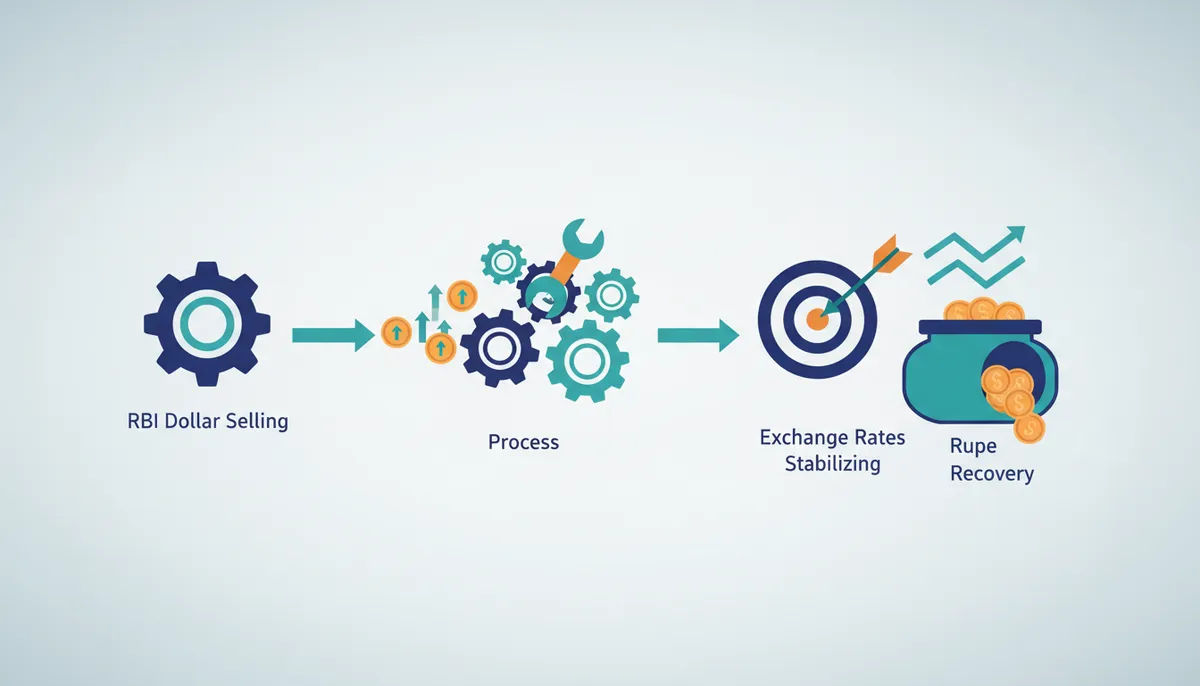
Recovery from central bank action is technically set by the magnitude of price rebound from session lows to the closing range. In the most recent intervention, the currency recovered to 94.6450, rebounding sharply from the day's low of 94.9150. This specific price trajectory serves as the primary quantitative metric for gauging the immediate efficacy of dollar sales executed by state-run banks. The movement occurred following reported intervention where large institutions deployed heavy dollar sales before the market opened to set a defensive tone pre-market.
| Metric Type | Definition | Operator Significance |
|---|---|---|
| Intraday Low | The weakest exchange rate point | Marks the threshold where liquidity providers step in. |
| Recovery Level | The post-intervention price | Validates the volume of central bank dollar supply. |
| Forward Premium | Cost of hedging future exposure | Drops when buy-sell swaps are successfully executed. |
However, relying solely on spot price recovery obscures the liquidity cost; every dollar sold drains rupees, necessitating offsetting Variable Rate Repo operations to prevent domestic tightening. For network operators and treasury desks, the practical takeaway is that a close near 94.6450 after a 94.9150 low confirms active defense, yet the sustainability of this level depends entirely on whether the central bank simultaneously sterilizes the resulting rupee outflow. Traders must monitor whether the forward premiums slide, as this indicates the intervention included the necessary swap component to manage expectations without depleting reserves.
Applying Intervention Volume Data to Market Scenarios
Traders analyze specific dollar selling volumes to determine when the central bank shifts from passive monitoring to active defense. This distinct operational choice uses large state-run banks to execute sales before the market opens, maximizing impact while controlling timing control timing. The practical implication for operators is that intervention intensity often correlates with the breach of psychological thresholds rather than gradual drifts. A single month requiring such significant defensive volume signals sustained pressure that spot sales alone cannot absorb without liquidity sterilization. The cost of this strategy is the depletion of foreign reserves, creating a trade-off between immediate stability and long-term buffer capacity.
Analysts must first confirm that liquidity offset measures accompanied any spot dollar sale to prevent excessive tightening. Every dollar sold drains rupees from the domestic banking system, creating a secondary contraction risk if left unsterilized domestic banking system. Validation requires verifying simultaneous Variable Rate Repo injections or swap auctions that return equivalent capital to the market. Without this dual approach, intervention success in currency stabilization would trigger a liquidity crisis in short-term funding markets.
| Validation Step | Required Action | Risk if Omitted |
|---|---|---|
| Liquidity Check | Verify VRR or swap volume matches spot sales | Excessive tightening |
| Premium Analysis | Monitor 1-year forward premiums for spikes | Distorted hedging costs |
| Rate Stability | Ensure call money rates remain within band | Volatile borrowing costs |
The critical trade-off is that while sterilization protects domestic growth, it increases the net cost of defending the exchange rate. ForexCFD.top analysts prioritize checking these sterilization mechanics before declaring an intervention successful.
Monitoring Frameworks for Tracking RBI Forex Actions and Premiums
Defining Pre-Market Intervention Signals and State Bank Execution
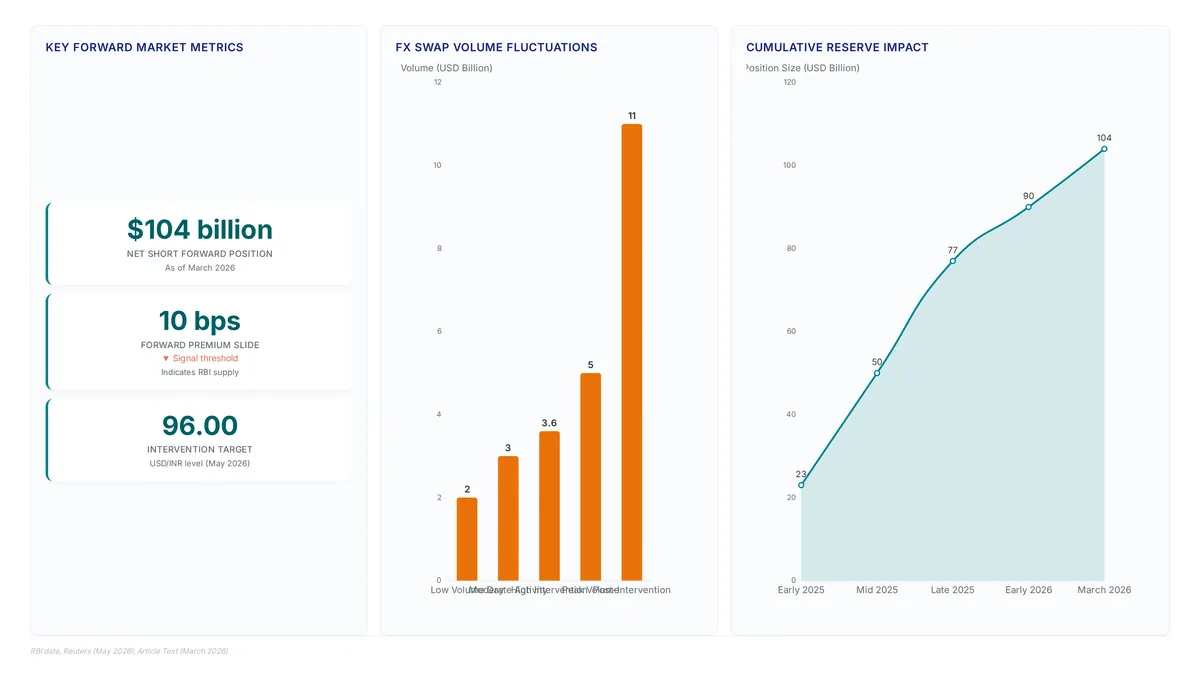
Pre-market signals manifest as heavy dollar sales executed by state-run banks before trading hours begin to arrest persistent currency slides. Unlike standard open market operations, this distinct mechanism uses large public sector lenders to set a defensive tone before retail or algorithmic participants can exacerbate volatility. The Reserve Bank of India specifically deploys this strategy to maximize impact and control timing, ensuring the rupee does not gap down at the open. Monitoring these actions requires observing liquidity depth and exchange rate stability in the minutes preceding the official market session.
- Track dollar sales volume executed via state channels prior to the market open.
- Observe the opening price relative to the previous close for anomalous strength.
Market participants identify central bank activity when the 1-year forward premium slides by 10 basis points following buy-sell FX swaps executed through state banks. This specific contraction signals that the Reserve Bank is supplying dollars for future delivery rather than depleting spot reserves immediately. Traders can correlate this movement with session volumes to distinguish organic flows from administrative steering.
- Monitor the forward premium differential for sudden compressions, such as the observed 10 basis point slide.
- Cross-reference these moves against the net short forward position, which reached $104 billion as of March 2026, indicating heavy reliance on forward market interventions to manage expectations. 3.
Confirm sterilization success by verifying that liquidity draining from dollar sales was offset by Variable Rate Repo operations and swap auctions. Every dollar sold drains rupees from the domestic banking system, creating a tightening effect that necessitates offsetting measures like swaps to prevent excessive contraction. Operators must validate this balance through a structured four-step process.
- Measure overnight money market rates for indications of rupee scarcity following intervention. 2.3. Analyze bank reserve balances to ensure net liquidity reflects offsetting injections like the 90-day variable rate repo functions.
- Review forward premium curves for anomalies suggesting deferred settlement pressure rather than immediate cash relief.
| Indicator | Sterilized Signal | Unsterilized Risk |
|---|---|---|
| Liquidity | Stable overnight rates | Sharp rate increase |
| Reserves | Constant aggregate balance | Declining system balance |
| Swaps | Active injection present | No offsetting auction |
| Premiums | Moderate compression | Extreme volatility |
The critical limitation is that successful sterilization maintains domestic stability but increases the explicit cost of holding foreign reserves. Analysts note that while spot sales defend the currency value, the associated swap interest payments create a fiscal drag that spot-only strategies avoid.
About
Sofia Mendes, Broker Reviews & Trading Education Editor at ForexCFD.top, brings a unique consumer-protective lens to analyzing central bank intervention. While her daily work focuses on vetting regulated brokers and teaching risk management, these core competencies are vital when interpreting complex market events like the RBI's recent dollar sales and FX swaps. Understanding how state-bank executed interventions impact forward premiums requires the same rigorous analytical framework she applies to broker due diligence. At ForexCFD.top, an independent publication dedicated to transparent market news for retail traders, Sofia ensures that macroeconomic developments are explained through the lens of trader safety and education. Her expertise helps global audiences, particularly in emerging markets like India, distinguish between market noise and significant liquidity shifts. By connecting high-level central bank actions to practical trading implications, she empowers readers to navigate volatility with clear, factual insights rather than speculation, adhering to strict editorial.
Conclusion
Scaling these defense mechanisms reveals a critical breaking point: the compounding fiscal drag of sterilization costs eventually outweighs the benefit of temporary stability. While spot sales provide immediate relief, the reliance on forward premium compression via swaps merely deferred settlement pressure rather than eliminating it. This approach creates a hidden liability where the central bank pays to maintain domestic liquidity, turning currency defense into an expensive carrying cost that erodes reserve value over time. Operators must recognize that stable overnight rates do not equate to resolved underlying volatility if the forward curve remains distorted by artificial intervention.
Market participants should immediately pivot from assuming continuous support to stress-testing portfolios against a scenario where swap rollovers become prohibitively expensive. The recommendation is clear: reduce unhedged exposure now while liquidity remains artificially abundant through these paired operations. Do not wait for the maturity mismatch to force a larger, more disruptive correction later. Start by auditing your firm's forward book this week to identify any positions relying on compressed premiums that may widen sharply if auction frequency decreases. This specific review ensures you are not caught holding assets priced on transient market conditions created by temporary liquidity injections.
Frequently Asked Questions
The central bank sold an estimated in the billions in one session. This volume required immediate liquidity sterilization to prevent sharp rises in short-term funding costs for lenders.
Swaps inject rupee liquidity while capping volatility, unlike spot sales that drain money. This engineering allows the regulator to support value without unintentionally tightening financial conditions for banks.
One-year forward premiums slid by 10 basis points immediately following the activity. This drop proves the coordinated move successfully lowered hedging costs and managed forward market expectations effectively.
These 90-day operations neutralize the rupee drain caused by selling dollars. Without such matching injections, the massive volumes would sharply raise short-term funding costs for local lenders.
Pre-market execution sets a decisive opening tone to halt slides before algorithms react. This proactive timing differs sharply from peers relying on reactive spot sales during active trading sessions.
References