
Fed rate hold: Why Warsh ignores the 3.8% dot plot
CITIC Securities predicts the Fed will hold rates at 3.5%-3.75% all year, ignoring the dot plot's 3.8% hike signal.
Political constraints and fading geopolitical inflation will force Chair Kevin Warsh to maintain the status quo despite a fractured committee. While the median FOMC projection suggests tightening is imminent, the reality of an election-sensitive economy and the unfolding US-Iran memorandum create an impassable barrier to raising borrowing costs.
The elimination of explicit forward guidance forces investors to rely on volatile data prints rather than clear signals, increasing market uncertainty. The potential US-Iran deal specifically targets the energy-driven inflation that hawks currently cite as justification for aggression. Finally, the analysis contrasts CITIC Securities' steady outlook against the market's nervous anticipation of an October move, highlighting the historical tendency for committee splits to converge around the chair's cautious stance.
Even as AI adoption surges across the banking sector, with Gartner projecting 80% implementation by year-end to handle this very complexity, the human element of political survival remains the dominant variable. Warsh cannot afford to fracture the recovery or provoke the White House, meaning the hawkish dots will likely remain theoretical.
The Role of Forward Guidance Removal in Modern Monetary Policy
Defining Forward Guidance Removal Under Chair Warsh
Forward guidance removal shifts policy signaling from committee projections to raw incoming economic data. Chair Warsh stripped the June statement of path forecasts, reducing the text to roughly 130 words. The Federal Reserve held its benchmark rate in a range of 3.5% to 3.75% during this session. This compression forces market participants to interpret monetary policy implementation through observable conditions rather than explicit committee intent. Eliminating the safety net of predicted rates increases volatility around CPI and payrolls releases. Traders can no longer rely on dot plot medians when the Federal Reserve Board explicitly disavows them as binding signals. Data dependency creates a feedback loop where transient noise triggers disproportionate pricing swings. Without the path, the cost of hedging against policy error rises sharply for fixed-income desks.
Operational risk increases as algorithms react to every minor data revision without a central bank filter. The divergence between the 3.8% median projection and the hold decision highlights this tension. Markets must now price a 50-50 split on hikes without the usual textual cues from the chair. This structural shift demands revised risk models that account for unfiltered signal interpretation. This dot plot distribution reveals that committee members are split roughly 50-50 on whether a rate hike is warranted this year, creating significant uncertainty. Market participants must now interpret raw incoming economic data rather than relying on explicit forward guidance. Ambiguity drives measurable volatility around each CPI release as traders recalibrate expectations. The limitation of the dot plot here is its failure to account for the chair's specific directive to ignore path forecasts in favor of monetary policy implementation based on real-time conditions. The rapid adoption of Generative AI by more than 80% of banks by 2027 could alter productivity dynamics, complicating the inflation signals the committee watches. Operators must recognize that the median dot does not dictate policy; the chair's interpretation of lagging data does. This disconnect between the median projection and the likely policy outcome defines the current trading environment.
Volatility Risks From the 50-50 FOMC Split
A 50-50 FOMC split on rate hikes forces market pricing to react violently to every CPI and payrolls release. With the committee divided, traders cannot rely on committee consensus and must instead parse monetary policy implementation signals from raw data streams. This ambiguity increases price swings because the removal of forward guidance eliminates the stabilizing effect of explicit Fed signaling. The Federal Reserve Board recently adjusted pricing for payment services proven January 1, 2026 adding another layer of operational cost data that markets must now weigh alongside inflation metrics. Consequently, liquidity conditions tighten unpredictably around data drops as algorithms attempt to price in a hike that only half the committee supports.
The primary risk is not the rate level itself, but the path volatility induced by this deadlock. If incoming data shows even slight inflation persistence, the 50-50 balance tips toward hawks, spiking yields instantly. Conversely, weak data triggers a sharp rally as hold arguments gain traction. This binary outcome dependency creates a fragile equilibrium where minor data revisions cause disproportionate market moves. Unlike previous cycles with clear guidance, the current environment demands constant recalibration of risk models. The lack of a dominant narrative within the Fed means volatility will remain elevated until the committee achieves a clearer majority or new data decisively resolves the policy.
Political Inflation Crosswinds Drive Divergent Rate Projections
Political Constraints on Fed Chair Kevin Warsh
CITIC Securities maintains its call for the Federal Reserve to hold its policy rate unchanged through the remainder of 2026. The firm argues that Fed Chair Kevin Warsh faces a combination of political constraints and fading inflation pressure that will prevent the hawkish dot plot from translating into an actual hike. CITIC explicitly factors White House political dynamics into its call, noting that a Fed that hikes into an election-sensitive economy risks friction with the administration. The firm contends that progress toward the US-Iran memorandum of understanding should ease geopolitically driven energy and inflation pressures, which have provided the primary justification for tightening.
Progress toward the US-Iran memorandum directly removes the energy-price justification for tightening measures. This diplomatic shift alters the inflation calculus by targeting the geopolitically driven premium embedded in crude valuations. With this specific tailwind fading, the primary argument for a rate hike loses its empirical basis. Monetary policy now faces reduced pressure to counteract supply-side shocks that previously threatened price stability. CITIC Securities The firm identifies a clear mechanism where diplomatic progress translates into lower input costs, effectively neutralizing the hawkish case. This flexible creates a divergence between the dot plot projections and the actionable policy path.
| Risk Factor | Previous Impact | Current Trajectory |
|---|---|---|
| Energy Prices | Upward pressure on CPI | Downward adjustment expected |
| Inflation Justification | Strong case for tightening | Weakening due to supply ease |
| Committee Consensus | Split 50-50 on hikes | Converging toward hold stance |
The limitation of this assessment rests on the fragility of international negotiations. Should the memorandum stall, the geopolitical risk premium could re-emerge instantly, forcing a rapid repricing of inflation expectations. Operators must monitor energy markets as the leading indicator for this policy pivot. The majority owner. This alignment implies that political constraints will likely override marginal inflation data in the near term.
Data-Dependent Pricing Checklist Post-Guidance
Incoming CPI and payrolls releases now serve as the sole policy signals following Chair Warsh's removal of forward guidance. Markets must price monetary policy on these raw conditions rather than committee projections, a shift that amplifies volatility around each data drop. This data-driven stance requires operators to ignore the hawkish dot plot and focus on lagging indicators that actually trigger action.
- Monitor CPI prints for geopolitical energy shifts tied to the US-Iran deal progress.
- Track payrolls data to validate economic recovery without premature tightening fears.
- Ignore median FOMC projections when political dynamics constrain Chair Warsh.
- Validate liquidity costs against the raised FedNow Service transaction limits.
| Signal Type | Previous Reliance | Current Action |
|---|---|---|
| Forward Guidance | High | Zero |
| CPI Data | Moderate | Primary |
| Payrolls | Moderate | Primary |
| Dot Plot | High | Ignore |
The cost of this ambiguity is measurable price swings, yet CITIC Securities Revenue growth in the financial sector suggests stability favors a hold. Operators betting on an October move face mispricing risk if the chair prioritizes election sensitivity over inflation targets. The Federal Reserve now demands real-time data interpretation, rendering historical path-dependency models obsolete.
CITIC Securities Outlook Contrasts With Market Hike Expectations
CITIC's 2026 Hold Forecast vs Market Hike Pricing
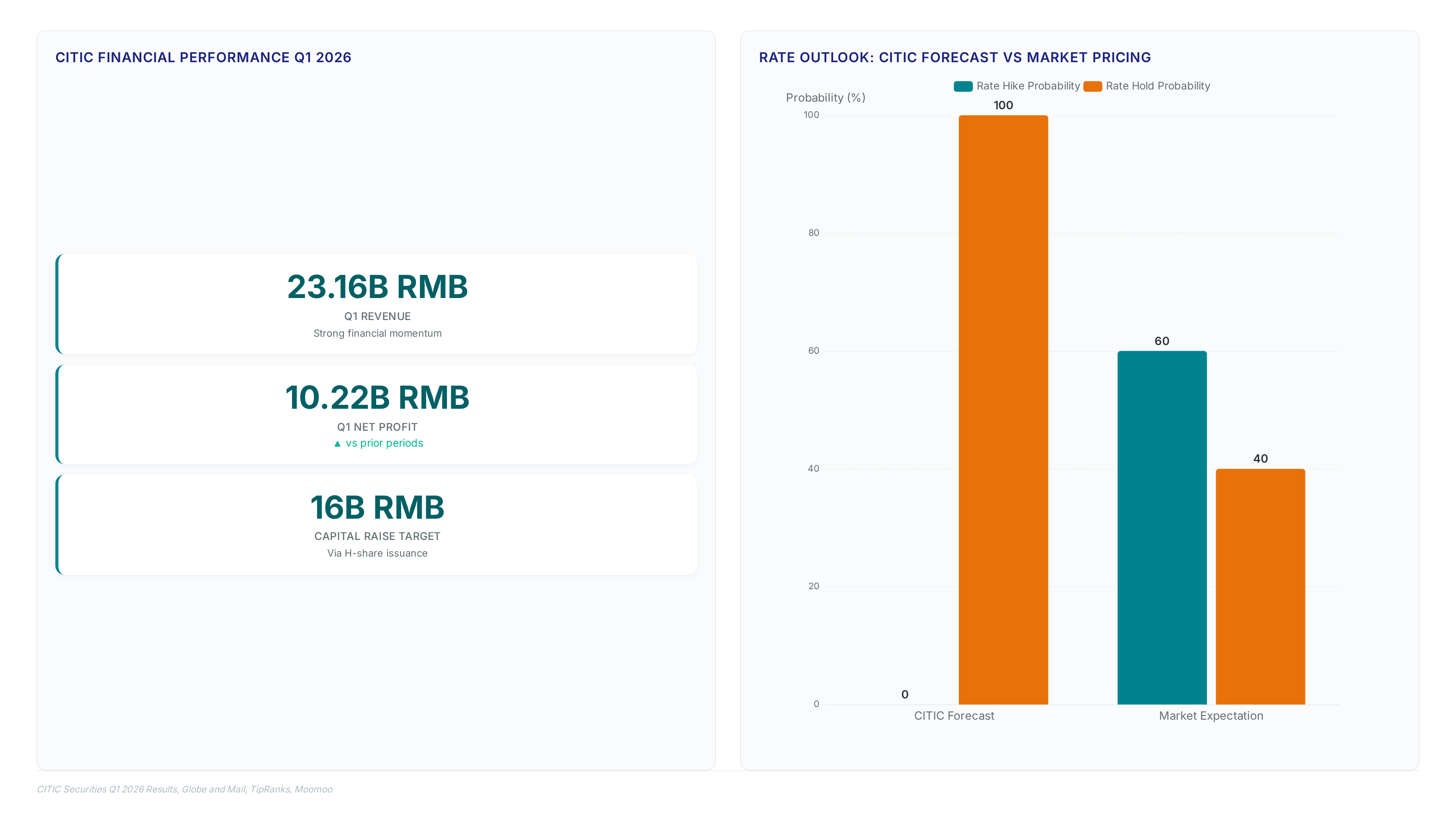
Political constraints and fading inflation pressures form the bedrock of the 2026 hold forecast issued by CITIC Securities, standing in direct opposition to market pricing that anticipates a rate increase. Traders betting on an October move now face heightened volatility because the removal of forward guidance forces reliance on raw data streams rather than central bank signals. The US-Iran memorandum acts as a critical variable by reducing energy-driven inflation, effectively stripping away the primary justification for tightening policy. This geopolitical shift undermines the hawkish argument and suggests the current FOMC split will eventually resolve in favor of the chair's position.
Investors should not expect a rate hike in 2026 because political constraints outweigh the hawkish dot plot signals. The regulatory fragmentation between deregulated zones and strict oversight complicates global compliance for AI-heavy lenders. A hold policy allows firms to capitalize on operational momentum without the stress test of rising borrowing costs. Conversely, a hike would expose the fragility of legacy systems unable to compete with AI-native speed. Best practices for navigating this data-dependent policy require ignoring median projections that ignore political reality. Portfolio construction must favor entities with proven risk management over those relying solely on rate arbitrage. Operators must recognize that economic data now reflects technological deflation rather than pure demand heat. This distinction dictates asset allocation more than any single CPI print.
Inflation Case Erosion If US-Iran Memorandum Progresses
Oil premium unwinding removes the primary justification for a rate hike if the US-Iran deal holds. Should the geopolitical premium in oil continue to unwind, the inflation case for hiking weakens, potentially invalidating market expectations for an October move. This flexible shifts the internal FOMC calculus, where the roughly 50-50 split on tightening may resolve toward the chair's hold position. Operational durability data from CITIC Securities illustrates this stability; the firm reported RMB23.16 billion, their net profit a substantial amount shows how stable policy supports financial sector performance improved than aggressive hikes.
| Scenario | Inflation Driver | Policy Probability |
|---|---|---|
| MOU Stalls | Energy spikes persist | Hike likely |
| MOU Progresses | Geopolitical premium fades | Hold confirmed |
The limitation for traders betting on higher yields is that political constraints often override dot plot projections. A Fed that hikes into an election-sensitive economy risks severe friction with the administration, a factor CITIC explicitly weights. Consequently, the inflation case erodes not through data, but through the strategic withdrawal of the geopolitical risk premium. Operators asking should i expect a rate hike in 2026 must weigh this diplomatic progress against static economic models. The divergence between citic outlook vs market expectations narrows only if energy prices spike again, a signal currently absent in forward curves.
Strategic Portfolio Adjustments for a Data-Dependent Rate Environment
Defining the Data-Dependent Policy Signal
Raw CPI and payrolls prints now drive policy signals after the Federal Reserve issued a 130-word statement stripping forward guidance. Chair Kevin Warsh eliminated explicit pathing to force markets toward lagging data, creating volatility where pricing swings on every release rather than committee projection. CITIC Securities contends that fading energy inflation and political dynamics will block rate hikes despite the recent hawkish shock. Tracking inflation impact now demands observing how autonomous decision making algorithms react to these unguided drops. Pricing volatility spikes around each data point until the FOMC split resolves, a sharp departure from previous cycles reliant on signaling. Industry participants expect monetary policy to remain strictly data-driven as they balance premature easing risks against recovery needs per trends research Flexible tracking becomes necessary for survival in this ambiguous environment. Coverage Pillars suggests implementing real-time data ingestion to parse lagging indicators before market overreactions take hold. Ignoring this shift invites mispriced duration risk while the 50-50 committee split fluctuates.
Executing Portfolio Adjustments on CPI and Payrolls Releases
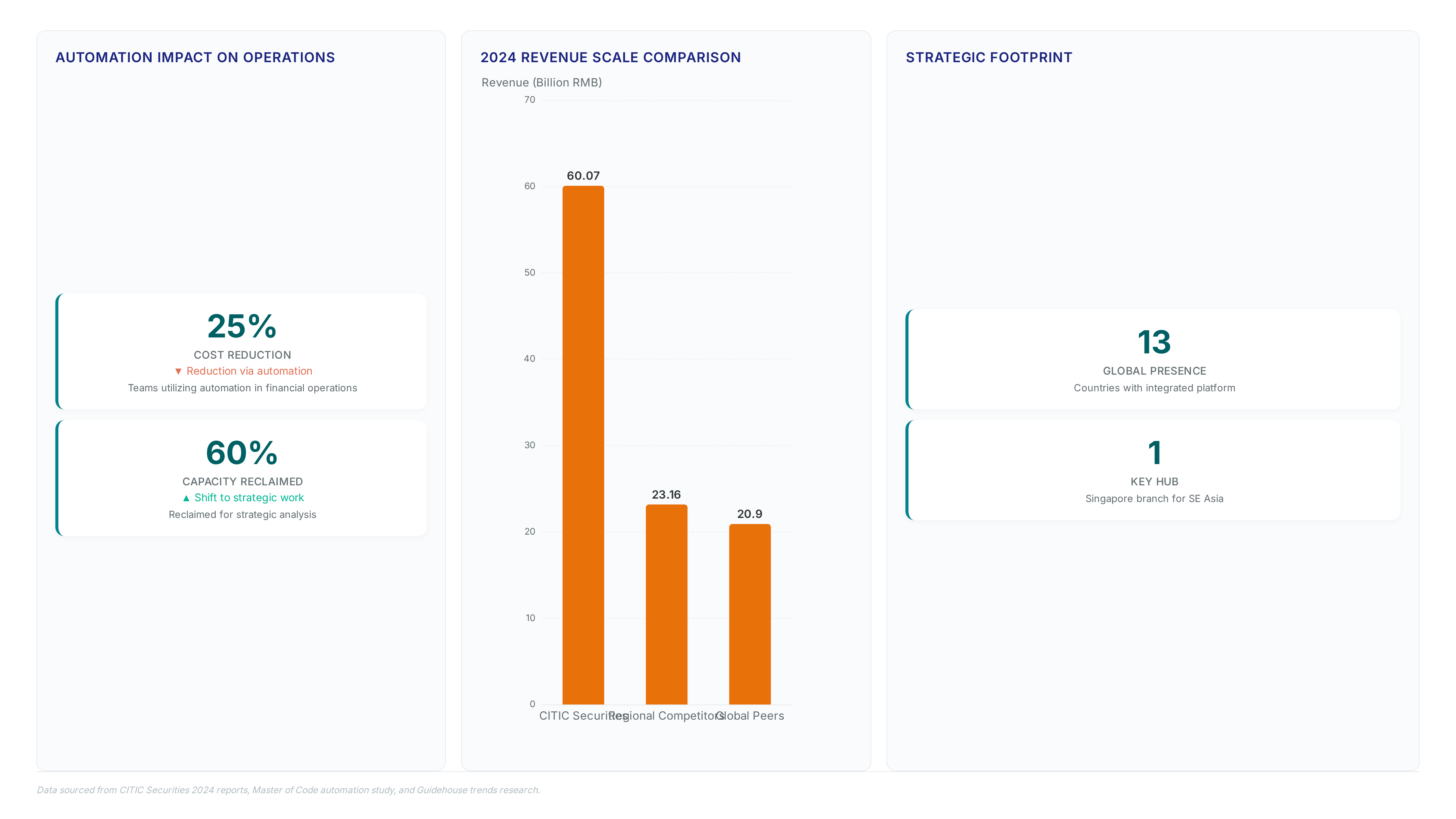
Rebalancing portfolios within minutes of CPI prints is necessary now that Chair Warsh removed forward guidance. Investors must weigh inflation prints against the geopolitical premium currently embedded in energy markets. CITIC Securities argues this premium will fade if the US-Iran deal holds, weakening the case for a rate hike despite hawkish dot plots. Operational execution now relies on speed previously unseen in manual workflows. Teams using automation in financial operations cut costs by 25% while reclaiming 60% of capacity for strategic analysis during these high-volatility windows. This efficiency allows firms to pivot capital quicker than peers relying on legacy signal processing. Divergence between market pricing and the CITIC hold call creates arbitrage opportunities for those monitoring political constraints on the FOMC.
| Data Release | Action if Above Consensus | Action if Below Consensus |
| CPI MoM | Reduce duration; hedge energy exposure | Extend duration; buy growth equities |
| Payrolls | Short Treasuries; increase cash buffer | Add used loans; reduce cash |
Global reach provides an edge when domestic signals conflict. Firms with an integrated platform spanning 13 countries can offset US volatility with stable Asian yields unlike domestic-only peers. Geographic diversification mitigates the risk of a sudden policy error by the Federal Reserve. Coverage Pillars recommends deploying autonomous agents to execute these trades since human reaction times often fail to capture the full move before correction. Latency costs in this environment exceed infrastructure upgrade expenses.
Application: CITIC's 2026 Hold Forecast vs Market Hike Pricing
CITIC Securities maintains its hold forecast against market pricing for an October hike by citing political friction risks. The firm argues that Chair Kevin Warsh faces White House pressure preventing tightening into an election cycle. This stance relies on the US-Iran Operational confidence supports this view as the parent CITIC.
| Metric | Market Expectation | CITIC Forecast |
|---|---|---|
| Policy Action | October Hike | Hold through 2026 |
| Inflation Driver | Sticky Core Data | Geopolitical Unwind |
| Political Risk | Ignored | Primary Constraint |
Portfolio managers must adjust duration targets only after confirming CPI prints align with geopolitical de-escalation rather than reacting to dot plot noise. The divergence creates a narrow window where hedging against a hike proves costly if the FOMC split resolves toward the chair's position. Operators relying on algorithmic cost reductions may miss this political signal entirely. Coverage Pillars recommends monitoring incoming data releases specifically for energy premium compression before rebalancing fixed income allocations.
About
Vikram Nair, Emerging Markets & Asia FX Writer at ForexCFD. Top, brings critical perspective to the federal funds rate debate through his specialized focus on how US monetary policy ripples through developing economies. While his daily coverage centers on USD/INR, USD/NGN, and regional central bank decisions, understanding the Federal Reserve's trajectory is necessary for analyzing capital flows into Asia and Africa. At ForexCFD. Top, an independent publication dedicated to factual market analysis for retail traders, Nair applies his expertise in global macro dynamics to dissect complex forecasts like CITIC Securities' prediction of a paused Fed. His work connects high-level US policy shifts directly to their tangible impacts on emerging market currencies and local funding rails. By contextualizing how political constraints and fading inflation might keep rates steady, Nair helps traders navigate the volatility inherent in cross-border FX markets without hype or vendor bias.
Conclusion
The current market equilibrium fractures when political constraints on rate adjustments collide with the massive operational shift coming from Generative AI. These systems will not merely execute trades quicker; they will fundamentally alter liquidity depth by reacting to geopolitical signals that human analysts often dismiss as secondary. Latency will no longer be the primary bottleneck; interpretive alignment with non-traditional data sources will define profitability. Relying on standard duration hedges without accounting for this algorithmic surge in capacity reclamation creates a hidden vulnerability in portfolio construction.
You must treat the current divergence between market hike pricing and the "hold" forecast as a temporary arbitrage opportunity driven by human hesitation. Commit to a full infrastructure audit of your data ingestion pipelines by Q4 2027 to ensure your systems can parse energy premium compression distinct from core inflation metrics. Do not wait for the next FOMC meeting to validate this approach. Start by mapping your current trade execution logic against known geopolitical triggers this week to identify where manual overrides still exist. Eliminating these bottlenecks now prevents costly misalignment when machine-driven volume dominates the environment.
Frequently Asked Questions
CITIC believes political constraints and fading energy inflation will stop hikes. The committee's 3.8% median projection conflicts with the chair's cautious stance on holding rates within the current 3.5% to 3.75% range.
Eliminating path forecasts forces traders to rely on raw data, increasing volatility. Markets must now interpret the split decision without clear signals, even as the benchmark rate sits between 3.5% and 3.75%.
Members are divided on whether inflation pressures justify tightening policy further. This uncertainty exists while the median projection hints at 3.8%, contrasting sharply with the decision to hold rates steady.
Rapid Generative AI adoption by over 80% of banks could alter productivity dynamics. This shift complicates inflation signals that the committee monitors when deciding on rate adjustments within the 3.5% to 3.75% range.
Historical trends show committee splits often align with the chair's position. Political survival and the US-Iran deal suggest maintaining the 3.5% to 3.75% range is more likely than hiking to 3.8%.