
Regulated forex brokers: Only 8 US firms left
Eight regulated Retail Foreign Exchange Dealers operated in the US as of 2023. That scarcity turns broker selection into a statistical bottleneck. You aren't just picking a platform; you are hunting for compliance in a consolidated market. Data from fx-list.com confirms just eight entities hold regulated RFED status within the United States. This forces a granular audit of every variable, from capital thresholds to trading platforms. Our analysis leverages testing by expert traders who evaluated order execution quality and Trustpilot ratings to generate definitive quality scores.
These scores sit alongside a brutal reality: up to 89% of retail CFD accounts lose money. We dissect the mechanics behind Raw Spread and Zero Account structures, highlighting specific licenses held by firms like FP Markets, which maintains credentials with ASIC and CySEC. These distinctions are your primary defense against the high probability of capital erosion inherent in used products.
The Critical Role of Regulatory Compliance in Forex Broker Selection
Defining Regulated Forex Brokers via ASIC and CySEC Licenses
Tier-1 authorities define a regulated forex broker through strict financial oversight and verifiable license numbers. FP Markets demonstrates this adherence with ASIC license #286354 and CySEC registration #371/18. Fusion Markets holds ASIC #385620 alongside FSAS credentials. These numbers separate legitimate entities from unregulated operators that lack audit requirements or capital safeguards. Ratings now weigh these licenses heavily against execution quality to differentiate market participants. Traders increasingly prioritize Tier-1 regulation to mitigate fraud risks inherent in the global FX marketplace.
Holding a license does not eliminate the high probability of retail capital loss due to use. The distinction lies in the regulatory compliance track record used to generate overall quality scores. Regulatory standing acts as a primary differentiator for serious market access. A license number confirms adherence to reporting standards yet leaves market risk entirely with the trader. As of 2023, there were exactly eight Retail Foreign Exchange Dealers operating as regulated forex brokers in the United States.
The 74-89% Retail Loss Risk in Unregulated CFD Trading
Data confirms that 74-89% of retail CFD accounts lose money. This statistic reflects the mathematical certainty of use without protective oversight. The high failure rate emerges because trading used products involves significant risk. Some platforms offer deep liquidity, yet the absence of regulatory scrutiny allows for potential conflicts of interest that harm traders. Choosing a regulated broker becomes necessary when an operator requires verified order execution quality and transparent cost structures.
Regulation does not eliminate market volatility, only the risk of broker malfeasance. Use risks compound rapidly when counterparty protection is absent. Understanding these mechanics is vital before engaging with any financial instrument. Investors should prioritize brokers subject to proactive protections to mitigate the probability of total capital loss.
Evaluating Broker Regulation: Spreads, Platforms, and License Verification
License verification begins by cross-referencing provided registration numbers against official regulator databases to confirm active status. Traders must validate these credentials before depositing capital, as unverified entities often lack necessary investor protections. Once regulatory standing is confirmed, the evaluation shifts to trading costs and platform compatibility. XTB demonstrates competitive pricing with an average spread of 1.36 pips on substantial pairs, undercutting the general industry average of 1.52 pips. Alternatively, specific account tiers at Pepperstone charge a commission structure alongside raw spreads startin from 0.1 pips.
Platform availability further dictates operational capability for algorithmic or manual strategies. FP Markets supports platforms including cTrader, IRESS, MetaTrader 4, MetaTrader 5, and TradingView, offering diverse technical environments. The following table summarizes key differentiators found during assessment:
| Feature Category | Evaluation Metric | Strategic Implication |
|---|---|---|
| Regulatory Status | Active License Number | Contributes to overall quality score based on compliance track record |
| Cost Structure | Spread Width vs Commission | Impacts total trading costs alongside order execution quality |
| Technology Stack | Platform Suite Diversity | Determines available trading instruments and supported languages |
Low nominal spreads often conflict with commission fees. A trader executing small lot sizes may find raw accounts with commissions mathematically inferior to standard spread-only accounts. Apply proprietary screening tools to model these cost structures against specific trading volume rather than relying on advertised headline rates. Always verify that the chosen entity holds a valid license in your jurisdiction before initiating any used positions.
Inside Forex Trading Costs and Use Mechanics
Use Mechanics and CFD Risk Exposure
Use in forex functions as a multiplier of exposure rather than an increase in actual capital. This mechanism allows traders to control large positions with a small margin deposit, mathematically amplifying both potential gains and losses relative to the initial outlay. CFD trading inherently involves a high risk of losing money rapidly due to this use structure. The mathematical reality is that a minor price fluctuation can trigger a margin call or total capital depletion if risk is not strictly managed.
| Feature | Standard Account | High Use Exposure |
|---|---|---|
| Capital Required | Full Notional Value | Fractional Margin |
| Risk Profile | Linear Price Movement | Amplified Volatility |
| Liquidation | Rare without crash | Accelerated on spike |
Many global entities offer use ratios up to 1:400 on specific assets, yet US-regulated brokers face strict limits imposed by the CFTC. While some platforms require a minimum deposit to access competitive trading packages, the primary barrier is often psychological discipline rather than funding. Traders must recognize that use does not create value but merely accelerates the realization of market moves. Transparent pricing structures and educational resources help clients understand these mechanics before using real capital. Chasing maximum use ratios offered by third-party entities is generally discouraged, as higher use reduces the buffer against market noise. Trading used products is risky and requires a clear understanding of how liquidation levels are calculated.
Raw Spread Pricing and Commission Structures
Raw spread pricing reduces the bid-ask differential, charging a fixed commission per trade instead. This structure benefits high-frequency strategies where tight execution outweighs fixed fees. Specific account tiers offer spreads starting from 0.1 pips alongside a round-turn charge. Traders must calculate the break-even volume where these reduced spreads offset the explicit commission cost compared to standard models.
Assessing total trading costs requires analyzing both variable spreads and fixed fees rather than advertising claims alone. Competitive providers achieve tighter pricing to attract cost-sensitive participants. A comparison of account types reveals distinct cost profiles for different trading styles. Unlike standard accounts where costs are opaque within the spread, raw pricing makes the transaction cost visible and immediate. This transparency allows precise calculation of the profit target needed to cover expenses before realizing gains. Regulated access to these pricing structures ensures traders operate within a compliant environment. Used metal and currency trading carries a high risk of rapid capital loss. Retail investors should verify the specific fee schedule before selecting an account type.
Mechanics: Broker License Verification and Platform Audit
FP Markets holds license #371/18 from CySEC (Cyprus) and #286354 from ASIC (Australia). Cross-referencing these identifiers prevents exposure to entities lacking proper oversight. Traders increasingly prioritize Tier-1 regulation to mitigate fraud risks prevalent in offshore jurisdictions. Confirming platform availability ensures compatibility with your execution strategy before depositing capital.
- Test order execution latency on a demo account to validate server stability.
Execution quality is a key factor in determining the quality of a broker's offer, alongside the range of instruments and ease of access. The limitation here is that a valid license does not guarantee superior fill quality during high volatility.
| Verification Step | Primary Risk Mitigated |
|---|---|
| License Cross-Check | Entity Fraud |
| Platform Demo Test | Technical Failure |
| Spread Audit | Hidden Cost Exposure |
Validating these technical parameters rigorously is necessary for market participation. CFD trading involves a high risk of losing money rapidly due to use. Even with a verified broker, inappropriate position sizing can deplete an account quickly. Traders must balance these competing forces carefully. Always ensure your chosen use ratio aligns with your personal risk tolerance and account equity.
Comparative Analysis of Leading Forex Platforms and Account Types
FP Markets vs Fusion Markets: Platform Ecosystems and License Jurisdictions
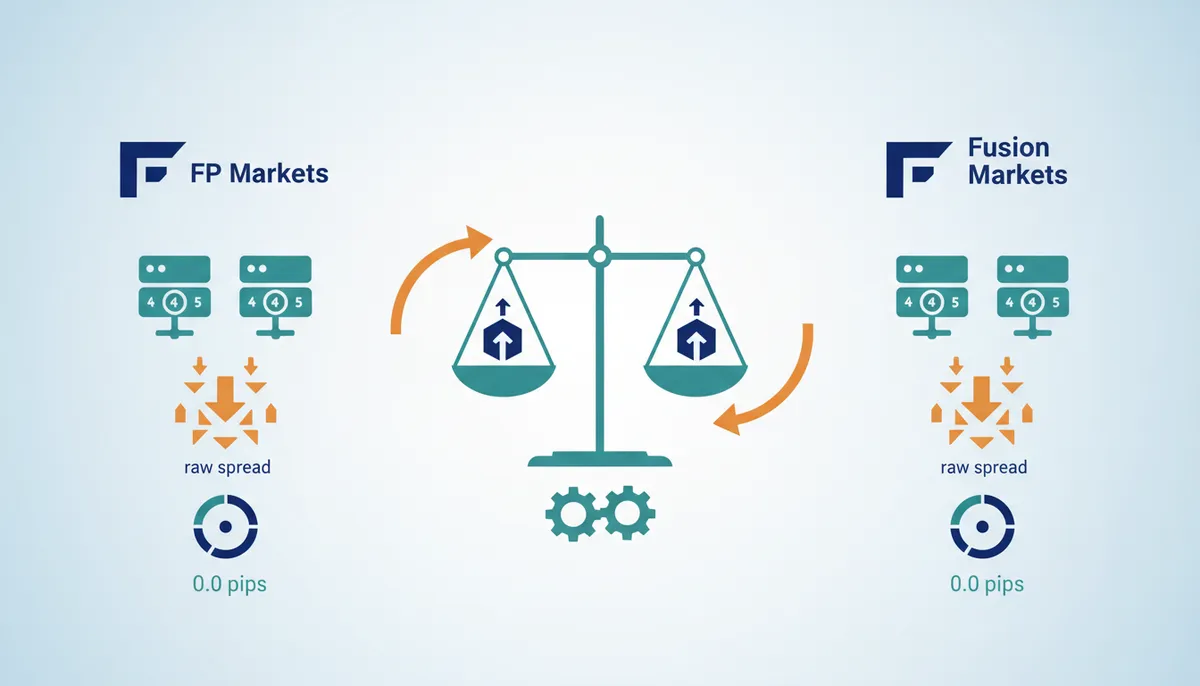
ASIC (#286354), CySEC (#371/18), FSAS (#SD130), FSCA (#50926), and the SCB grant FP Markets a broad compliance footprint. Fusion Markets holds authorizations from ASIC (#385620), VFSC (#40256), and FSAS (#SD096). These distinct regulatory maps define the operational boundaries for traders seeking specific jurisdictional oversight. Platform availability further separates these entities. FP Markets supports IRESS institutional software alongside MetaTrader 4, MetaTrader 5, cTrader, and TradingView to cater to professional order flow needs. Fusion Markets emphasizes its proprietary MetaFX system, Fusion+ Copy Trading tools, DupliTrade integration, MetaTrader 4, MetaTrader 5, cTrader, and TradingView, targeting social trading demographics rather than deep institutional integration.
Deploying Copy Trading and Multi-Platform Strategies on Fusion+ and IRESS
DupliTrade and proprietary copy solutions via Fusion+ allow Fusion Markets users to mirror positions across substantial pairs without constant monitoring. FP Markets integrates IRESS to support advanced technical analysis on a single screen alongside its support for MetaTrader and cTrader. This divergence creates a clear choice between passive income generation and active tactical management. Broker infrastructure now supports trading across multiple asset classes within a single account structure, facilitating smooth shifts between forex and indices. Relying solely on copied signals ignores the latency risks inherent in retail execution environments. Retail capital faces high probability of loss when use increases these timing discrepancies. ForexCFD.top provides the regulated environment and educational resources necessary to navigate these platform differences safely.
Account Type Selection Risks: Raw Spread Updates and Zero Account Compatibility
Stale pricing timestamps create immediate execution risk when traders select account types based on outdated data. FP Markets Raw Account spread figures reflect updates from 2025-12-03 13:41:57 UTC. Fusion Markets Zero Account data dates to 2025-12-01 09:16:48 UTC. This temporal misalignment means a trader comparing current spreads against these benchmarks may miscalculate true entry costs by several pips during volatile sessions. The mechanism of failure involves latency arbitrage, where the displayed spread does not match the live executable price, leading to rejected orders or unexpected slippage. Relying on static spread tables ignores the flexible nature of liquidity provision, where costs fluctuate second-by-second regardless of the last update time. A guide to comparing trading platforms must prioritize real-time demo account testing over historical tables to validate actual fill quality. Traders should verify that their chosen broker offers transparent pricing mechanisms that align with their specific trading strategy. ForexCFD.top provides regulated access to diverse market conditions, allowing clients to test execution quality without the risk of capital loss associated with unverified data. Used metal and currency trading carries a high risk of losing money rapidly; investors should ensure they fully understand the implications of use before engaging.
Strategic Framework for Selecting a Regulated Forex Broker
Defining the Broker Quality Score Components
Quantifying verified regulatory audit trails starts the evaluation of any serious brokerage firm. A team of expert traders tested multiple brokers to compile a ranking, assigning an overall quality score by weighting these findings against hard data like trading costs and order execution fidelity. Trading costs dictate the viability of a strategy just as much as instrument range or platform stability. Compliance track records offer a safety net against fraud, yet they provide no shield against market losses. Retail traders must recognize that a significant majority of investor accounts lose money even when using fully licensed entities. This statistic proves compliance stops theft but cannot fix a bad strategy. Selection frameworks filter unsuitable candidates early by enforcing capital thresholds. Some stability-focused providers require minimum deposits to align client risk profiles with their service model. These structural requirements ensure participants meet baseline financial criteria. Cheap spreads mean nothing if order execution fails during news events. Traders should prioritize brokers where the quality score reflects a balance of tight pricing and proven uptime rather than marketing promises alone.
Application: Applying License Verification to FP Markets and Fusion Markets
Specific license numbers prevent capital exposure to unregulated clones masquerading as legitimate firms. FP Markets operates under CySEC license 371/18 for European clients and ASIC license 286354 for Australian traders. Fusion Markets holds ASIC license 385620, granting access to strict capital adequacy standards. Traders must cross-reference these identifiers against official registers rather than trusting website footers alone.
| Broker | Primary License | Jurisdiction | Verification Status |
|---|---|---|---|
| FP Markets | 371/18 | Cyprus (CySEC) | Active |
| Fusion Markets | 385620 | Australia (ASIC) | Active |
Regulatory divergence creates complex environments where a single brand offers different protections based on the selected entity.
Checklist for Validating Spread Data Recency and Account Types
Confirming the timestamp on pricing feeds prevents execution on stale models that ignore volatility spikes. Raw Account spreads at FP Markets were last updated 2025-12-03 13:41:57 UTC, providing a concrete benchmark for data freshness. Traders comparing Raw versus Zero structures must align commission schedules with their specific scalping or swing strategies. Outdated charts often obscure these fixed fees, leading to miscalculated break-even points during high-frequency sessions.
| Feature | Raw Account Focus | Zero Account Focus |
|---|---|---|
| Cost Structure | Low spreads + Commission | Wider spreads + No Commission |
| Data Recency | Critical for scalping | Less sensitive to micro-shifts |
| Best Use | High frequency | Swing trading |
Availability varies notably by jurisdiction and broker, fundamentally altering the risk profile of low-spread accounts. Maximum fixed use on crypto CFDs with certain brokers can reach up to 1:400, whereas other instruments or regions may enforce stricter limits. Retail traders should note that CFD trading involves a high risk of losing money rapidly due to use. Validating license numbers and fee schedules directly with the broker before funding is necessary. Capital preservation requires treating spread verification as a daily operational ritual rather than a one-time setup task.
About
Aisha Rahman serves as the Gold & Commodities Analyst at ForexCFD.top, where she leads coverage of XAUUSD and global commodity markets. Her deep expertise in Islamic finance principles and swap-free trading structures makes her uniquely qualified to evaluate forex brokers for a diverse, global audience. In her daily work, Aisha analyzes how regulatory frameworks and trading costs impact retail traders in the Gulf, Southeast Asia, and emerging markets. This article's rigorous broker comparison directly reflects her professional focus on transparency, regulatory compliance, and ethical trading conditions. By examining factors like execution quality and account types, she ensures that ForexCFD.top provides vendor-neutral insights aligned with strict editorial standards. Her analysis helps traders navigate complex market choices without endorsing specific third-party platforms, maintaining an education-first approach that prioritizes risk management and factual accuracy over commercial promotion.
Conclusion
Scalability in raw spread trading breaks when commission opacity masks the true cost of frequent entries, turning minor slippage into sustained capital erosion. While a roundturn fee appears competitive, it demands precise volume calculations that many retail strategies overlook until drawdowns accelerate. The persistent statistic that 73.7% of retail investor accounts lose money highlights that low spreads alone cannot compensate for inadequate risk management or poor execution logic. Regulatory landscapes are shifting, with increased scrutiny expected on social-driven acquisition funnels by 2027, signaling that gamified promotions will face tighter constraints. Traders must therefore pivot from chasing marketing hype to verifying structural integrity.
You should prioritize brokers that offer transparent, jurisdiction-specific license validation over those promising unrealistic use ratios. Do not wait for regulatory enforcement to dictate your safety standards; instead, treat spread verification as a daily operational ritual. Start this week by manually cross-referencing your broker's license number against your local regulator's database before placing your next trade. This single step ensures your capital remains under valid legal protection rather than exposed to regulatory arbitrage. By anchoring your strategy in verified data and compliant entities, you build a resilient foundation capable of withstanding market volatility and evolving oversight.
Frequently Asked Questions
Studies show 73.7% of retail investor accounts lose money trading CFDs. This high failure rate means you must prioritize strict risk management and verify broker regulation before deploying any capital to avoid rapid losses.
This fixed cost structure requires traders to calculate break-even points carefully, as frequent small trades can erode profits faster than wider spread models.
Unregulated brokers lack the oversight that protects against the 89% loss risk seen in some CFD environments. Choosing a licensed entity ensures your funds are segregated, reducing the chance of total capital erosion from broker malfeasance.
Some regulated firms report that 72% of retail investor accounts lose money, which is slightly better than the highest averages. This variance suggests that platform stability and execution quality directly impact your probability of survival.
Ignoring license checks exposes traders to the same 89% loss risk found in unregulated sectors. Without verified oversight, there is no guarantee of fair order execution, making capital recovery impossible if the operator engages in fraudulent activities.
References