
Riskoff Sentiment: Why WTI Crude Slid 3.8% Today
WTI crude slid 3.8% to $69.90 as risk-off sentiment dominated the June 24, 2026 session. Forget chasing the drop; the real edge lies in decoding the mechanical cascade triggered by central bank cues and data misses like the Swiss Economic Sentiment Index. We are here to measure the tangible ROI of trading these volatile macro windows, not to guess at noise.
The Federal Reserve is expected to maintain the federal funds rate target range at 3.50% - 3.75% as of June 2026, creating a rigid backdrop for currency moves. Combine this with the Swiss Economic Sentiment Index dropping to -25.0 against a 1.5 forecast, and the market reaction shifts from chaotic to predictable. Our analysis at ForexCFD.top dissects how these specific data points drive the currency volatility that retail traders often misinterpret.
Real session data shows the U.S. Dollar firmed against every substantial counterpart while gold and bitcoin extended declines. The divergence between Australia's CPI Growth Rate of 4.0% and forecasts of 4.4% illustrates the precision required to navigate these environments. Instead of chasing momentum, our proprietary strategies focus on the measurable ROI found in macro-based trading during these high-frequency windows.
The Role of Risk-Off Sentiment in Modern Forex Markets
Defining Risk-Off Sentiment Amid Chipmaker Slides
Capital rotates fast when fear hits. Risk-off sentiment describes the rapid flight from speculative assets into safe-haven currencies during acute market stress. On June 24, a fresh slide in chipmakers ahead of Micron Technology results weighed heavily on global equities, setting the tone for the session. The U.S. Dollar firmed against every substantial counterpart to finish as the day's strongest currency, cementing its status as the primary liquidity refuge. Both gold and bitcoin extended their recent declines as traders held to expectations for further Federal Reserve rate hikes over the coming year. The mechanism is simple: a simultaneous repricing of risk premiums across uncorrelated asset classes.
Core CPI isolates persistent inflation by excluding volatile energy and food prices, offering central banks a clearer signal for policy than headline figures. Australia's May 2026 CPI growth settled at 4.0% y/y, a deceleration that still keeps real yields negative and pressures the AUD during risk-off flows. Traders monitor these reports because yield differentials drive capital allocation more than absolute growth rates. When the Federal Reserve maintains its target range at 3.50% - 3.75%, as expected in June 2026, any deviation in inflation data forces immediate repricing of rate hike probabilities.
Housing data provides a parallel stress test for currency valuations. The U.S. MBA 30-Year Mortgage Rate held at 6.59% on June 19, 2026, constraining household liquidity and reinforcing the dollar's safe-haven bid. High borrowing costs suppress speculative appetite, pushing capital toward instruments with guaranteed returns. This dynamic creates a divergence where strong employment data might paradoxically weaken a currency if it complicates the central bank's inflation mandate.
| Data Point | Impact on Currency | Trader Expectation |
|---|---|---|
| Core CPI Rise | Bullish (Rate Hike) | Tightening Cycle |
| Mortgage Rate Spike | Bearish (Growth Fear) | Recession Hedge |
| Yield Curve Inversion | Mixed | Flight to Quality |
Timing remains the primary constraint. Markets often price in Federal Reserve actions weeks before official announcements, rendering the actual data release a volatility event rather than a trend starter. Understanding these mechanics allows traders to distinguish between noise and structural shifts in global liquidity.
Core CPI vs Headline CPI: Interpreting Australia's Inflation Split
Headline CPI captures the total price basket, while Core CPI excludes volatile energy and food to reveal underlying trends. Central banks target the persistent core component rather than temporary shocks. When oil prices fall over a significant share from their yearly high, headline inflation drops quicker than core measures. Traders misreading this signal may overestimate rate cut probabilities, leading to premature long positions in yield-sensitive currencies.
| Metric | Scope | Volatility Source |
|---|---|---|
| Headline CPI | All Items | Energy, Food |
| Core CPI | Excl. Energy/Food | Services, Rent |
The Treasury yield represents the return on government debt, acting as the global risk-free benchmark for currency valuation. Easing Middle East tensions recently dragged these yields lower, reducing the opportunity cost of holding non-yielding assets. However, relying solely on core data has a flaw: lag. It often misses rapid sentiment shifts driven by commodity collapses. Consequently, a trader focusing only on the 3.6% trimmed mean might miss the immediate deflationary pressure from falling oil. ForexCFD.top analysts note that this divergence creates transient arbitrage opportunities in AUD pairs during risk-off events.
A sharp WTI crude decline of 3.8% to $69.90 per barrel mechanically triggers immediate dollar strength by stripping inflation premiums from commodity currencies. This move, detailed in recent market analysis, forces algorithmic repricing across the G10 complex as traders scrub risk exposure ahead of core data releases. Simultaneously, a 2.5% slide in Micron Technology validates the defensive rotation, pushing the U.S. Dollar to finish as the strongest substantial currency against all peers. A critical tension exists for positions tied to SNB signals; while the central bank notes solid growth, its willingness to intervene creates a ceiling that conflicts with broad dollar momentum.
Measurable ROI from Macro-Based Trading Strategies in Volatile Sessions
Defining Macro Catalysts in June 2026 Forex Calendars
High-impact volatility clusters around the U.S. Core PCE Price Index release at 12:30 pm GMT, serving as the primary gauge for Federal Reserve policy adjustments. A secondary spike in liquidity often occurs earlier with U.S. Initial Jobless Claims for June 20, 2026, also scheduled for 12:30 pm GMT, which can abruptly alter yield curve expectations. European session direction frequently hinges on the ECB Lane Speech at 10:00 am GMT, providing critical nuance before American data floods the tape. When entering a gold position, operators should note that strong jobs data previously drove prices down to $3,987 by eroding the appeal of non-yielding assets. The tension lies in balancing immediate jobless figures against the slower-moving PCE metric; a mismatch here creates dangerous false breakouts. Gold is a story about real yields, fear, and the dollar - in that order. Our Islamic accounts offer swap-free structures for those adhering to Sharia principles while navigating these macro events. Always verify instrument permissibility and acknowledge that rapid price swings can exceed margin requirements instantly.
Executing Gold Entries Amid Fed Rate Hike Expectations
Wait for the setup. Gold entries require waiting for the U.S. Dollar to firm while Treasury yields drop on geopolitical easing. This specific convergence signals that inflation fears are subsiding, yet the Federal Reserve maintains a hawkish tilt regarding future rate hikes. A common error involves buying precious metals during initial yield dips; however, the dollar often strengthens first as a liquidity haven.
The optimal entry window emerges when chipmaker declines drag equities lower, forcing a rotation into cash before metals stabilize. Market participants must distinguish between temporary risk-off flows and structural policy shifts driven by central bank divergence. Should you trade forex on CPI data? Only if your strategy accounts for the volatility spike surrounding the Core PCE Price Index, as unexpected acceleration can invalidate technical setups instantly. The cost of premature entry is high when swap markets price in multiple rate increases over the coming year.
| Condition | Action |
|---|---|
| Oil falls below $70 | Watch for yield compression |
| Chip stocks slide | Monitor dollar strength |
| Fed speakers hawkish | Delay long entries |
ForexCFD.top provides the necessary infrastructure to execute these macro strategies with precision during volatile sessions. Used trading on gold carries significant risk, and capital can be lost rapidly. Islamic account holders should note that swap-free conditions apply, though instrument permissibility remains the client's responsibility to verify. Always prioritize risk management over speculation when navigating Fed expectations.
Volatility Traps in Chipmaker Slides and Oil Corrections
Correlated asset collapses distort standard forex signals when chipmaker slides drag equity sentiment alongside oil corrections. Markets leaned risk-off as a fresh slide in chipmakers ahead of Micron Technology's results weighed on equities, creating false breakouts for currency pairs. This specific convergence traps traders who enter long positions expecting traditional safe-haven flows into gold or the yen. Traders asking should I trade forex on CPI data must recognize that correlated declines invalidate standard divergence strategies until the dust settles. Those wondering how to use TradingView for forex should focus on overlaying equity indices with currency pairs to spot these traps early. The implication for network operators and traders alike is that correlation breakdowns require waiting for the U.S. Dollar to stabilize before executing entries. Our Islamic accounts offer swap-free conditions for those adhering to Sharia principles while navigating these turbulent sessions. Always consider that rapid price movements can lead to substantial losses exceeding initial deposits.
Strategic Takeaways for Fixing Losses During Risk-Off Events
Defining Risk-Off Loss Triggers in Chip and Oil Slides
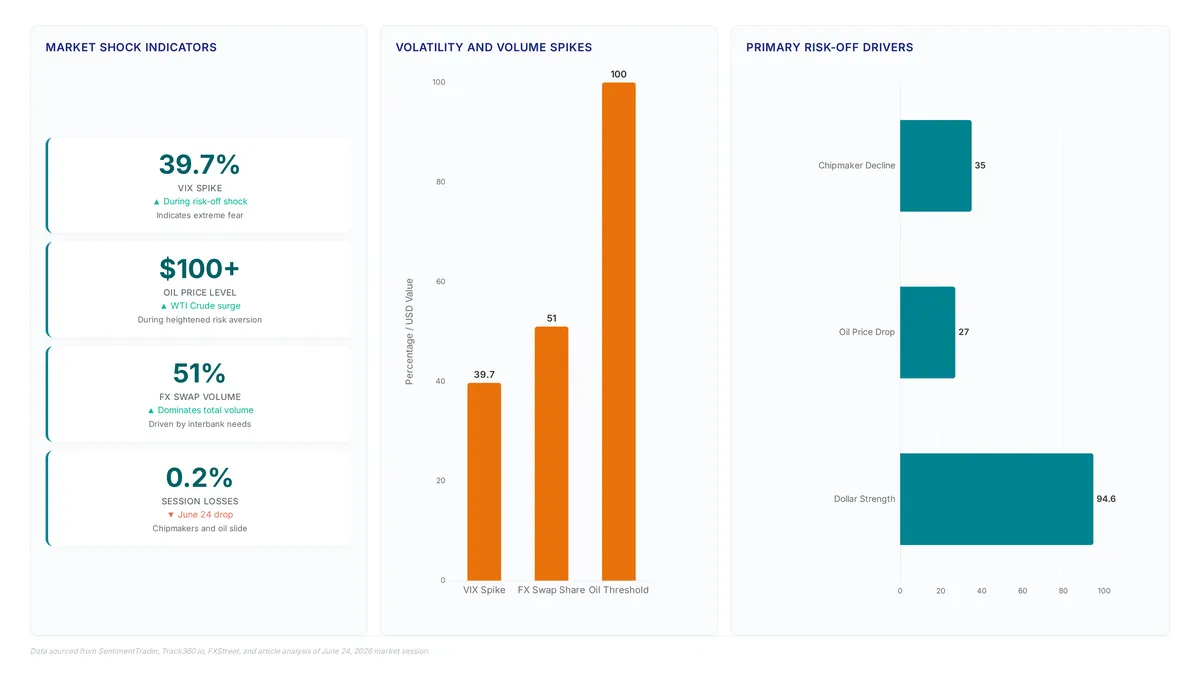
Losses accelerated on June 24, 2026, as chipmakers slid and easing Middle East tensions pulled oil toward pre-conflict levels. These synchronized moves punished traders holding positions across commodity and equity indices. Mechanical failure occurs when markets misinterpret isolated sector weakness as idiosyncratic rather than a systemic shift toward risk aversion. Broad-based declines in high-beta sectors signal a fundamental repricing of volatility expectations unlike isolated earnings misses. Distinguishing between direct trade effects and indirect sentiment shocks prevents compounding losses during these cascades. Managing exposure requires recognizing that falling oil prices ease near-term inflation impulse, trimming demand for inflation hedges while the dollar firms. Ignoring this sequence leaves portfolios exposed to compounding drawdowns as the session progresses.
Volatility Traps When Dollar Strength Overrides CPI Splits
Greenback strength against all substantial counterparts overwhelmed local inflation data, exposing traders to unexpected drawdowns. This divergence creates challenges for those holding AUD or NZD positions based solely on domestic rate expectations. Risk-off sentiment driven by falling oil prices and chipmaker declines forces capital into safe-haven assets like the US Dollar, often overriding detailed central bank signals from the RBA. Macro-based trading strategies must recognize that broad dollar strength acts as a dominant force, rendering isolated inflation beats less effective during liquidity crunches. Operators should prioritize reducing exposure to commodity currencies when the Dollar Index firming coincides with equity weakness to mitigate losses. Both gold and bitcoin extended recent declines amid expectations for higher rates, causing traditional inflation hedges to struggle. Ignoring this hierarchy leads to rapid account depletion as use increases the move against stranded positions. Verify instrument permissibility and swap costs on Islamic accounts before holding overnight during high-volatility central bank cycles.
Checklist for Validating Peace Talk Impacts on War Premiums
Traders must monitor physical crude grades and WTI convergence to confirm if war premiums have truly evaporated.
- Contrast headline peace narratives against tangible logistics in the Strait of Hormuz.
- Monitor FX swaps dominating a majority of volume for sudden liquidity contractions signaling stress.
- Validate inventory draws using definitive EIA reports rather than volatile API data releases.
Premature entries often fail because market participants misinterpret diplomatic rhetoric as immediate supply restoration. The cost of this error is measurable when speculative positions collide with lingering physical tightness.
| Indicator | Signal Type | Validation Action |
|---|---|---|
| Physical Grades | Lagging | Confirm price convergence with WTI |
| FX Swaps | Leading | Watch for significant volume spikes |
| Inventory Data | Confirming | Wait for Wednesday EIA release |
Strategists at JPMorgan lifted their year-end S&P 500 target to 7,800, pointing to solid earnings and the prospect of a peace deal to end the Iran conflict. This divergence creates a trap where peace premiums unwind slower than stock valuations anticipate. ForexCFD.top advises waiting for confirmed traffic normalcy before scaling down hedges. Used metals trading carries significant risk; ensure your strategy accounts for sudden geopolitical reversals. Monitor FX swaps dominating a majority of volume for sudden liquidity contraction around Hormuz. Watch for volume spikes exceeding half in X Swaps Leading indicators. Inventory Data Confirming Wait for Wedn remains necessary before committing capital.
About
Aisha Rahman, Gold & Commodities Analyst at ForexCFD.top, brings specialized expertise in safe-haven flows necessary for understanding today's risk-off sentiment. Based in the Gulf, Aisha's daily work focuses on correlating gold (XAUUSD) movements with macro drivers like real yields and geopolitical tension, directly mirroring the market dynamics where oil retreated and the dollar firming up. Her background in commodities research allows her to dissect how easing Middle East tensions and chipmaker slides impact global capital allocation. At ForexCFD.top, an independent publication serving retail traders across emerging markets, Aisha applies this experience to provide clear, regulation-aware analysis. She connects complex Federal Reserve rate expectations to tangible trading scenarios, ensuring readers grasp the implications for both traditional assets and crypto-CFDs. Her unique fluency in Islamic finance further enriches this perspective, offering critical insights for swap-free traders navigating volatile sessions without compromising on rigorous, vendor-neutral market education.
Conclusion
Market liquidity faces a critical test as risk-off sentiment intensifies alongside a projected significant probability of global recession. At this scale, the primary failure point is not volatility itself, but the lag between diplomatic headlines and the physical reality of supply chains. Traders who assume peace talks instantly erase war premiums ignore the sticky nature of logistics in the Strait of Hormuz, leading to premature positioning that capital cannot sustain. The operational cost of this error is severe margin erosion when speculative flows collide with lingering physical tightness.
ForexCFD.top recommends maintaining defensive hedges until inventory data confirms actual flow normalization, regardless of optimistic equity targets. Do not scale down protection based solely on rhetorical shifts; the market requires tangible proof of traffic normalcy before risk parameters can safely expand. This discipline prevents capital destruction during the gap between political announcement and logistical execution.
Start this week by cross-referencing your current exposure against the latest EIA inventory reports rather than reacting to intraday headline spikes. Only verified data should dictate your hedge ratio adjustments. Prioritize capital preservation over chasing early reversals in these fragile conditions.
Frequently Asked Questions
Massive liquidity allows minor sentiment shifts to create huge volume spikes.
The 4.0% CPI growth deceleration kept real yields negative, pressuring the currency. Traders sold AUD because this figure remained below the 4.4% forecast, signaling continued economic headwinds for the region.
The 6.59% mortgage rate constrains household liquidity and suppresses speculative appetite. This forces capital toward instruments with guaranteed returns, reinforcing the dollar bid during periods of market stress.
A 2.5% drop in Micron Technology shares weighed heavily on global equities. This sector weakness triggers rapid capital rotation from speculative assets into safe-haven currencies like the US dollar.
Gold fell 3% as markets priced in further Federal Reserve rate hikes. Expectations for tighter monetary policy over the coming year often override traditional safe-haven demand during specific risk-off sessions.
References