
USD/CNY rate: Why 6.7752 matters today
At 0115 GMT, the PBOC fixing at 6.7752 sets the yuan's immediate trading ceiling and floor. This daily ritual is the primary lever Beijing pulls to enforce stability within its managed floating system. Global FX volume hit $9.6 trillion daily in April 2025 according to Reuters data, yet China's approach remains rigidly controlled through the 2% trading band.
The counter-cyclical factor allows regulators to override pure market sentiment and offset pro-cyclical volatility. This discretion turns the fixing into a potent policy signal, distinguishing it from the free-floating regimes of the US dollar or Euro.
Global pressures mount as AI agents are predicted to intermediated 90% of B2B buying by 2028 per Gartner, potentially amplifying reaction speeds to Beijing's cues. (Gartner's strategic predictions for 2026) A stronger CNY midpoint signals a defense against depreciation; a weaker one implies tolerance for softness. The reference rate remains the single most watched metric for gauging the conflict between market forces and state intent.
The Role of the USD/CNY Reference Rate in China's Managed Floating Exchange System
PBOC USD/CNY Reference Rate and Managed Float Mechanics
Liquidity onshore hinges on a daily USD/CNY midpoint established by the People's Bank of China This specific number anchors the center of a trading band where the currency fluctuates plus or minus 2% during official hours. Free-floating regimes governing the US dollar or Euro lack such a set boundary.
The Chinese system embeds a unique counter-cyclical factor into its quotation model. Technical adjustments within this variable offset pro-cyclical volatilities driven by speculative sentiment rather than economic fundamentals. Global liquidity presents a hard limit on unilateral intervention capacity. Daily foreign exchange turnover reaches $9.6 trillion, dwarfing even substantial national reserve holdings. Such sheer volume forces the central bank to rely on price signaling via the midpoint rather than continuous direct market absorption.
Operators must distinguish between the mechanical calculation of the rate and the policy discretion embedded in the counter-cyclical factor. Inclusion of this variable means the midpoint does not purely reflect prior closing prices or basket movements. It serves as an explicit signal of tolerance for depreciation or appreciation pressures. Ignoring the factor leads to mispricing of tail risk in CNY derivatives.
Daily Fixing Schedule Impact on Asian FX Markets
Publication occurs at 0115 GMT when the People's Bank of China releases the USD/CNY reference rate to establish the center point for daily trading. This specific timing forces global liquidity providers to price risk before European markets open, creating a distinct volatility window. The managed floating exchange rate system relies on this anchor to guide expectations without rigid pegs.
Global scale complicates this signaling mechanism because the PBOC cannot simply trade against the market. It must signal intent effectively to shift sentiment across vast pools of capital. Unlike the free-floating US dollar, where price discovery is continuous and decentralized, the yuan depends on this discrete morning event for direction.
Mechanics of Midpoint Determination and the Two Percent Trading Band
PBOC Midpoint Calculation Inputs and Discretionary Policy
The midpoint derivation blends prior closing prices, overnight US dollar movements, and discretionary inputs targeting domestic stability. This calculation is not a purely mechanical formula but a policy instrument where the People's Bank of China weighs external FX conditions against internal growth momentum. Operators observe that the 7-day Reverse Repo (OMO) rate serves as the operational anchor for this stance, having been set at 1.40% following a trim on May 8, 2025.
Unlike free-floating regimes, the fixing mechanism prioritizes Policy Autonomy to support state-owned enterprises rather than adhering strictly to market-clearing levels.
Strategic Interpretation of Policy Signals and Market Expectations
Decoding PBOC Fixing as a Strategic Policy Signal

A stronger-than-expected CNY midpoint signals the PBOC is actively leaning against depreciation pressure rather than passively tracking market drift. Market participants interpret this deviation as a deliberate stance where authorities prioritize capital stability over export competitiveness during periods of dollar strength. This specific configuration of the midpoint transforms the daily rate from a mechanical reference into a forward-looking policy signal that dictates intraday trading behavior.
Conversely, a weaker fixing indicates tolerance for currency softness to absorb domestic economic headwinds without triggering panic outflows. The cost of misreading these signals is acute liquidity tightening, as seen when the central bank adjusts the 7-day Reverse Repo rate to penalize speculators betting against the official stance. Operators must distinguish between noise and genuine policy shifts by correlating the fix with broader monetary policy objectives announced at substantial forums.
| Fixing Direction | Implied Stance | Operational Consequence |
|---|---|---|
| Stronger | Resist Depreciation | Increased liquidity costs for shorts |
| Weaker | Allow Softness | Reduced intervention frequency |
The limitation of this approach lies in its reliance on market trust; if traders doubt the commitment behind the fixing, volume spikes can overwhelm the signaled intent. Global volatility often tests this mechanism, forcing a choice between defending the peg and preserving foreign reserves.
Assessing Market Sentiment During Global Volatility Events
Heightened global volatility forces investors to scrutinize midpoint deviations for signs of capital stability prioritization over export competitiveness. During US rate shifts, the fixing gains added significance as a direct signal of Policy Autonomy where Beijing balances competing economic mandates. Operators should adjust forex positions only when the reference rate diverges from market pricing models, indicating an active stance against pro-cyclical volatilities driven by sentiment.
The mechanism relies on a counter-cyclical factor embedded in the quotation model to offset speculative drift without exhausting reserve assets.
Autonomous algorithms from institutions like ING digest deep learning signals differently than human traders, often misreading a weaker fixing as pure depreciation tolerance rather than a reaction to dollar strength. This divergence creates immediate positioning errors when machines fail to distinguish between policy fatigue and temporary headwinds.
- Midpoint deviations trigger automated sell orders before human analysts assess domestic economic context.
- Legacy statistical models miss the detailed Policy Autonomy required to balance state-owned enterprise support against market stability.
- High-frequency systems amplify noise during periods where the central bank actually seeks to absorb shocks without depleting reserves.
The sheer scale of the market, with daily trading volume far exceeding equity turnover, means these algorithmic misinterpretations propagate globally within milliseconds. A softer currency indication might be a calculated move to aid exporters, yet AI-driven flows treat it as a fundamental break in the.
Operators must fix misinterpretation of PBOC signals by layered filtering that separates mechanical drift from strategic intent. Relying solely on the reference rate direction ignores the counter-cyclical factors embedded in the calculation model. The cost of ignoring this complexity is premature capitulation to algorithmic trends that reverse once human policymakers re-assert control over the narrative.
Operational Framework for Monitoring FX Policy and Currency Intervention
Defining PBOC Intervention Tools: Direct FX Swaps and Liquidity Adjustments
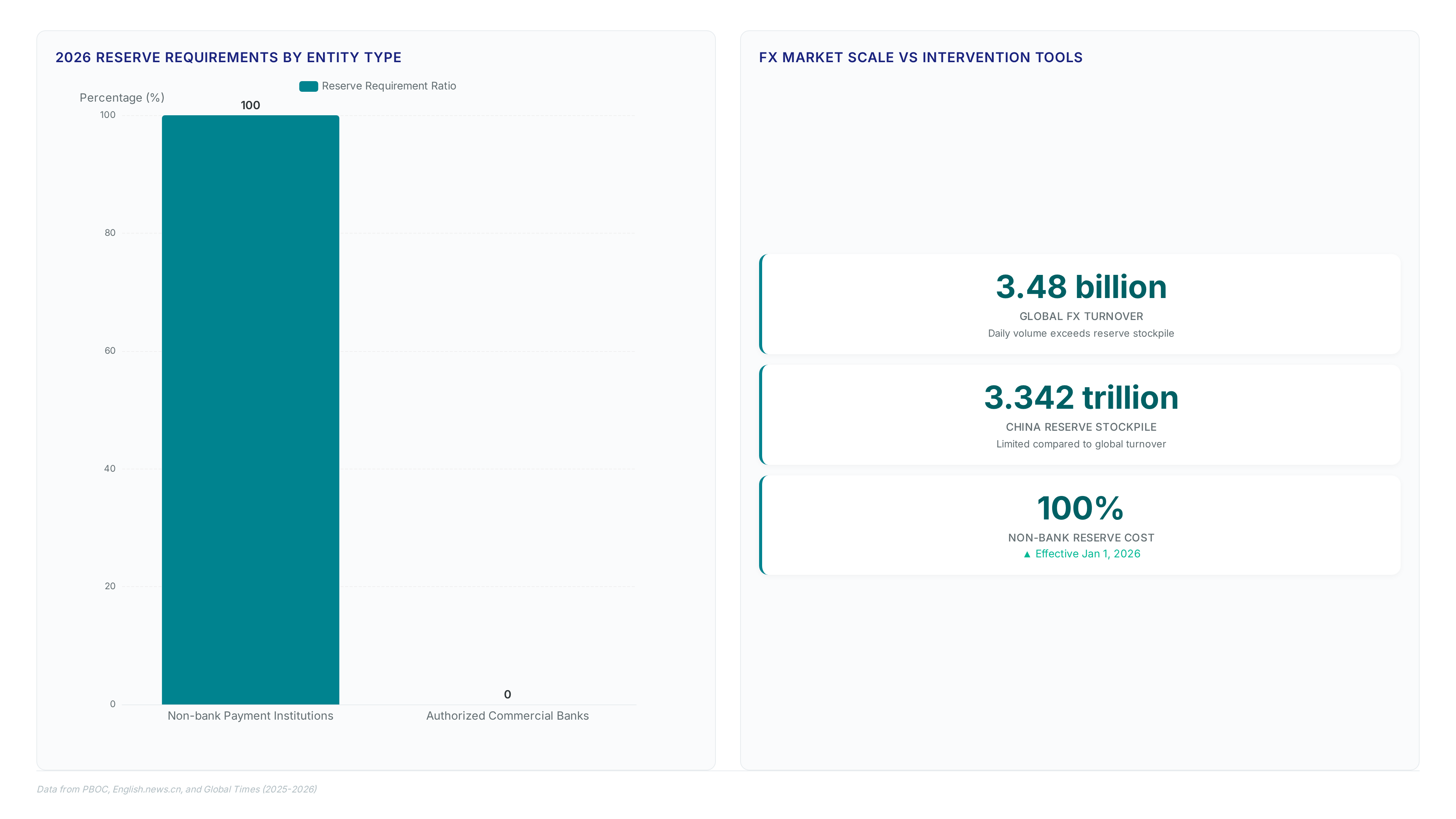
Direct yuan sales or purchases constitute the primary mechanism for smoothing volatility when market pressure hits the trading band edges. This approach contrasts with liquidity adjustments, where the central bank manipulates short-term funding costs to deter speculative attacks without depleting foreign reserves.
- Execute direct currency swaps to absorb excess supply during sharp depreciation events.
- 3. Monitor the gap between onshore and offshore rates to gauge intervention efficacy.
A critical limitation exists: global FX turnover vastly exceeds China's reserve stockpile, rendering direct buying unsustainable over prolonged periods. Operators must distinguish between temporary liquidity drains and structural reserve defense, as the latter signals deeper policy distress. The counter-cyclical factor further complicates analysis by masking true market sentiment within the official midpoint calculation. Misidentifying a liquidity tweak as a full-scale defense leads to premature positioning against the trend. Successful navigation requires separating mechanical band maintenance from genuine shifts in the operational anchor of monetary policy.
Tracking the 0115 GMT Fixing and State Bank Guidance Signals
Monitoring the 0115 GMT USD/CNY reference rate requires parsing discrete deviations alongside opaque guidance channels used by state institutions.
- Capture the official midpoint release at 0115 GMT to establish the daily trading band anchor before onshore liquidity opens.
- Compare the printed rate against forward market pricing to detect active Policy Autonomy where Beijing prioritizes stability over mechanical valuation.
- Scan interbank funding spreads for sudden tightness indicating state-owned banks are executing verbal or covert intervention directives.
A stronger-than-expected midpoint signals an intent to lean against depreciation pressure, yet this stance conflicts with the need to support export competitiveness during global slowdowns.
About
Sofia Mendes, Broker Reviews & Trading Education Editor at ForexCFD. Top, brings a unique, risk-aware perspective to the analysis of the USD/CNY reference rate. While her daily work focuses on vetting regulated brokers and teaching risk management to retail traders, this expertise is critical when interpreting high-impact central bank events like the PBOC fixing. As the editor responsible for the site's education library, Sofia understands that sudden volatility in emerging market pairs directly impacts execution quality and spread stability across trading platforms. Her rigorous approach to broker due diligence ensures that traders recognize how macro signals from China's managed floating exchange rate system can affect liquidity conditions. By connecting these institutional movements to practical trading realities, she helps the global audience at ForexCFD. Top navigate complex market environments with a clear focus on capital preservation and informed decision-making rather than speculation.
Conclusion
Manual interpretation of liquidity conditions creates a bottleneck as transaction velocity accelerates. By 2028, when AI agents intermediating $15 trillion in B2B spend demand millisecond-level certainty, the opacity surrounding state-directed interventions will cause algorithmic mispricing that human intuition cannot correct in real-time. The finite nature of reserve deployment means that defending specific price levels becomes increasingly expensive against automated, high-frequency flows that do not respect political nuance.
Organizations must transition from reactive monitoring to predictive modeling of policy divergence immediately. Do not wait for a crisis to audit your exposure; instead, mandate a full stress test of FX execution algorithms against scenarios where capital stability mandates override export competitiveness by the end of Q3 2026. Specifically, firms should integrate interbank funding spread analysis directly into their treasury management systems this week to detect early signals of covert intervention before the official 0115 GMT fixing locks in unfavorable rates. This proactive shift ensures that procurement strategies remain viable even when traditional valuation metrics decouple from market reality due to non-economic priorities.
Frequently Asked Questions
The currency fluctuates within a strict plus or minus 2% band around the official midpoint. This 2% trading band prevents excessive volatility while allowing some market-driven price discovery during onshore trading hours for investors.
Daily foreign exchange turnover reaches $9.6 trillion, which dwarfs even substantial national reserve holdings available for intervention. This massive $9.6 trillion volume forces the central bank to rely heavily on price signaling rather than direct trading.
AI agents are predicted to intermediate 90% of B2B buying by 2028, potentially amplifying reaction speeds to Beijing's cues. This 90% adoption rate means policy signals in the reference rate will trigger faster automated market responses globally.
Publication occurs at 0115 GMT, forcing global liquidity providers to price risk before European markets open. This specific timing creates a distinct volatility window that traders must navigate carefully before the main session begins.
A stronger-than-expected fix signals a desire to stabilize capital outflows and lean against depreciation pressure. This policy signal indicates the central bank is actively using the reference rate to guide market expectations regarding financial stability.