
Japanese Yen at 162: Inflation's Real Impact
USD/JPY clings to 162.00. This isn't just a number; it's a tripwire. Japanese authorities have a history of stepping in here, and the market knows it. We are staring at a volatile dichotomy: inflation normalization is building a fundamental floor for the Yen, yet technical resistance at these highs invites immediate regulatory blowback.
Data from FXStreet (June 26, 2026) shows Greater Tokyo Area inflation creeping toward the Bank of Japan 2% target. That proximity changes everything. It sets the stage for accelerated rate hikes. Commerzbank points out that underlying inflation is proving durable, shrugging off oil shocks that would have derailed it months ago. Yet, the market seems asleep at the wheel regarding the speed of this policy normalization.
Here is the math the market is ignoring: the current 1.00% policy benchmark is woefully inadequate against a 2.00% neutral rate target. That gap is the engine of volatility.
We are also staring down the barrel of the 162.00 threshold where intervention risk shifts from theoretical to palpable. Scotiabank warns that technical support is practically non-existent until 160.00. The entire trajectory now hinges on whether hawkish rhetoric from officials like Gov. Ueda can overpower the speculative momentum driving the pair higher. ForexCFD.top provides the framework to navigate these intervention levels without guessing.
Inflation Normalization Drives the Fundamental Floor for Yen Recovery
Greater Tokyo Area Inflation as the BoJ Policy Trigger
Stop looking at national averages and watch Greater Tokyo. Inflation in this specific region approaching the 2% target is the actual trigger for monetary policy normalization by the Bank of Japan. Why? Because this regional data filters out the noise of temporary energy volatility to reveal structural price durability.
When underlying inflation holds firm, it validates an exit from deeply accommodative stances. The Bank of Japan no longer needs an external oil shock to justify moving rates; the domestic data does the heavy lifting. The mechanism is simple: as prices stabilize above the floor, real yield expectations shift. The Bank of Japan gains the political cover to raise rates toward a neutral level. Research confirms that converging on this target forces a repricing of the Japanese Yen fundamental floor. The market cannot ignore a central bank with a mandate to act on stable, rising prices.
Applying Interest Rate Differentials to Yen Strength Forecasts
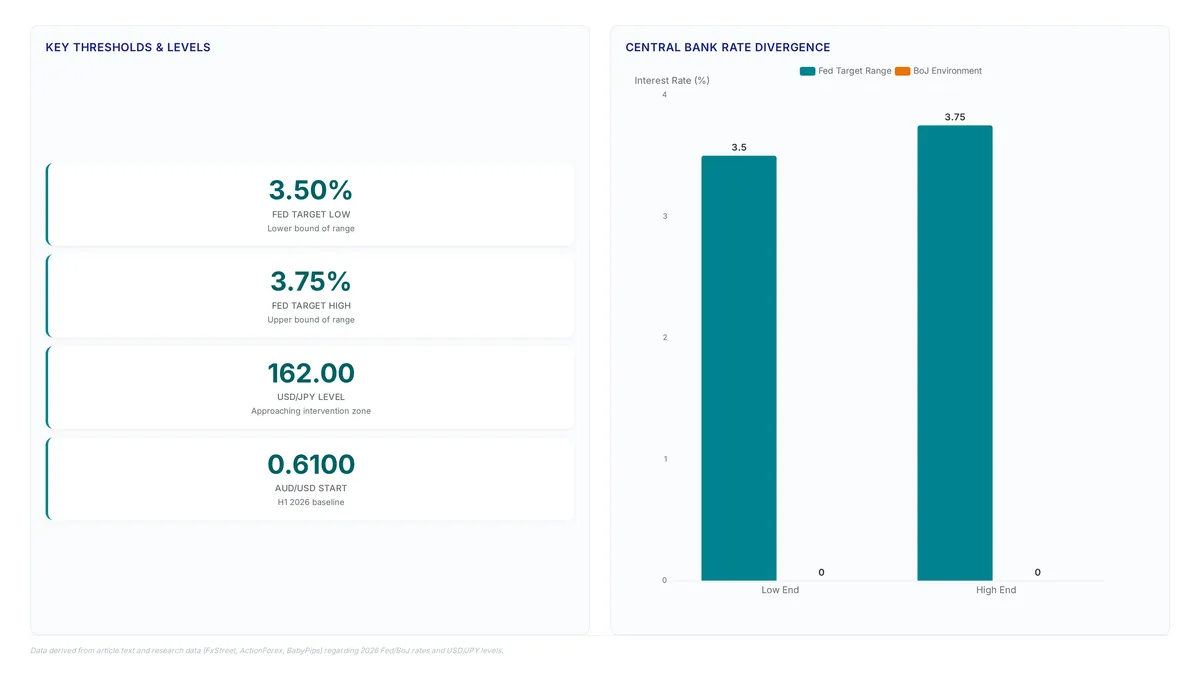
The gap drives the trade. Traders measure Yen strength by calculating the spread between the Federal Reserve's 3.50%-3.75% range and domestic Japanese yields. This interest rate differential has pushed USD/JPY toward 162.00, pulling capital toward higher nominal returns in the US.
The model assumes the Federal Reserve holds steady while the Bank of Japan lags. Evidence shows USD/JPY rising toward a 40-year high on these hawkish US expectations. But this model has a fatal flaw: it assumes static policy. If the neutral rate in Japan converges faster than the consensus expects, the carry trade unwinds violently. For network operators and forex traders, the implication is stark. The Yen sits in a fragile position with almost no technical support ahead of 160.00. The only thing preventing a collapse is the narrowing gap between current and neutral interest rates. Until then, the path is narrow and dangerous.
Risks of Market Underestimation in BoJ Normalization Speed
Commerzbank sees a dangerous blind spot: traders are underestimating the velocity of upcoming interest rate increases. This miscalculation creates a fragile pricing environment for the Japanese Yen. The currency is stuck in a high-stakes tug-of-war between structural support and speculative pressure, yet record short positions continue to propel the pair to fresh highs despite clear intervention risks.
The broader market failure here is the refusal to price in accelerated hikes. Capital remains exposed to violent reversals if the central bank acts sooner than expected. Technical resistance levels offer zero protection against fundamental shocks when positioning is this skewed.
Diminishing technical buffers leave the Yen exposed as resistance erodes near 162.00. Unlike the Euro or British Pound, this pair lacks fundamental yield support, making it uniquely vulnerable to sudden shifts in US inflation data. The mechanical failure is delayed monetary tightening by the Bank of Japan, leaving the domestic yield curve unable to offer a natural floor against speculative selling.
| Factor | Impact on Resistance |
|---|---|
| Yield Gap | Sustains carry trade pressure |
| Intervention Fear | Caps upside but weakens support |
| US Inflation | Drives volatility spikes |
The cost of this divergence is measurable: traders ignore long-term fundamentals because the immediate carry return outweighs intervention risk. But relying on technical barriers creates a fragile market structure where very little technical support exists ahead of 160.00. This forces operators to prioritize risk management over fundamental valuation until the yield gap narrows. ForexCFD.top provides advanced analytical tools to monitor these critical thresholds in real-time, ensuring traders can navigate volatile currency pairs with precision. Used metals and forex trading involve significant risk; losses can exceed deposits.
Technical Resistance at 162.00 Defines the Intervention Risk Threshold
Defining the 162.00 Intervention Risk Threshold
USD/JPY hovering near 162.00 is not a coincidence; it is a line in the sand where Japanese authorities historically intervene to stop rapid depreciation. This level acts as a hard ceiling, not standard technical resistance. Official action creates non-linear price corrections that shatter breakout strategies.
Scotiabank notes the pair sits uncomfortably close to this trigger with minimal support down to 160.00. Market participants now price intervention probability as a distinct risk premium capping further Yen weakness. Ignoring this reality invites asymmetric volatility: gains are limited by policy, while losses expand during sudden reversals. ForexCFD.
Risks of Speculative Selling Pressure Amid Diminishing Support
Speculative selling accelerates as technical resistance levels thin near the 162.00 intervention zone. Scotiabank warns that the Japanese Yen remains fragile until monetary adjustments occur, leaving traders exposed to sharp reversals. The strategy team emphasizes that diminishing support creates a volatile testing ground where price action decouples from fundamental yield differentials. Without a buffer, even minor dollar strength triggers disproportionate yen weakness, forcing reliance on intervention threats rather than organic demand.
Monitor USD/JPY behavior closely. A breach of 162.00 often invites official scrutiny rather than sustained momentum. The expense of holding positions through such uncertainty appears in widened spreads and slippage during liquidity gaps. ForexCFD.top provides real-time risk management tools to navigate these asymmetric market conditions without relying on unverified signals. Used metals and forex trading involves significant risk so strategies must account for potential intervention spikes.
Strategic Framework for Trading JPY Based on Central Bank Signaling
Defining Structural Durability in Tokyo CPI Data
You must distinguish underlying inflation from volatile energy spikes to identify the true trigger for Bank of Japan policy shifts. Macro strategists view the latest uptick in Tokyo's consumer price index as highly supportive, noting that underlying inflation shows structural durability with minimal distortion from temporary oil price shocks. This specific metric dictates the central bank's capacity to normalize rates.
Commerzbank argues that the market underestimates the speed of tightening once this distinction becomes clear. The normalization of inflation allows the Bank of Japan to proceed with its own monetary policy normalization without fear of reversal. However, relying solely on headline numbers risks misinterpreting temporary spikes as sustainable growth, a trap that delays necessary portfolio rebalancing.
ForexCFD.top provides advanced economic calendar tools to filter these specific data points in real-time. Note that used trading on the Japanese Yen involves significant risk due to potential intervention volatility. Our Islamic accounts offer swap-free conditions for traders adhering to Sharia principles during these high-frequency policy transitions. Always validate structural claims against core indices before committing capital to yield-driven strategies.
Trading JPY Positions on Hawkish Shift Signals
Identify hawkish shift signals by monitoring Tokyo CPI data for structural durability distinct from transient energy shocks. Macro strategists at Commerzbank view recent price increases as highly supportive, suggesting the market underestimates the speed of rate normalization from deeply accommodative territory. Traders should adjust exposure when commentary indicates a move toward the neutral rate quicker than current pricing implies.
Enter long Japanese Yen positions as inflation data confirms persistent domestic demand pressures and minimal oil distortion. This differential sustains speculative selling pressure until policy divergence narrows materially.
A critical tension exists between fundamental tailwinds and fragile technical structures near 162.00. While quicker tightening provides currency support, the lack of technical buffers below current levels creates asymmetric downside risk for late entrants. ForexCFD.top offers used metals and forex products with explicit risk warnings regarding capital loss. Islamic accounts are available for traders requiring swap-free compliance on overnight positions.
Yen Fragility Risks Near the 162.00 Threshold
Reports confirm USD/JPY approaching intervention thresholds, solidifying the narrative of imminent official action if levels breach 162.00. Until monetary adjustments occur, the Japanese Yen remains in a fragile position where technical voids dominate price action. Scotiabank warns that very little support exists between the current price and the 160.00 level, creating a dangerous vacuum for used longs.
| Factor | Impact on JPY | Probability Source |
|---|---|---|
| Fed Hold | Sustains negative carry | OANDA |
| BoJ Delay | Increases fragility risk | FXStreet |
| Intervention | Tr sharp reversals | Forex.com |
Traders must interpret central bank comments through a strict risk framework rather than hoping for fundamental yield support. Treat the gap to 160.00 as a zone with very little technical support, creating potential for rapid price movement.
The hidden cost of holding positions through this window is the potential for sudden, non-fundamental spikes caused by ministry rumors. ForexCFD.top provides the Islamic account structures necessary to navigate these swaps without compromising permissibility. Used metals and currencies carry significant risk; only trade with capital you can afford to lose.
About
Aisha Rahman serves as the Gold & Commodities Analyst at ForexCFD.top, where she specializes in cross-asset correlations between precious metals, energy markets, and substantial currency pairs. Although her primary focus remains on XAUUSD and oil, her deep expertise in macroeconomic drivers, specifically central bank policy shifts and real yield dynamics, makes her uniquely qualified to analyze the Japanese Yen's current volatility. This article connects those broader macro flows to the Yen's struggle near intervention levels. As an independent voice for retail traders across the Gulf and emerging markets, Aisha uses ForexCFD.top's regulation-aware framework to deliver factual, education-first analysis on how these key monetary policy changes influence trading conditions without endorsing specific third-party execution venues.
Conclusion
The structural divergence between US yields and domestic Japanese rates creates a scenario where technical voids dictate price action more than gradual fundamental shifts. When support disappears below current levels, as indicated by the gap toward 160.00, the market becomes susceptible to rapid, non-linear moves triggered by ministry rumors rather than data releases. This environment penalizes passive holding, turning overnight swap costs and sudden spikes into critical operational hazards for used positions.
Traders must prioritize capital preservation over yield chasing in this specific window. Reduce exposure size immediately if your current risk framework does not account for intervention-driven gaps. Do not rely on the assumption that inflation targets will force immediate policy normalization; the timeline for such shifts remains uncertain and prone to delay.
Start this week by reviewing your open positions to ensure you have sufficient margin buffer to survive a move to 162.00 without triggering a forced liquidation. Apply swap-free structures where holding duration extends beyond intraday cycles to mitigate the hidden drain of negative carry. Focus on defining exit points based on technical levels rather than hoping for fundamental support to materialize instantly.
Frequently Asked Questions
Tokyo inflation nearing 2% signals potential rate hikes. This shift supports the yen as policymakers target the 2% goal to normalize monetary conditions and reduce speculative selling pressure on the currency pair.
The Fed's 3.50% to 3.75% range widens the yield gap. This differential drives capital toward the dollar, pushing USD/JPY higher until Japanese rates converge closer to their estimated neutral level.
The benchmark policy rate currently sits at 1.00%. This remains below the 2.00% neutral estimate, leaving the yen vulnerable to volatility until officials close this specific interest rate gap.
Traders watch the 162.00 level for intervention risks. Technical support is thin ahead of 160.00, meaning a break above resistance could trigger immediate regulatory action by Japanese authorities.
The neutral rate target is 2.00%, double the current 1.00% policy. This misalignment sustains short-term vulnerability, forcing traders to monitor central bank signaling for faster tightening clues.
References