
Verbal intervention fails as USD/JPY hits 161.9
USD/JPY hitting 161.9 proves verbal intervention fails without tangible monetary shifts.
Diplomatic reassurances cannot offset a widening yield gap. Finance Minister Katayama reaffirmed a decisive action pact with US Treasury Secretary Bessent, yet the currency slid to a 40-year low. Investors ignore Chief Cabinet Secretary Kihara's warnings of appropriate action because the underlying economic signals point toward continued weakness. The market has priced in that Yen depreciation is a feature, not a bug, of the current macroeconomic environment until actual rate differentials narrow.
Flash PMI data reveals a troubling contradiction: Japan's composite index reached a three-month high of 52.5 even as input costs surged to a near four-year peak. Middle East war pressures are fueling inflation that verbal threats cannot cure. This stands in stark contrast to South Korea, where officials explicitly labeled the USD/KRW level around mid-1,500 as excessive due to foreign profit-taking. Tokyo hesitates; Seoul draws lines.
Portfolios exposed to Asia Pacific volatility require a strategic currency risk assessment grounded in balance sheets, not speeches. China's US$3.342 trillion stash reported by Reuters creates a complex backdrop for any coordinated defense. Annualized volatility forecasts matter less than the raw capital available to absorb selling pressure. The market is no longer listening to rhetoric.
The Mechanics of Verbal Intervention and Flash PMI Data
Defining Verbal Intervention via PBOC Central Rate Settings
Finance Minister Koo Yun-cheol declared USD/KRW levels near 1,500 "excessive" relative to fundamentals. That statement lacks binding force. Compare this to the mechanical precision of the People's Bank of China setting the USD/CNY central rate at 6.8171, diverging from the market estimate of 6.7762. Ministers issue statements; the PBOC enforces price floors by deepening control over short-term money markets. The mechanism fixes a daily reference point rather than hoping speech alters trader psychology. Flash PMI data often triggers these responses by revealing sudden contractions in new orders or output.
Risks of Divergent Business Confidence in Australia and China GDP Forecasts
Headline PMI stability masks severe risk when business confidence hits decade lows while new orders contract. Australia's sentiment index reached its weakest point in ten years, excluding the pandemic period, signaling that firms are halting investment despite steady activity. This divergence creates a false sense of security for operators modeling regional traffic growth based on top-line indices. Goldman Sachs slashed its China Q2 GDP forecast to 4.5%, reflecting deepening skepticism about demand sustainability. Rising input cost inflation compresses margins before volume declines appear in aggregate data. Services inflation remains sticky as geopolitical tensions keep energy transport costs elevated, forcing providers to absorb losses or delay upgrades.
Divergent Central Bank Signals Across Asia Pacific Markets
PBOC Central Rate Mechanics and FX Reserve Buffers
The People's Bank of China maintains currency stability through a managed exchange rate regime that rejects free-floating mechanics. This system requires the central bank to publish a daily central rate, fixing the reference point for the USD/CNY pair regardless of market pressure. Unlike floating majors, this mechanism allows direct administrative control over the Yuan valuation rather than relying on interest rate differentials alone. Markets observed the USD/CNY rate settle at 7.772 on June 22, 2026, reflecting a mere negligible shift despite global volatility.
The primary constraint on this model is transparency; the U. S. Treasury highlights China's relative lack of disclosure standards compared to Western peers. Enforcement of these fixed levels relies on a massive liquidity backstop. Foreign reserves totaled $3.342 trillion as of March 2026, providing the capital necessary to absorb selling pressure without depleting national savings. Operators must distinguish between rhetorical signals from finance ministries and this tangible balance sheet capacity.
| Feature | Verbal Intervention | Mechanical Fixing |
|---|---|---|
| Authority | Finance Minister | Central Bank |
| Mechanism | Public Statement | Daily Rate Setting |
| Enforcement | Market Psychology | Reserve Deployment |
| Reliability | Low | High |
A significant limitation exists in the sidecar mechanism often triggered during extreme stress, which halts algorithmic trading to prevent cascading failures. However, this circuit breaker only pauses volatility; it does not resolve the underlying divergence between fixed rates and inflation data. Maintaining this peg prevents the use of independent monetary policy for domestic stimulus.
Translating Fed Inflation Signals into FX Thresholds
Chicago Fed Governor Goolsbee flagged persistent services inflation as the primary trigger for potential liquidity squeezes affecting Asian FX markets. Traders decompose this signal by isolating tariff effects from geopolitical resolution timelines to predict central bank tolerance thresholds. The mechanism requires mapping services inflation persistence against specific geopolitical variables, specifically the status of Middle East conflict resolution.
- Monitor divergence between headline PMI and input cost indices.
- Cross-reference tariff implementation schedules with shipping lane throughput.
- Apply deep learning models to forecast price progressions in currency pairs.
The Bank of China employs deep learning applications to reveal these hidden price progressions before they manifest in spot rates. This analytical layer is necessary because verbal interventions often lag behind algorithmic pricing adjustments driven by raw data feeds.
| Variable | Impact on FX Threshold | Detection Method |
|---|---|---|
| Tariff Effects | Temporary spike in volatility | Schedule monitoring |
| Conflict Resolution | Sustained pressure on input costs | Shipping lane telemetry |
| Liquidity Squeeze | Sharp repricing of risk assets | Overnight funding rate spikes |
Morgan Stanley identifies a liquidity squeeze rather than rate hikes as the immediate threat to regional stability. However, the CME Group launch of new FX options suggests markets are hedging for prolonged divergence rather than quick corrections. Algorithmic models often overfit to historical intervention patterns that no longer apply under current inflationary regimes. Operators must therefore discount verbal signals by a factor reflecting the credibility gap between rhetoric and actual balance sheet constraints.
Yuan Appreciation Risks Against December 2025 Peaks
Current Yuan strength contradicts devaluation narratives as the currency approaches a 28-month high following the December 2025 peak. Markets now price USD/CNY appreciation toward the 6.70-6.80 range by year-end, assuming annualized volatility stays within a moderate range. This trajectory creates a specific operational hazard: hedging strategies built on depreciation expectations face immediate mark-to-market losses.
| Metric | December 2025 | June 2026 Projection |
|---|---|---|
| USD/CNY Rate | 7.0545 | 6.70, 6.80 |
| Market Sentiment | Devaluation Fear | Appreciation Reality |
| Volatility Anchor | Peak Stress | Stabilized Range |
Traders analyzing Fed inflation comments must distinguish between temporary tariff effects and persistent services inflation to avoid false signals. Chicago Fed leadership notes price pressures remain above target, yet the USD/CNY pair decouples when local reserves buffer external shock. The limitation lies in liquidity; a squeeze can force unwinding of long Yuan positions regardless of fundamental strength.
- Isolate tariff-induced price spikes from core inflation trends.
- Monitor USD/CNY deviation from the central rate fix.
Misinterpreting these signals causes capital erosion during rapid revaluation events. Verbal interventions aim to stabilize expectations, but the market prioritizes hard data on reserve levels and inflation differentials. Rhetorical support fails when divergent inflation data drives capital flows.
Strategic Currency Risk Assessment Amidst Yen Depreciation
Defining Liquidity Squeeze Risks in FX Markets
A liquidity squeeze manifests when algorithmic trading halts abruptly, distinct from gradual rate hike cycles that erode capital over quarters. Morgan Stanley identifies this sudden evaporation of market depth as the primary near-term threat to equities, overriding inflation concerns. Operators assessing currency risk must distinguish between solvency issues and temporary funding gaps caused by such freezes.
- Monitor order book depth deviations during peak volatility windows.
- Analyze transaction fees across OTC and exchange venues to predict flight-to-quality moves.
- Evaluate collateral haircuts relative to realized volatility spikes.
The cost of misdiagnosis is severe; firms relying on standard Transaction Cost Analysis often miss the latency-induced feedback loops that characterize these events. Unlike inflation-driven corrections, liquidity crises resolve only when central banks provide bilateral swap lines or circuit breakers reset participant confidence. The limitation remains that verbal intervention cannot restore automated market making functions once code enforces a hard stop.
Applying Gold Price Forecasts as a Yen Hedge Strategy
Standard Chartered projects gold at $5,100 by mid-2027, offering a quantifiable target for hedging against the USD/JPY 40-year low context. Investors addressing whether to invest in gold now must weigh this upside against the divergent inflation data driving the yen vs dollar trend. The mechanism requires correlating precious metal appreciation with fiat devaluation signals, specifically where central bank verbal intervention fails to curb volatility. This cost disparity drives adoption toward non-exchange instruments despite counterparty risks. Proven strategy demands more than static allocation; the Bank of China uses deep learning applications ING forecasts a narrowing yield spread that could support CNY appreciation, complicating a pure gold-long stance if regional currencies stabilize.
The limitation is that gold lacks yield, creating an opportunity cost if the liquidity squeeze Morgan Stanley warns of resolves quickly without triggering broad inflation. Ignoring the fee structure difference between exchange-traded and OTC routes erodes final returns regardless of the macro outcome.
Checklist for Monitoring USD/CNY Rates and Transaction Fees
Validate USD/CNY central rate deviations against the PBOC fix before executing hedges to capture spread anomalies.
- Compare the official fix with market expectations to identify intervention signals.
- Contrast exchange costs against OTC instruments where direct fees average significantly lower.
- Monitor unrealized balance sheet losses via automated accounting software updates.
The yen vs dollar trend exacerbates this by increasing correlation across Asian pairs, forcing simultaneous liquidity usage. Selecting the wrong venue based solely on headline rates ignores the structural cost disparity inherent in the trade lifecycle.
Market Failures When Rhetoric Ignores Inflation Realities
Lessons: Defining Verbal Intervention Limits via PBOC Rate Settings
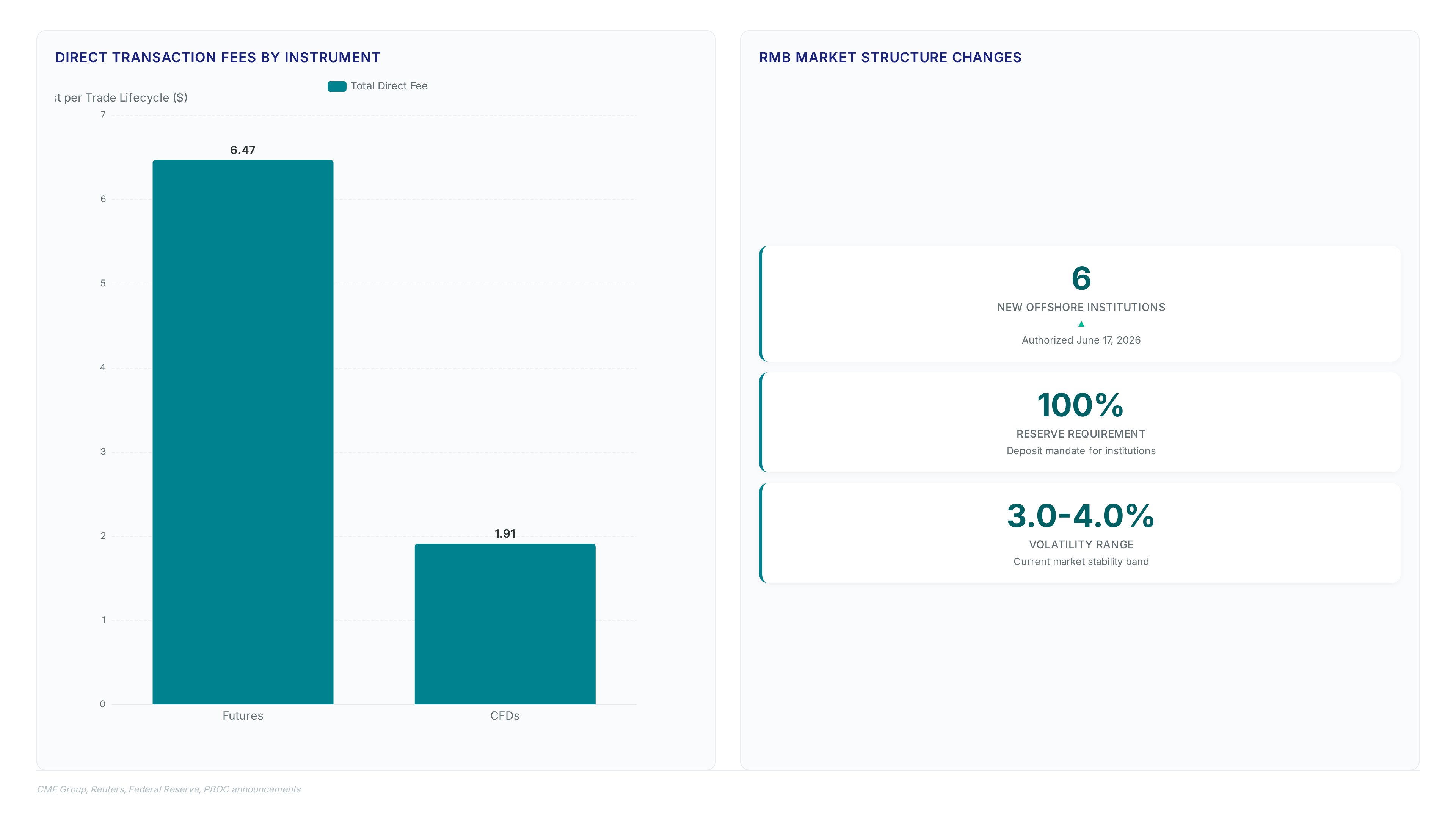
The PBOC central rate divergence from market estimates quantifies the gap between rhetorical signals and tradable reality. Unlike free-floating currencies, the renminbi operates under a managed regime where the central bank sets a daily reference point that often contradicts spot market pressure. This mechanism creates a specific blind spot for operators relying on official statements rather than the actual fix. The People's Bank of China announced on June 17, 2026, it was deepening control. Market participants face hidden costs when balance sheets reflect unrealized gains that vanish upon execution at the stricter official rate.
Applying FX Reserve Data to Validate Currency Stability Claims
Validating currency stability requires cross-referencing official statements against authorized transaction data and reserve depth. On June 17, 2026, six substantial institutions gained authorization to conduct offshore RMB trades via the China Foreign Exchange Trade System expanding the visible liquidity pool beyond state reserves. This structural shift allows operators to test verbal claims using hard settlement volumes rather than rhetoric. Unlike the U. S. Dollar, the renminbi operates under a managed regime where the central bank limits attractiveness as a reserve currency compared to free-floating alternatives, according to Federal Reserve analysis. Traders must distinguish between total reserve figures and accessible liquidity for immediate intervention.
About
Vikram Nair serves as the Emerging Markets & Asia FX Writer at ForexCFD. Top, where he specializes in the complex interplay between regional central bank policies and currency volatility. His deep expertise in Asian FX dynamics makes him uniquely qualified to analyze the USD/JPY environment alongside broader regional developments like the Yuan's recent strength. While his daily work often focuses on Tier-2 and Tier-3 pairs such as USD/INR and USD/IDR, Nair closely monitors substantial crosses like USD/JPY because shifts in Japanese monetary policy directly impact liquidity and sentiment across all Asian markets. At ForexCFD. Top, an independent publication dedicated to factual market news and broker transparency, Nair uses his on-the-ground understanding of RBI and Bank Indonesia decisions to provide context for how verbal interventions by the BoJ or PBOC ripple through the trading day. This perspective ensures readers receive grounded analysis rather than hype, connecting high-level macro themes to actionable trading realities.
Conclusion
Liquidity fragmentation breaks at scale when geopolitical friction exceeds the capacity of six authorized dealers to absorb shock. While aggregate reserves offer a comforting headline, the operational cost of maintaining the current peg rises sharply as AI-driven models detect deviations quicker than human regulators can respond. The market is not pricing in a collapse, but rather a structural decoupling where accessible liquidity diverges from reported wealth. Traders relying on total reserve figures face a critical blind spot; the real signal lies in the velocity of new bank authorizations and spot-fix deviations.
Adopt a conditional defense strategy for USD/JPY exposures tied to CNY volatility. If annualized volatility breaches 4.0% by Q3 2026, immediately hedge half of exposure, assuming the exchange rate tests the 6.75 threshold. Do not wait for official policy shifts, as the lag in data reporting will render reactive measures too late. The window to position based on dealer expansion rather than reserve totals is narrowing as algorithmic trading accelerates price discovery.
Start by auditing your current counterparty list this week to identify which institutions hold fresh offshore RMB trading authorization. Cross-reference these names against your prime broker's liquidity sources to ensure you are not relying on stale channels during the next volatility spike.
Frequently Asked Questions
Direct transaction fees for futures total $6.47 across the entire trade lifecycle. This specific cost encompasses both exchange and broker commissions, significantly exceeding the lower average fees found in commission-free CFD trading alternatives.
At least 20 ships crossing the Strait of Hormuz recently sustained supply friction. This logistical bottleneck directly drives input cost inflation to a near four-year peak, undermining the effectiveness of verbal intervention against Yen depreciation.
Goldman Sachs slashed its China Q2 GDP forecast to 4.5% recently. This reduction reflects deepening skepticism about regional stability, creating a complex backdrop for any coordinated currency defense efforts across Asia Pacific markets.
Standard Chartered projects gold will reach $5,100 by mid-2027. Investors view this quantifiable target as a strategic hedge against the ongoing USD/JPY volatility and the currency approaching its forty-year low context.
China holds foreign reserves totaling $3.342 trillion as of March 2026. This massive financial backstop provides liquidity support, yet divergent central bank signals continue to drive volatility across the broader Asia Pacific region.