
Broker safety starts with Tier1 regulation checks
Global directories list over 100 brokers, but marketing copy rarely distinguishes a solvent firm from a fraud trap. Tier-1 regulation is the only baseline that matters for retail safety; offshore registrations simply do not qualify for serious capital. You need to verify licenses directly against public registers maintained by the FCA and ASIC, ensuring your funds benefit from mandatory segregation and actual legal recourse.
This guide dissects execution models to show how order handling dictates your fill quality. We skip the surface features and look at the technical infrastructure driving slippage and latency when volatility spikes. That distinction separates professional connectivity from the re-quoted orders plaguing unregulated entities.
You will also learn to calculate all-in trading costs by hunting down hidden fees buried in fine print. Spread markups and commission schedules interact to erode profitability, often silently. By applying this due diligence framework, you can filter out unsafe operators and focus exclusively on platforms meeting strict capital requirements.
The Critical Role of Tier-1 Regulation in Broker Safety
Defining Broker Due Diligence and Tier-1 Hierarchy
Broker due diligence is a rigid filter. It separates verified intermediaries from fraudulent traps before you commit a single dollar. The process prioritizes Tier 1 status to minimize risk exposure. Top-tier regulators explicitly named for their fraud prevention standards include the CFTC and NFA (USA), FCA (UK), ASIC (Australia), and BaFin. These bodies enforce strict capital requirements and fund segregation rules that offshore jurisdictions lack.
Retail traders often mistake any business registration for regulatory approval. They are wrong. Offshore licenses offer minimal fraud prevention. The distinction determines whether legal recourse exists during insolvency. A broker lacking these specific approvals operates without enforceable client protection standards. Verification requires searching public registers using the legal entity name rather than the brand.
Traders must avoid funding accounts until they confirm negative balance protection in the client agreement. Offshore registrations frequently omit this safety net, exposing clients to unlimited liability. Marketing claims cannot override jurisdictional limits on fund recovery. Only entities under these specific regulators provide a viable path for dispute resolution.
Verifying Licenses and Enforcing Fund Segregation
Search the regulator's public register directly to confirm a broker's legal status before funding any account. Each regulator maintains a public register where a broker's license number can be searched directly on the regulator's website rather than the broker's 'About' page. Reliance on a brokerage's "About" page invites fraud, as offshore entities often mimic legitimate firms to bypass scrutiny. Fund segregation mandates that client capital remains separate from company operating funds, protecting deposits if the firm faces insolvency. Under MiFID II frameworks, EU and UK brokers must maintain capital reserves exceeding 730,000 EUR to guarantee liquidity during market stress.
Due Diligence Checklist: Live Withdrawal Tests and Parallel Trials
Confirm license validity on the regulator's public register before depositing capital. Broker due diligence requires independent verification because fraudulent entities often mimic legitimate firms to bypass scrutiny. Retail traders frequently encounter forex scams linked to offshore brokers with little to no regulation, making this step non-negotiable. Verification must occur on the regulator's website, not the brokerage's "About" page, to ensure the license is active and unencumbered by sanctions.
Operational safety demands a parallel trial across multiple intermediaries rather than single-vendor reliance. Testing two brokers simultaneously over two weeks generates comparative data on execution quality and spread stability during volatile sessions. This window reveals latency issues or requotes that marketing materials conceal. A structured comparison helps traders weigh low costs against the safety track record of established entities versus newer market entrants.
Open live microaccounts to begin the physical audit of broker performance. Funds clear in <24 hours Week 2. Execute 20+ trades. Slippage matc. Conducting live withdrawal tests ensures broker safety and integrity before funding an account with significant capital. Testing multiple brokers simultaneously over two weeks provides real data to choose the best fit for your trading style and risk management. Traders should prioritize brokers who process withdrawals within standard banking cycles without requiring excessive documentation retries.
Deconstructing Execution Models and Platform Architectures
ECN Routing vs Market Maker Internalization Mechanics
ECN brokers send orders straight to liquidity providers without a dealing desk, standing in stark contrast to market makers that absorb the other side of trades internally. This structural split determines if a trader operates under an agency model or faces a principal conflict when prices spike. Order routing logic drives the entire mechanism. ECN accounts pull pricing from multiple banks to match buyers and sellers instantly, avoiding internal inventory risk. Market makers internalize flow instead, hedging net exposure later rather than matching every ticket immediately. Retail traders must check the execution model because platform breakdowns show how front-ends like MetaTrader 4 or cTrader link to these backend systems.
| Feature | ECN Routing | Market Maker Internalization |
|---|---|---|
| Counterparty | External Liquidity Provider | The Broker |
| Spread Type | Raw (Variable) | Fixed or Managed |
| Conflict | None (Agency) | Structural (Principal) |
| Commission | Explicit ($3.00, $7.00) | Embedded in Spread |
Transparency in ECN models carries a specific cost structure: commissions appear as line items, while standard accounts bury fees inside wider spreads. Zero-commission accounts frequently hide expenses within inflated spreads. Total cost calculation depends entirely on trading volume and frequency. A scalper moving 50 lots daily faces a radically different expense profile than a swing trader executing five weekly trades. An ECN environment might expose the trader to slippage. Internalized models present their own execution quirks.
Operators need to test execution quality across various sessions. Competitive ECN accounts show all-in costs around 0.8, 1.2 pips for EUR/USD. Any broker claiming ECN pricing but displaying all-in costs above 1.5 pips during normal market hours demands scrutiny. Verify the specific legal entity through safety track records before funding, as execution speed varies notably between these two models.
Platform Selection for Scalping and Algorithmic Execution
Scalpers frequently choose cTrader for its depth-of-market display and one-click execution capabilities. Algorithmic traders rely on the stability of MetaTrader 4 (MT4) for consistent Expert Advisor performance. The distinction hinges on price rendering. CTrader shows raw liquidity tiers vital for one-click entries. MT4 remains the most widely supported platform for EA-based and algorithmic trading. This specialization introduces a constraint: MetaTrader 5 (MT5) offers more order types and asset classes, yet many traders stick with the extensive compatibility of the MT4 ecosystem. Network latency and server proximity heavily influence fill quality, a variable technical teams assess through platform breakdowns before deployment.
Retail traders must confirm their broker supports the specific protocol their strategy requires, as conditions vary across account tiers. Rigid adherence to one platform without testing execution logic against live spreads invites unnecessary risk.
| Feature | cTrader | MetaTrader 4 (MT4) |
|---|---|---|
| Primary Use | Manual Scalping | Algorithmic Trading |
| Order Display | Depth of Market | Standard Chart |
| Execution | One-Click | Script Dependent |
| Best For | News Spikes | 24/5 Automation |
Operators should filter potential partners by account types to match infrastructure with intended trading frequency. High-frequency strategies demand precise cost calculations, given that trading cost is the single largest controllable drag on performance. No single platform optimizes both deep liquidity visualization and complex historical scripting equally. Traders must prioritize their primary edge rather than seeking a universal solution.
STP Order Pass-Through Versus True ECN Liquidity Aggregation
STP brokers pass orders to liquidity providers, eliminating the dealing desk. This structural variance dictates whether a trader encounters an agency model or a hidden principal conflict during volatility. STP execution removes the dealing desk, yet the specific pool of upstream providers can result in varying effective spreads compared to deep liquidity aggregation. Retail traders must distinguish these models because account types notably alter the final price paid per transaction.
True ECN brokers aggregate pricing from multiple banks, matching orders without internal inventory risk. Standard arrangements may route flow to different tiers of providers. The cost implication is measurable: ECN accounts typically show all-in costs of 0.8, 1.2 pips on EUR/USD. Non-ECN structures often bundle fees into wider, opaque spreads.
| Feature | STP Model | True ECN Model |
|---|---|---|
| Liquidity Sources | Provider Network | Multi-bank aggregation |
| Conflict of Interest | Potential markup | None (Agency only) |
| Cost Structure | Wider spread | Raw spread + commission |
| Order Visibility | Partial depth | Full market depth |
Simplicity competes with transparency in this analysis. A standard account offers fixed costs but hides the dealer's edge within the spread. An ECN account exposes raw volatility in exchange for visible commissions. Operators must verify if their broker publishes trading fees separately to avoid paying for execution quality they do not receive. Choosing the wrong model for a specific strategy, such as scalping, guarantees performance drag regardless of technical skill.
Calculating All-In Trading Costs and Hidden Fee Structures
Deconstructing All-In Costs: Spreads, Commissions, and Swaps
Trading cost remains the single largest controllable drag on retail performance. True expense calculation requires summing advertised spreads, explicit commissions, and overnight swap financing. Many traders overlook that zero-commission accounts often embed revenue inside wider spreads rather than eliminating fees. Regulatory guides emphasize reviewing trading fees as a broad category encompassing all execution costs. This structure creates transparency but demands active management of volume to justify the fixed commission. A scalper trading 50 lots per day faces a very different cost structure than a swing trader placing five trades per week. The hidden risk lies in non-trading charges; inactivity fees or withdrawal penalties can erode gains regardless of spread width. Traders must request full fee schedules in writing to capture these peripheral costs before funding. Ignoring the sum of parts leads to selecting brokers where apparent savings vanish under actual trading conditions.
Calculating True EUR/USD Expenses: ECN vs Standard Account Scenarios
Compute final EUR/USD expense by adding raw spread, fixed commission, and overnight swap rates. This structure creates a transparent but variable cost profile that demands active volume management to justify the fixed fee component. Standard accounts bundle these revenue requirements into a wider advertised spread ranging from 1.2 to 2.0 pips with no explicit commission. The limitation is that zero-commission models often hide total costs inside these inflated spreads, masking the true drag on frequency-dependent strategies. High-frequency scalpers often find the lower all-in cost of ECN structures advantageous despite the fixed fee, whereas low-volume swing traders may prefer the simplicity of bundled spreads. A critical oversight occurs when traders ignore swap rates on long-term positions, allowing overnight financing to erode gains regardless of the initial spread width. Always request the full fee schedule in writing to confirm whether non-trading charges apply to your specific jurisdiction.
The Zero-Commission Trap: Hidden Inactivity Fees and Spread Markups
Marketing touts zero commission while embedding recovery costs inside wider spreads. Brokers claiming ECN pricing with all-in costs above 1.5 pips on EUR/USD during normal market hours demand immediate scrutiny. Unexpected inactivity fees further erode capital when accounts remain dormant past arbitrary deadlines. Traders must sum spreads, commissions, and non-trading charges to find the real cost. Reviewing the full trading fees schedule reveals penalties absent from headline rates. The limitation is that low-frequency traders may pay more on nominal commission structures due to fixed minimums. Ignoring these hidden layers turns a seemingly free account into an expensive liability over time.
| Cost Component | Zero-Commission Model | Transparent ECN Model |
|---|---|---|
| Spread | Widened notably | Raw market rate |
| Commission | None stated | Explicit per lot |
| Hidden Risk | Inactivity penalties | Volume requirements |
Calculating all-in expenses prevents surprise deductions from eroding equity.
Executing Parallel Live Tests to Validate Broker Performance
Defining the Parallel Live Test Protocol
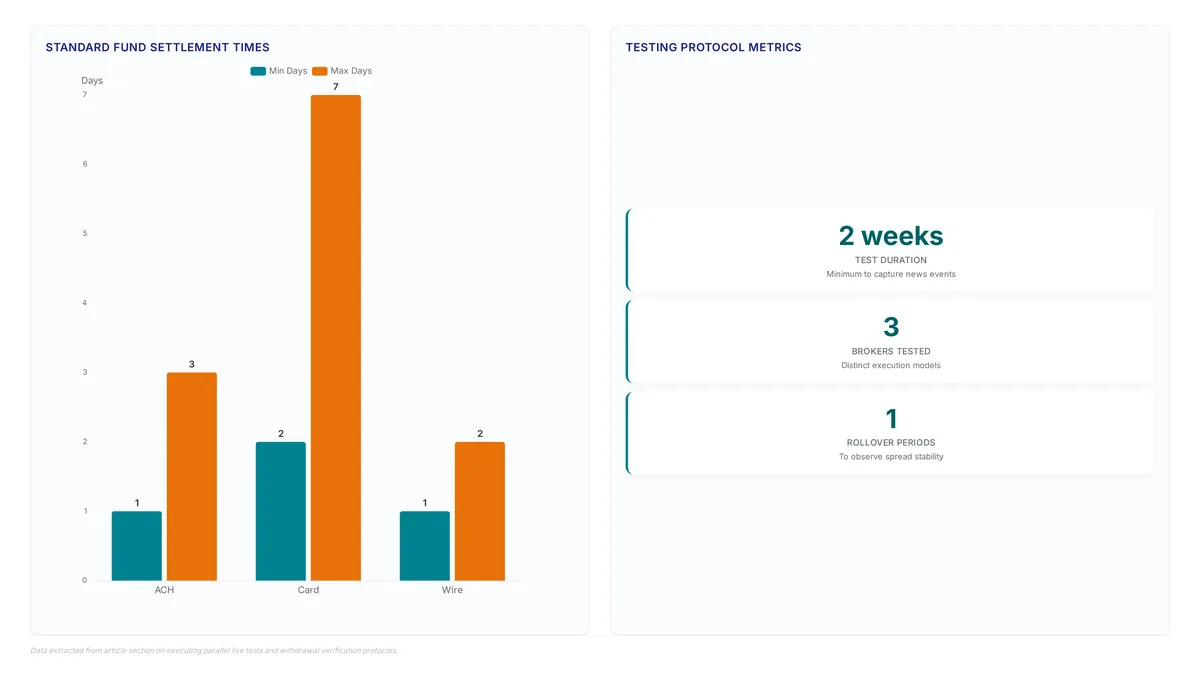
Simultaneous operation of demo and live accounts across three distinct brokers isolates execution variables effectively. Candidates must differ in at least two dimensions, such as regulation jurisdiction or execution model, to generate valid comparative data. Open demo environments immediately, then fund minimal live accounts on the top two contenders for back-office verification. Adhere to this structured routine:
- Test in parallel for a minimum of two weeks to capture one substantial scheduled news event.
- Include one rollover period to observe spread stability and liquidity depth.
- Document findings in a spreadsheet, tracking slippage, execution speed, and support response times.
- Perform a live withdrawal test using ACH transfers which typically settle in 1, 3 days.
Delays beyond standard windows indicate operational friction. Modern filtering tools allow sorting by account types, confirming that pricing models differ notably across tiers. Validate community feedback via Trustpilot scores as a secondary checkpoint alongside the licensing. Testing breadth competes against capital exposure; spreading funds too thin dilutes the significance of withdrawal friction costs. Skipping the live component hides latency spikes that demo environments smooth over. Purple Trader mandates this protocol because unregulated entities often mask liquidity issues until real capital is at risk. Skipping this phase leaves traders exposed to hidden fee structures and unverified withdrawal paths.
Executing Withdrawal and Support Stress Tests
Initiate the stress test by depositing minimal capital and requesting a full withdrawal immediately to measure actual settlement latency. ACH transfers typically clear in 1, 3 days, whereas card withdrawals require 2, 7 days and wire transfers settle in 1, 2 days. Delays exceeding these windows or unexpected documentation requests signal severe back-office friction. Traders often validate these timelines against community feedback on Trustpilot scores to gauge real-world reliability. Parallel to financial testing, probe customer support via live chat, email, and phone using specific technical queries about execution models. Unresponsive channels during this phase predict failure during actual market crises.
| Method | Expected Window | Risk Indicator |
|---|---|---|
| ACH Transfer | 1, 3 days | Undisclosed fees |
| Card Withdrawal | 2, 7 days | Missing confirmations |
| Wire Transfer | 1, 2 days | Manual review delays |
- Fund the account with the smallest allowable amount.
- Execute a few trades to generate a transaction history.
- Request a full withdrawal of all equity.
- Log every minute of delay and every support interaction.
Withdrawal friction often precedes liquidity insolvency, yet most traders ignore it until funds are trapped. Commissions appear visible upfront, but hidden administrative hurdles during exit reveal the true operational cost. Brokers lacking transparent processes here frequently operate without the negative balance protection mandated by top-tier regulators. Prioritize entities where the exit path is as frictionless as the entry.
Avoiding Pitfalls Like Bonus Traps and Offshore Risks
Chasing bonus offers often masks the inability to withdraw principal from unregulated entities. Retail traders must prioritize verified oversight over promotional credits to avoid total capital loss.
- Verify the broker appears on the NFA registry before depositing funds.
- Reject any entity registered solely in offshore jurisdictions lacking legal recourse.
- Ignore low advertised spreads that disappear during live execution conditions.
- Execute a small withdrawal test immediately to confirm fund recovery pathways.
Skipping this due diligence frequently leaves traders holding accounts with no regulatory body having jurisdiction. The allure of high use often correlates directly with entities operating outside standard compliance frameworks. Many operators fail to recognize that slick platforms served by offshore brokers can freeze assets without warning. A common error involves treating regulation as a mere checkbox rather than a core safety requirement. Traders who skip the parallel testing approach due to time constraints expose themselves to irreversible financial damage. Some venues promise rapid wealth, but the structural reality often involves hidden fees and impossible withdrawal conditions. Selecting a partner based on marketing noise rather than regulatory depth invites catastrophic failure. Only brokers subject to strict government supervision provide the necessary legal mechanisms for dispute resolution.
About
Vikram Nair serves as the Emerging Markets & Asia FX Writer at ForexCFD.top, where he specializes in the complex regulatory landscapes of Tier-2 and Tier-3 jurisdictions. His daily work involves dissecting local legal frameworks for traders in India, Nigeria, and Southeast Asia, making him uniquely qualified to guide retail traders through necessary broker due diligence. Because he constantly evaluates which brokers legally serve these specific regions and which funding rails remain compliant, Vikram understands that verifying Tier-1 regulation a formality but a critical safety measure. At ForexCFD.top, an independent publication dedicated to vendor-neutral analysis, his expertise ensures that the comparison checklist provided is grounded in real-world accessibility and strict regulatory adherence. By connecting macro policy with practical broker access, Vikram helps traders navigate the often confusing world of forex brokerage with a focus on safety, legality, and execution quality tailored to their specific geographic realities.
Conclusion
Operational friction during fund recovery reveals the true integrity of a forex broker, distinguishing legitimate firms from those relying on liquidity traps. While entry is often smooth, the structural cost emerges when withdrawal windows exceed standard banking timelines or when hidden administrative hurdles appear. Traders must recognize that unregulated entities frequently lack the legal mechanisms necessary for dispute resolution, leaving capital exposed to indefinite freezes. The industry shift toward strict licensing means operating without verified oversight is an unnecessary risk that compromises asset safety.
Prioritize brokers who demonstrate consistent settlement times matching standard ACH or wire transfer windows before committing significant capital. You should immediately execute a small withdrawal test on any new account to verify that the exit path functions as promised without unexpected delays. This single action validates the broker's operational liquidity and confirms that your funds remain accessible under normal market conditions. Do not rely on promotional claims or advertised spreads when the ability to recover principal remains unproven. Secure your trading environment by confirming regulatory standing and testing fund recovery protocols today.
Frequently Asked Questions
ECN commissions typically range from $3.00 to $7.00 per standard lot round-turn. This explicit fee structure replaces wider spreads, offering greater transparency for calculating your true all-in trading costs accurately.
Zero-commission accounts often embed costs inside wider spreads rather than charging direct fees. This makes the total expense less transparent compared to accounts with explicit commissions between $3.00 and $7.00 per lot.
Competitive all-in costs for EUR/USD should sit around 0.8 to 1.2 pips during normal hours. Costs exceeding 1.5 pips warrant scrutiny, even if the broker claims to offer raw ECN pricing structures.
You must verify licenses on regulator sites because brokers often mimic legitimate firms to bypass scrutiny. Relying on brand names instead of legal entity names allows fraudulent operators to hide behind generic branding effectively.
EU brokers must maintain capital reserves exceeding 730,000 EUR to guarantee liquidity during market stress. This legal minimum ensures they can meet obligations, unlike offshore entities lacking such strict financial safety nets.
References