
Consumer sentiment index: Watch the 50 level now
The University of Michigan consensus sits at 50. Today's consumer sentiment print dictates immediate EURUSD volatility.
Market direction hinges on whether American households view inflation as transitory or structural. Traders must dissect the gap between reported inflation expectations and actual central bank rhetoric to predict currency pair movements. Speeches by Federal Reserve officials Williams and Kashkari will likely compound any deviation from the 4.6% short-term expectation, creating sharp liquidity spikes.
This analysis details the mechanics of central bank communications and their direct correlation to currency volatility. We examine how divergent inflation expectations alter trading volume during typically thin Friday sessions. Finally, we outline a strategic framework for using economic calendars to navigate these specific high-risk windows without relying on guesswork.
The Role of Consumer Sentiment and Inflation Expectations in Market Direction
University of Michigan Consumer Sentiment and Inflation Expectations Set
Hard data records what happened; the University of Michigan index guesses what households will do next. It tracks confidence rather than transactional reality like CPI. Survey results gauge future spending behavior across American consumers. March 2024 saw the US consumer sentiment index print 79.4, marking a peak before a deteriorating trend observed through mid-2026. Market participants currently watch for a consensus reading near 50 for the June release. Sub-components regarding short- and long-term inflation expectations remain vital for Federal Reserve policy models. This forward-looking indicator drives the dollar's trajectory alongside Fed speeches unlike backward-looking government statistics.
Survey responses create noise because they do not equal actual economic output. Network operators weigh these soft data points against hard inventory levels. Market participants pay a premium for liquidity and safety in the US Dollar. Gains may be fading, indicating a potential shift in the cost-benefit analysis of USD longs. Deteriorating consumer sentiment competes with persistent inflation concerns that reinforce a higher-rate outlook.
How EURUSD Traders React to Hawkish or Dovish Sentiment Shifts
Afternoon US publications fully influence EURUSD pricing when hard data remains absent. Added volatility ahead of the weekend could be triggered by hawkish or dovish tones in speeches by Williams and Kashkari. Price discovery relies on forward guidance rather than realized metrics during these quiet sessions. Traders weigh deteriorating consumer sentiment against persistent inflation concerns that reinforce a higher-rate outlook. A hawkish Fed tilt overrides safe-haven demand even during geopolitical tension as gold's decline illustrates. Current prints must be distinguished from previous CPI data to gauge reaction magnitude.
The US Dollar strengthened due to Fed hawkishness and energy slumps while gold declined. This inverse competitive relationship shows how a stronger dollar and higher rate outlook suppress precious metal prices. Relying solely on sentiment creates fragility in positioning. The "price" of certainty in the market has increased with traders positioning themselves ahead of key FOMC meetings. Stabilization attempts in EUR/USD occur as operators await clarity on rate cut justifications. Capital preservation takes priority over speculative aggression when inflation expectations drive pricing models.
Soft Data Sentiment vs Hard Data PCE and CPI Releases
Soft data surveys measure psychological intent rather than the transactional reality captured by hard inflation metrics like PCE. Investors digest yesterday's PCE inflation figures alongside hawkish Federal Reserve communications. Today's relatively empty macroeconomic calendar creates a complex backdrop for trading decisions. Hard data confirms past price actions whereas sentiment indices attempt to forecast future spending contractions or expansions. Traders interpret University of Michigan data by comparing current consensus estimates against previous prints. Momentum shifts in household confidence emerge from this comparison process.
Deteriorating sentiment often fails to immediately impact hard inflation numbers, leading to mixed signals for currency pairs. The AUD/USD currency pair experienced a significant climb in the first half of 2026, rising from a low of 0.6100 to a high of nearly 0.7300. Low liquidity can exaggerate price moves beyond fundamental justification during quiet sessions. Volatility often stems from position squaring rather than new economic information without heavyweight data releases. Risk management becomes necessary when soft data contradicts the established hard data trend.
Mechanics of Central Bank Communications and Currency Pair Volatility
Defining Hawkish and Dovish Tone Transmission in Fed Speeches
Algorithms parse verbal cues from Williams and Kashkari to adjust interest rate probability models in milliseconds. This mechanism distinguishes explicit guidance from implicit sentiment shifts, driving immediate liquidity changes. When Fed members signal a hawkish tilt, markets react by pricing in higher rates, as seen when gold adjusted to a "more hawkish Fed tilt" narrative near record highs. Conversely, dovish tones suggest potential easing, lowering yield expectations.
| Tone Type | Signal Interpretation | Market Reaction |
|---|---|---|
| Hawkish | Inflation focus, rate hike bias | Currency strength, bond yield rise |
| Dovish | Growth focus, rate cut bias | Currency weakness, bond yield fall |
The transmission relies on natural language processing to weight specific keywords against historical Federal Reserve patterns. However, a limitation exists: algorithms may overreact to single-sentence ambiguities before human traders validate the context. This creates transient volatility spikes that do not always align with the actual policy trajectory. Traders must recognize that while explicit numbers guide long-term models, implicit tonal shifts often dictate short-term EURUSD movements. The practical takeaway is that monitoring the divergence between spoken tone and prior data offers a predictive edge before broad market repricing occurs. ForexCFD.top education resources emphasize interpreting these signals within the wider macro framework rather than reacting to isolated headlines.
EURUSD Liquidity Shifts During Williams and Kashkari Speeches
EURUSD dropped below 1.14 support as liquidity providers withdraw ahead of specific Fed speech timings. This movement illustrates how central bank communications drive immediate USD currency movement without new economic data releases. When these officials signal a hawkish tilt, markets react by pricing in higher rates, altering the EURUSD trajectory instantly. Conversely, dovish tones suggest potential easing, lowering yield expectations and triggering reversals.
| Speech Timing | Liquidity Condition | Volatility Outcome |
|---|---|---|
| Pre-Speech | Thin order books | Sharp spikes on entry |
| During Speech | Algorithmic dominance | Rapid re-pricing |
| Post-Speech | Manual intervention | Trend confirmation or reversal |
Traders must monitor these Fed speeches closely, as late-week timing exacerbates slippage risks. A critical tension exists between holding positions for weekend gaps and managing exposure to sudden verbal shifts. Most retail platforms widen spreads during these windows, increasing transaction costs significantly. The limitation here is that technical support levels often fail when liquidity vanishes during live commentary. ForexCFD.top education modules emphasize that understanding liquidity shifts prevents forced liquidation during these events. Traders should reduce position sizes before scheduled addresses to mitigate execution risk. The weekend close further incentivizes institutional de-risking, compounding the initial shock from hawkish rhetoric. Effective risk management requires anticipating these withdrawals rather than reacting to the resulting price action.
Volatility Traps in Empty Calendars and Sentiment Data Releases
Thin order books on relatively empty macroeconomic calendars amplify price moves driven by sentiment sub-components rather than hard data. Trading volume drops significantly on Fridays, creating conditions where University of Michigan readings dictate direction despite the absence of heavyweight releases. Market participants categorize Federal Reserve announcements as high-impact events capable of generating significant movement, yet low-liquidity environments magnify these reactions disproportionately. The EURUSD pair slipped below key support at 1.14, illustrating how Fed speeches from Williams and Kashkari alter pricing without new economic fundamentals.
| Condition | Market State | Risk Outcome |
|---|---|---|
| Heavy Calendar | Deep liquidity | Absorbed volatility |
| Empty Calendar | Thin depth | Exaggerated spikes |
Traders monitoring central bank communications face a specific trap: algorithms parse verbal cues for hawkish or dovish tones instantly, but limited counterparties exacerbate slippage. Unlike sessions with concurrent GDP reports, empty calendars lack the counterbalancing flow that usually stabilizes price action during speech events. The limitation here is structural; retail operators cannot access the tier-one depth required to absorb sudden sentiment shifts efficiently. ForexCFD.top advises reducing position sizes during these windows to mitigate the risk of stop-outs caused by transient liquidity gaps rather than genuine trend changes.
Strategic Application of Economic Calendars for Trading Volatility
Defining Volatility Triggers in US Goods Trade Balance and Consumer Sentiment
Scheduled releases for US Goods Trade Balance and Consumer Sentiment function as primary volatility catalysts by forcing immediate position squaring when actuals diverge from consensus estimates. Traders monitor the Goods Trade Balance consensus of -85.1 bn USD against the previous -82.4 bn USD deficit to gauge external demand shifts that influence currency liquidity. An unexpected widening of the deficit may pressure the dollar, whereas an improvement could trigger short-covering rallies in substantial pairs. Simultaneously, the University of Michigan Consumer Sentiment Index provides a forward-looking measure of household confidence, with a consensus reading of 50 compared to the prior 44.8 print. Market volatility scales categorize such sentiment data as high-impact events capable of generating significant price movement relative to lower-tier releases. The divergence between these two indicators creates a complex trading environment where goods data reflects past transactions while sentiment captures future spending intent. Analysts note that relying solely on one metric ignores the cross-currents created when trade data contradicts consumer outlook.
Executing EURUSD Trades Around Bundesbank Speeches and Weekend Gaps
Traders often monitor liquidity conditions ahead of the 10:30 speech by Bundesbank Chairman Joachim Nagel to navigate potential slippage during European hours. This specific central bank speech often lacks the technical classification of a market-moving event unless monetary policy shifts are explicitly signaled, yet algorithms may react to headline keywords with increased volatility. A distinct tension exists between holding positions for potential European breaks and securing capital before US data dominance begins later in the session.
| Time | Event Type | Risk Profile |
|---|---|---|
| 10:30 | Bundesbank Speech | Moderate / Noise |
| 16:00 | US Consumer Sentiment | High / Directional |
| Close | Weekend Gap | Structural / Binary |
The EURUSD pair remains fully under the influence of afternoon US publications, rendering early European price action largely corrective rather than trend-defining. Historical analysis shows that hawkish tones from Federal Reserve officials like Williams or Kashkari can significantly influence market direction, potentially overriding prior European narrative flows.
Risk Management for Brent Crude Near Resistance Amid Middle East Tensions
Brent Crude prices hover near local resistance as the tense geopolitical situation in the Middle East creates a fragile equilibrium between supply fears and macroeconomic headwinds. This specific market state increases the probability of false breakouts just before the weekly Baker Hughes report, where consensus expects the US rig count to rise slightly to 436. The interaction between physical supply constraints and financial positioning means traders must differentiate between genuine scarcity and speculative noise. This flexible forces a re-evaluation of risk management protocols, as correlation breakdowns occur when rate concerns dominate geopolitical premiums.
| Factor | Impact on Brent | Action Required |
|---|---|---|
| Middle East Tensions | Upward Pressure | Monitor headlines |
| Rig Count Consensus | Bearish if met | Watch for misses |
| Fed Rate Outlook | Downward Pressure | Reduce use |
The cost of holding long positions through this event is the heightened risk of a sharp correction if the rig count meets expectations. Traders should prioritize capital preservation over chasing breakout moves until the data confirms a shift in supply fundamentals.
Comparative Analysis of Commodity and Equity Responses to Macro Data
Defining US Rig Count Consensus and Geopolitical Resistance in Brent Crude
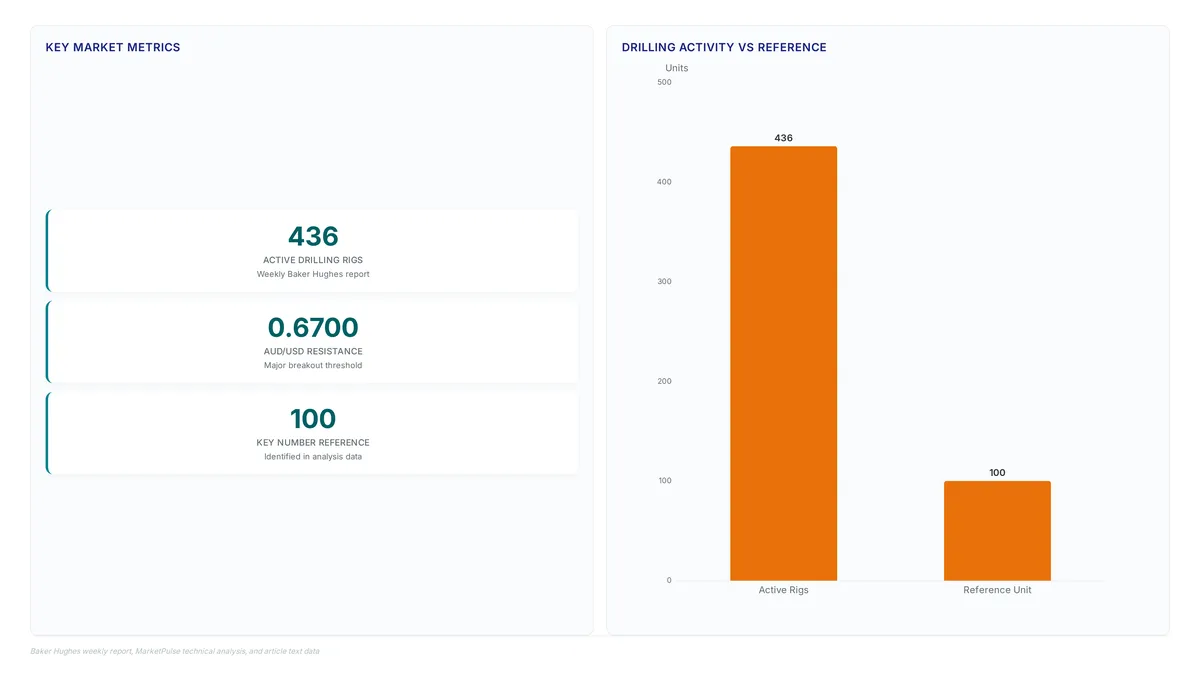
Active drilling operations reach a projected 436 units according to the weekly Baker Hughes report, a figure that quantifies immediate supply potential. Geopolitical friction in the Middle East establishes a price floor even as this metric suggests expanding capacity. Market participants observe how regional instability prevents deeper corrections despite the prospect of increased output. Technical resistance levels cap rallies when selling pressure overwhelms buying interest, regardless of favorable headlines. An increase in the rig count typically signals lower future prices by indicating reliable production growth. Supply uncertainty introduced by conflict creates a competing flexible that supports valuations. Divergence between reported counts and actual output helps traders spot genuine trend reversals rather than temporary spikes.
Nasdaq 100 Selloff Dynamics Versus Brent Crude Bounce Pretexts
Futures on the Nasdaq 100 (US100) face renewed pressure as rising component costs and hawkish Fed messaging weigh on valuations. This Nasdaq tech selloff reflects broad risk aversion where hardware giants struggle against escalating expenses. Brent Crude (OIL) participants watch drilling data for signs of a rebound before the trading week concludes. A decline in US drilling activity might offer a pretext for a price bounce, standing in sharp contrast to the extended losses in technology shares. Such divergence illustrates how the inflation expectations release influences asset classes differently depending on their exposure to input costs versus future demand. High-impact events usually drive primary volatility, yet corporate-specific developments can overshadow macro signals in the short-term. Federal Reserve announcements and GDP reports generate significant movement compared to lower-tier data releases. Relying only on rig count consensus ignores the geopolitical premium already embedded in oil prices. A drop in the rig count offers a technical bounce opportunity, while the overarching inflation expectations release remains the dominant force limiting sustainable gains across both sectors. Operators must balance immediate supply signals against the persistent drag of elevated rate expectations.
Divergent Asset Responses: EURUSD Sensitivity to Inflation Expectations vs Oil Supply Shocks
Currency movements for EURUSD depend heavily on the sub-components regarding short- and long-term inflation expectations, which guide the dollar's path more effectively than headline sentiment scores. Investors compare these psychological metrics against physical supply data to adjust allocations between fiat currencies and hard assets. Consensus for the University of Michigan index sits at 50, yet the market weighs deteriorating sentiment against persistent price pressures that reinforce a higher-rate outlook. Brent Crude reacts to the weekly Baker Hughes report on US rig counts, creating distinct reaction windows during mixed economic releases. This divergence suggests currency traders monitor the convergence of oversold chart conditions and Federal Reserve hawkishness when positioning for weekend gaps. A drop in drilling activity offers a bounce pretext for oil, whereas EURUSD requires a fundamental shift in rate expectations to reverse trends. Volatility tracking systems often assign high-impact ratings to Federal Reserve speeches, marking them as primary drivers for exchange rate fluctuations. Operators should isolate these drivers to avoid false correlations when sentiment and supply metrics conflict. The market extends losses as investor concerns grow.
About
Sofia Mendes, Broker Reviews & Trading Education Editor at ForexCFD.top, brings a disciplined, risk-aware perspective to the analysis of the US Consumer Sentiment Index. While this macroeconomic release often drives volatility in substantial pairs like EUR/USD, Sofia's expertise lies in helping traders navigate such events through structured education and regulated broker selection. Her daily work involves rigorous due diligence on execution quality and spread stability during high-impact news, ensuring that retail traders in emerging markets can access reliable trading conditions. By connecting fundamental data points to practical risk management strategies, she highlights why understanding sentiment shifts is critical for preserving capital. At ForexCFD.top, an independent publication dedicated to vendor-neutral analysis, Sofia ensures that market coverage remains grounded in factual clarity rather than hype, empowering traders to make informed decisions without relying on unverified third-party recommendations.
Conclusion
When sentiment fractures under a hawkish Fed tilt, the operational cost shifts from chasing headlines to managing the lag between psychological data and physical supply realities. Traders often fail when they treat the Consumer Sentiment Index as a standalone trigger, ignoring how its inflation sub-components specifically dictate EURUSD trajectories while oil reacts to rig counts. This divergence creates a fragile market structure where consensus figures around 50 become irrelevant noise against the dominant force of rate expectations. You must stop correlating these assets during mixed releases and instead isolate the specific driver for each class.
Adopt a strict separation protocol immediately: trade currency pairs solely on inflation expectation shifts and energy assets strictly on supply inventory data. Do not attempt to synthesize a single macro narrative when the underlying mechanics operate on different clocks. Start this week by mapping the last three instances where headline sentiment diverged from inflation sub-scores, then backtest how EURUSD reacted compared to Brent Crude during those exact windows. This exercise reveals the false correlations that drain capital during volatile cycles. Focus your execution on the inflation expectations release as the primary filter for fiat exposure, leaving commodity supply shocks to drive energy positions independently.
Frequently Asked Questions
The market focuses on the 4.6% short-term inflation expectation to guide trading. A deviation from this consensus triggers sharp liquidity spikes during thin Friday sessions.
Verbal cues from officials create volatility when heavyweight data is absent. Traders watch for tones that contradict the 4.6% inflation expectation to gauge potential currency pair movements.
Surveys measure psychological intent rather than the transactional reality captured by hard data. This distinction matters because sentiment often fails to immediately impact actual price levels or output.
Low liquidity can exaggerate price moves beyond fundamental justification during quiet sessions. Volatility often stems from position squaring rather than new economic information without heavyweight data releases.
Sub-components regarding inflation expectations remain vital for Federal Reserve policy models. Deteriorating consumer sentiment competes with persistent inflation concerns that reinforce a higher-rate outlook for traders.
References