
Rate expectations shift as Fed dots show 40% hike odds
Markets have priced in 38 basis points of tightening by year-end. Fed rate expectations have shifted hard toward aggression. This repricing confirms a fracture in global monetary policy: the Federal Reserve leans into short-term tightening while peers like the ECB and BoE signal stagnation. Investors now face a global policy range spanning over 1,300 basis points, stretching from Switzerland's stagnant 0.25% to Norway's restrictive 4.50%.
Fed Chair Warsh has tethered volatility to raw data, explicitly rejecting forward guidance. He lets financial markets dictate the tempo of inflation control. Political headwinds have vanished; former President Trump signaled acceptance of necessary hikes to crush persistent inflation. The result is a precarious environment where a 40% probability of a July hike drives asset allocation more than any official statement.
Central bank mandates are being reinterpreted through hawkish lenses. The RBNZ faces an 80% hike probability while the BoJ remains dovish. Even as Gartner predicts AI infrastructure growth will sustain IT spending above a substantial amount in 2026, capital costs are rising to match this industrial fervor.
The Role of Central Bank Mandates in Defining Rate Expectations
Defining the Fed Dot Plot and Price Stability Mandate
Eighteen participants populate the FOMC dot plot, visualizing rate projections without binding commitments. This mechanism debuted in 2012 to enhance transparency regarding the federal funds rate path. Do not confuse these individual estimates with the official price stability mandate. That legal obligation forces the central bank to maintain low inflation. The statutory target remains 2%, a threshold the institution has failed to meet consistently since 2021.
Global divergence complicates this domestic focus. The Iran war triggered energy shocks that forced peers like the Reserve Bank of Australia to hike rates to 4.1%. Such external pressure tests the Fed's ability to ignore transitory spikes while adhering to its dual mandate. Relying on median dots creates a false sense of consensus among divergent voter models. The plot reveals dispersion but hides the specific data dependencies driving each participant's forecast. Markets pricing a 40% chance of a hike may misinterpret a single dot's movement as a coordinated shift rather than statistical noise. This ambiguity forces network planners to hedge against volatility that pure textual guidance might otherwise suppress. The dot plot provides granularity yet sacrifices the clarity of explicit forward guidance.
Interpreting Dot Plot Projections Amid Core PCE Spikes
Read the dot plot by overlaying the modest Core PCE rise against the split where 9 participants projected hikes while 8 projected a hold. This distribution reveals a tightening bias driven by data rather than fixed forward guidance. Map this divergence to the Iran war shock that spiked energy costs, distinguishing transient volatility from sticky inflation. The mechanism relies on market participants parsing individual FOMC member projections to gauge the probability of rate adjustments absent explicit policy statements.
This policy divergence forces network planners to model liquidity costs under multiple yield curve scenarios rather than a single global baseline. However, relying on the median dot ignores the tail risk of aggressive hawks within the committee. A simple majority does not guarantee action if economic data softens before the next meeting. Consequently, capital allocation strategies must weight the price stability mandate above political signals or transient market noise. Treasury functions need flexible hedging against a potential 38 bps tightening by year-end. Ignoring the upward shift in the advanced economy inflation forecast to 2.8% invites duration risk in fixed-income portfolios.
Market Efficiency Risks When Ignoring Data-Driven Guidance
Market efficiency degrades when participants guess at Federal Reserve reactions instead of reacting to incoming data. Fed Chair Warsh explicitly warns this flaw reduces price discovery. The cost of ambiguity rises as global growth slows to 2.5% in 2026, forcing operators to parse divergent signals without clear forward guidance. This structural difference means misreading the dot plot carries higher volatility risks domestically than in jurisdictions revitalizing interbank participation.
The lag between Core PCE measurements and policy implementation creates windows for arbitrage that destabilize short-term funding markets. Portfolio managers must treat the absence of explicit guidance as a signal to increase sensitivity to real-time economic prints. Failure to align with the price stability mandate through data interpretation rather than speculation invites significant mark-to-market losses during adjustment periods.
Market Pricing Mechanisms Reveal Divergent Global Rate Trajectories
Decoding Basis Point Pricing and Probability Metrics
Futures contracts aggregate against current policy rates to translate central bank expectations into basis points and percentage probabilities. This calculation exposes a global policy rate span exceeding 1,300 basis points, ranging from Switzerland's 0.25% to Norway's 4.50%. Operators track these metrics to gauge the likelihood of tightening versus holding. The RBNZ shows 62 bps priced with an 80% probability of a rate hike at the next meeting. Conversely, the BoJ shows 23 bps with a 96% probability of no change at the next meeting.
Such a wide gap forces treasury managers to model cash flows against volatile probability curves instead of fixed schedules. Capital gets misallocated when implied volatility spikes because data conflicts with the dot plot. Real-time probability feeds beat static annual projections for avoiding liquidity traps.
Traders map the median dot plot against futures curves to derive these probabilities, noting that the median projection now indicates one rate hike this year. This shift contrasts sharply with the previous consensus expecting no change, forcing a repricing of forward guidance risk. Nine officials project hikes while eight see unchanged rates, creating a tangible tightening bias. Reliance on these visual projections carries execution risk if incoming data diverges from the FOMC participant medians. The dot plot represents individual estimates rather than a committee commitment, unlike explicit policy statements. Rapid de-risking occurs if inflation cools.
Kevin Warsh, who did not submit an interest rate projection for the June 2026 dot plot, emphasized that markets function best when reacting to data rather than guessing at central bank intent. This stance removes the safety net of verbal cues. Traders must weigh every economic release against the skewed distribution of official forecasts. The absence of a chair projection complicates the signal. Deeper analysis of the remaining eighteen submissions becomes necessary to gauge true policy direction.
Comparing ECB Hold Probabilities Against Fed Tightening Bias
Market pricing assigns a 78% probability of no change to the ECB, contrasting sharply with the Fed's emerging tightening bias. Elevated volatility results from misinterpreting these signals, especially as wartime disruptions skew inflation data away from core trends. High hold probabilities for the BoJ and SNB reflect structural deflationary pressures absent in the US economy. Portfolio construction requires separating currency hedging strategies from duration targets. Ignoring this split risks over-hedging the euro while underestimating dollar strength. Basis point pricing reveals the market expects the Fed to act before European peers adjust. Traders should apply Coverage Pillars to model these asymmetric rate paths against currency forwards. A static ECB and an active Fed define the current trade environment.
Strategic Investment Adjustments Based on Evolving Fed Signals
Defining Data-Dependent Fed Signals and Tightening Bias
A tightening bias emerges when the FOMC median projection shifts toward rate hikes despite absent explicit forward guidance. This operational pivot replaces fixed calendar paths with reactive measures tied to Core PCE inflation metrics. Fed Chair Warsh argues that financial markets lose efficiency when forced to deduce policy reactions rather than responding directly to incoming data. The mechanism relies on the dot plot, a visualization tool introduced in 2012 that maps individual rate projections from committee members. Unlike previous eras of clear guidance, the current environment forces operators to interpret a split committee where hawkish members expect multiple hikes.
Elevated volatility defines this ambiguity as traders parse divergent signals without a unified narrative. Such uncertainty compels investors to monitor financial markets as the primary information source for the central bank. Reliance on market interpretation creates a drawback; prices can overshoot or undershoot the intended policy stance. Operators must therefore model scenarios where data dependency creates sudden shifts in liquidity conditions. Coverage Pillars recommends building stress tests that assume zero forward guidance to survive this regime. This specific volatility profile demands a shift toward assets with pricing power rather than fixed yields.
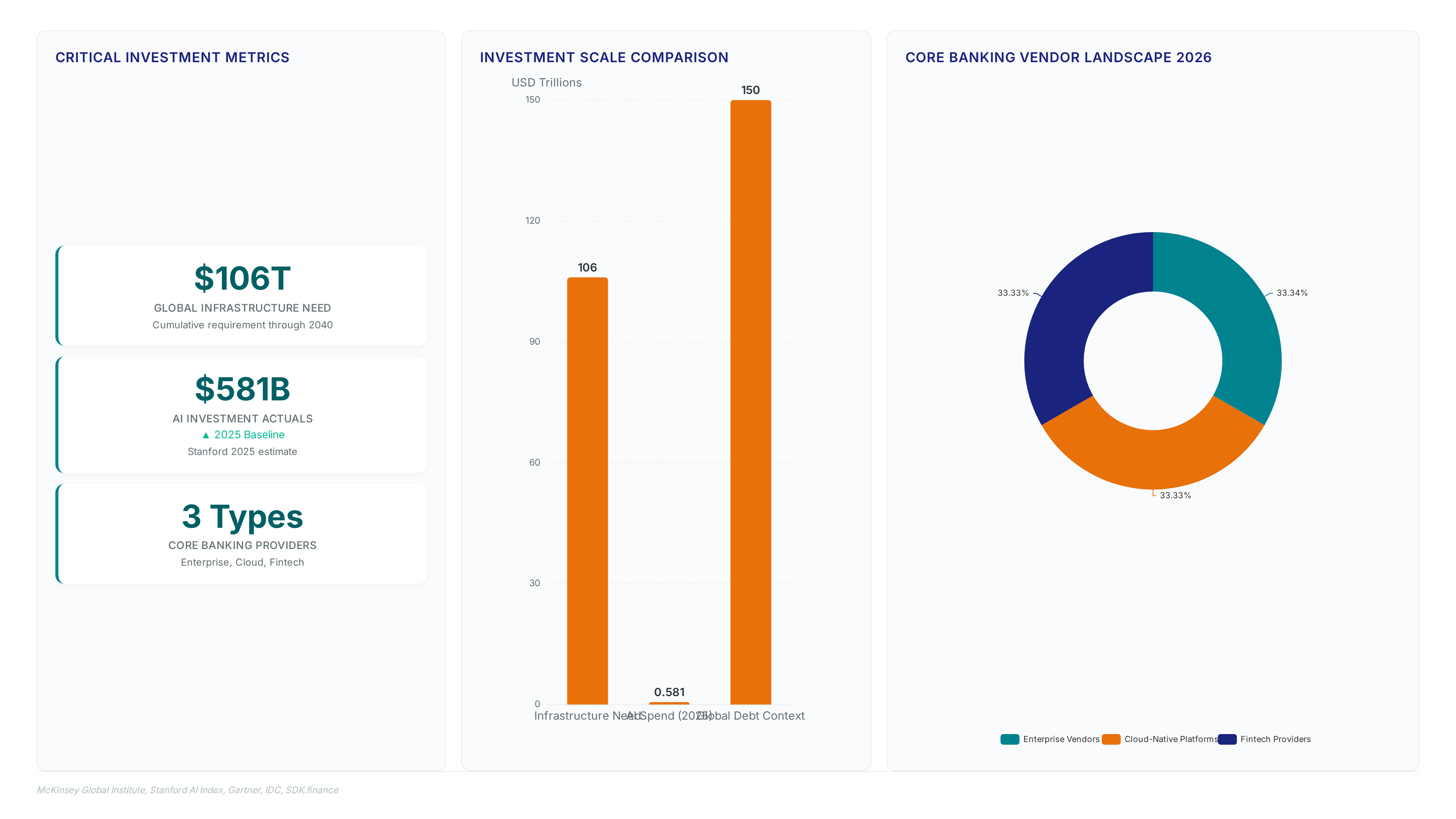
Rising fuel costs historically erode consumer discretionary spending before broader inflation metrics adjust, a flexible that links energy price shocks with immediate liquidity reallocation. Data from McKinsey indicates that a cumulative $106 trillion in infrastructure investment is required through 2040. Capital focused on these long-term assets may offer a hedge against short-term rate hikes driven by transient energy spikes. Execution speed presents a constraint here; traditional reallocation often lags behind the rapid repricing seen in oil futures. Legacy core banking software systems frequently struggle to process the high-frequency data feeds necessary for real-time hedging decisions.
PwC forecasts that global infrastructure spending will double over the next quarter-century, creating a divergence between physical asset demand and financial instrument availability. Reliance on static allocation models fails when WTI crude oil exhibits such extreme variance. Investors asking whether they should adjust investments based on Fed signals must recognize that the central bank now reacts strictly to incoming data rather than providing explicit forward guidance. Coverage Pillars recommends integrating real-time commodity feeds into asset allocation algorithms to mitigate the risk of holding devalued fixed-income securities during these transitional periods. Operators adjusting portfolios based on Fed signals must recognize that political silence does not equate to economic stability.
Conflicting cycles spill over into domestic yield curves as disparities force central banks into difficult positions. The core tension lies between the FOMC maintaining rates at 3-1/2 to 3-3/4 percent and the reality of rising price pressures. Data-dependent guidance removes the certainty of calendar-based paths, increasing the cost of hedging against sudden moves. Unlike previous eras where political pressure forced accommodation, the current green light posture means the Fed will hike regardless of market pain if Core PCE inflation persists. Portfolios must price in a higher terminal rate rather than hoping for political intervention to soften the blow.
A Framework for Analyzing FOMC Statements and Incoming Data
Defining the Hawkish Shift in FOMC Dot Plot Projections
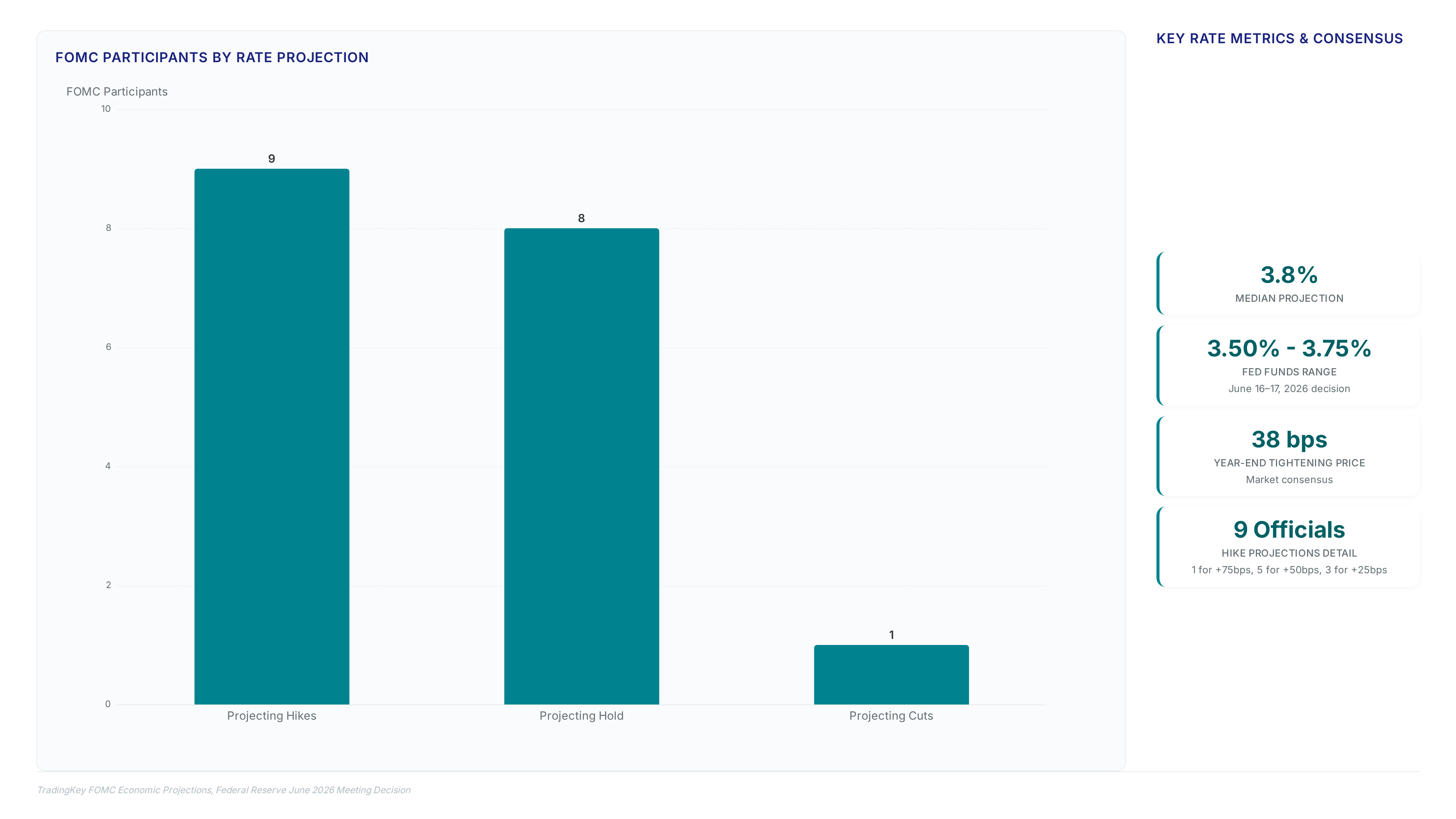
The median projection shifted to 3.8% while the official statement carried no new policy directives. This divergence marks a structural change where the dot plot functions as the primary signal rather than explicit forward guidance. Operators must parse the split committee vote to understand the tightening bias hidden within unchanged language. 1.2. Count the 9 officials projecting hikes against the 8 favoring a hold.
- Note the single outlier predicting a cut to gauge dissent range.
- Compare the rate hike cluster density to previous quarters.
A critical limitation exists because Fed Chair Warsh refuses to validate these projections with verbal cues, forcing markets to price uncertainty.
Traders must cross-reference the 38 bps year-end tightening price against the specific probability metrics derived from central bank data.
- Verify the federal funds rate range remains at 3-1/2 to 3-3/4 percent per the June 16, 17, 2026 meeting decision before assuming a shift. 2.3. This creates a fragile equilibrium where a single inflation print can invalidate the 38 bps consensus instantly. Operators relying on static models will fail when the dot plot median shifts quicker than derivatives pricing. Coverage Pillars recommends automating these cross-checks to capture latency in probability updates.
About
Marcus Halloran serves as Chief Market Strategist at ForexCFD. Top, where he specializes in G10 macroeconomics and central bank policy analysis. His extensive background as a former interbank FX strategist in London uniquely qualifies him to dissect the complex shifts in global interest rate expectations detailed in this article. Halloran's daily work involves translating dense monetary policy data from the Fed, ECB, and RBNZ into actionable insights for retail traders, directly aligning with the article's focus on diverging global rate paths. At ForexCFD. Top, an independent publication dedicated to vendor-neutral market news, he uses his expertise in interest-rate differentials to clarify how varying probabilities of rate hikes impact substantial currency pairs. This specific analysis of the 1,300 basis point spread in global policy rates reflects his core competency in navigating the macroeconomic calendar. By connecting high-level central bank decisions to practical trading contexts, Halloran ensures readers understand the strategic implications of these key monetary shifts.
Conclusion
Capital allocation strategies fracture when liquidity tightens quicker than portfolio duration can adjust. The real operational cost here is yield volatility, but the latency penalty incurred by manual verification of shifting probability metrics matters more. As AI infrastructure spending accelerates through 2026, demand for credit will clash with constrained supply, forcing a brutal repricing of risk assets that static models fail to capture. Markets often misinterpret isolated data points as trend reversals, leading to premature hedging or dangerous overexposure.
Investors must transition from reactive data interpretation to automated cross-referencing of derivative pricing against real-time committee projections by Q3 2026. Relying on visual summaries like the dot plot without algorithmic validation leaves portfolios vulnerable to sudden narrative shifts driven by energy price shocks or divergent global growth rates. The window for passive management of fixed-income exposure is closing as divergence between substantial economies widens.
Start by auditing your current hedging latency this week. Specifically measure the time gap between a new inflation print and your portfolio's rebalancing execution. If this delay exceeds four hours, implement an automated alert system for spread widening immediately. This specific tactical adjustment protects capital more effectively than broad macroeconomic speculation.
Frequently Asked Questions
Markets currently price a 40% chance of a Federal Reserve rate hike occurring this July. This probability reflects a shift toward aggression with 38 basis points of tightening now expected by year-end.
The RBNZ faces an 80% probability of a rate hike at its next scheduled meeting. This high likelihood contrasts with other central banks that signal stagnation or no change in their current policies.
Chair Warsh prefers letting financial markets dictate tempo rather than providing fixed forward guidance statements. This approach aims to improve market efficiency by forcing reactions to incoming data instead of policy guesses.
The statutory price stability target remains 2%, a threshold the institution has failed to meet consistently since 2021. Achieving this goal drives the current hawkish bias seen in recent committee projections.
Investors must navigate a global policy range spanning from 0.25% in Switzerland to 4.50% in Norway. This divergence requires adjusting portfolios to handle varying liquidity costs across different economic zones.