
USDJPY Targets 161.92 After Hawkish Fed Shift
The 2-year yield jumped 17 basis points to 4.22%. USDJPY immediately shattered the 160.717 ceiling.
Warsh's influence and a unanimous vote to hold rates at 3.65 percent confirm a hardline shift. Fed hawkishness now overrides traditional intervention fears. While North America commands 41.9% of projected FX growth according to Technavio, the Federal Reserve's pivot is the real engine, pushing the median 2026 funds rate estimate to 3.8%. Markets are aggressively pricing in a 65% probability of a September hike, completely ignoring the psychological gravity of the 160.00 level that previously spooked Japanese officials.
Rising yields drive currency momentum. The Bank for International Settlements recorded daily volumes hitting a staggering amount amidst this volatility. We need technical frameworks to determine if the pair sustains above the 100/200 hour moving averages near 160.25 or reverses toward support at 160.44. Strategic execution above resistance thresholds targets the 2024 high of 161.92 if momentum holds.
Anticipating cuts is a losing strategy. The current environment demands a approach built on yield differentials and hard data. With reporting dealers handling over 41% of North American volume, understanding these yield-driven triggers is mandatory for survival in the foreign exchange market.
The Mechanics of Fed Hawkishness and Yield-Driven Currency Momentum
Defining Fed Hawkishness via the 3.8% Funds Rate Projection
Markets want relief; the Fed offers restriction. On June 18, 2026, the Federal Reserve Board voted unanimously to hold the interest rate paid on reserve balances at 3.65 percent. This static nominal figure contrasts sharply with rising internal projections pointing toward 3.8 percent. That gap signals a firm shift from accommodation to sustained restriction. Future cuts are off the table.
Traders pricing in a 65% chance of a hike via September futures face elevated volatility if the Federal Reserve Board delays actual increases. High yields attract capital but risk overvaluing the currency beyond sustainable trade levels. Cross-border settlement latency becomes unpredictable during peak FX windows because of this uncertainty. Liquidity provision algorithms must account for wider spreads driven by this specific projection.
Immediate USDJPY re-pricing above 160.00 follows the data. The 17 basis point surge to a 4.22% 2-year yield forces immediate USDJPY rep pricing. Persistent inflation validates the link where higher US yields pull capital away from the Japanese.
Analyzing Fed policy impact requires watching how Core PCE deviations alter forward rate expectations. When inflation prints at 3.3%, markets price out rate cuts, widening the spread that drives the USDJPY pair higher. Currency futures on the CME apply standard trade units such as €125,000 for Euro contracts, meaning liquidity shifts in these instruments often precede moves in the underlying spot rate. Distinguishing momentum driven by genuine yield differentials from speculative flows remains vital. Speculative flows reverse quickly upon official verbal warnings. Operators must monitor these shifts closely. The market reacts to real money moving through standardized channels rather than theoretical models.
Technical Frameworks for Identifying Support Levels and Intervention Triggers
Defining Flexible Support via 100/200 Hour Moving Averages
Selling pressure lacks conviction if price action fails to break below the 100/200 hour MAs near 160.25. These moving averages function as flexible support where algorithmic execution models often trigger buy orders, creating a self-reinforcing floor. High-frequency systems reference these specific timeframes for trend confirmation, making the technical baseline necessary for market structure. Bears cannot control session momentum if USDJPY cannot sustain a position below these levels.
Liquidity conditions remain extreme. Daily North American gross volume reached $1,465,578 million as reporting dealers handle a 41% share of global flow. This volume concentration means substantial institutions using autonomous trading algorithms will defend key technical zones aggressively. A failure to pierce the 160.25 cluster suggests programmed sellers are absent or overwhelmed by passive buyers. Traders must distinguish between genuine breakdowns and false dips when assessing Bank of Japan intervention risks.
Significant slippage awaits those misinterpreting this signal. Total direct transaction fees for futures can reach $6.47 per lifecycle. Market participants analyzing renminbi trading growth note similar volatility patterns when liquidity thins near round numbers. Operators should watch for a close below 160.25 on a four-hour candle to confirm seller dominance. The path of least resistance remains upward toward the 2024 highs without this confirmation. Staying above the moving averages invalidates any short-term bearish thesis according to the technical framework.
Applying Futures Hedging Data to Assess Intervention Risk
Asset managers increased FX futures hedging 32% to a substantial amount, signaling elevated intervention risk near 160.00. Institutions brace for volatility consistent with Bank of Japan defense actions rather than speculating on further yield-driven expansion. Unwinding hedges accelerates moves when technical levels like 160.44 break, linking these positions directly to price action. Instrument choice dictates execution viability during such events.
Traders seeking low-friction entry near 160.79 may prefer CFDs. Those requiring certainty of fulfillment during liquidity crunches must absorb the higher futures premium. Cheap execution offers no protection if counterparty risk spikes during a sovereign defense event. Rapid hedge liquidation would precede an active defense, rendering low-cost CFD entry dangerous due to potential slippage. Operators must weigh the $1.91 savings against the risk of non-execution when yields diverge sharply. Price stalling above the 100/200 hour MAs while hedging volumes remain static suggests the market expects a passive Bank of Japan.
Strategic Execution for Trading USDJPY Above Resistance Thresholds
Defining USDJPY Resistance at the 160.717 High and 161.92 Target
The USDJPY extends above the 2026 high at 160.717, forcing immediate re-evaluation of upside targets toward 161.92. This specific resistance level represents the next significant technical ceiling on the daily chart, provided momentum sustains away from the 160.00 psychological barrier. That lower threshold previously attracted Bank of Japan attention, making the current distance from it a critical risk metric for long positions.
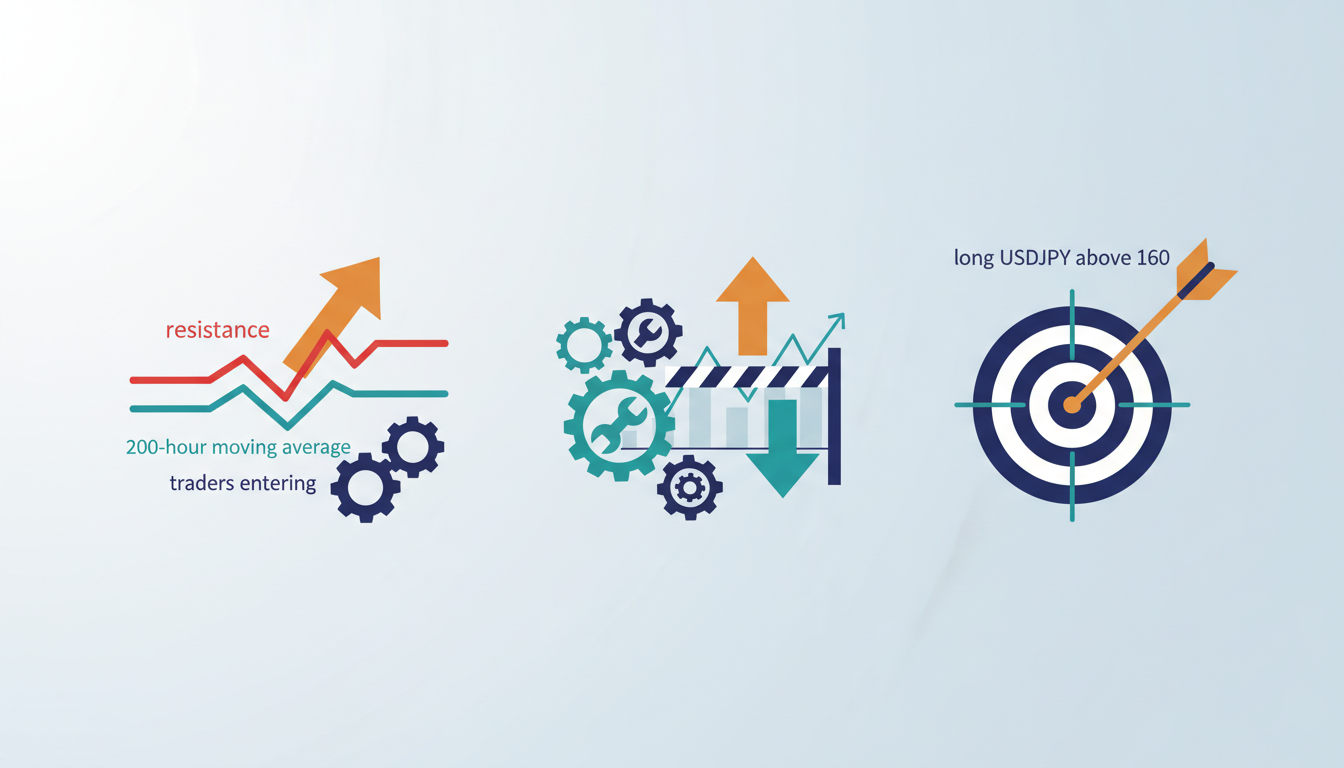
Traders assessing exit strategies must weigh instrument costs against potential volatility near these highs. The total direct transaction fee for futures across the trade lifecycle creates a higher breakeven threshold compared to spot alternatives, demanding larger moves for profitability. Institutional flows complicate this environment, as hedging activity reached unprecedented levels last year.
| Factor | Implication for Longs |
|---|---|
| Price Action | Break above 160.79 confirms path to 161.92 |
| Cost Structure | Higher fees erode margins on tight stops |
| Intervention Risk | Distance from 160.00 dictates stop-loss width |
A decisive close above 160.717 invalidates bearish divergence, yet the specter of official intervention remains the primary constraint on trend continuation. Market participants ignoring the historical significance of the 160.00 level face asymmetric downside risk if Japanese officials return to defend the yen. Exit points should therefore scale out into strength rather than targeting a single maximum price.
Executing Entries Above 160 Using 100/200 Hour Moving Averages
Sustained price action above the 100/200 hour MAs near 160.25 confirms seller exhaustion before capital commitment. This technical filter prevents premature entries when the massive daily liquidity environment amplifies noise around the 160.00 psychological barrier. A decisive break and hold above these averages signals that the massive reporting dealers dominating market structure are absorbing supply rather than distributing.
Traders ignoring this flexible support risk fixing incorrect entries during false breakdowns that quickly revert to the mean. The mechanism relies on algorithmic systems referencing these specific timeframes to trigger buy orders, creating a self-reinforcing floor. However, execution costs vary significantly by instrument choice in this high-volume regime.
| Factor | Bullish Confirmation | Bearish Invalidations |
|---|---|---|
| Price Location | Above 100/200 HR MA | Below 160.25 Support |
| Momentum | Extending past 160.79 | Rejection at 160.44 |
| Volume | Dealer Accumulation | Retail Liquidation |
The limitation of this strategy emerges if Bank of Japan officials intervene, as political mandates override technical confluence regardless of moving average positioning. Operators must monitor the 160.79 high; a failure to extend beyond this peak while holding the MA suggests a trap rather than a trend continuation. Successful navigation requires distinguishing between genuine structural shifts and transient spikes driven by uneven order flow.
About
Marcus Halloran serves as the Chief Market Strategist at ForexCFD. Top, where he specializes in G10 macroeconomics and central bank policy. His deep expertise in monetary policy and interest-rate differentials makes him uniquely qualified to analyze the USDJPY surge to 2026 highs. Having previously worked as an interbank FX strategist in London, Marcus understands the institutional flows driving this volatility, particularly the impact of a hawkish Federal Reserve versus the Bank of Japan's stance. At ForexCFD. Top, an independent publication dedicated to unbiased market news, he translates complex macroeconomic data into actionable insights for retail traders. His daily work involves dissecting economic calendars and central bank communications to forecast moves in substantial pairs like USD/JPY. This article reflects his core competency: connecting high-level liquidity trends and policy shifts to precise price action, ensuring readers receive factual, vendor-neutral analysis rather than market hype.
Conclusion
Technical moving averages fail when North American volume surges to dominate nearly a substantial share of global flow by 2030, creating liquidity pockets that ignore hourly charts. The operational cost of this shift appears in widening spreads during Tokyo-London overlaps, where algorithmic clustering around the 160.25 level triggers false breaks that erode capital through repeated stop-outs. This allocation protects against political intervention risks while capturing the bulk of trend moves driven by institutional dealer accumulation. If the Federal Reserve maintains its current stance through the next quarter, this ratio should shift to a dominant macro weighting to account for reduced technical efficacy during policy-driven volatility. Ensure it sits below the 100-hour moving average rather than arbitrary price points, adjusting any tight stops that fail to account for the increased noise floor near 160..
Frequently Asked Questions
A 17 basis point yield surge to 4.22% forces immediate repricing. Markets now price a 65% chance of a September hike, overriding traditional intervention fears and pushing the pair decisively higher.
Failure to break below the 100/200 hour MAs near 160.25 signals weak selling pressure. This technical baseline suggests algorithmic models are triggering buy orders rather than allowing a sustained downward trend.
North American gross volume reached $1,465,578 million recently. Reporting dealers handle a 41% share of this global flow, ensuring major institutions aggressively defend key technical zones against bearish attacks.
When inflation prints at 3.3%, markets price out rate cuts entirely. This widens the yield spread that drives the USDJPY pair higher, validating the link between persistent inflation and currency strength.
The Federal Reserve's pivot pushes the median 2026 funds rate estimate to 3.8%. This static nominal figure contrasts with rising internal projections, signaling a firm shift toward sustained monetary restriction.