
Headline inflation drops but core rises
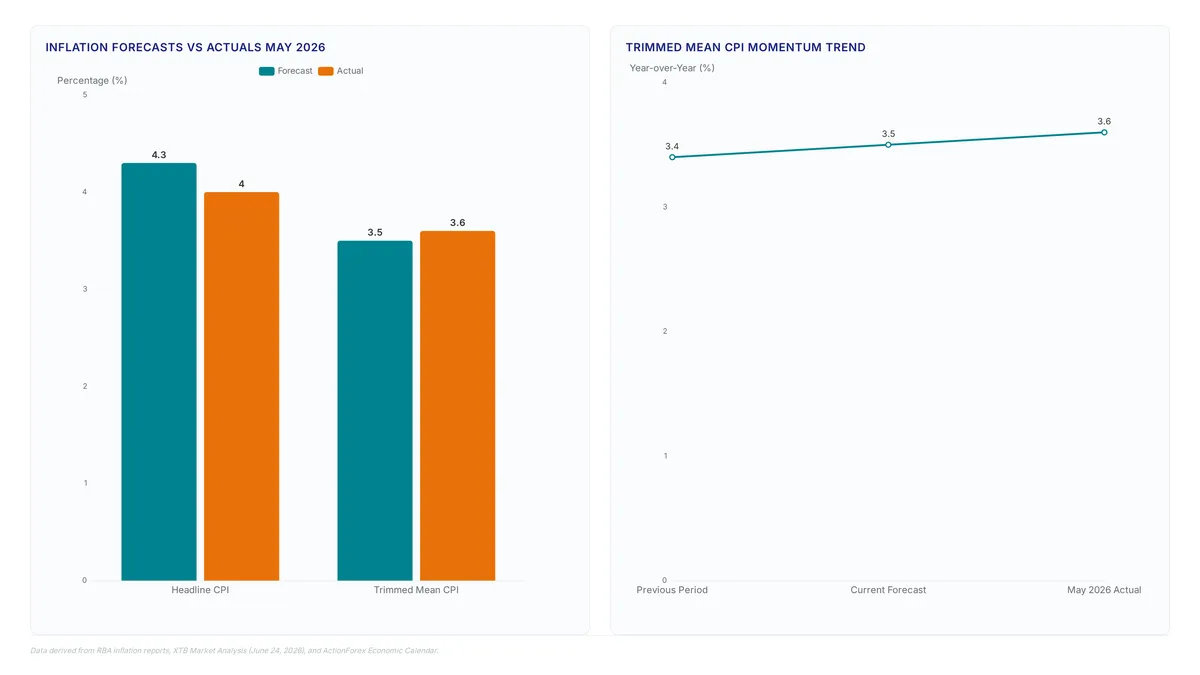
Australia's headline CPI fell to 4.0% in May while core inflation accelerated to 3.6%, creating a policy headache for the RBA. This split verdict defines the current economic environment where temporary fuel relief masks persistent underlying price pressures. The data confirms that sticky core prices remain the primary obstacle for central bankers attempting to declare victory over inflation.
The Australian Bureau of Statistics data reveals a 0.4% monthly rise in the trimmed mean, which now sits well above the bank's target ceiling. A modest drop in fuel prices artificially suppressed the headline figure while core metrics continued their upward climb. This analysis separates the noise of volatile energy costs from the signal of broadening domestic inflation.
These conflicting signals translate directly into concrete rate hike probabilities. Markets have priced a 36% chance of an August move according to investingLive. Understanding this data divergence is necessary for anticipating when the RBA will resume its tightening cycle.
The Divergence Between Headline and Core Inflation Metrics
Defining Trimmed Mean CPI vs Volatile Headline Metrics
Headline CPI tallies the total price change across the consumer basket, leaving the metric highly susceptible to sharp swings in energy and food costs. Fuel prices fell 11.9% month-on-month in May, mechanically dragging the annual headline rate down to 4.0%. This volatility often obscures the persistent price pressures facing the economy.
Trimmed Mean CPI removes the most extreme price movements, excluding roughly 30% of the data distribution to reveal underlying trends. This methodology isolates the steady 70%+ of the basket experiencing consistent increases, filtering out temporary relief from excise cuts or oil dips. The divergence between these metrics clarifies the Reserve Bank's policy dilemma. The headline figure suggests cooling inflation. The trimmed mean rose to 3.6%, exceeding forecasts and accelerating from 3.4% in April. This gap indicates that temporary supply-side factors are masking entrenched demand-side inflation. Core acceleration confirms that the inflation problem remains unresolved despite the mechanical buffer of fuel excises. Markets have adjusted accordingly, pricing a 36% probability for an August rate hike as the RBA prioritizes the core signal over volatile noise. Ignoring this methodological distinction risks miscalculating the duration of elevated borrowing costs.
May 2026 Data Divergence and RBA Communication Challenges
Policymakers face a complex environment where falling headline metrics mask accelerating underlying price pressures. This divergence creates a significant communication challenge because temporary relief in energy costs obscures persistent inflation within the broader economy. Fuel excise extensions provide a mechanical buffer that artificially suppresses the headline reading for a single period. This temporary suppression complicates the assessment of true inflationary momentum since the excise cut does not address structural demand pressures.
Analysts note that this specific combination of a headline miss and core beat represents the most difficult scenario for central bank guidance. The RBA cannot claim the inflation problem is resolving while core measures remain well above the target band ceiling. However, the flat response in the Australian dollar suggests traders view this as a modest hawkish tilt rather than a decisive shift. The constraint here is that relying on headline data alone would lead to premature policy easing. Such an error could allow secondary pass-through from energy costs to become entrenched in broader price setting behavior. Policymakers must therefore prioritize the core acceleration over the transient headline improvement to maintain credibility. Ignoring the rising trimmed mean risks anchoring inflation expectations above the target range.
Market Misinterpretation Risks from Scissors Effect Inflation
Secondary pass-through describes the mechanism where initial energy cost shocks embed into broader service pricing, persisting long after fuel volatility fades. Investors focusing solely on the headline CPI miss this entrenchment because temporary excise cuts mechanically suppress the aggregate print. The divergence creates a scissors effect where falling headline numbers mask accelerating core pressure, leading markets to underprice the duration of tight monetary policy. This misinterpretation risks premature portfolio positioning for rate cuts that the underlying data does not support.
| Metric Type | Primary Driver | Policy Signal |
|---|---|---|
| Headline CPI | Volatile energy and food prices | Temporary relief, often misleading |
| Trimmed Mean | Entrenched demand-side pressures | Persistent inflation requiring action |
The bifurcation suggests that while temporary supply-side factors may be cooling aggregate prices, entrenched demand-side pressures in the service sector are persisting. Market participants initially interpreted the slowdown as a signal for policy pivots, yet probability models now reflect a modest hawkish tilt rather than a decisive shift. The cost of ignoring core acceleration is evident in the repricing of rate hike expectations, which climbed notably for the December meeting. Policymakers cannot claim the inflation problem is resolving while the trimmed mean remains well above the target band ceiling.
| Risk Factor | Consequence |
|---|---|
| Focus on Headline | Underestimating required rate hikes |
| Ignoring Core | Allowing inflation expectations to unanchor |
| Premature Easing | Restarting the inflationary spiral |
Retail traders must distinguish between mechanical price drops and genuine disinflation to avoid costly position errors. This statistical filter removes extreme outliers from both tails of the distribution, preventing temporary shocks like fuel spikes from distorting the underlying signal. In May 2026, this methodology recorded a 0.4% monthly rise, surpassing the 0.3% forecast and highlighting accelerating domestic price pressures.
Conversely, the Weighted Median identifies the middle price change when all items are ranked by their rate of increase. This approach assumes the central tendency of the distribution best represents the inflationary impulse affecting the typical household basket.
The trimmed mean sits 1.1 percentage points above the midpoint of the RBA target band, signaling entrenched price pressure. This gap forces policymakers to look beyond the temporary relief provided by falling fuel costs. When core metrics exceed the inflation target ceiling by 0.6 points, the central bank faces a difficult communication task.
The divergence between headline cooling and core acceleration creates a complex policy environment. If the board waits for headline figures to stabilize, they risk allowing secondary pass-through from energy to embed permanently in service sector wages. Conversely, hiking rates aggressively based on core data alone could stifle growth if the headline disinflation proves durable. The Reserve Bank of Australia must weigh the cost of premature tightening against the danger of losing anchor on inflation expectations. Investors should monitor labour force data for the decisive signal that breaks this stalemate, as a soft unemployment print could push August hike odds higher, while deterioration in employment conditions would take pressure off the board.
Translating Inflation Data into Rate Hike Probabilities
Defining the RBA Policy Fulcrum: Labour Data vs CPI
Employment figures arriving later this week function as the genuine policy fulcrum for the Reserve Bank of Australia. A soft unemployment print could push August hike odds back toward 50%, forcing the board to act despite headline noise. Deterioration in job markets would conversely relieve a board that has already delivered three hikes this year. Distinguishing between temporary fuel excise effects and genuine wage-driven inflation defines the current challenge. Regional dynamics carry weight here, as synchronized tightening pressure across the Asia-Pacific suggests domestic labour strength may override transitory price dips. Operators must identify the specific unemployment rate threshold that shifts the RBA from data-dependent to preemptive modes.
Risks of Secondary Pass-Through from Energy Costs
The mechanical buffer from the fuel excise extension to end-July masks accelerating underlying cost pressures in core sectors. Businesses continue embedding higher input costs into final pricing structures despite falling petrol rates. Data confirms this stickiness, showing the trimmed mean rose 0.40% monthovermonth even as headline volatility increased source. Divergence between falling headline noise and rising core momentum complicates the path for inflation to return to the target band. Once the excise buffer expires, the headline rate may mechanically spike, reinforcing entrenched inflation expectations. This flexible forces the RBA to prioritize trimmed mean metrics over temporary relief when assessing future rate hikes. Ignoring the lag between energy shocks and final consumer prices risks underestimating the duration of restrictive policy settings.
Operational Framework for Forecasting Inflation Trends
Implementation: Defining the Labour Force Fulcrum in RBA Policy Decisions
Operators must treat upcoming labour force reports as the primary trigger for recalibrating rate hike probabilities. This mechanic exists because the Reserve Bank of Australia prioritizes trimmed mean acceleration over temporary fuel excise effects when assessing secondary pass-through risks.
1.2. Isolate core inflation signals that remain 0.6 points above the target band ceiling despite headline volatility.
- Adjust position sizing if employment conditions deteriorate, as this outcome removes the imperative for an immediate fourth hike.
The critical limitation traders face is that fuel prices can mask underlying momentum, yet the board cannot ignore secondary pass-through forever. This divergence highlights a systematic forecast error bias where analysts consistently underestimate sticky price persistence in the Australian economy. The mechanical buffer provided by the extended fuel excise cut masks underlying momentum, creating a dangerous signal for models relying solely on headline volatility.
Operators should execute the following integration steps to adjust inflation trajectories:
1.2.3. Apply a qualitative penalty to headline forecasts if unemployment remains below levels that historically trigger wage spirals.
The cost of ignoring this core vs headline disconnect is measurable mispricing of rate hike probabilities. While the headline suggests cooling, the accelerating trimmed mean indicates the Reserve Bank of Australia faces renewed pressure to tighten despite earlier easing cycles. A soft labour print remains the only catalyst capable of reducing August tightening odds significantly.
Implementation: Validation Checklist for August Rate Hike Scenarios
Validate August tightening probabilities by cross-referencing labour force tightness against persistent core price momentum. Analysts must first isolate the unemployment rate, as a print below expectations reinforces the case for immediate action despite headline noise. This step is critical because any deterioration in employment conditions would take pressure off a board that has already delivered three hikes this year. Next, compare the latest jobless figures against the 4.1% level observed in recent market assessments to gauge slack. A failure to tighten amidst such data risks unanchoring long-term inflation expectations permanently. Market participants often lag real-time labour dynamics during these divergent phases. ForexCFD.top advises caution; used trading on rate decisions carries significant risk of loss.
About
Vikram Nair serves as the Emerging Markets & Asia FX Writer at ForexCFD.top, where he specializes in translating complex macroeconomic data into actionable insights for retail traders. His deep expertise in Asia-Pacific monetary policy makes him uniquely qualified to analyze Australia's divergent CPI figures. While his daily work often focuses on the RBI and CBN, the transmission mechanism of core inflation to currency volatility in emerging markets mirrors the dynamics seen in Australian FX pairs. At ForexCFD.top, an independent publication dedicated to regulation-aware market analysis, Vikram connects high-level central bank dilemmas to practical trading strategies. His ability to dissect how sticky core inflation complicates the RBA's communication task provides necessary context for traders navigating USD/IDR or USD/INR flows. This analysis reflects the platform's commitment to vendor-neutral, fundamental clarity, ensuring readers understand not just the numbers, but their tangible impact on global currency markets.
Conclusion
Falling fuel costs create a false sense of security while underlying core CPI acceleration signals entrenched pressure. When temporary energy relief masks persistent price growth across the majority of the basket, monetary policy inevitably pivots toward restriction regardless of headline optics. Traders must prioritize the core-core CPI momentum over transient energy dips when positioning for August decisions.
Recalibrate rate hike probability models this week to weight the trimmed mean data at least twice as heavily as the headline print. This adjustment accounts for the structural inflation that excise cuts temporarily suppress. If unemployment data remains tight alongside these core metrics, expect the central bank to act decisively against the core vs headline disconnect. Ignoring this divergence leads to costly misalignment with actual policy trajectories. Focus immediate analysis on how persistent core components interact with current labor constraints rather than waiting for headline numbers to confirm what the underlying data already shows.
Frequently Asked Questions
Falling fuel prices mechanically drag the headline rate down to 4.0%. However, core metrics exclude volatile energy costs to reveal persistent pressure, with the trimmed mean accelerating to 3.6% as underlying demand remains entrenched despite temporary relief.
Trimmed Mean CPI excludes roughly 30% of extreme price movements to isolate trends. This methodology focuses on the steady 70% of the basket experiencing consistent increases, filtering out temporary noise from excise cuts or sharp oil dips.
Markets have priced a 36% probability for an August rate hike following the data release. This reflects uncertainty as policymakers weigh the 0.4% monthly rise in core prices against the misleadingly low headline figure.
Fuel prices fell 11.9% month-on-month, significantly suppressing the overall headline inflation rate. This sharp decline created a divergence where headline numbers improved while core inflation accelerated, masking the true extent of domestic price pressures.
The trimmed mean recorded a 0.4% monthly rise, surpassing the 0.3% forecast. This acceleration from 3.4% in April signals that inflationary momentum is building in broad sectors, complicating the central bank's path forward.
References